

The energies required for nuclear fusion and why uranium is a limit

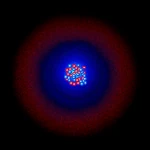
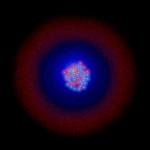
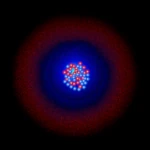
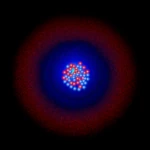
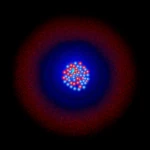
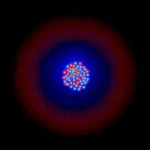
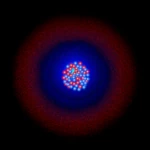
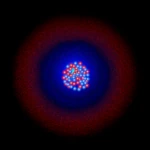
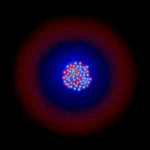
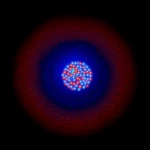
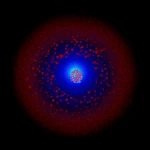
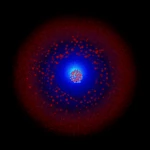
Progression of the energy climb of nuclear fusion reactions: light nuclei (hydrogen, helium) fuse to form heavier elements like carbon, oxygen, silicon, iron, up to uranium, the limit where fusion consumes more energy than it produces.
Image source: astronoo.com (new window)
Scientific summary
Stellar nuclear fusion is a process that synthesizes elements up to iron, crossing increasingly high Coulomb barriers. The ignition (temperature at which the fusion reaction becomes self-sustaining) temperature thus goes from 15 million K for hydrogen (Z₁×Z₂ = 1) to 3.5 billion K for silicon (Z₁×Z₂ = 196), the larger this product, the more energy is needed to bring nuclei close enough for them to fuse. Beyond iron‑56, fusion becomes endothermic: it consumes more energy than it produces. The formation of elements heavier than iron, like uranium, then relies on neutron captures during extreme events (supernovae, neutron star mergers). Uranium marks the upper limit of naturally observable elements, because beyond it, fission prevails and half-lives are too short to survive cosmic ages.
Why doesn't the Universe naturally produce elements heavier than uranium?
Astronoo's article explores a fundamental question of nuclear astrophysics: why does stellar fusion stop at iron and why is uranium the upper limit of natural elements? The answer lies in an inexorable energetic escalation that governs each stage of a massive star's life. The heavier the nuclei that must fuse, the higher their electric charge (Z), and the more difficult it is to overcome the Coulomb barrier (the electrostatic repulsion that must be surpassed to bring nuclei together). The article's table shows this progression: from hydrogen fusion at 15 million kelvins (Z₁×Z₂ = 1) to silicon fusion at 3.5 billion kelvins (Z₁×Z₂ = 196), the required temperature is multiplied by more than 200. This escalation makes each stage shorter than the previous one: hydrogen burning lasts millions of years, silicon burning barely a few days. This struggle against the Coulomb barrier leads to the iron impasse: beyond nickel‑56 and iron‑56, fusion no longer releases energy. To create heavier elements, up to uranium, the Universe must resort to other mechanisms, neutron captures. But even these processes have a limit: beyond uranium, the fission cycle and radioactivity prevent any element from persisting over long timescales. The article thus demonstrates that the uranium limit is not a coincidence, but the result of a competition between nuclear physics and cosmic timescales.
Also worth exploring
Continue your exploration of the Universe with these topics:
The energies required for nuclear fusion, from hydrogen to iron and beyond
The Coulomb barrier: an obstacle that worsens at each step
The fusion of two nuclei requires overcoming their mutual electrostatic repulsion, the Coulomb barrier, whose height increases with the product of the atomic numbers Z₁×Z₂ of the nuclei involved. In stellar cores, this energy is provided by thermal agitation: the more charged the nuclei, the higher the temperature required to bring them sufficiently close.
This escalation is directly visible in the Z₁×Z₂ product of each burning stage: 1 for two protons (hydrogen), 4 for two helium nuclei, 36 for two carbon nuclei, 64 for two oxygen nuclei. For two silicon nuclei, this product would reach 196, a barrier so high that it cannot be overcome by direct fusion within the star's remaining lifetime.
The silicon lock: photodisintegration rather than direct fusion
"Silicon burning" therefore does not consist of Si+Si fusion: at these extreme temperatures (2.7 to 3.5 billion K), photons are energetic enough to photodisintegrate part of the silicon nuclei, releasing alpha particles, protons, and neutrons, which are immediately recaptured by other nuclei. This rapid back-and-forth of reactions leads to a nuclear statistical equilibrium (NSE), which progressively builds the elements of the iron peak.
It is this equilibrium that marks the natural limit of exoenergetic fusion reactions in stars: beyond it, no combination of nuclei releases net energy anymore. Nickel‑62 does indeed have the highest binding energy per nucleon of all known nuclides; but the final and most abundant product of this equilibrium is nickel‑56, which decays in a few weeks into cobalt‑56 and then into stable iron‑56, hence the usual designation "iron peak".
The stages of nuclear fusion in a massive star
| Burning stage | Main reaction | Z₁×Z₂ | Ignition temperature | Main products | Typical duration (25 M☉ star) |
|---|---|---|---|---|---|
| Hydrogen (proton-proton chain) | 4 ¹H → ⁴He + 2e⁺ + 2ν | 1 | ≈ 10–15 million K | Helium-4 | ≈ 7 × 10⁶ years |
| Hydrogen (CNO cycle) | catalyzed by ¹²C, ¹⁴N, ¹⁶O | — | ≈ 17–20 million K | Helium-4 | dominant in massive stars |
| Helium (triple-alpha process) | 3 ⁴He → ¹²C | 4 | ≈ 100 million K | Carbon-12, oxygen-16 | ≈ 7 × 10⁵ years |
| Carbon | ¹²C + ¹²C → ²⁰Ne, ²³Na, ²⁴Mg | 36 | ≈ 0.6–0.8 billion K | Neon-20, sodium-23, magnesium-24 | ≈ 600 years |
| Neon | ²⁰Ne + γ → ¹⁶O + α ; ²⁰Ne + α → ²⁴Mg | — | ≈ 1.2–1.7 billion K | Oxygen-16, magnesium-24 | ≈ 1 year |
| Oxygen | ¹⁶O + ¹⁶O → ²⁸Si + ⁴He | 64 | ≈ 1.5–2.7 billion K | Silicon-28, sulfur-32 | ≈ 6 months |
| Silicon | photodisintegration and successive α captures | 196 | ≈ 2.7–3.5 billion K | Iron-56, nickel-56 | ≈ 1–5 days |
These durations, taken from reference models (Woosley, Heger & Weaver), decrease spectacularly at each stage: hydrogen burning lasts several million years, silicon burning only a few days. This acceleration directly reflects the escalation of neutrino losses and temperature requirements imposed by the growing Coulomb barrier.
Nucleosynthesis of heavy elements beyond iron
The energy limit of iron and nickel
Beyond iron‑56, fusion becomes globally endothermic and ceases to provide usable energy to the star. Contrary to popular belief, it is not iron‑56 that has the highest binding energy per nucleon: this record belongs to nickel‑62 (8.7945 MeV/nucleon), followed by iron‑58 and then iron‑56 (8.7903 MeV/nucleon). The status of iron‑56 as the "end point" of stellar fusion chains is due to another quantity, its mass per nucleon, which is the lowest of all known nuclides. This distinction between binding energy and mass per nucleon explains why silicon burning mainly produces nickel‑56, via the alpha process, favored by photodisintegration, rather than nickel‑62, which is more stable but much less abundant. Nickel‑56, being radioactive, then decays into cobalt‑56 and then into stable iron‑56, which explains the high cosmic abundance of the latter. In both cases, beyond this region of the valley of stability, fusion no longer releases energy: it marks the natural limit of exoenergetic fusion reactions in stars.
Neutron captures
The formation of heavier elements, up to uranium, then relies on neutron capture mechanisms rather than fusion. The s-process (slow) occurs mainly in asymptotic giant branch (AGB) stars, during thermal pulses that expose the core to a moderate neutron flux, notably from the reaction ¹³C(α,n)¹⁶O. Each capture is followed, when the formed nucleus is unstable, by a β decay before the next capture: matter thus progresses slowly along the valley of stability. This process produces about half of the elements heavier than iron, including strontium, barium, and lead; the detection of technetium, an element with no stable isotope, in the spectrum of certain AGB stars constitutes direct observational proof, as its half-life is too short for it to originate from anywhere other than recent nucleosynthesis within the star itself.
Extreme environments of the r-process
The r-process (rapid) occurs in much more violent contexts, where the neutron flux is so intense that many captures occur before a β decay has time to take place: matter is pushed towards very neutron-rich isotopes, far from the valley of stability, before descending towards stable nuclei through a cascade of decays. Neutron star mergers are today the best observationally established site: the event GW170817, detected in 2017 jointly in gravitational waves and light, produced a kilonova (AT2017gfo) whose spectrum allowed the identification of freshly synthesized strontium, providing direct confirmation of the r-process in this type of event. Some very energetic and rapidly rotating core-collapse supernovae (magnetorotational), as well as collapsars, are also studied as possible additional sites, particularly to explain the presence of r-process elements in very old, metal-poor stars in the Milky Way. The r-process is responsible for about the other half of the roughly 64 elements heavier than iron present in nature, including the heaviest like gold, platinum, thorium, and uranium.
From iron to uranium: why stars don't go further
The fission cycle: a natural ceiling for the r-process
Nothing prevents the r-process from continuing to capture neutrons beyond uranium: in the most neutron-rich environments, transuranic nuclei (Z >92) do form, and traces of elements like einsteinium or fermium have even been detected in the fallout of thermonuclear tests, where a similar process briefly occurs on uranium‑238. But these extremely neutron-rich nuclei, around atomic mass A ≈ 260, become so unstable that spontaneous fission, neutron-induced fission, or fission delayed by β decay prevails over continued captures. The nucleus then splits into two lighter fragments (typically around A ≈ 130), which re-enter the process as new capture seeds. This fission cycle acts as a safety valve: it prevents matter from accumulating beyond a critical mass and closes the nucleosynthesis chain on itself rather than allowing it to progress indefinitely towards ever heavier elements.
Produced, but not surviving: the question of half-lives
Added to the fission ceiling is a second limit, independent of the nuclear physics of the reactions themselves: that of time. Even transuranic elements that escape immediate fission are radioactive, with half-lives ranging from a few hours to a few hundred million years. Only the heaviest nuclei with sufficiently long half-lives have been able to survive through time to us: uranium‑238 (4.47 billion years), uranium‑235 (704 million years), and thorium‑232 (14 billion years) are essentially the ultimate survivors of this race. Plutonium-244, with a half-life of 80 million years, could not have survived since the formation of the Solar System. However, it has left fossil traces: tiny amounts are detected in deep ocean sediments and lunar samples. These traces testify to a relatively recent r-process event that occurred near our system.
Thus, the Universe does produce, transiently, elements heavier than uranium during the most extreme events, but none persists naturally in the matter surrounding us today. It is this combination of a fission ceiling and a temporal filter that makes uranium, in practice, the upper limit of naturally observable elements on Earth.
How to artificially bypass the limit: Accelerator fusion
Beyond uranium, the only known way to produce new elements is to synthesize them artificially, nucleus by nucleus, in particle accelerators. The method no longer relies on neutron capture but on the direct fusion of a carefully chosen projectile and target, a strategy that faces the same obstacle as the natural r-process: the compound nucleus formed is so heavy and excited that it tends to fission again before it can shed its excess energy by emitting neutrons. It is this competition between fission and neutron evaporation that explains the extremely low production cross-sections, on the order of a picobarn or less, observed for the synthesis of superheavy elements.
N.B.:
1 barn (b) = 10−24 cm² (a unit of area used to describe the probability of interaction between particles).
| Reaction (projectile + target) | Element produced | Atomic number Z | Beam energy | Regime |
|---|---|---|---|---|
| ⁴⁸Ca + ²⁴⁴Pu | Flerovium | 114 | ≈ 30–35 MeV (exc.) | warm fusion |
| ⁴⁸Ca + ²⁴⁵Cm | Livermorium | 116 | ≈ 243 MeV (beam) | warm fusion |
| ⁴⁸Ca + ²⁴⁹Cf | Oganesson | 118 | ≈ 245 MeV (beam) | warm fusion |
| ⁵¹V + ²⁴⁸Cm (proposed) | Element 119 | 119 | ≈ 300 MeV (beam) | hot fusion |
N.B.:
In these reactions, called "warm" fusion (⁴⁸Ca on actinide targets), the excitation energy of the compound nucleus is typically between that of "cold" fusions (lead or bismuth targets, 10 to 20 MeV) and "hot" fusions (light targets, 40 to 50 MeV). The choice of the projectile ⁴⁸Ca, doubly magic, is not trivial: its closed-shell structure limits the excitation energy of the compound nucleus and therefore its probability of fissioning before cooling down, an echo, on the laboratory scale, of the same trade-off between fission and survival that ceilings the r-process in stars.
Why didn't the Big Bang produce heavy elements?
Too short a window
Primordial nucleosynthesis lasts only about twenty minutes. The expanding Universe cools too quickly: the temperature drops from 10 billion to 1 billion kelvins in a few minutes, interrupting any reaction before it could go beyond lithium.
Absence of catalysts
The Big Bang produced only protons, neutrons, and light nuclei. There was no carbon, nitrogen, or oxygen to catalyze reactions like in the CNO cycle of stars. Without these "seeds", two-body reactions are too slow and inefficient.
Energy dilutes
The Big Bang possesses an energy far greater than that of stellar cores, but it dissipates in a constantly expanding volume. Stars, on the contrary, gravitationally confine their energy within a restricted volume, maintaining extreme temperatures for millions or billions of years.
Iron, an insurmountable barrier
Massive stars fuse elements up to iron, step by step (H → He → C → Ne → O → Si → Fe). Iron being the most stable nucleus, its fusion consumes energy instead of releasing it. The core then collapses, causing a supernova or a neutron star merger, the only events capable of producing elements heavier than iron.
Synthesis
The Big Bang did not produce heavy elements not for lack of energy, but for lack of time and stability. Only stars, through their lifespan, and stellar cataclysms, through their violence, can create the elements that surround us, from oxygen to uranium.
References
- Woosley, S. E.; Heger, A., The evolution and explosion of massive stars, Rev. Mod. Phys. 74 (2002). DOI : 10.1103/RevModPhys.74.1015 (new window)
- Rapid neutron-capture process (r-process), Wikipedia en.wikipedia.org/wiki/Rapid_neutron_capture_process (new window)
- Mumpower, M. et al., Fission Cycling in a Supernova r-process, arXiv:0707.4498. arxiv.org/abs/0707.4498 (new window)
- Skúladóttir, Á. et al., Element abundance patterns in stars indicate fission of nuclei heavier than uranium, Science 379 (2023). DOI : 10.1126/science.adf1341 (new window)
- Watson D. et al., Identification of strontium in the merger of two neutron stars, Nature (2019). DOI : 10.1038/s41586-019-1676-3 (new window)
- Abbott B.P. et al., Multi-messenger Observations of a Binary Neutron Star Merger, ApJL (2017). DOI : 10.3847/2041-8213/aa91c9 (new window)
- Sarmiento, L. et al., Actinide targets for the synthesis of superheavy nuclei, Eur. Phys. J. A (2023). DOI : 10.1140/epja/s10050-023-01144-y (new window)
FAQ: All about nucleosynthesis of elements
What observational evidence confirms the existence of the r-process in neutron star mergers?
The most direct evidence of the r-process in neutron star mergers came from the event GW170817, detected in 2017 both in gravitational waves (by LIGO/Virgo) and in light (by numerous telescopes). The observation of the kilonova AT2017gfo that followed allowed the identification of strontium freshly synthesized in the spectrum of the explosion. This detection provided a direct observational confirmation that neutron star mergers are indeed a major site of the r-process. Other clues come from the study of very old, metal-poor stars in the Milky Way, whose spectra show abundances of r-process elements (like europium) that suggest r-process events enriched the interstellar medium very early in the Universe's history.
How does the discovery of technetium in AGB stars confirm the s-process?
Technetium is an element that has no stable isotope; its longest half-lives (⁹⁸Tc: 4.2 million years; ⁹⁹Tc: 211,000 years) are very short on a cosmic scale. The detection of technetium in the spectrum of certain asymptotic giant branch (AGB) stars therefore constitutes a direct observational proof of the s-process. Indeed, the observed technetium can only come from recent nucleosynthesis within the star itself: it must be produced in situ, by neutron captures during thermal pulses that expose the core of the AGB star to a moderate neutron flux. Its presence in the atmosphere of these stars, while it would decay in a few million years if formed elsewhere, confirms that the s-process is active and continuous in these objects.
Why is uranium the upper limit of naturally observable elements on Earth?
Uranium marks the upper limit for two complementary reasons:
- A fission ceiling: in the most extreme environments of the r-process, very heavy nuclei (around A ≈ 260) become so unstable that fission prevails over neutron captures. The nucleus splits into two lighter fragments, which re-enter the cycle. This fission cycle prevents matter from accumulating beyond a critical mass.
- A temporal filter: even transuranic elements that escape immediate fission are radioactive, with half-lives ranging from a few hours to a few hundred million years. Only nuclei with sufficiently long half-lives, uranium‑238 (4.47 billion years), uranium‑235 (704 million years), and thorium‑232 (14 billion years), have survived to us.
The Universe does produce transiently elements heavier than uranium, but none persists naturally in the matter surrounding us today.
Why does fusion stop at iron and not nickel, which is more stable?
Contrary to popular belief, nickel‑62 has the highest binding energy per nucleon of all nuclei (8.7945 MeV/nucleon), ahead of iron‑56 (8.7903 MeV/nucleon). But it is iron‑56 that has the lowest mass per nucleon, which makes it the energetic endpoint of fusion reactions. Silicon burning actually produces mainly nickel‑56 (via the alpha process), which is radioactive: it decays in a few weeks into cobalt‑56 and then into stable iron‑56. This decay explains the high cosmic abundance of iron‑56 and its status as the "final point" of stellar fusions. In all cases, beyond this region, any fusion consumes more energy than it produces: it becomes endothermic.
Why does nuclear fusion become increasingly difficult as nuclei get heavier?
The increasing difficulty of fusion is due to the Coulomb barrier, the electrostatic repulsion between positively charged nuclei. The heavier the nuclei, the higher their electric charge (their atomic number Z), and the greater the repulsive force. To fuse, nuclei must be propelled against each other with sufficient kinetic energy to overcome this barrier. In stars, this energy is provided by thermal agitation: the higher the barrier, the more extreme the required temperature. This is why hydrogen fusion (Z₁×Z₂ = 1) occurs at 15 million kelvins, while silicon fusion (Z₁×Z₂ = 196) requires 3.5 billion kelvins.
How do scientists artificially synthesize superheavy elements beyond uranium?
Beyond uranium, the only way to produce new elements is artificial synthesis in accelerators. The method consists of directly fusing a carefully chosen projectile and target, for example 48Ca on an actinide target like 244Pu or 249Cf. These reactions, called "warm" fusion, aim to form a superheavy compound nucleus. But the challenge is immense: the formed nucleus is so heavy and excited that it tends to fission again before it can shed its excess energy by emitting neutrons. Production cross-sections are extremely low, on the order of a picobarn (10⁻³⁶ cm²). It is this competition between fission and neutron evaporation that explains why the synthesis of superheavy elements, up to oganesson (Z=118), is so difficult and only produces a few atoms at a time.
 The energies required for nuclear fusion and why uranium is a limit
 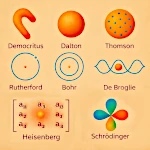 The Atom in All Its Forms: From Ancient Intuition to Quantum Mechanics