

Radon (Rn, Z = 86): The Domestic Radioactive Gas
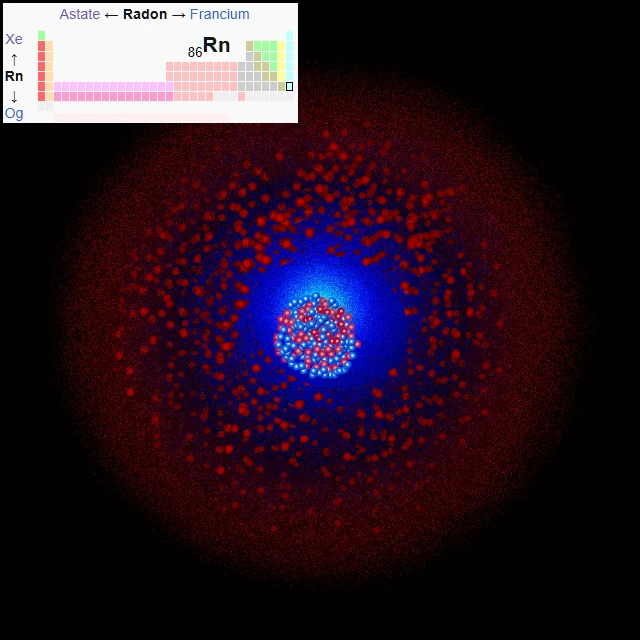
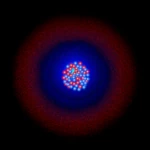
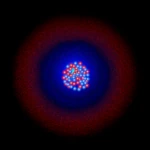
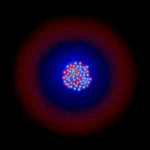
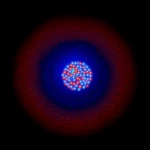
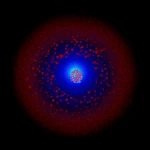
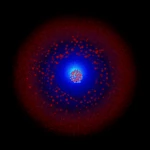
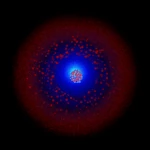
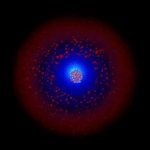
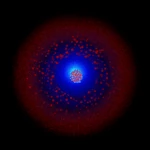
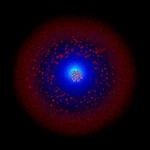
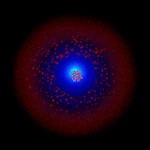
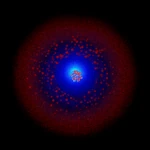
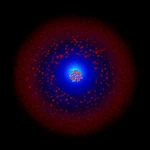
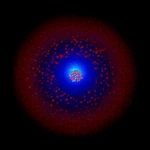
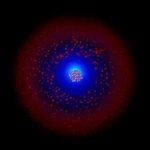
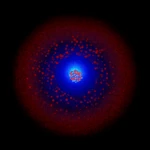
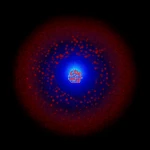
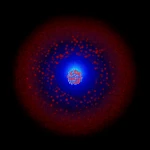
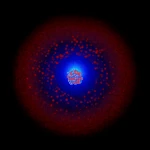
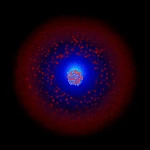
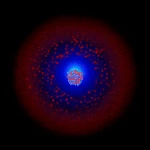
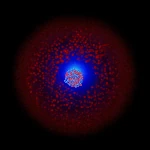
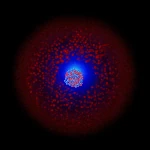
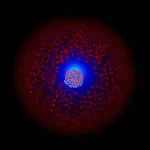
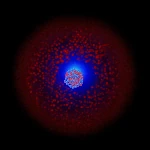
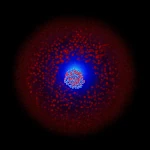
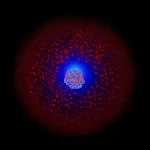
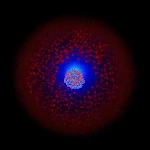
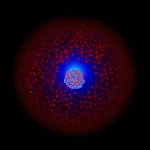
Image description:
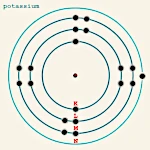
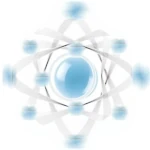
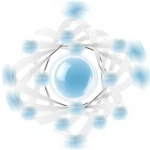
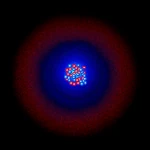
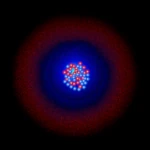
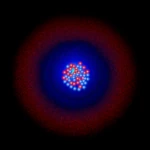
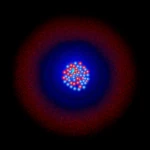
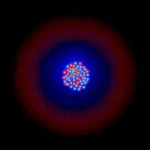
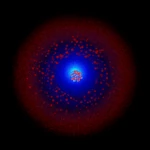
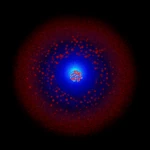
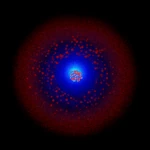
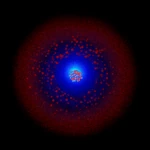
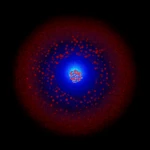
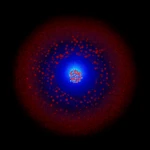
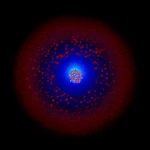
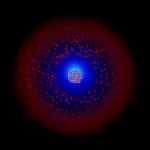
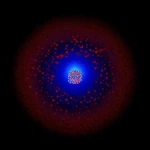
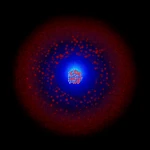
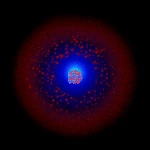
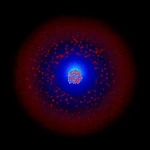
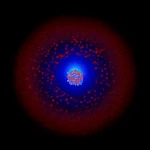
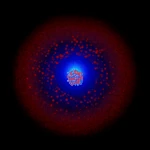
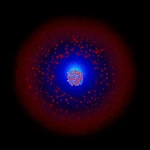
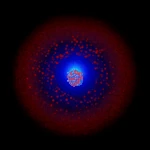
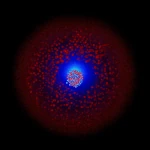
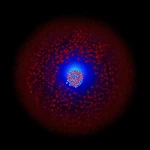
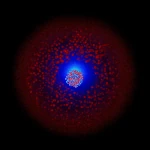
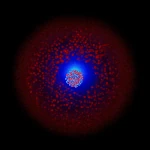
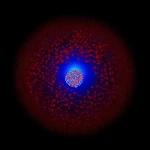
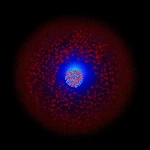
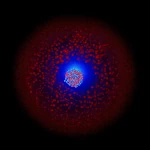
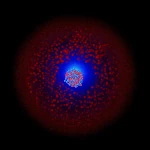
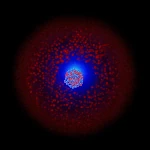
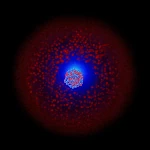
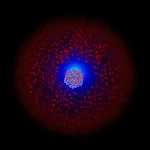
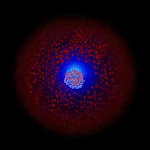
Simplified atomic model of the radon atom. The most important natural isotope is \(^{222}\mathrm{Rn}\)
with its 86 protons, 86 electrons, and 136 neutrons.
Image source: astronoo.com (new window)
Role of Radon in Geophysics and as an Environmental Tracer
Decay product of uranium and thorium
Radon is a gaseous element continuously produced in the Earth's crust by the radioactive decay of radium, itself derived from the uranium-238, uranium-235, and thorium-232 chains. It is the only naturally radioactive noble gas under normal conditions. Three natural isotopes are significant, each corresponding to these chains:
- Radon-222 (\(^{222}\mathrm{Rn}\)): Member of the uranium-238 chain (4n+2 series). Half-life of 3.8235 days. It is by far the most abundant and important for public health, as its half-life allows it to migrate from the soil to the atmosphere.
- Radon-220 (\(^{220}\mathrm{Rn}\), "thoron"): Member of the thorium-232 chain (4n series). Half-life of 55.6 seconds. Much less mobile, it poses a danger mainly in industrial environments (monazite sand processing).
- Radon-219 (\(^{219}\mathrm{Rn}\), "actinon"): Member of the uranium-235 chain (4n+3 series). Half-life of 3.96 seconds. Its presence is negligible due to the low abundance of U-235 and its very short half-life.
Geochemistry and soil exhalation
Radon-222 formed in radium-containing minerals can, depending on soil porosity and water content, diffuse to the surface and be released into the atmosphere. This flux, called radon exhalation, varies significantly depending on geology (granitic and uranium-rich shales >sedimentary rocks), season, atmospheric pressure, and humidity. Measuring this flux is used in geophysics for:
- Uranium deposit prospecting: Radon anomalies can indicate the presence of deep ores.
- Study of active seismic faults: Variations in radon flux can precede earthquakes (studied seismic precursor, but not reliable).
- Volcanology: Monitoring volcanic activity.
Tracer in oceanography and atmospheric science
Once in the atmosphere, radon-222 (an inert gas) is transported by winds. Since it decays with a known half-life, its decrease with distance from its continental source (oceans produce very little) allows the study of air mass mixing times between continents and oceans. In oceans, dissolved radon (produced by radium in sediments) serves as a tracer for vertical mixing processes and air-sea exchanges.
History of the Discovery of Radon
Etymology and origin of the name
The name "radon" is derived from radium, its direct parent in the decay chain. The isotope \(^{222}\mathrm{Rn}\) was initially called "radium emanation" or simply "emanation" (denoted Em) by its discoverers, as it "emanated" from radium. Later, when isotopes from thorium and actinium were discovered, they were named thoron (Tn) and actinon (An), respectively. The generic name "radon" (symbol Rn) for element 86 was officially adopted in 1923.
Discovery of Radon by Friedrich Ernst Dorn (1900)
Radon-222 was discovered in 1900 by the German physicist Friedrich Ernst Dorn. While studying radium compounds newly discovered by the Curies, he noticed that radium emitted a radioactive gas. He demonstrated that this gas, which he called "radium emanation," was itself radioactive and transformed into other solid elements. This discovery was crucial for understanding radioactive decay series.
Isolation and study by William Ramsay and Robert Whytlaw-Gray
In 1908, the Scottish chemist Sir William Ramsay (already discoverer of the noble gases argon, krypton, xenon, and neon) and his assistant Robert Whytlaw-Gray succeeded in isolating radon, measuring its density, and proving it was the heaviest of the known noble gases. They managed to condense enough to observe its emission spectrum, confirming its status as an element. Ramsay received the Nobel Prize in Chemistry in 1904 for his work on inert gases, even before the discovery of radon.
Recognition of health risks (20th century)
As early as the 1920s, radon was suspected of causing the high incidence of lung cancer among uranium miners (notably in the Joachimsthal mines in Czechoslovakia and later in New Mexico). However, it was not until the 1980s that epidemiological studies (such as those on American miners) firmly established the link between radon exposure and lung cancer. In the 1990s, awareness spread to domestic risk, transforming radon from a scientific curiosity into a major public health issue.
Presence and sources
Radon is present everywhere, but its concentrations vary greatly.
- Primary source: Soil and subsoil (granitic rocks, black shales, certain sandstones, uranium-rich glacial moraines).
- Secondary sources:
- Groundwater (wells, springs) that can release radon during use (showering, washing).
- Building materials derived from natural rocks (granite, pumice, certain concretes).
- Untreated natural gas (may contain radon that concentrates in combustion appliances).
There is no "production" of radon per se; it is constantly generated by natural decay and must be managed where it accumulates.
Structure and Fundamental Properties of Radon
Classification and atomic structure
Radon (symbol Rn, atomic number 86) is an element of group 18, the noble gases (or rare gases). It is the heaviest and only naturally radioactive member of this group under normal conditions (oganesson, Z=118, is synthetic). Its atom has 86 protons and, depending on the isotope, 131 to 150 neutrons. The isotope \(^{222}\mathrm{Rn}\) has 136 neutrons. Its electronic configuration is [Xe] 4f¹⁴ 5d¹⁰ 6s² 6p⁶, with a complete p valence shell (6 electrons), making it a chemically inert gas.
Physical properties
Radon is a colorless, odorless, and tasteless noble gas.
- Gaseous state: At room temperature and pressure.
- Gas density: Very high for a gas (9.73 g/L at 0°C), about 8 times that of air. It therefore tends to accumulate in the lower parts of buildings (basements, ground floors).
- Melting point: -71 °C (202 K).
- Boiling point: -61.7 °C (211 K). It is the noble gas with the highest melting and boiling points, due to its high mass and polarizability.
- Alpha radioactivity: \(^{222}\mathrm{Rn}\) decays by alpha emission (5.49 MeV) into polonium-218 (RaA), with a half-life of 3.8235 days.
In solid form, radon has a yellow-orange color due to its radioactivity.
Transformation points
Radon melts at 202 K (-71 °C) and boils at 211 K (-61.7 °C). It can be liquefied relatively easily by cooling.
Chemical reactivity (very low, but present)
As a noble gas, radon is extremely inert. However, due to its large size and high polarizability, it is the most reactive noble gas. Theoretical calculations predict it could form a few unstable compounds, such as radon fluoride (RnF₂) and possibly oxides or clathrate complexes. In practice, only solid-state compounds, highly unstable and radioactive, have been obtained in minute quantities (clathrates with water or hydrocarbons). Its chemistry has little practical application.
Summary of Radon's Physical Characteristics
State (20°C, 1 atm): Colorless gas.
Density (gas, 0°C): 9.73 g/L (8.1 x air).
Melting point: 202 K (-71 °C).
Boiling point: 211 K (-61.7 °C).
Electronic configuration: [Xe] 4f¹⁴ 5d¹⁰ 6s² 6p⁶.
Radioactivity: Main isotope \(^{222}\mathrm{Rn}\), α, T½=3.82 days.
Table of Radon Isotopes (natural)
| Isotope / Notation | Protons (Z) | Neutrons (N) | Atomic mass (u) | Parent chain | Half-life / Decay mode | Remarks / Importance |
|---|---|---|---|---|---|---|
| Radon-222 — \(^{222}\mathrm{Rn}\) | 86 | 136 | 222.017578 u | Uranium-238 (4n+2) | 3.8235 days (α) | Most important isotope. Half-life long enough to migrate from soil and accumulate in buildings. Mainly responsible for domestic health risk. |
| Radon-220 — \(^{220}\mathrm{Rn}\) (Thoron) | 86 | 134 | 220.011394 u | Thorium-232 (4n) | 55.6 seconds (α) | Very short half-life, limiting its accumulation away from the source. Mainly dangerous in industries processing thorium-rich materials (monazite sands, ceramics). |
| Radon-219 — \(^{219}\mathrm{Rn}\) (Actinon) | 86 | 133 | 219.009480 u | Uranium-235 (4n+3) | 3.96 seconds (α) | Negligible for public health due to its ultra-short half-life and low abundance of U-235 (0.72%). |
Electronic Configuration and Electron Shells of Radon
N.B.:
Electron shells:
How electrons are organized around the nucleus (new window).
Radon has 86 electrons distributed over six electron shells. Its electronic configuration [Xe] 4f¹⁴ 5d¹⁰ 6s² 6p⁶ has a completely filled valence shell (6p), giving it great chemical stability and noble gas character. This can also be written as: K(2) L(8) M(18) N(32) O(18) P(8), or fully: 1s² 2s² 2p⁶ 3s² 3p⁶ 3d¹⁰ 4s² 4p⁶ 4d¹⁰ 4f¹⁴ 5s² 5p⁶ 5d¹⁰ 6s² 6p⁶.
Detailed Structure of Shells
K shell (n=1): 2 electrons (1s²).
L shell (n=2): 8 electrons (2s² 2p⁶).
M shell (n=3): 18 electrons (3s² 3p⁶ 3d¹⁰).
N shell (n=4): 32 electrons (4s² 4p⁶ 4d¹⁰ 4f¹⁴).
O shell (n=5): 18 electrons (5s² 5p⁶ 5d¹⁰).
P shell (n=6): 8 electrons (6s² 6p⁶).
Valence Electrons and Chemical Inertia
Radon has 8 valence electrons in its outer shell (6s² 6p⁶), achieving the stable octet configuration. This saturated electronic structure makes it extremely reluctant to form classical covalent bonds. Its first ionization potential is relatively low for a noble gas (10.75 eV), but still too high for easy chemistry. Any attempt to form compounds (such as RnF₂) requires very strong oxidants like fluorine, and the resulting compounds are thermodynamically unstable and decompose rapidly.
This inertia is crucial for its environmental behavior: once formed in the soil, radon does not react with minerals or water; it diffuses freely as an atomic gas. In the lungs, it does not chemically interact with tissues; its danger is purely radiological.
Environmental Behavior and Public Health
The path to the lungs
- Production in soil: Decay of radium-226 → Radon-222.
- Migration: Radon gas diffuses through soil pores. Pressure differences (house depression, chimney effect) draw it through cracks, joints, and pipe passages.
- Entry and accumulation: It enters the building and, being heavy, can accumulate in lower levels and poorly ventilated rooms.
- Inhalation: Occupants breathe radon and its decay products (Po-218, Pb-214, etc.) suspended in the air.
The real culprits: solid decay products
The radon gas itself, once inhaled, is largely exhaled. The danger comes from its solid and radioactive decay products:
- \(^{218}\mathrm{Po}\) (RaA, α, T½=3.1 min)
- \(^{214}\mathrm{Pb}\) (RaB, β/γ, T½=26.8 min)
- \(^{214}\mathrm{Bi}\) (RaC, β/γ, T½=19.9 min)
- \(^{214}\mathrm{Po}\) (RaC', α, T½=164 µs)
These particles (often charged) attach to ambient aerosols or dust. When inhaled, they can deposit in the respiratory tract, especially in the bronchi. Their alpha and beta decay inside lung tissue directly irradiates epithelial cells, causing DNA damage that can lead to cancer.
Health risk of Radon: certain carcinogen (IARC Group 1)
The International Agency for Research on Cancer (IARC) classifies radon as a certain human carcinogen. It is the second leading cause of lung cancer after smoking, and the leading cause among non-smokers. It is estimated that about 3 to 14% of lung cancers worldwide are attributable to radon, corresponding to tens of thousands of deaths annually. The risk is multiplicative with smoking: a smoker exposed to radon has a much higher risk of lung cancer than the sum of individual risks.
Measurement, Reference Levels, and Regulations
Measurement units
- Becquerel per cubic meter (Bq/m³): SI unit. 1 Bq/m³ = 1 decay per second in a cubic meter of air. This is the unit used for air concentrations.
- Picocurie per liter (pCi/L): Historical unit still used in the United States. 1 pCi/L = 37 Bq/m³.
Reference levels and actions
Health authorities set levels above which corrective actions are recommended:
- WHO: Recommends a reference level of 100 Bq/m³. Below 300 Bq/m³, simple reduction actions are possible. Above, mitigation is necessary.
- European Union: Directive 2013/59/Euratom sets a reference level of 300 Bq/m³ for existing buildings and a design target of 200 Bq/m³ for new constructions.
- United States (EPA): Recommends action if the concentration exceeds 148 Bq/m³ (4 pCi/L).
Average outdoor concentrations are typically 5 to 15 Bq/m³. Indoors, they can range from less than 10 to over 10,000 Bq/m³ in the most affected areas.
Measurement methods
- Passive activated charcoal detectors: Small pots exposed for 2 to 7 days, then analyzed in the laboratory by gamma scintillation. Inexpensive, for screening.
- Passive nuclear track detectors (CR-39): A plastic film is exposed for 1 to 12 months. The tracks left by alpha particles are counted after chemical etching. Reference method for long-term integrated measurement.
- Continuous electronic detectors: Electronic devices (ionization chamber, scintillation cell) providing real-time or short-term readings. Useful for identifying entry paths and verifying the effectiveness of work.
Applications (Very Limited) of Radon
- Historical radiotherapy ("radon seeds"): In the early 20th century, tiny radon capsules (gold or glass) were implanted directly into tumors for local irradiation. Practice abandoned in favor of more practical isotopes (iridium-192, iodine-125).
- Hydrology and geological research: As a natural tracer to study underground flows, water-soil-rock interactions, and aquifer dynamics.
- Atmospheric studies: As a tracer to quantify air-sea exchanges and tropospheric mixing.
- Fundamental research: In nuclear physics for the study of alpha decays and heavy nuclei.
- Thermal cures (radon spas): Some thermal stations (notably in Austria, Germany, Japan) use naturally radon-rich waters for baths, claiming beneficial effects against joint pain (rheumatism). This practice, called "low-dose radiotherapy," is highly controversial from a scientific and health perspective, as it deliberately exposes patients to a known carcinogen. It is not recognized by conventional medicine.
Mitigation and Prevention
Strategies for existing buildings
The goal is to reduce radon concentration. Techniques, ranked by effectiveness and cost, are:
- Improved ventilation: Regular airing (simple but ineffective in winter, energy-intensive).
- Sealing the substructure: Sealing cracks, joints, and pipe passages with appropriate sealants.
- Active soil depressurization system (SDS): Most effective method. A pipe is inserted under the slab or in the fill, connected to a small fan that draws radon from under the house and releases it outside, far from openings. This creates a depression under the slab, reversing the radon entry flow.
- Controlled mechanical ventilation (CMV) by insufflation: Maintaining slight overpressure in the building to prevent radon entry.
Prevention in new construction
- Site selection: Avoid high radon potential areas if possible, or adapt techniques.
- Radon-proof barrier: Install a sealed membrane under the foundation slab.
- Ventilated gravel layer: Under the slab, to facilitate gas evacuation.
- Pre-equipment for SDS: Install necessary ducts during construction, in case an active system is needed later.
Regulations and Awareness
Radon potential mapping
Many countries have established radon potential maps based on geology and measurements. In France, the IRSN has published a municipal map classifying communes into 3 potential categories. These maps are used to prioritize information actions and monitoring obligations (schools, workplaces in high-potential areas).
Legal obligations
- Information for buyers and tenants: Obligation to measure and inform in certain areas (e.g., in France in areas with significant potential).
- Workplace monitoring: Mandatory in public buildings (ERP) located in basements or ground floors in risk areas, and in certain industries (spas, cellars, etc.).
- Training for building professionals: To integrate mitigation techniques.
Perspectives
The radon issue is a perfectly identifiable and manageable environmental health problem. Current challenges are:
- Public and health professional awareness: Radon remains poorly known.
- Improvement and standardization of measurement and mitigation techniques.
- Systematic integration into building codes for new homes in risk areas.
- Research: To better understand the spatial and temporal variability of concentrations, and refine risk models, especially interactions with other indoor pollutants.
Radon, an invisible and natural gas, perfectly illustrates how a geological phenomenon can have a direct health impact on the population, and how science and regulation can combine to mitigate this risk.
 The energies required for nuclear fusion and why uranium is a limit
  The Atom in All Its Forms: From Ancient Intuition to Quantum Mechanics