

Astatine (At, Z = 85): The Phantom of the Periodic Table
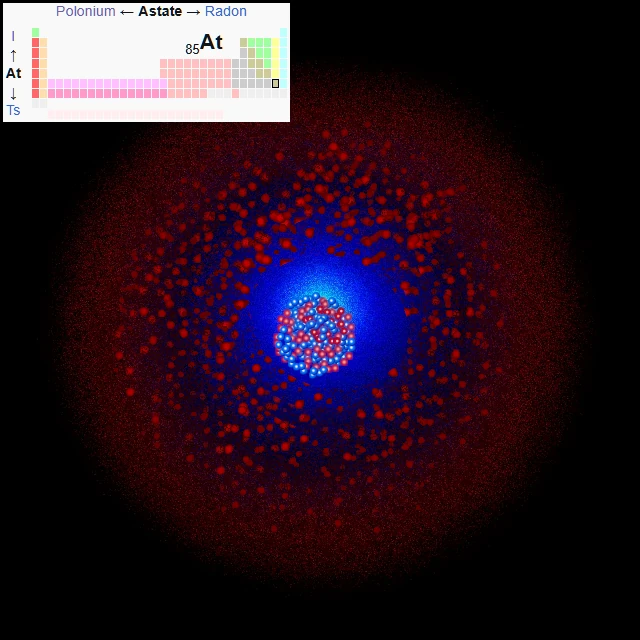
Image description:
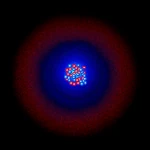
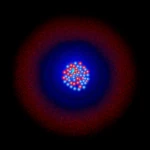
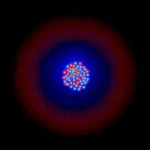
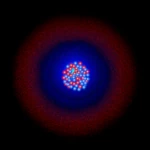
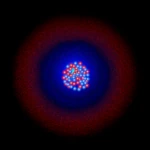
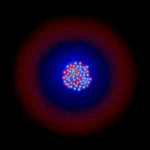
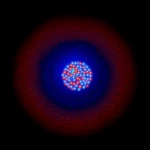
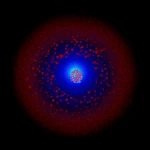
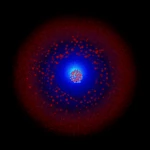
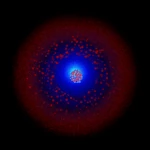
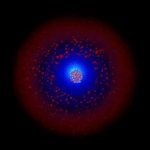
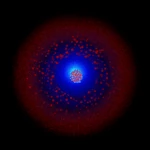
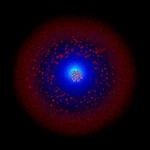
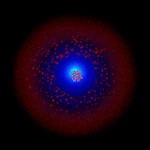
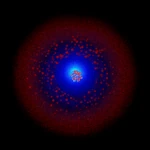
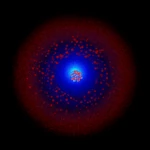
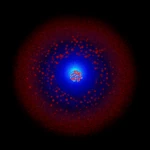
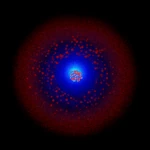
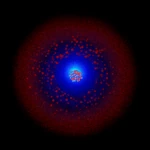
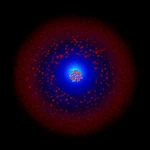
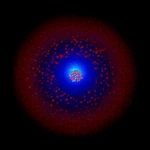
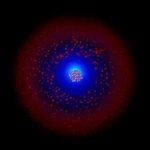
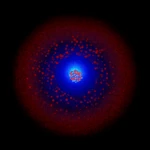
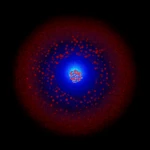
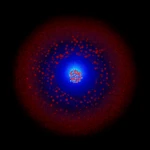
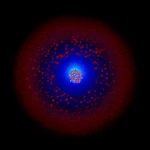
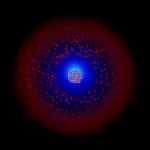
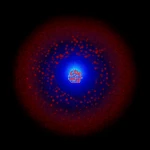
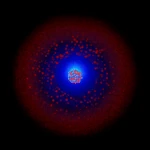
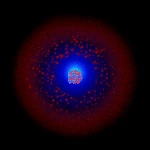
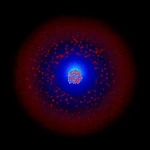
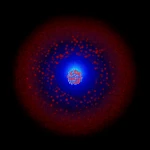
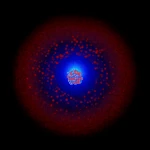
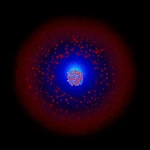
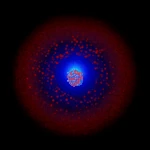
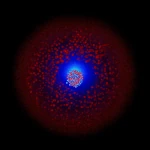
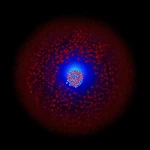
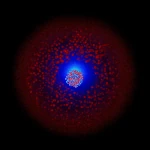
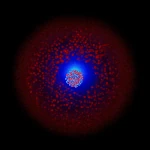
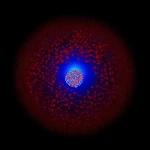
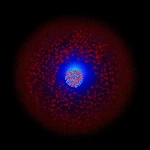
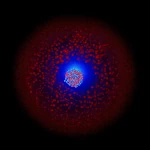
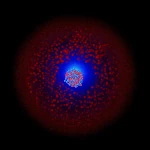
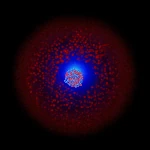
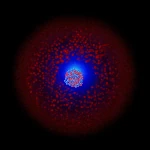
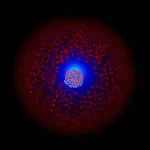
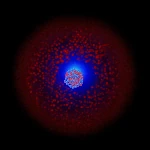
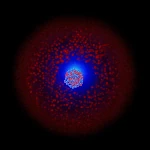
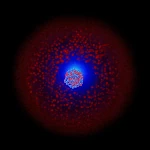
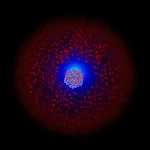
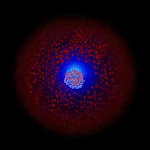
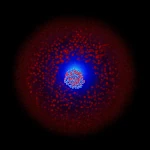
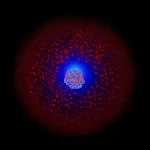
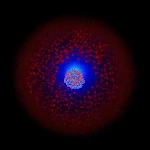
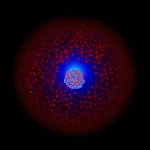
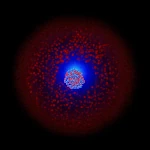
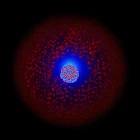
Simplified atomic model of the astatine atom. The most studied isotope is \(^{211}\mathrm{At}\)
with its 85 protons, 85 electrons, and 126 neutrons. Background evoking rarity and instability.
Image source: astronoo.com (new window)
Role of Astatine in Astrophysics and Radiochemistry
The rarest natural element
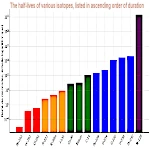
Astatine holds a unique record: it is the rarest natural element on Earth. Estimates suggest that the total amount of astatine present in the Earth's crust at any given time is less than 30 grams. This extreme rarity is due to the fact that all its isotopes are radioactive with very short half-lives. The longest-lived, astatine-210, has a half-life of only 8.1 hours. Thus, any primordial astatine present during the formation of the Earth has long since decayed. The astatine present today is constantly recreated as an intermediate decay product in the natural uranium and thorium decay chains, but it disappears almost immediately.
Member of decay chains
Several isotopes of astatine appear in the decay chains of uranium and thorium, through beta decays of their parent elements, polonium or bismuth. For example:
- In the uranium-235 chain (4n+3): \(^{219}\mathrm{Rn}\) (Actinon) decays by alpha emission to \(^{215}\mathrm{Po}\), which decays by beta (99.99977%) to \(^{215}\mathrm{At}\) (half-life 0.10 ms), which decays almost instantaneously.
- In the uranium-238 chain (4n+2): \(^{218}\mathrm{Po}\) (Radium A) decays by beta (0.02%) to \(^{218}\mathrm{At}\) (half-life 1.5 s).
These isotopes are produced in infinitesimal quantities and have such short lifetimes that they cannot accumulate.
Production by cosmic spallation
Apart from radioactive decay, astatine can be produced naturally, in even smaller quantities, by cosmic spallation: when high-energy cosmic rays strike heavier nuclei such as lead or bismuth in the Earth's crust, they can fragment them and produce exotic nuclei, including astatine.
An object of study for the stability of heavy nuclei
Astatine is located in a region of the periodic table where nuclear stability is very low. The study of its isotopes, particularly those with a "magic" number of neutrons (such as \(^{211}\mathrm{At}\) with 126 neutrons, a magic number), helps nuclear physicists refine models of nuclear structure and understand the limits of heavy nucleus stability.
History of the Discovery of Astatine
Prediction and search for "eka-iodine"
The existence of astatine was predicted by Dmitri Mendeleev as early as the creation of his periodic table in 1869. He gave it the provisional name of "eka-iodine", predicting that it would be a halogen heavier than iodine, with similar chemical properties but a higher atomic mass and probably metallic characteristics. The search for this missing element mobilized several chemists for decades, without success, due to its extreme instability.
Synthetic discovery by Corson, MacKenzie, and Segrè (1940)
Astatine was finally artificially produced in 1940 by a team of researchers at the University of California, Berkeley: Dale R. Corson, Kenneth Ross MacKenzie, and Emilio Segrè. They bombarded a bismuth-209 target with alpha particles accelerated in Berkeley's 60-inch cyclotron. The nuclear reaction produced astatine-211:
\(^{209}\mathrm{Bi} + \alpha \, (^{4}\mathrm{He}) \rightarrow \,^{211}\mathrm{At} + 2n\)
They identified it by its characteristic radioactivity and initially named it "alabamine" (symbol Ab), but this name was not retained.
Confirmation of its natural presence and final name
After World War II, in 1943, Berta Karlik and Traude Bernert succeeded in identifying traces of astatine (the isotopes \(^{218}\mathrm{At}\) and \(^{219}\mathrm{At}\)) in natural decay products of uranium and thorium, thus confirming that it does exist in nature, albeit in infinitesimal quantities. The final name, "astatine" (derived from the Greek astatos, αστατος, meaning "unstable"), was proposed by the discoverers and adopted, emphasizing its most striking property.
Modern production
Today, astatine is produced exclusively artificially, mainly in particle accelerators (cyclotrons). The most common methods are:
- Bombardment of bismuth-209 with alpha particles: The historical method, still in use. It mainly produces astatine-211, the most interesting isotope for medicine.
- Bombardment of thorium or uranium targets with high-energy protons (spallation).
- Neutron irradiation of radon: Less common.
Global production is extremely low, on the order of a few micrograms to a few milligrams per year, mainly in specialized research laboratories (United States, Russia, Europe, Japan). Its cost is astronomical (millions of dollars per gram, if one could even accumulate a gram), and there is no "market" in the conventional sense.
Structure and Fundamental Properties of Astatine
Classification and atomic structure
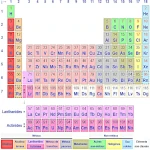
Astatine (symbol At, atomic number 85) is an element of group 17, the halogens. It is the heaviest and most radioactive member of this family, which includes fluorine, chlorine, bromine, iodine, and tennessine. Its atom has 85 protons and, depending on the isotope, 116 to 140 neutrons. The most used isotope, \(^{211}\mathrm{At}\), has 126 neutrons. Its electronic configuration is [Xe] 4f¹⁴ 5d¹⁰ 6s² 6p⁵, with seven valence electrons (6s² 6p⁵).
Hypothetical and extreme physical properties
Due to its instability and the tiny amounts ever produced (it is estimated that less than a millionth of a gram of elemental astatine has ever been synthesized in total), most of its physical properties have never been directly measured on a macroscopic sample. They are deduced from theoretical calculations, extrapolations from halogen group trends, and studies on infinitesimal quantities.
- Physical state: Predicted to be a metalloid or metallic solid at room temperature, unlike iodine, which is a molecular solid. It might have a black metallic appearance.
- Melting and boiling points: Estimated at around 302 °C and 337 °C, respectively (very uncertain values).
- Intense radioactivity: All its isotopes are radioactive. Astatine-211 emits alpha particles (100%) of 5.87 MeV with a half-life of 7.214 hours.
- Heat of decay: Like polonium, a macroscopic amount would be very hot and self-destruct by radiolysis.
Transformation points (estimated)
Estimated melting point: ~575 K (~302 °C).
Estimated boiling point: ~610 K (~337 °C).
Chemical reactivity (deduced)
Chemically, astatine is expected to behave like a halogen, but with marked differences due to its weight and relativistic effects. It is expected to be the least reactive of the halogens and to exhibit metallic character (tendency to form cations, At⁺). Its possible oxidation states range from -1 to +7, with -1, +1, +3, +5, and +7 being plausible.
Main characteristics (estimated and confirmed)
Atomic number: 85.
Group: 17 (Halogens).
Electronic configuration: [Xe] 4f¹⁴ 5d¹⁰ 6s² 6p⁵.
Physical state (20°C): Solid (predicted).
Radioactivity: All isotopes are radioactive.
Key medical isotope: \(^{211}\mathrm{At}\) (half-life 7.2 h, α emitter).
Table of Astatine Isotopes (main)
| Isotope / Notation | Protons (Z) | Neutrons (N) | Atomic mass (u) | Production / Occurrence | Half-life / Decay mode | Remarks / Applications |
|---|---|---|---|---|---|---|
| Astatine-210 — \(^{210}\mathrm{At}\) | 85 | 125 | 209.987148 u | Synthetic / Natural trace | 8.1 hours (α, 99.8%; CE, 0.2%) | Isotope with the longest half-life (but less pure α than \(^{211}\mathrm{At}\)). |
| Astatine-211 — \(^{211}\mathrm{At}\) | 85 | 126 | 210.987496 u | Synthetic (α on Bi-209) | 7.214 hours (α, 100%) | The most important isotope. Pure high-energy alpha emitter (5.87 MeV). Ideal half-life for medicine (therapy). Target of choice for research. |
| Astatine-217 — \(^{217}\mathrm{At}\) | 85 | 132 | 216.992420 u | Produced in the decay chain of \(^{225}\mathrm{Ac}\) | 32.3 ms (α, 99.99%) | Decay product of actinium-225, used in targeted alpha therapy (TAT). Its chain produces three alpha particles. |
| Astatine-218 — \(^{218}\mathrm{At}\) | 85 | 133 | 217.995350 u | Natural trace (U-238 chain) | 1.5 s (α, 99.9%; β⁻, 0.1%) | Very fleeting natural isotope. |
| Astatine-219 — \(^{219}\mathrm{At}\) | 85 | 134 | 218.996590 u | Natural trace (U-235 chain) | 56 s (α, 97%; β⁻, 3%) | Natural isotope, longest half-life among natural astatines. |
Electronic Configuration and Electron Shells of Astatine
N.B.:
Electron shells:
How electrons are organized around the nucleus (new window).
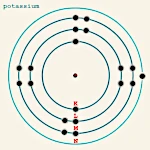
Astatine has 85 electrons distributed across six electron shells. Its electronic configuration [Xe] 4f¹⁴ 5d¹⁰ 6s² 6p⁵ features seven valence electrons in the 6th shell (s² p⁵), a configuration characteristic of halogens. This can also be written as: K(2) L(8) M(18) N(32) O(18) P(7), or fully: 1s² 2s² 2p⁶ 3s² 3p⁶ 3d¹⁰ 4s² 4p⁶ 4d¹⁰ 4f¹⁴ 5s² 5p⁶ 5d¹⁰ 6s² 6p⁵.
Detailed Shell Structure
K shell (n=1): 2 electrons (1s²).
L shell (n=2): 8 electrons (2s² 2p⁶).
M shell (n=3): 18 electrons (3s² 3p⁶ 3d¹⁰).
N shell (n=4): 32 electrons (4s² 4p⁶ 4d¹⁰ 4f¹⁴).
O shell (n=5): 18 electrons (5s² 5p⁶ 5d¹⁰).
P shell (n=6): 7 electrons (6s² 6p⁵).
Valence Electrons and Oxidation States
Astatine has 7 valence electrons (6s² 6p⁵). Like other halogens, it tends to gain an electron to achieve the stable configuration of the noble gas (radon), thus forming the astatide ion (At⁻). This is the -1 oxidation state, which should be the most stable. However, due to its large size and relativistic effects, astatine shows a strong tendency to exist in positive oxidation states, unlike lighter halogens. The +1 (At⁺), +3 (AtO⁻ or At³⁺), +5 (AtO₃⁻), and +7 (AtO₄⁻) states are possible and have been observed in trace compounds. This chemistry is more similar to that of iodine than to chlorine or bromine.
Chemical Reactivity of Astatine (Trace Studies)
Chemistry studied at the atomic scale
The chemistry of astatine has never been studied with visible samples. It is explored using trace radiochemistry techniques: the behavior of a few atoms or molecules labeled by the radioactivity of astatine in ultra-dilute solutions is tracked. This allows the determination of properties such as partition coefficients, redox potentials, or the stability of different complexes.
Halogen behavior and metalloid tendencies
Studies confirm that astatine behaves like a halogen:
- It forms interhalogen compounds (e.g., AtI, AtBr).
- It can be extracted by organic solvents like other halogens.
- It is co-precipitated with silver iodide (AgI).
But it also shows differences:
- It is more easily reduced than iodine (standard potential At/At⁻ lower than I₂/I⁻).
- It shows an affinity for metallic structures, suggesting a metallic character.
- It has a tendency to hydrolyze and form oxyanions (astatite, AtO⁻) more markedly.
Studied Compounds (in traces)
- Elemental astatine (At₂): The diatomic molecule At₂ is predicted but never isolated.
- Hydroastatic acid (HAt): Predicted to be a strong acid, but very unstable (decomposes into At⁰ and H₂).
- Astatides (At⁻ salts): Such as NaAt or AgAt (analogous to AgI).
- Oxyanions: Astatite (AtO⁻), astatate (AtO₃⁻), perastatate (AtO₄⁻).
- Organoastatine compounds: Crucial for medicine. Molecules such as methylastatine (CH₃At) or astatobenzenes have been prepared and studied in traces for their biological behavior.
Applications of Astatine: Almost Exclusively Medical
Targeted Alpha Therapy (TAT) with Astatine-211
This is the most promising and practically the only application. Astatine-211 is a pure alpha emitter ideal for targeted internal radiotherapy:
- Locally deposited energy: The alpha particle (5.87 MeV) has a very short range in tissues (50-80 µm, or a few cell diameters). It deposits all its energy in a tiny sphere, destroying the target cell with a very high relative biological effectiveness (RBE), while sparing surrounding healthy cells.
- Optimal half-life: 7.2 hours. Long enough to allow chemical synthesis, purification, conjugation to a vector, and administration to the patient. Short enough to limit patient and handler exposure, and for the activity to disappear rapidly after treatment.
- No parasitic gamma emission: Unlike some other alpha emitters (e.g., \(^{225}\mathrm{Ac}\)), \(^{211}\mathrm{At}\) does not emit significant gammas, simplifying radiation protection and reducing the dose to non-target tissues.
The targeting challenge: bioconjugates
To guide astatine-211 to the tumor, it must be covalently and stably attached to a vector molecule that specifically recognizes cancer cells. These bioconjugates are major chemical challenges because the At-C (carbon-astatine) bond is relatively weak and sensitive to deastatination (loss of the astatine atom). The vectors studied include:
- Monoclonal antibodies (mAbs): Very specific, but large (slow circulation).
- Small molecules: Such as PSMA inhibitors (for prostate cancer) or peptides.
- Nanoparticles: For passive targeting.
Clinical research areas
Preclinical and clinical trials (phases I/II) with \(^{211}\mathrm{At}\) focus on:
- Leukemias (particularly acute myeloid leukemia).
- Prostate cancer (via PSMA).
- Ovarian cancer and glioblastomas.
- Neoplastic meningitis (direct intrathecal injection).
Preliminary results are encouraging, showing antitumor efficacy with limited toxicity.
Other applications (very marginal)
- Fundamental research: In radiochemistry and nuclear physics to study the properties of superheavy elements and nuclear structure.
- Tracer: In halogen chemistry for mechanism studies (at trace scale).
Toxicology, Radiation Protection, and Hazards of Astatine
Extreme radioactive toxicity (like polonium)
Astatine-211 shares with polonium-210 an extreme radioactive toxicity in case of incorporation, due to its high-energy alpha emission. Its danger is even greater in some respects:
- Thyroid affinity: As a halogen, astatine is chemically similar to iodine and has a strong tendency to accumulate in the thyroid. Even minimal incorporation would lead to intense and destructive alpha irradiation of this vital organ.
- General distribution: In other chemical forms, it distributes to the liver, spleen, and lungs.
- Shorter half-life: The specific activity is even higher than that of \(^{210}\mathrm{Po}\), making weighable amounts even more dangerous.
Handling and radiation protection
Handling of astatine-211 is done exclusively in high-security laboratories (P3 level) equipped with sealed glove boxes under controlled atmosphere (nitrogen or argon). Protection against alpha emissions is simple (gloves, box), but prevention of incorporation (inhalation of vapors, ingestion, skin contact) is paramount. All operations are designed to work with activities on the order of gigabecquerels (GBq) in minuscule volumes.
Treatment in case of contamination
There is no specific antidote. Prevention is the only effective strategy. In case of suspected contamination, emergency measures (decontamination, monitoring of excreta) and administration of stable iodine (to saturate the thyroid and limit astatine uptake) could be considered, although their efficacy is unproven.
Management, Regulation, and Prospects of Astatine
Drastic controls
Like polonium and other Category 1 radioactive materials, astatine-211 is subject to the strictest IAEA regulations regarding nuclear safety and security. Its transport is highly regulated (ADR/RID regulations for radioactive materials). Only a few laboratories worldwide are authorized to produce and handle it.
Production and supply: a bottleneck
The main obstacle to the development of astatine-211 therapies is its limited production. It requires a medium-energy cyclotron (~30 MeV) with a dedicated beamline for bismuth bombardment. The chemical separation of astatine from molten bismuth (distillation method) or in solution is complex and must be rapid. Developing more efficient production methods and logistics to deliver the isotope to hospitals within hours of production is an active area of research.
Future prospects
The future of astatine is almost entirely linked to theranostic nuclear medicine:
- Optimization of bioconjugates: Develop new, more stable, and faster labeling methods.
- Advanced clinical trials: Move from phases I/II to phase III to demonstrate clinical efficacy and obtain marketing authorizations.
- Increased production: Network cyclotrons and standardize procedures.
- Fundamental research: Better understand the chemistry of astatine to improve its use.
Astatine, this "phantom" of the periodic table, could thus move from the status of a laboratory curiosity to that of a life-saving precision therapeutic tool, embodying the paradox of radioelements: destructive power channeled toward healing.
 The energies required for nuclear fusion and why uranium is a limit
  The Atom in All Its Forms: From Ancient Intuition to Quantum Mechanics