

Bismuth (Bi, Z = 83): The Heavy and Colorful Metal for Medical Applications
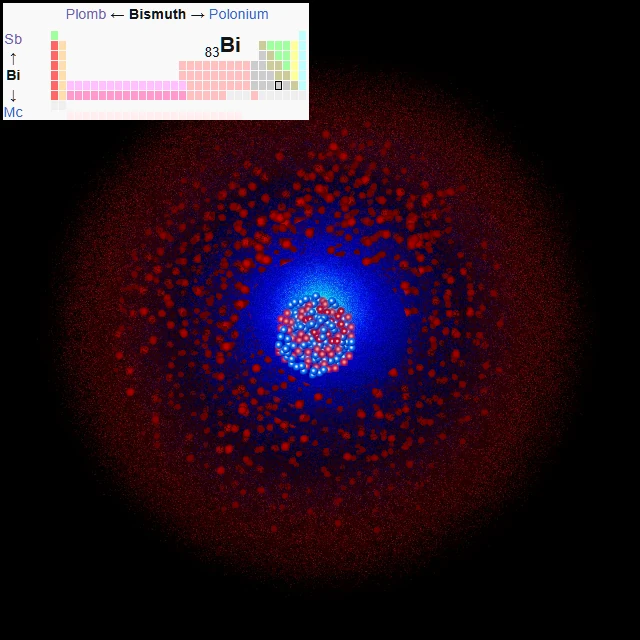
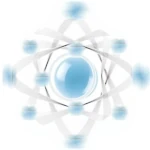
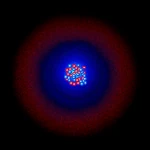
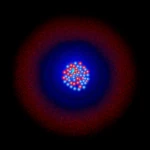
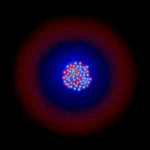
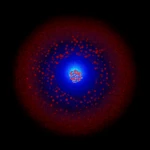
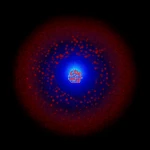
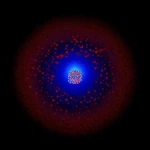
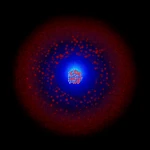
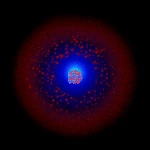
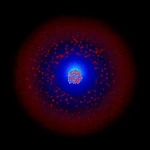
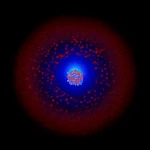
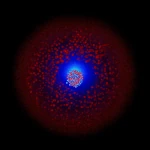
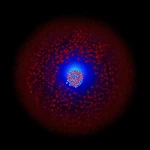
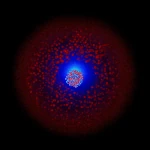
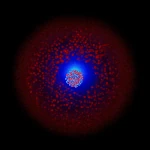
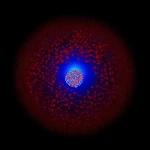
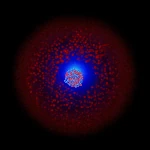
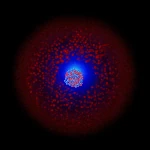
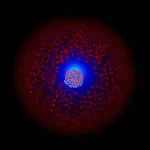
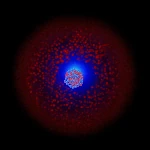
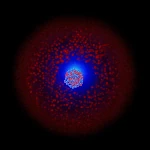
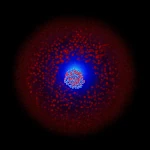
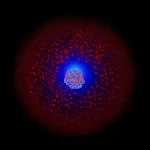
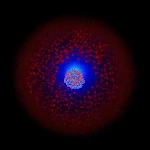
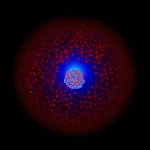
Image description:
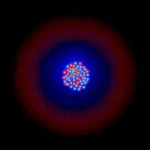
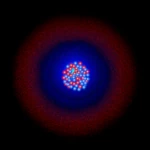
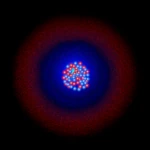
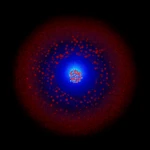
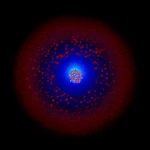
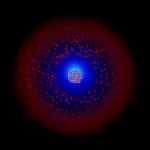
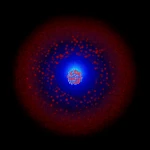
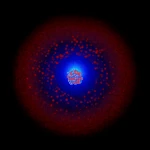
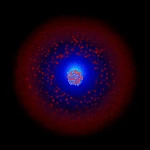
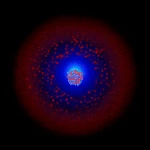
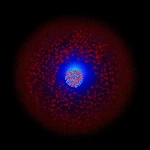
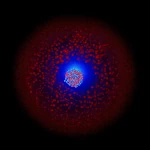
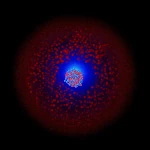
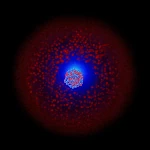
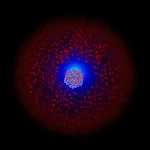
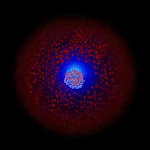
Simplified atomic model of the bismuth atom.
The main quasi-stable isotope is \(^{209}\mathrm{Bi}\) with its 83 protons, 83 electrons, and 126 neutrons.
Image source: astronoo.com (new window)
Role of Bismuth in Astrophysics and Radiochronology
Last stable element? The discovery of Bismuth-209 radioactivity
For decades, bismuth was considered the heaviest stable element. The isotope \(^{209}\mathrm{Bi}\) was thought to have an infinite half-life. However, in 2003, a team from the Institut d'Astrophysique Spatiale in Orsay demonstrated that it is actually weakly radioactive, with an extraordinarily long half-life of about \(1.9 \times 10^{19}\) years (nearly 19 billion billion years), a billion times longer than the age of the universe! This decay occurs via alpha emission into thallium-205.
This discovery has a major consequence: lead-208 (the final product of the thorium chain) regains its status as the heaviest known stable nucleus. Bismuth-209 is now classified as "quasi-stable" or "primordial radioactive".
Stellar synthesis and cosmochemistry
Bismuth is mainly synthesized by the s-process (slow neutron capture) in AGB stars (asymptotic giants). It marks an important limit: it is the last element whose isotopes can be produced significantly by the s-process before the following elements (polonium, astatine, radon) become too unstable to persist. Its production by the r-process (rapid capture) is also possible during supernovae. In stars, it can also be produced by the p-process (proton capture).
A geological and environmental tracer
The ratio of bismuth isotopes (notably \(^{209}\mathrm{Bi}\)) to lead is used as a sensitive geochemical tool to study ore formation processes, magma sources, and even to trace industrial pollution. Bismuth compounds have distinct isotopic signatures that can help trace their origin.
Role in the decay chain
Although bismuth-209 is effectively the end of many natural decay chains (due to its extremely long half-life), it is not the true final product. Theoretically, any matter containing bismuth will, over unimaginable timescales, transform into thallium and then into stable lead.
History of the Discovery and Use of Bismuth
Etymology and origin of the name
The origin of the name "bismuth" is uncertain. It may come from the German "Wismuth" or "Weisse Masse" ("white mass"), referring to its appearance. Another hypothesis links it to the Arabic "bi ismid" (having the properties of antimony), as it was often confused with tin, lead, and especially antimony. The symbol Bi is obvious.
Discovery and recognition
Bismuth has been known since antiquity but was only recognized as a distinct element in the mid-18th century. The alchemist Claude François Geoffroy demonstrated in 1753 that it was a metal distinct from lead and tin. Before that, it was often considered a variety of lead or antimony.
Historical uses
Historically, bismuth has been used:
- In low-melting alloys, such as fine printing type.
- As a white pigment (bismuth suboxide, "pearl white") in cosmetics and porcelain paints.
- In medicine: Bismuth compounds (subnitrate, subcitrate) have been used since the 18th century to treat digestive disorders (diarrhea, indigestion).
Deposits and production
Bismuth is rare, with a crustal abundance of about 0.008 ppm. There are no mines dedicated to bismuth; it is almost always a byproduct of the refining of other metals, mainly:
- Lead: The major source (≈75%).
- Copper.
- Tungsten and Tin.
- Gold and Silver.
The main producers are China (world leader), Peru, Mexico, Bolivia, and Japan. Annual production is about 10,000 to 15,000 tons. Due to its production being linked to lead (whose demand may decrease with the energy transition), the supply of bismuth could become tighter in the future.
Structure and Fundamental Properties of Bismuth
Classification and atomic structure
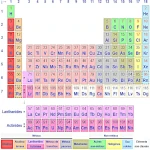
Bismuth (symbol Bi, atomic number 83) is a post-transition element, located in group 15 (nitrogen group or pnictogens) of the periodic table, along with nitrogen, phosphorus, arsenic, and antimony. It is the heaviest and most metallic member of this group. Its atom has 83 protons, usually 126 neutrons (for the quasi-stable isotope \(^{209}\mathrm{Bi}\)), and 83 electrons with the electronic configuration [Xe] 4f¹⁴ 5d¹⁰ 6s² 6p³. It has five valence electrons (6s² 6p³).
Remarkable physical properties
Bismuth is a silvery-white crystalline metal with a pale pink tint. It has several exceptional properties:
- Strong diamagnetism: It is one of the most diamagnetic metals; it is repelled by a magnetic field. This property is used in magnetic levitation experiments.
- Low thermal conductivity: One of the lowest among metals.
- High electrical resistivity.
- Expansion on solidification: Like water, bismuth expands by about 3.3% when it changes from liquid to solid. This is a rare property for a metal, shared with gallium and germanium.
- Low melting point: 271.4 °C.
- Iridescent shine: The surface of crystals or oxidized metal exhibits rainbow colors (blue, violet, yellow) due to light interference on a thin oxide layer.
Bismuth crystallizes in a rhombohedral (trigonal) structure that gives rise to its beautiful "staircase" crystals.
Transformation points
Bismuth melts at 271.40 °C (544.55 K) and boils at 1564 °C (1837 K). Its low melting point makes it easy to melt and work with.
Chemical reactivity
Bismuth is a fairly stable metal in air at room temperature. It slowly becomes covered with a thin oxide layer that gives it its iridescent colors. It burns in air at high temperatures to form bismuth(III) oxide (Bi₂O₃), which is yellow. It is attacked by concentrated nitric and sulfuric acids but resists dilute hydrochloric acid (unlike its cousins arsenic and antimony).
Summary of physical characteristics
Density: 9.78 g/cm³.
Melting point: 544.55 K (271.40 °C).
Boiling point: 1837 K (1564 °C).
Crystal structure: Rhombohedral (trigonal).
Electronic configuration: [Xe] 4f¹⁴ 5d¹⁰ 6s² 6p³.
Main oxidation state: +3.
Table of Bismuth Isotopes
| Isotope / Notation | Protons (Z) | Neutrons (N) | Atomic mass (u) | Natural abundance | Half-life / Stability | Decay / Remarks |
|---|---|---|---|---|---|---|
| Bismuth-209 — \(^{209}\mathrm{Bi}\) | 83 | 126 | 208.980399 u | ≈ 100 % | \(1.9 \times 10^{19}\) years | Quasi-stable isotope, historically considered stable. Alpha radioactive with an extremely long half-life. It constitutes all natural bismuth. Its decay into \(^{205}\mathrm{Tl}\) was observed in 2003. |
Electronic Configuration and Electron Shells of Bismuth
N.B.:
Electron shells:
How electrons are organized around the nucleus (new window).
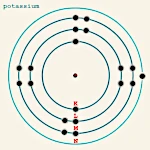
Bismuth has 83 electrons distributed over six electron shells. Its electronic configuration [Xe] 4f¹⁴ 5d¹⁰ 6s² 6p³ has five valence electrons in the 6th shell (s² p³). This can also be written as: K(2) L(8) M(18) N(32) O(18) P(5), or fully: 1s² 2s² 2p⁶ 3s² 3p⁶ 3d¹⁰ 4s² 4p⁶ 4d¹⁰ 4f¹⁴ 5s² 5p⁶ 5d¹⁰ 6s² 6p³.
Detailed Shell Structure
K shell (n=1): 2 electrons (1s²).
L shell (n=2): 8 electrons (2s² 2p⁶).
M shell (n=3): 18 electrons (3s² 3p⁶ 3d¹⁰).
N shell (n=4): 32 electrons (4s² 4p⁶ 4d¹⁰ 4f¹⁴).
O shell (n=5): 18 electrons (5s² 5p⁶ 5d¹⁰).
P shell (n=6): 5 electrons (6s² 6p³).
Valence Electrons and Oxidation States
Bismuth has 5 valence electrons (6s² 6p³). The predominant and most stable oxidation state is +3. As with lead, the inert pair effect is very pronounced: the 6s² pair is energetically stable and reluctant to participate in bonding. Thus, the +5 state (which would require the loss of all five valence electrons) is very rare, unstable, and highly oxidizing.
- Bismuth(III) (Bi³⁺): The characteristic state. Bi(III) compounds often exhibit interesting coordination chemistry with a pyramidal geometry due to the presence of the non-bonding pair (stereochemical effect of the inert pair). They are generally poorly soluble in water (e.g., oxychloride BiOCl, subnitrate), which limits their systemic absorption and contributes to their low toxicity.
- Bismuth(V) (Bi⁵⁺): Exists in a few compounds such as pentafluoride (BiF₅) or sodium metabismuthate (NaBiO₃), which is a powerful oxidant used in analytical chemistry.
- Elemental state (Bi⁰): The metal itself.
Chemical Reactivity of Bismuth
Reaction with air and oxygen
At room temperature, bismuth becomes covered with a thin oxide layer that protects it and gives it its iridescent colors. When heated above its melting point, it burns with a blue flame to form bismuth(III) oxide (Bi₂O₃), a yellow solid: 4Bi + 3O₂ → 2Bi₂O₃.
Reaction with water and acids
- Water: No reaction, even at boiling.
- Acids:
- Nitric acid (HNO₃): Dissolves it to give bismuth(III) nitrate, Bi(NO₃)₃.
- Hot concentrated sulfuric acid (H₂SO₄): Dissolves it to give bismuth(III) sulfate, Bi₂(SO₄)₃, and releases SO₂.
- Hydrochloric acid (HCl): Reacts slowly, especially in the presence of oxidants. In dilute solution, bismuth(III) often forms insoluble oxychlorides (BiOCl) that precipitate.
- Organic acids (acetic, citric): React to form salts.
Important compounds
- Bismuth(III) oxide (Bi₂O₃): Yellow powder, used in glasses, ceramics, and as a precursor for other compounds.
- Bismuth subnitrate (BiONO₃·H₂O): White powder, historical gastroprotective medicine.
- Colloidal bismuth subcitrate (CBS) and Ranitidine Bismuth Citrate (RBC): Modern medicines for ulcers and eradication of Helicobacter pylori.
- Bismuth oxychloride (BiOCl): White pearlescent powder, used as a pearl pigment in cosmetics (lipsticks, nail polishes).
- Bismuth telluride (Bi₂Te₃): Reference thermoelectric material for converting heat into electricity (generators) or for cooling (Peltier modules).
- Bismuth pentafluoride (BiF₅): Powerful fluorinating agent.
Industrial and Technological Applications of Bismuth
- As an active ingredient in gastrointestinal medicines for the treatment of ulcers, heartburn, diarrhea, and eradication of Helicobacter pylori;
- As a non-toxic substitute for lead in lead-free alloys: electronic solders (tin-silver-copper-bismuth alloys), hunting ammunition ("bismuth shot"), plumbing plates, counterweights;
- In pigments and pearlescent agents for cosmetics (bismuth oxychloride giving a pearl effect);
- As a base material for low-temperature thermocouples (bismuth-antimony alloy);
- In thermoelectric materials (bismuth telluride) for generating electricity from waste heat or precision electronic cooling;
- As a neutron absorber in nuclear reactors (molten bismuth-lead alloys);
- In the manufacture of special glasses with high refractive index and ferroelectric ceramics;
- As a catalyst in the production of acrylic fibers and other chemical syntheses;
- For the manufacture of electrical fuses and alloys with precise melting points (fire safety systems, foundry molds);
- In physics, for diamagnetic levitation experiments;
- As a target in particle detectors and for the production of certain radioisotopes;
- Historically, in fine printing type and molds for manufacturing small metal objects (taking advantage of its expansion on solidification).
Key Applications: Medicines and Lead Substitution
Gastrointestinal medicines
Bismuth compounds (subcitrate, subsalicylate) have been used for centuries. Their mechanism of action is multifaceted:
- Protective effect (cytoprotective): They form a gel or adherent coating on the stomach and intestinal mucosa, protecting it from acid, pepsin, and bile salts.
- Antibacterial action: They inhibit the growth of Helicobacter pylori, a bacterium responsible for most gastroduodenal ulcers and some stomach cancers. Bismuth penetrates the bacterial biofilm and alters the structure of bacterial proteins.
- Anti-inflammatory and astringent effect.
These medicines (e.g., Gaviscon®, Pepto-Bismol®, De-Nol®) are considered safe for short-term use, although long-term absorption can lead to accumulation (bismuthosis).
Lead-free alloys (eco-friendly substitution)
Given the toxicity of lead, bismuth, with similar density and melting points but non-toxic, is an ideal substitute in many areas:
- Electronic solders: Sn-Ag-Cu-Bi ("SAC-Bi") alloys offer good mechanical properties and suitable melting temperatures, complying with the RoHS directive.
- Hunting ammunition: Bismuth shot is almost as dense as lead shot, effective, and non-toxic to birds and the environment.
- Counterweights and ballast: For balancing (wheels, bowling balls) where lead was used.
- Plumbing plates and other applications where malleability and density are required.
Thermoelectric materials
Bismuth telluride (Bi₂Te₃) is the most effective thermoelectric material around room temperature. It directly converts a temperature difference into electrical voltage (Seebeck effect) or uses electricity to create a temperature difference (Peltier effect). Applications:
- Thermoelectric generators: To recover waste heat from exhaust gases, industrial processes, or to power space probes (RTG).
- Peltier coolers: For precise cooling of electronic components, small portable refrigerators, or scientific devices.
Toxicology and Safety
Low toxicity: an exception among heavy metals
Bismuth is remarkably non-toxic for a heavy metal, especially compared to its neighbors in the periodic table (lead, polonium). This low toxicity is due to several factors:
- Low absorption: Most bismuth compounds are insoluble in water and biological fluids, limiting their passage into the blood.
- Rapid excretion: Absorbed bismuth is mainly excreted by the kidneys.
- No interference with essential metals: Unlike lead, it does not easily substitute for calcium or zinc in enzymes.
Side effects and toxicity at high doses
However, at high doses or with prolonged administration, bismuth can be toxic:
- Encephalopathy: The most serious toxic effect, historically observed with the abuse of soluble bismuth salts (e.g., subgallate). It manifests as gait, speech, and tremor disorders, and can progress to coma. It is generally reversible upon discontinuation of treatment.
- Blackening of stools: A benign and reversible effect due to the formation of black bismuth sulfide.
- Kidney failure: Rare, linked to very high doses.
- Bismuthosis: Chronic accumulation leading to blue-gray discoloration of the skin (argyria-like) and mucous membranes.
Precautions
Medical use must respect recommended dosages and durations. It is contraindicated in cases of severe renal failure. Fine bismuth metal powder can pose an explosion risk (combustible dust) and should be handled with caution.
Environment and Recycling
Environmental impact
Bismuth is naturally present in trace amounts. Its production as a byproduct means that its environmental impact is mainly related to the extraction and refining of the main metals (lead, copper). Bismuth compounds are not very mobile in the environment and have low ecological toxicity. Its substitution for lead in many applications (ammunition, solders) has a very positive net environmental benefit, reducing lead pollution.
Recycling
Bismuth recycling is not as systematic as for lead or copper, due to its dispersion in many products and alloys. However:
- Bismuth from used catalysts can be recovered.
- Production waste from alloys and solders is recycled in the industry.
- Bismuth present in lead smelting slag is often recovered.
With the increase in its use in lead-free alloys, more specific recycling channels could develop. The Basel Convention applies to bismuth-containing waste when mixed with other hazardous metals.
Future prospects and challenges
Bismuth is a promising strategic element:
- Lead substitution: Demand is expected to grow with the tightening of environmental regulations.
- Energy technologies: Its role in thermoelectric materials for energy recovery and cooling could expand.
- New catalysts: The chemistry of bismuth(III), with its inert pair, is being explored for non-toxic organic catalysts.
- Supply: Its dependence on lead production is a risk. Research into primary sources or byproducts of other metals is important.
- Fundamental research: Its quasi-stable isotope and quantum properties (bismuth is a semimetal with Dirac electrons) make it a material of study for condensed matter physics.
 The energies required for nuclear fusion and why uranium is a limit
 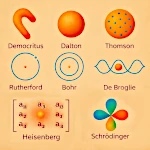 The Atom in All Its Forms: From Ancient Intuition to Quantum Mechanics