

Rhodium (Rh, Z = 45): The Most Precious Metal in the World

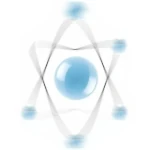
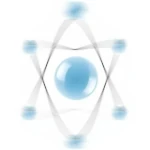
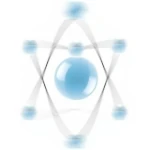
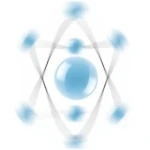
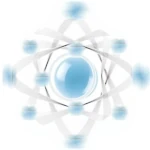
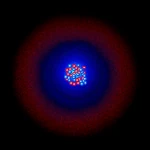
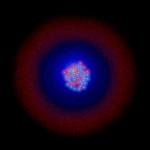
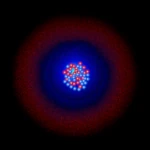
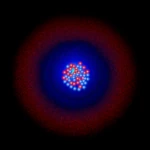
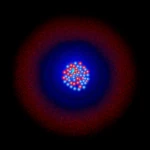
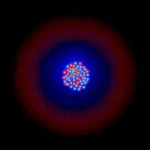
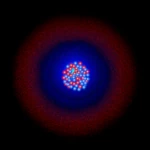
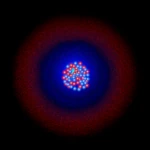
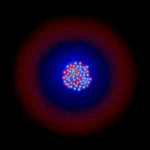
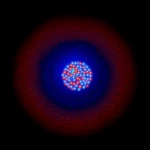
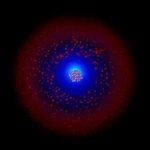
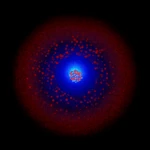
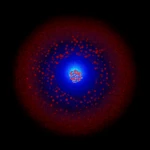
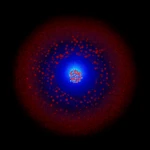
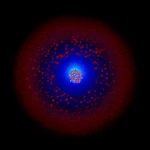
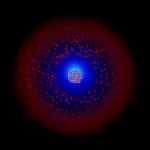
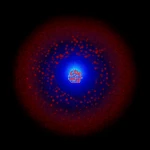
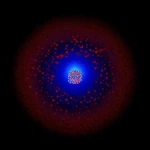
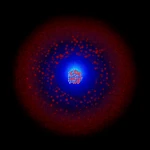
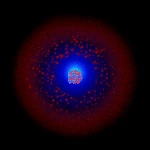
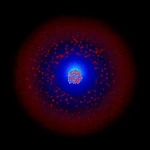
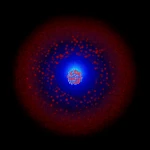
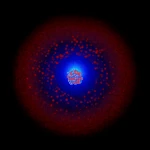
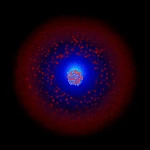
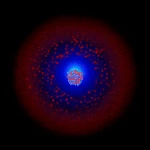
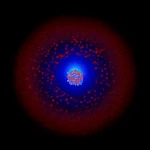
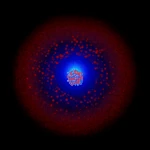
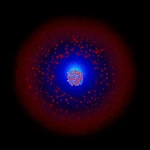
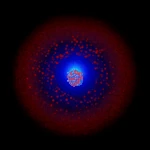
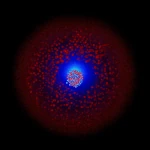
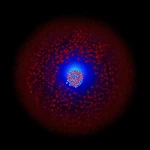
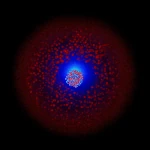
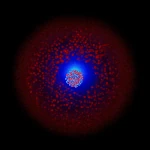
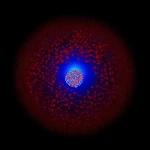
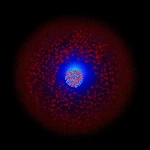
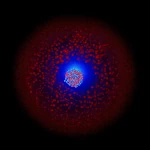
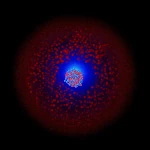
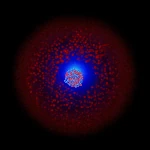
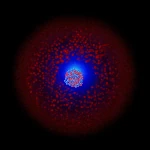
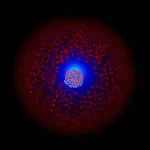
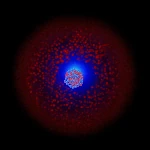
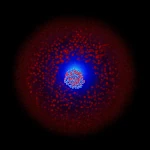
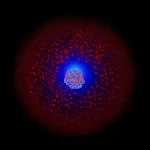
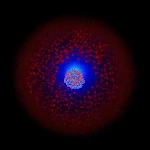
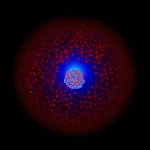
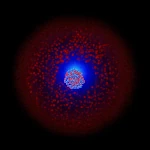
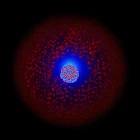
Image description: Simplified atomic model of the rhodium atom. The only stable isotope is \(\,^{103}\mathrm{Rh}\,\)
with its 45 protons, 45 electrons, and 58 neutrons.
Image source: astronoo.com (new window) — AI-generated image, public domain.
History of the Discovery of Rhodium
Rhodium was discovered in 1803 by the British chemist William Hyde Wollaston (1766-1828), the same year he also discovered palladium. Wollaston, a versatile scientist who contributed to physics, chemistry, and optics, was working on the chemical analysis of crude platinum from South America.
After dissolving the platinum ore in aqua regia (a mixture of hydrochloric and nitric acids), Wollaston precipitated platinum by adding ammonium chloride. By treating the remaining solution with sodium chloride, he obtained a rose-red precipitate, which he identified as a salt of a new element. He named this element rhodium from the Greek rhodon, meaning rose, in reference to the characteristic pink color of its diluted salt solutions.
Wollaston's discovery of rhodium and palladium, along with Smithson Tennant's discovery of osmium and iridium in the same year, 1803, completed the family of six platinum group metals. Wollaston kept his discovery method secret for several years, allowing him to commercialize purified platinum and amass considerable wealth before publicly revealing his techniques in 1828.
Structure and Fundamental Properties
Rhodium (symbol Rh, atomic number 45) is a transition metal in group 9 of the periodic table, belonging to the platinum group metals. Its atom has 45 protons, 58 neutrons (for the only stable isotope \(\,^{103}\mathrm{Rh}\)) and 45 electrons with the electronic configuration [Kr] 4d⁸ 5s¹.
Rhodium is an extremely bright silvery-white metal, with one of the highest reflectivities of all metals (about 80% of visible light). It has a density of 12.41 g/cm³, similar to that of ruthenium. Rhodium crystallizes in a face-centered cubic (fcc) structure. It is a very hard metal (Mohs hardness 6) but more ductile than ruthenium or iridium.
Rhodium melts at 1964 °C (2237 K) and boils at 3695 °C (3968 K). Although these temperatures are high, rhodium has the lowest melting point of the platinum group metals after palladium. Rhodium has high thermal and electrical conductivity, comparable to that of silver.
Rhodium is remarkably chemically inert, resistant to almost all acids at room temperature, including aqua regia. This exceptional inertness, combined with its brilliance and corrosion resistance, makes it an ideal coating material for jewelry and reflectors.
Melting point of rhodium: 2237 K (1964 °C).
Boiling point of rhodium: 3968 K (3695 °C).
Rhodium has the highest reflectivity of all platinum group metals.
Table of Rhodium Isotopes
| Isotope / Notation | Protons (Z) | Neutrons (N) | Atomic mass (u) | Natural abundance | Half-life / Stability | Decay / Remarks |
|---|---|---|---|---|---|---|
| Rhodium-103 — \(\,^{103}\mathrm{Rh}\,\) | 45 | 58 | 102.905504 u | 100 % | Stable | Only stable isotope of rhodium. Rhodium is a mononuclidic element. |
| Rhodium-101 — \(\,^{101}\mathrm{Rh}\,\) | 45 | 56 | 100.906164 u | Synthetic | ≈ 3.3 years | Radioactive (electron capture). Produced by neutron activation, used in research. |
| Rhodium-102 — \(\,^{102}\mathrm{Rh}\,\) | 45 | 57 | 101.906843 u | Synthetic | ≈ 207 days | Radioactive (β⁺, electron capture). Used as a tracer in industrial research. |
| Rhodium-105 — \(\,^{105}\mathrm{Rh}\,\) | 45 | 60 | 104.905694 u | Synthetic | ≈ 35.4 hours | Radioactive (β⁻). Fission product, used in industrial radiography. |
Electronic Configuration and Electron Shells of Rhodium
N.B.:
Electron shells:
How electrons are organized around the nucleus (new window).
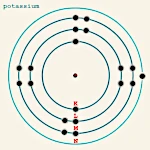
Rhodium has 45 electrons distributed over five electron shells. Its full electronic configuration is: 1s² 2s² 2p⁶ 3s² 3p⁶ 3d¹⁰ 4s² 4p⁶ 4d⁸ 5s¹, or simplified: [Kr] 4d⁸ 5s¹. This configuration can also be written as: K(2) L(8) M(18) N(16) O(1).
Detailed Structure of the Shells
K shell (n=1): contains 2 electrons in the 1s subshell. This inner shell is complete and very stable.
L shell (n=2): contains 8 electrons distributed as 2s² 2p⁶. This shell is also complete, forming a noble gas configuration (neon).
M shell (n=3): contains 18 electrons distributed as 3s² 3p⁶ 3d¹⁰. This complete shell contributes to the electronic screen.
N shell (n=4): contains 16 electrons distributed as 4s² 4p⁶ 4d⁸. The eight 4d electrons are valence electrons.
O shell (n=5): contains 1 electron in the 5s subshell. This electron is also a valence electron.
Valence Electrons and Oxidation States
Rhodium has 9 valence electrons: eight 4d⁸ electrons and one 5s¹ electron. Rhodium mainly exhibits oxidation states +1, +2, +3, and +4, although the +3 state is by far the most common and stable. The +3 oxidation state appears in most rhodium compounds, notably rhodium trichloride (RhCl₃) and rhodium(III) oxide (Rh₂O₃).
The +1 state is particularly important in homogeneous catalysis, where rhodium(I) complexes such as Wilkinson's catalyst [RhCl(PPh₃)₃] are widely used for the hydrogenation of alkenes. The +2 and +4 states are less common but exist in some coordination complexes. Metallic rhodium corresponds to the 0 oxidation state.
Chemical Reactivity
Rhodium is one of the noblest and most chemically inert metals. At room temperature, it resists almost all acids, including aqua regia, which dissolves gold and platinum. Only concentrated boiling sulfuric acid can slowly attack rhodium. This exceptional corrosion resistance makes it valuable for applications requiring extreme chemical stability.
Rhodium does not oxidize in air at room temperature, indefinitely retaining its bright luster. At high temperatures (above 600 °C), it forms a gray-black Rh₂O₃ oxide layer that decomposes spontaneously above 1100 °C, regenerating the pure metal. This thermal decomposition of the oxide is a rare property among metals.
Rhodium can be dissolved by fusion with alkaline bisulfates or by electrochemical attack under certain conditions. Chlorine gas at high temperature attacks rhodium, forming rhodium trichloride (RhCl₃), a reddish-brown compound used as a precursor for the synthesis of rhodium complexes.
Rhodium forms a rich coordination chemistry, particularly with phosphines, carbonyls, and other σ-donor ligands. Rhodium complexes are among the most active and selective homogeneous catalysts known, widely used in industrial organic synthesis and fine chemistry.
Industrial and Technological Applications of Rhodium
- in three-way automotive catalysts to reduce nitrogen oxides (NOₓ) to nitrogen;
- as an electroplated coating on white gold and silver jewelry for brilliance and protection;
- in high-performance reflectors and mirrors for optics, lasers, and projectors;
- for high-temperature platinum-rhodium thermocouples (up to 1800 °C);
- as a catalyst in fine chemistry for hydrogenation and hydroformylation (Wilkinson catalyst);
- in crucibles and laboratory wires resistant to high-temperature corrosion;
- for high-reliability electrical contacts in aerospace;
- as an alloy with platinum to increase hardness and corrosion resistance;
- in infrared optical filters and anti-reflective coatings;
- for corrosion-resistant glass fiber spinning nozzles;
- as a catalyst in the production of nitric acid (Ostwald process);
- in electrodes for electrolysis and electroplating;
- for LCD screens and electrochemical cells.
Rhodium in Automotive Catalysts
The dominant application of rhodium, accounting for more than 80% of global demand, is in three-way automotive catalysts. These anti-pollution devices, mandatory on gasoline vehicles in most countries since the 1980s, use rhodium for its unique ability to efficiently catalyze the reduction of nitrogen oxides (NOₓ) to nitrogen and oxygen.
In a three-way catalyst, platinum and palladium oxidize carbon monoxide (CO) to carbon dioxide (CO₂) and unburned hydrocarbons to CO₂ and H₂O, while rhodium simultaneously reduces nitrogen oxides (NO, NO₂) to harmless nitrogen gas (N₂). No other metal rivals rhodium's efficiency for this reduction reaction under the harsh conditions of an exhaust system (high temperatures, corrosive gases, thermal cycles).
Each automotive catalyst typically contains 1 to 2 grams of rhodium, or about 10-20% of the total platinum group metal content. Automotive demand for rhodium has exploded with the tightening of Euro, EPA, and Chinese emission standards, creating significant pressure on the limited supply of this extremely rare metal.
The recycling of used automotive catalysts has become a major source of rhodium, accounting for about 30% of the annual supply. Rhodium is recovered from catalytic converters through complex processes involving grinding, smelting, chemical dissolution, and electrolytic refining. Fluctuations in the price of rhodium have led to massive theft of catalysts in many countries.
Rhodium Prices and Markets
Rhodium is regularly the most expensive precious metal in the world, even surpassing gold, platinum, and palladium. Its price is extremely volatile due to the very limited supply (about 30 tons per year) and the inelastic demand from the automotive industry, which cannot substitute rhodium with any other metal for NOₓ reduction.
The price of rhodium has experienced spectacular fluctuations: around $500 per troy ounce in the early 2000s, a historic peak of over $10,000 in 2008, a drop to $1,000 during the financial crisis, a gradual rise to $2,000-$3,000 in the 2010s, and then an explosion to over $29,000 per ounce in 2021 (nearly one million dollars per kilogram) before falling back to $4,000-$6,000 in 2023-2024.
These extreme fluctuations reflect imbalances between a geographically highly concentrated supply (80% in South Africa) and subject to disruptions (mining strikes, energy issues), and rigid automotive demand amplified by financial speculation. The rhodium market is one of the smallest and most opaque of the precious metals, with only a few thousand kilograms traded annually.
Role in Astrophysics and Cosmology
Rhodium is synthesized in stars mainly through the s-process (slow neutron capture) in asymptotic giant branch (AGB) stars, with significant contributions from the r-process (rapid neutron capture) during supernovae and neutron star mergers. Rhodium-103, the only stable isotope, lies in a region of the nuclear stability curve favored by these processes.
The cosmic abundance of rhodium is about 3×10⁻¹⁰ times that of hydrogen in number of atoms, making it one of the rarest elements in the universe. This extreme rarity is explained by its unfavorable position in the nuclear stability curve and the low neutron capture cross-sections of its precursors.
The spectral lines of neutral rhodium (Rh I) and ionized rhodium (Rh II) are extremely difficult to observe in stellar spectra due to the very low cosmic abundance of this element. Nevertheless, rhodium lines have been detected in a few chemically peculiar stars ultra-enriched in s-process and r-process elements.
N.B.:
Rhodium is one of the rarest elements in the Earth's crust, with an average concentration of about 0.001 ppm (1 part per billion), about 5,000 times rarer than gold and 10,000 times rarer than silver. It never forms its own ores but is always associated with other platinum group metals in native platinum ores.
South Africa dominates global rhodium production with about 80% of the supply, mainly from the Bushveld Complex, the world's largest platinum group metal deposit. Russia supplies about 10%, and the rest comes from Canada, Zimbabwe, and the United States. Total world production is about 30 tons per year, making rhodium one of the rarest commercially produced metals.
Rhodium is extracted as a byproduct of platinum and nickel refining through extremely complex hydrometallurgical processes. After dissolution in aqua regia, separation by liquid-liquid extraction, and selective precipitation, rhodium is purified by distillation of volatile complexes or by electrolysis. The entire process can take several months and requires considerable metallurgical expertise.
 The energies required for nuclear fusion and why uranium is a limit
 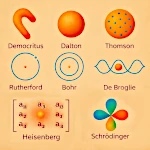 The Atom in All Its Forms: From Ancient Intuition to Quantum Mechanics