


Matter and Subatomic Particles
The origins of matter
Matter as we know it appears in the first instants of the Universe, emerging from the cosmic darkness. To understand this birth, we must go back to times when space, time and energy were intimately linked, and where fundamental particles formed in an extremely dense and hot environment.
An opaque Universe in its early days
Between 0 and 380,000 years after the Big Bang, the Universe is so dense that light cannot escape: photons and matter are in permanent interaction. It is only after this period that light decouples from matter, giving rise to the cosmic microwave background radiation we observe today. Exploring this era requires understanding the infinitely small and the laws governing subatomic particles.
Exploring the invisible with particle accelerators
To probe these extreme conditions, scientists use instruments like the Large Hadron Collider (CERN). By recreating energies close to those of the early Universe, they seek to reveal the particles and fundamental interactions that nature still hides from us. These experiments allow us to approach the origins of matter and refine our understanding of the forces that structure the cosmos.
There are articles on this page
 Does the electron have a shape? The surprising answer of quantum physics
  String Theory: When Physics Breaks the Boundaries of Four-Dimensional Spacetime
  At the Heart of Matter: The Proton's Well-Kept Secrets
  How an Electric Field Travels at 300,000 km/s with Almost Stationary Electrons
  Why Doesn't Matter Pass Through Matter?
  Magnets: From the Small Fridge Magnet to Levitation Trains
  From Electron Spin to Magnetism: Emergence of Mini-Magnets
  Free electrons: from colliding balls to dancing waves
  Water Anomalies: A Common and Abundant Molecule in the Universe
 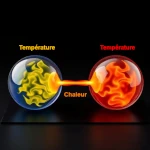 Heat and Temperature: Two Often Confused Thermal Notions
 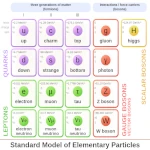 Electroweak Force: The Unification of Electromagnetism and the Weak Interaction
  Special Relativity: The Beginning of a New Physics
 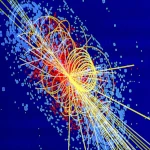 The Higgs Boson: The Unification of Fundamental Forces
 Quantum Entanglement: When Two Particles Become One!
 The Pentaquark: A New Piece of the Cosmic Puzzle!
 Why are Rare Gases rare?
 Brownian Motion: A Link Between Two Worlds
 The 4 Articles of Albert Einstein from 1905
  Why does nuclear fusion require so much energy?
  Stars cannot create elements heavier than iron because of the nuclear instability barrier
  Alpha, Beta, and Gamma Radiation: Understanding Their Differences
  Planck wall theory
  Is Absolute Vacuum a Utopia?
  Giant Colliders: Why the LHC is Unique in the World
 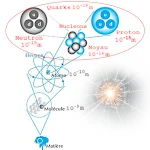 The World of Hadrons: From the LHC to Neutron Stars
  Radioactivity, natural and artificial
  The World of Nanoparticles: An Invisible Revolution
  Schrödinger's Cat: An Exploration of Quantum Mechanics
  Eternal inflation
  What is a wave?
  Quantum Field Theory: Everything is Fields
  Quantum Computers: Between Scientific Revolution and Technological Challenges
  Bose-Einstein Condensate: When Matter Becomes a Single Quantum State
  From Probability Cloud to Particle: The Electron in Quantum Mechanics
  What is Entropy? A Journey into Disorder and Information
 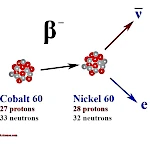 Beta Radioactivity and Neutrino: A Story of Mass and Spin
  Spacetime: Space and Time United, understand this concept
  Time Measurement: Scientific and Technological Challenge
  Spectroscopy, an inexhaustible source of information
  The Chemical Code of the Universe: Abundance and Origin of the Elements
  The size of atoms
 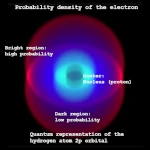 Magnetism and Magnetization: Why Are Some Materials Magnetic?
 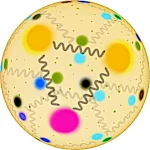 Quarks and Gluons: A Story of Confinement
 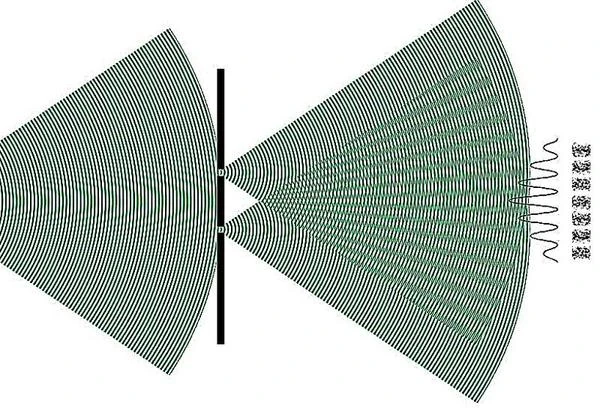 Superpositions of quantum states
  Alpha decay (α)
  Electromagnetic induction equation
 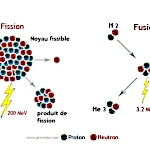 Fusion and Fission: Two Nuclear Reactions, Two Energy Paths
  From the Ancient Atom to the Modern Atom: An Exploration of Atomic Models
  The Origins of Mass: Between Inertia and Gravitation
 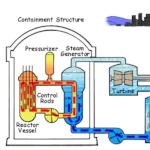 From the Nucleus to Electricity: Anatomy of a Nuclear Power Plant
  How many photons to heat a coffee?
  How Do We See the Hidden Structure of Atoms?
 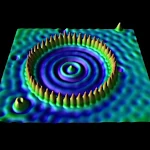 Quantum tunnelling: exploring the invisible atom by atom
  The 12 Particles of Matter: Understanding the Universe at the Subatomic Scale
 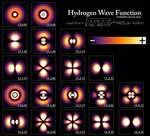 Atomic orbitals: from the probabilistic cloud to images of the infinitely small
 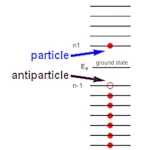 Antimatter: The Enigmas of Antiparticles and Their Energy
 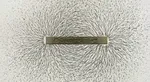 What is an electric charge?
  Our matter is not quantum!
 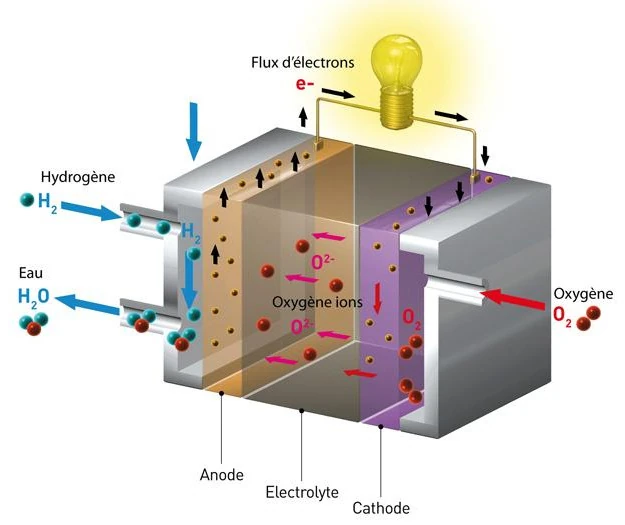 Why use hydrogen in the fuel cell?
  Newton and Einstein: Two Visions for the Same Mystery
  Where does the proton's mass come from?
  Einstein's Universe: Physical Foundations of the Theory of Relativistic Gravitation
  Einstein's Annus Mirabilis : 1905, the year that revolutionized physics
  What does the equation E=mc2 really mean?
  Between
Waves and Particles: The Mystery of Duality
Between
Waves and Particles: The Mystery of Duality 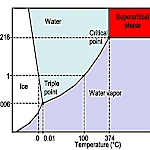 The supercritical state of water: between liquid and gas, a fourth phase?
  Quantum Mechanics and Spirituality: Another Way to See the World