


Galaxies and Galaxy Clusters
Islands of Stars in the Cosmic Expanse
A galaxy is a vast ensemble of billions of stars, gas, dust, and dark matter. The mass of a typical galaxy far exceeds a hundred million solar masses. These colossal structures are the fundamental building blocks of the observable Universe and come in various forms, from elegant spirals to massive ellipticals, including irregular galaxies.
Interactions That Shape Their Evolution
Galaxies do not evolve in isolation: they interact with their neighbors. These gravitational interactions can distort their spiral arms, trigger bursts of star formation, or even lead to spectacular mergers. These processes play an essential role in the evolution of galaxies and in the diversity of their morphologies.
Galaxy Clusters: Giant Structures of the Universe
Galaxies often group together in clusters containing hundreds or even thousands of members bound by gravity. These clusters are some of the largest coherent structures in the Universe. Their study helps us better understand the distribution of matter, both visible and invisible, as well as the large-scale dynamics of the cosmos.
There are articles on this page
 The Milky Way Is Not a Flat Disk: It Dances Like a Cosmic Wave
  JWST and Early Galaxies: When the Universe Defies Our Models
  Fermi Bubbles: When the Milky Way's Black Hole Awakens
  The Great Attractor: The Celestial Fountain Pulling Us into the Abyss
  The 5 Strangest Objects in Our Galaxy: From Zombie Stars to Diamond Planets
  Why Is It So Hard to See the Milky Way?
  What Is a Galaxy? Journey to the Land of Billions of Stars
  Galaxies from the Depths: Light from the Primordial Universe
  At the center of the Milky Way: a monster of 4 million suns
 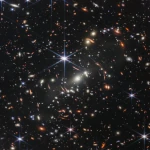 JWST and Protogalaxies: Exploring the First Cosmic Structures
 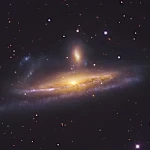 Giant galaxies: collisions, mergers and absorption
 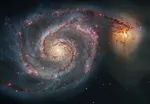 The upcoming merger between our Galaxy and the Sagittarius Galaxy
 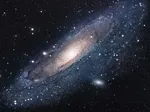 Differences between the Milky Way and the Andromeda Galaxy
  Why are Galaxies, Unlike Stars, So Close to Each Other?
 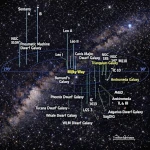 Galaxies of the Local Group
 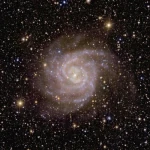 The hidden galaxy, one of Euclid's first images
  The Virgo Cluster spans approximately three Full Moons
 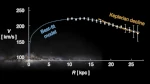 Where did the dark matter in our Galaxy go?
 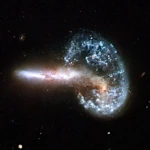 Galaxy Mergers: From Encounter to Coalescence
 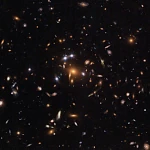 Gravitational Lenses: When Spacetime Bends Light
 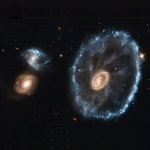 Cartwheel Galaxy: A Wheel of Fire in the Universe
 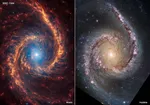 From Dust to Stars: The Composition of Galaxies
 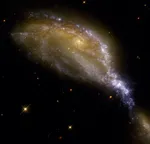 Galaxy Merger NGC 6745: A Traversal of One by the Other
 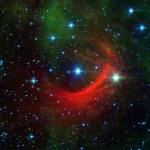 Extreme Shock Waves in the Universe: Impact on the Evolution of Cosmic Structures
 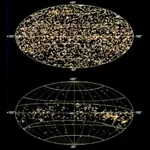 Gould Belt: The Mystery of the Milky Way's Tilted Ring
 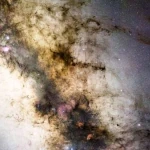 Zoom on Our Galaxy: Journey to the Center of the Milky Way
 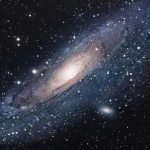 One Galaxy, Two Hearts: The Mystery of Andromeda's Double Nucleus
 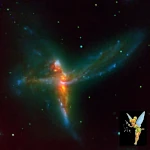 Tinker Bell's Gravitational Flight: A Merger of Three Galaxies
 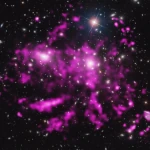 Coma or Berenice’s Hair: The Cosmic Colossus
  Bullet Cluster: Cosmic Collision and Direct Proof of Dark Matter
 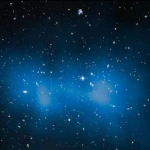 El Gordo: The Cosmic Giant That Challenges Our Models of the Universe
  Einstein Rings: When Gravity Draws Cosmic Rings
 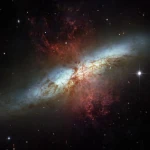 The Cigar Galaxy: A Smoke of Stars in the Night
 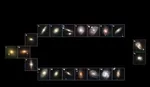 The Hubble Sequence: The Secret Code of Galactic Shapes
  Dance of the Stars: The Arms of the Milky Way
 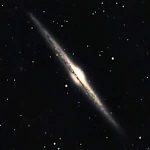 At the Heart of Galaxies: When Shape Tells the Story of the Universe
 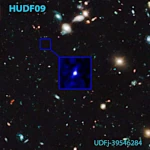 Ancient Galaxies and Cosmic Evolution: A Deep Look Back in Time
 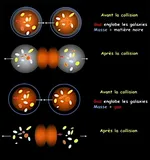 MOND Theory and Dark Matter: Why MOND Fails in Cluster Collisions
 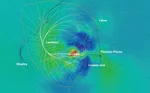 Laniakea, our supercluster of galaxies
 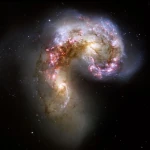 The Antennae Galaxies: An Ongoing Cosmic Collision
 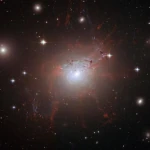 NGC 1275: A Turbulent Galaxy in the Perseus Cluster
 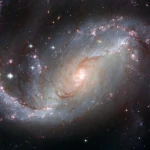 NGC 1672: A Barred Spiral Galaxy in Full Activity