


How far is the horizon?
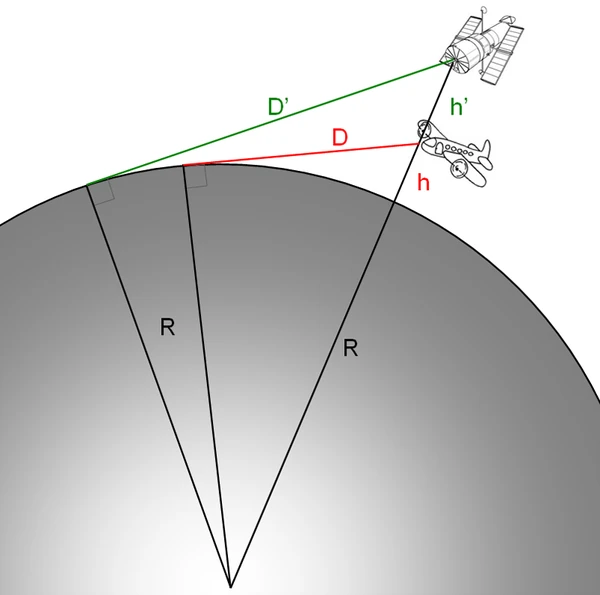
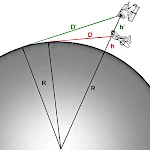
Image description: Diagram showing the geometry between an observer and the horizon line, on an ideal, perfectly spherical Earth without atmosphere. Image source: astronoo.com (new window)
Understanding the apparent distance of the horizon
The horizon is the apparent boundary between the Earth and the sky. Its distance depends on the Earth's curvature, the observer's height, and atmospheric refraction. This distance can be calculated using a simple geometric formula without considering atmospheric refraction.
Simple geometric distance to the horizon
The distance to the horizon, on an ideal, perfectly spherical Earth without atmosphere, is calculated by \(\,d = \sqrt{2Rh + h^2}\,\) where \(R\) is the Earth's radius (\(\approx 6371\) km) and \(h\) is the observer's height. For example, at 2 m height, the geometric horizon is about 5 km away.
Detailed calculation of the horizon distance
Consider an observer at a height \(h\) above the Earth's surface. Let \(R\) be the average radius of the Earth (\(R \approx 6371\) km). The line connecting the observer's eye to the point of tangency on the surface is perpendicular to the Earth's radius at that point. The triangle formed by the Earth's center, the point of tangency, and the observer is right-angled. Applying the Pythagorean theorem: \( (R + h)^2 = R^2 + d^2 \) where \(d\) is the straight-line distance between the observer and the horizon. The ground distance, following the curvature, is: \( s = R \cdot \theta \) with \(\theta = \arccos\left( \frac{R}{R+h} \right)\). Combining: \( s = R \cdot \arccos\left( \frac{R}{R+h} \right) \) and for \(h \ll R\), we obtain the approximation: \( s \approx \sqrt{2Rh + h^2} \)
Calculating the horizon distance with atmospheric correction
In reality, atmospheric refraction slightly increases this distance because light rays bend toward the ground. Under standard conditions, this effect is modeled by replacing \(R\) with \(R / (1 - k)\) where \(k \approx 0.13\).
Comparative table of horizon distances by altitude
| Situation | Eye height (m) | Geometric distance (km) | Distance with refraction (km) | Assumptions |
|---|---|---|---|---|
| Person standing | 2 | 5.06 | 5.24 | Standard atmosphere, \(k=0.13\) |
| Person on the 3rd floor of a building | 10 | 11.28 | 11.68 | Approximate height of 3 floors (3.3 m/floor) |
| 100 m cliff | 100 | 35.68 | 36.90 | Calm sea, maximum visibility |
| 1000 m mountain | 1000 | 112.88 | 116.55 | Clear summit |
| Airplane at 10,000 m | 10000 | 357.10 | 368.26 | Flight in standard atmosphere |
| ISS space station (~408 km) | 408000 | 2270.00 | 2336.00 | View above the troposphere |
| Geostationary orbit (~36,000 km) | 36000000 | 19040.00 | 19300.00 | View from geostationary orbit, half of the Earth visible |
N.B.:
The Earth's horizon never completely exists once you leave the surface: the higher you go, the more of the Earth's surface you can see.
From the ISS (408 km), about 3.2% of the total surface is visible (≈9 million km²).
In geostationary orbit (36,000 km), exactly half of the planet is visible.
To observe 99% of the surface at a glance, you would need to reach an altitude of about 21,700 km.
Beyond that, the horizon recedes almost to the opposite edge of the Earth, but it only disappears completely at infinite distance.
 Full text of Einstein's 1905 article on the nature and evolution of light
  The Speed of Light: The Ultimate Limit That Nothing Can Exceed
  Reality Escapes Us: Truths We Can Never Prove
  The Physics of the Universe in 50 Equations: User Guide
  The Kaya Identity: The Equation Complicating Our Decarbonization
  The Unsurpassable Speed in the Universe: When Energy Becomes Infinite
  How far is the horizon?
  How Do Solar Panels Inject Electricity into the Grid?
  Dynamics of Momentum to explain the propulsion of rockets or jellyfish
  How Electron Energy Dictates Chemical Properties
  How to weigh the sun?
  The Key Role of Quantum Uncertainty: No Particle Can Be at Rest
  Energy and Power: Don't Confuse Them, Time Makes All the Difference
  Why is there a limit to cold, but not to heat?
  Galileo's Law of Falling Bodies
  The Ideal Gas Law: One Equation, Thousands of Applications
  Schrödinger's Equation Revolutionized Our View of Matter
 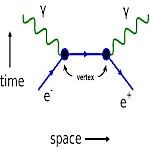 Feynman Diagram: Visualizing Particle Physics
 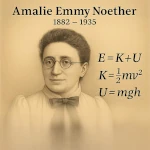 The Magic of Noether's Theorem: From the Principle of Least Action to Conservation Laws
  Relationship between gravitational mass and inertial mass and the equivalence principle
 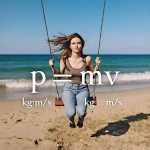 Third Equation of Physics: Momentum to Understand Collisions
 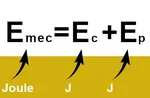 The second essential equation in physics: The intuition of a conserved quantity
  The First Equation of Physics: How to Mathematize Force
  The electromagnetic force or Lorentz force
  The solar energy received depends on the angle of incidence
  Why is marble colder than wood?
  Why does a photon, which has no mass, have energy?
  Bayes Formula and Artificial Intelligence
  The seven fundamental constants of physics
  What temperature does it feel like in interstellar space?
  Black body radiation curves: Planck's law
  The equivalence principle, gravitational effects are indistinguishable from acceleration
  The consequences of E=mc2 for our understanding of the Universe
  How to weigh the sun?
  Equation of the free fall of bodies (1604)
 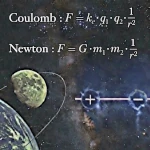 Coulomb vs Newton: The Mysterious Similarity of the Universe's Forces
 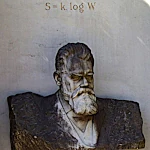 Boltzmann's equationon entropy (1877)
  Special relativity equations (1905)
  The equation of general relativity (1915)
  Planetary Rotation Equations: Between Angular Momentum and Gravitational Balance
  Equation of the orbital velocity of a planet
 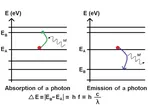 Planck's equation
  Understanding Schrödinger's Equation Without Math
 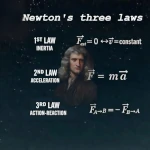 Newton's Three Laws: From the Falling Apple to the Orbiting Planets
  Maxwell's equations
 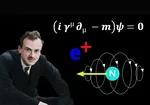 Paul Dirac's equation
  Conservation of energy: A fundamental principle of physics
  Equation of electromagnetic induction
  Why do elementary particles have no mass?