


International Date Line
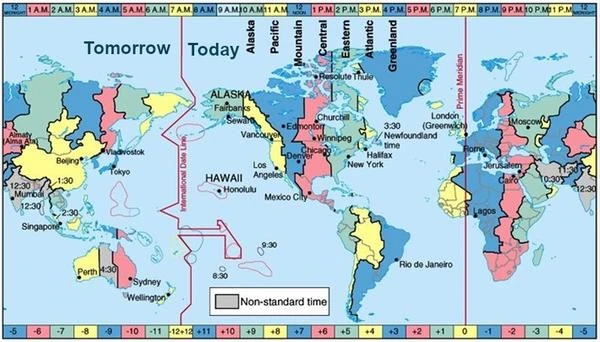
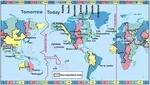
The International Date Line (IDL) is located approximately at 180° longitude, opposite the Greenwich meridian, primarily in the Pacific Ocean.
Course of a Day
The Date Line is an imaginary broken line located approximately at 180° longitude, primarily in the Pacific Ocean.
It allows for the coordination of dates on the planet by ensuring a clear transition from one day to the next despite time zone differences.
When crossing this line westward, one advances by a day, and when crossing it eastward, one goes back by a day.
Australia is located east of the International Date Line and west of the UTC+12 zone.
Due to this position, Australia is one of the first major countries to start the day.
The new day begins at midnight at the International Date Line.
Thus, the first regions to see the new day are the islands in the Pacific Ocean near this line, such as the Kiribati and Samoa islands.
Due to the Earth's west-to-east rotation, the regions east of the Date Line see the day start earlier than those to the west.
As a result, after the small Pacific islands, Australia and New Zealand are among the first major countries to enter the new day.
Position of the Date Line
The International Date Line allows for the coordination of dates on the planet by ensuring a clear transition from one day to the next despite time zone differences.
Its role is to mark the point where a new day begins and ends.
The Date Line is not a straight line but deviates to avoid dividing countries or territories into two different days.
For example, it bypasses certain islands in the Pacific Ocean to maintain local consistency in dates and times.
By deviating the Date Line to avoid inhabited lands or divided territories, a simpler and less disruptive management of local time and dates is allowed. Local communities and countries can thus function more coherently without having to handle frequent date transitions in their daily lives.
Reference to Greenwich
The Greenwich meridian, being at 0° longitude (reference for Universal Time adopted in 1884), is the place where UTC time is defined.
For example, when it is midnight UTC in Greenwich, it is already 10 AM in Sydney (in winter).
Thus, although Greenwich is the reference point for universal time, the regions east of Greenwich, such as Australia, start the day well before Greenwich due to their position in terms of time zones.
The Date Line and the Greenwich meridian are distinct and have different positions for historical and practical reasons related to navigation, international exchanges, and the management of time around the world.
The Date Line is placed at 180° from Greenwich to maximize geographical separation and minimize confusion. If it coincided with the Greenwich meridian, it would create a complex situation where date changes would occur at very inconvenient points for trade and navigation, especially in Europe and Africa.
 From Black Basalt to Blue Oceans: Earth's Changing Palette
  Plate Tectonics: The Invisible Engine Moving the Continents
  The Number 360: The Mathematical Key to the Babylonian Sky
  Wet-Bulb Temperature: Humanity's Climate Time Bomb
  Why Doesn't Earth's Atmosphere Escape into Space?
  Origins of Earth: Magmatic Chaos and the Birth of the Solid World
  Earth's Atmosphere: The Invisible Shield Protecting Life
  The 5 Cosmic "End of the World" Scenarios (and Why They Won't Happen)
  Where does the water in the oceans come from? Three key stages
  From Carbon 14 to Uranium-Lead: The Science of Dating
  Major natural disasters: what are the most likely threats?
  The Boundary of Space: Where Does It Really Begin?
  536: The Year Without a Summer and the Beginning of the Late Antique Little Ice Age
  The leap second: scheduled end in 2035
  Planetary Alignments: A Fascinating but Relative Phenomenon
  All Deserts of the World
  Earth's Paleoclimates and Carbon Dioxide
  What is the effect of large lakes and water reservoirs on Earth's rotation?
  International Date Line
  Start Date of the Seasons: A Complex Celestial Mechanism
 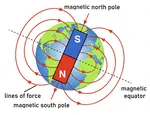 Paleomagnetism: the magnetic memory of rocks
  3D Simulator: Revolutions of the Planets
  Geological Time and Mass Extinctions: From the Ordovician to the Cretaceous
  Earth History: Timeline Compressed into 24 Hours
  Earth's Water: An Extraterrestrial Origin?
  Reading the Sky: Understanding Declination and Right Ascension
  How is Earth's magnetic field born and why does it reverse?
 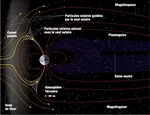 Earth's Magnetosphere: The Invisible Shield
  Fujita Scale: Classifying the Fury of Tornadoes
  Earth's Radioactivity: The Internal Energy of Our Planet
  The Deep Sea: Exploring the Deepest Ocean Trenches
  Why Are Days Getting Longer?
 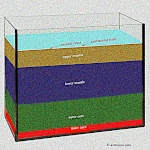 The Depths of the Earth: From the Lithosphere to the Core
  Earth's Movements: How Earth Traces Its Spiral Through the Universe?
  How much is the sea level rising?
 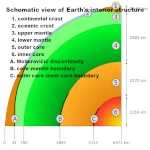 The Life of Earth: Structure and Layers of the Earth
  The Eccentricity of Earth's Orbit: An Ellipse That Changes Everything
  Little Ice Age: The History of a Natural Climatic Cooling
  The Quest for Time: How Ancient Civilizations Used Astronomy?
  Van Allen Belt: A Rampart Against Cosmic Particles
 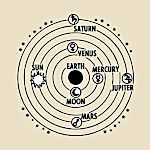 The Cosmos in Our Measure: When Man Invents the Universe
  What is the pendulum fixed relative to?
  Problem of longitude at sea
  World population, still gallopingin 2008
  The Oldest Image of Earth from Space
  Earth's Obliquity and Variations in Its Axis of Rotation
  The Astronomical Unit Fixed: A Length, No Longer an Orbit
  Water: one molecule, three states on Earth
  Simulator, the round of near-Earth cruisers
  Satellites that measure underwater relief
  Hadean's Hell
  The First Free Flight of an Astronaut in Space
  The first measurement of the Earth-Sun distance
  La The Announced End of the World on December 21, 2012: A Millennial Prophecy
 The Equinoxes: An Astronomical Event
 Milankovitch Cycles: The Astronomical Rhythm of Earth's Climate
 Why Is Earth So Often Cloudy?