

Protactinium (Pa, Z = 91): The Intermediate and Fleeting Element
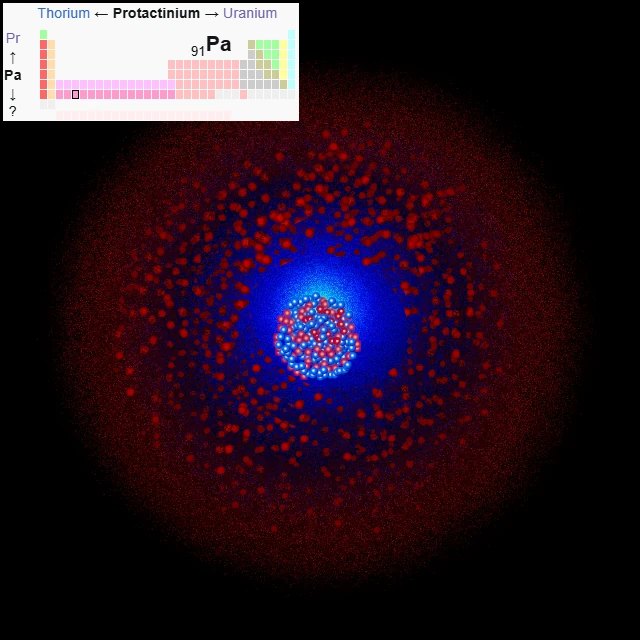
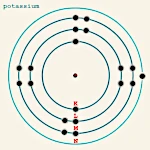
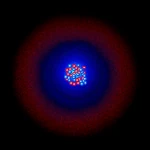
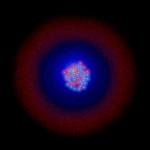
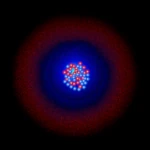
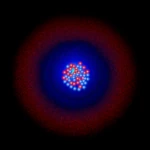
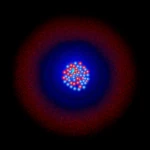
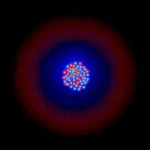
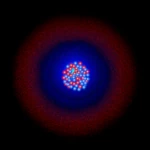
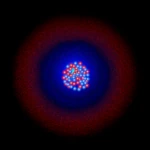
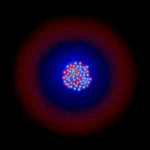
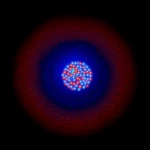
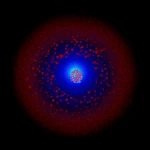
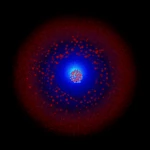
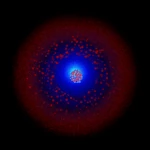
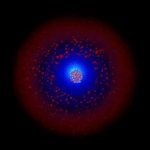
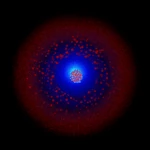
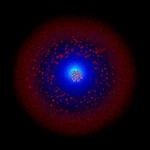
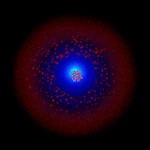
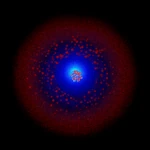
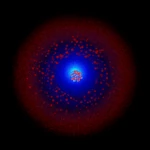
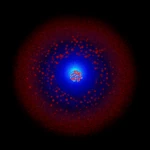
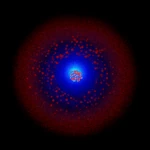
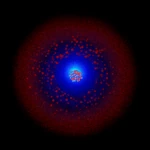
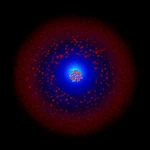
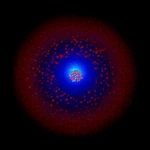
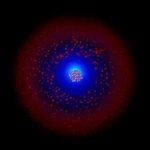
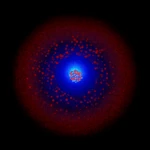
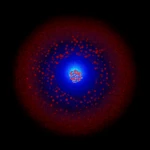
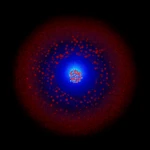
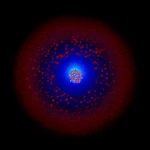
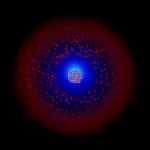
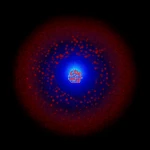
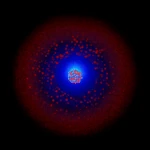
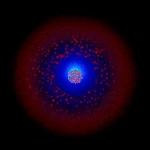
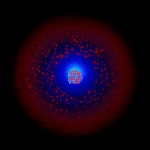
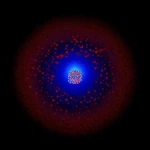
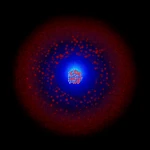
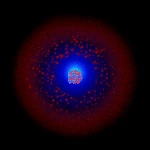
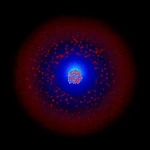
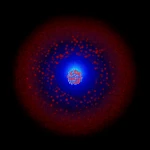
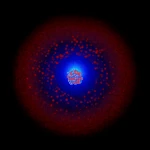
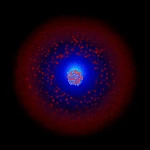
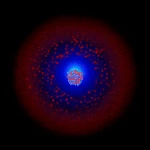
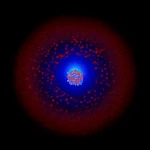
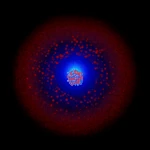
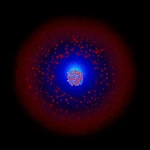
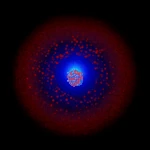
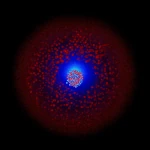
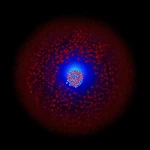
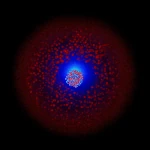
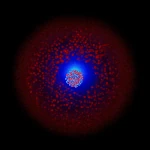
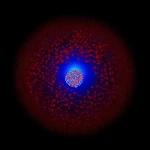
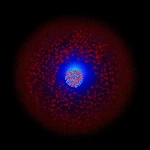
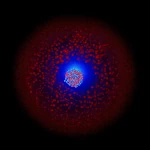
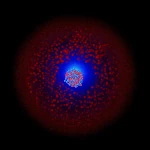
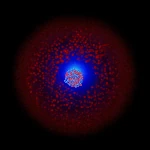
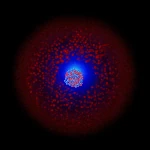
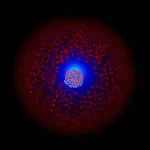
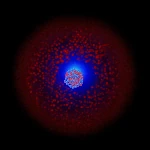
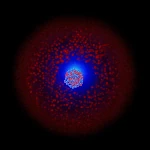
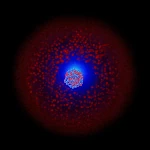
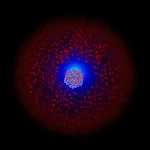
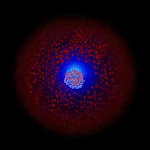
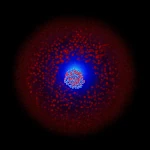
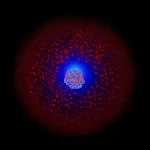
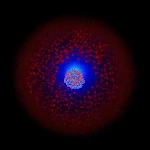
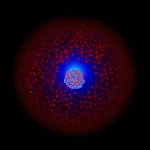
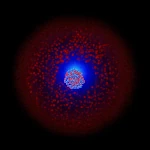
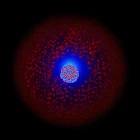
Simplified atomic model of the protactinium atom.
The most stable isotope is \(\,^{231}\mathrm{Pa}\,\) with its 91 protons, 91 electrons, and 140 neutrons.
Image source: astronoo.com (new window)
Role in Astrophysics and Cosmochemistry
Protactinium is not synthesized in significant quantities in stars. Like all heavy actinides, its formation is linked to extreme astrophysical processes such as the r-process (rapid neutron capture) during neutron star mergers or supernova explosions. In the solar system, its existence is fleeting and dependent on the decay chains of longer-lived parent elements. The isotope \(\,^{231}\mathrm{Pa}\) (half-life of 32,760 years) is a key link in the decay chain of uranium-235. Its presence in trace amounts in uranium minerals and marine sediments serves as a powerful geochronological tool. The \(\,^{231}\mathrm{Pa}\)/\(\,^{235}\mathrm{U}\) ratio is used to date geological processes on timescales of 10,000 to 300,000 years, complementing the thorium-230/uranium-238 pair.
History of the Discovery of Protactinium
The history of protactinium is marked by its fleeting nature. In 1913, physicists Kasimir Fajans (1887-1975) and Oswald Helmuth Göhring (1889-1915) discovered a new short-lived element in the decay chain of uranium-238. They named it "brevium" (from the Latin brevis, short) in reference to its short half-life (1.17 minutes for the isotope 234mPa). However, the true element 91, with a longer-lived isotope, was isolated later. In 1917-1918, two groups of scientists discovered it independently: Lise Meitner (1878-1968) and Otto Hahn (1879-1968) in Germany, and Frederick Soddy (1877-1956) and John Cranston (1891-1972) in the United Kingdom. They identified it in the uranium-235 chain and named it "protactinium" (from the Greek protos, first, and actinium), as it decays into actinium-227. It was not until 1934 that Aristid von Grosse (1905-1985) isolated 2 mg of pure protactinium oxide (Pa2O5) from 5.6 tons of pitchblende, a feat of radiochemistry.
N.B.:
Protactinium is one of the last natural elements to be discovered: for decades, it was the rarest and most expensive natural element in the world. Before the 1960s, global stocks did not exceed a few hundred grams, obtained from the reprocessing of tons of uranium residues. Its price was astronomical. It was only with the advent of large-scale nuclear industry and the processing of massive amounts of spent fuel that kilograms of protactinium could be isolated.
Structure and Fundamental Properties of Protactinium
Protactinium (symbol Pa, atomic number 91) is an actinide, located between thorium and uranium. It is a dense, malleable metal, silvery-gray in color, which slowly tarnishes in air by forming a protective oxide. It has a complex crystalline structure (body-centered tetragonal at room temperature). Its chemistry is particularly rich and complex for an early actinide, mainly exhibiting the +5 oxidation state (Pa5+), but also the +4 (Pa4+) stably, and sometimes +3 in certain compounds. This duality makes it unique among its immediate neighbors. All its isotopes are radioactive.
Density: 15.37 g/cm³.
Melting point: ≈ 1841 K (1568 °C).
Boiling point: ≈ 4300 K (≈ 4027 °C, estimate).
Table of Significant Protactinium Isotopes
| Isotope / Notation | Protons (Z) | Neutrons (N) | Atomic Mass (u) | Natural Abundance | Half-life / Stability | Main Decay Mode / Remarks |
|---|---|---|---|---|---|---|
| Protactinium-231 — \(\,^{231}\mathrm{Pa}\,\) | 91 | 140 | 231.035884 u | Trace (in uranium-235) | 32,760 years | α (100%). Most stable natural isotope. Crucial link in the 235U chain. Geological dating tool (231Pa/235U ratio). |
| Protactinium-234m — \(\,^{234m}\mathrm{Pa}\) | 91 | 143 | 234.043308 u | Trace (in uranium-238) | 1.17 minutes | β– (99.84%) and IT (0.16%). Metastable isomer. Daughter of uranium-238 via thorium-234. First discovered ("brevium"). |
| Protactinium-233 — \(\,^{233}\mathrm{Pa}\) | 91 | 142 | 233.040247 u | Not natural (synthetic) | 26.967 days | β– (100%). Key isotope in the thorium cycle. Produced by neutron capture on 232Th. Decays into fissile uranium-233. |
| Protactinium-230 — \(\,^{230}\mathrm{Pa}\) | 91 | 139 | 230.034541 u | Not natural (synthetic) | 17.4 days | β– and ε. Produced in accelerators. Studies of fundamental chemistry and nuclear properties. |
Electronic Configuration and Complex Chemistry of Protactinium
N.B.:
Electron shells: How electrons organize around the nucleus (new window).
Protactinium has 91 electrons. Its ground state electronic configuration is [Rn] 5f2 6d1 7s2. It is the first actinide where the 5f orbitals begin to be unambiguously populated in the ground state, marking a transition in the series. This configuration gives it a unique dual chemistry: it stably exhibits the +5 and +4 oxidation states, and to a lesser extent +3. In aqueous solution, Pa(V) is the most stable state, generally existing as the oxycation PaO2+. The Pa(IV) ion is stable in non-oxidizing environments. This duality makes its solution chemistry complex and highly dependent on redox potential and pH.
Solution Chemistry and Complexation
The chemistry of protactinium is dominated by its strong tendency to hydrolyze and form polynuclear or colloidal complexes, especially in the Pa(V) state. This makes its behavior in solution difficult to predict and experimentally manipulate. It forms stable complexes with anions such as fluorides, oxalates, and carbonates. The chemical separation of protactinium from other actinides (notably thorium, uranium, and neptunium) is a major challenge in radiochemistry, often exploiting subtle differences in the behavior of the +4 and +5 states, or the use of specific solvents such as methyl isobutyl ketone (MIBK).
Solid State and Compounds
In the solid state, protactinium mainly forms compounds in the +5 and +4 oxidation states. The white oxide Pa2O5 is the most stable. Mixed oxides (PaO2) and various halides (PaF5, PaCl4, PaBr4, etc.) also exist. Protactinium pentachloride (PaCl5) is a yellow solid used as a starting point for the synthesis of other compounds. The complexity of its solid-state chemistry reflects the richness of its transitional electronic configuration.
Applications of Protactinium
- Geochronology: The isotope 231Pa, with its half-life of 32,760 years, is an ideal radioactive chronometer for dating processes on scales of 10,000 to 300,000 years. The 231Pa/235U ratio is used in paleoceanography to date marine sediments, manganese nodules, and carbonates, allowing the reconstruction of past climates and currents.
- Thorium Cycle: The isotope 233Pa (half-life 27 days) is a crucial intermediate in the production of fissile uranium-233 from fertile thorium-232. Managing this "neutron poison" in a thorium reactor is an important design parameter.
- Fundamental Research in Radiochemistry: Protactinium is a privileged subject of study to understand the behavior of early actinides, the transition to 5f orbital chemistry, and the mechanisms of complexation and hydrolysis of heavy elements in solution.
- Radioactive Standard: In highly controlled and purified quantities, 231Pa can serve as a standard for calibrating alpha and gamma detectors in nuclear metrology.
Production and Availability
Protactinium does not exist in exploitable deposits. It is always produced as a byproduct of uranium extraction and processing. It concentrates in the residues (tailings) of uranium ore processing plants. The most important source for obtaining weighable quantities (on the order of grams to kilograms) is the reprocessing of spent nuclear fuels, where it accumulates as a fission and activation product. Isolating protactinium from these complex matrices is a long and costly process, involving a succession of precipitation, solvent extraction, and ion chromatography steps. There is no commercial market for protactinium; its production is solely driven by scientific research or specific technological development needs. If commercialized, its cost would be extremely high.
Safety and Radioprotection Aspects
Protactinium is a highly radioactive and toxic element. The isotope 231Pa, the most relevant in the long term, is a pure alpha emitter. As with other alpha emitters, the main danger is internal incorporation (inhalation, ingestion). Once in the body, it preferentially accumulates in the bones (chemical behavior similar to that of actinium and thorium), where its alpha decay irradiates bone marrow cells in a highly localized and damaging manner, significantly increasing the risk of cancer. Its handling, even in trace amounts, absolutely requires controlled atmosphere facilities (glove boxes or shielded cells) to prevent any contamination of the operator or the environment. Storage is done in chemically stable form (usually oxide or insoluble salt) in sealed and shielded containers.
 The energies required for nuclear fusion and why uranium is a limit
 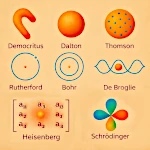 The Atom in All Its Forms: From Ancient Intuition to Quantum Mechanics