

Copper (Z=29): A Conductive Metal with Remarkable Properties
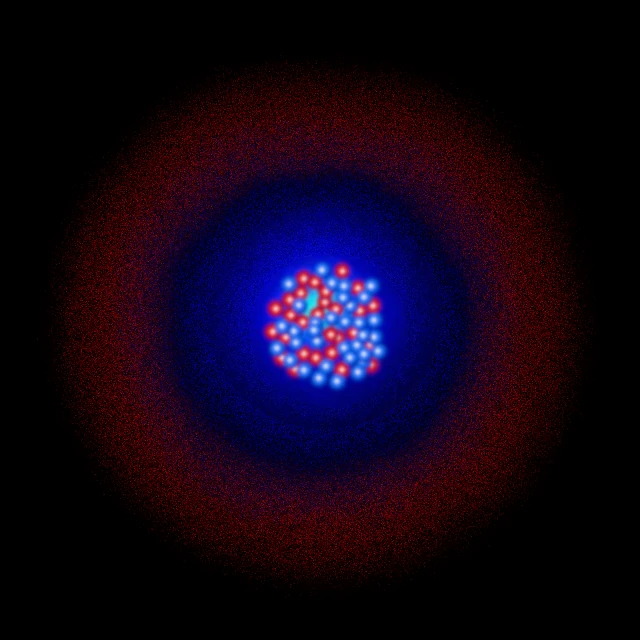
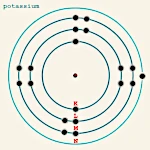
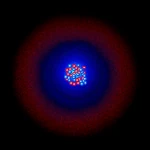
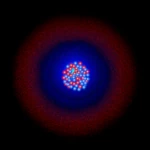
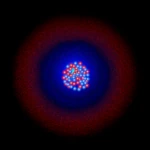
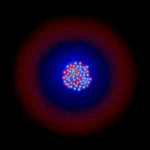
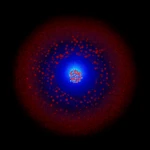
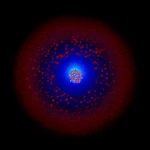
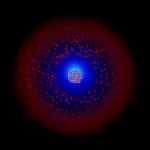
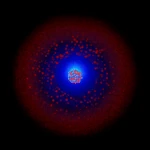
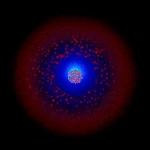
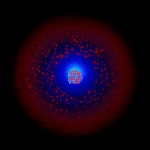
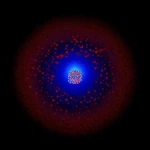
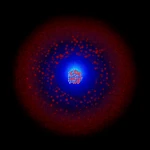
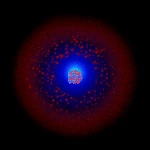
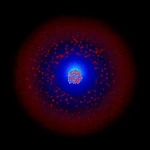
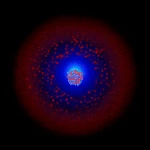
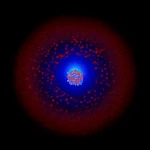
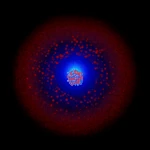
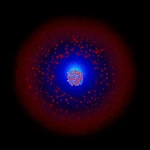
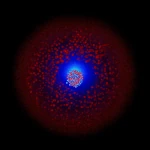
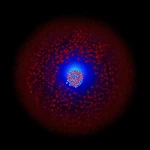
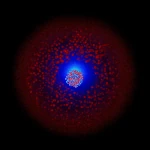
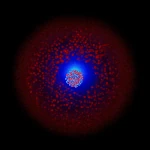
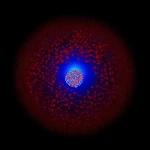
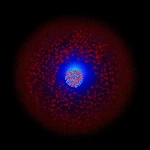
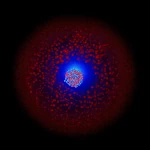
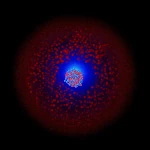
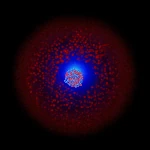
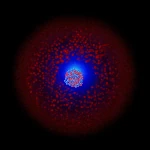
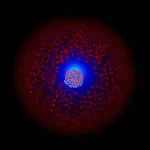
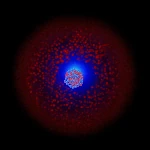
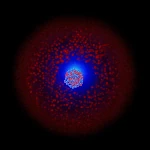
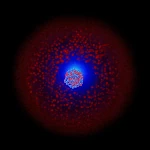
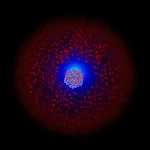
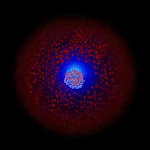
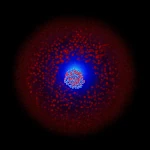
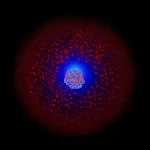
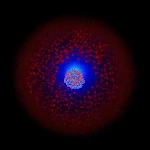
Simplified atomic model of the copper atom.
The most abundant isotope is \(\,^{63}\mathrm{Cu}\,\) with its 29 protons, 29 electrons, and 34 neutrons.
Image source: astronoo.com (new window) — AI-generated image, public domain.
History of the Discovery of Copper
Copper is one of the first metals used by humanity, known since prehistoric times. Its use dates back more than 10,000 years, with the earliest traces of native copper objects found in the Middle East around 8,700 BC. Around 5,000 BC, Mesopotamian civilizations began extracting copper by smelting ores, marking the beginning of metallurgy. The Bronze Age (around 3,300 BC) began when artisans discovered that alloying copper with tin produced a harder and more resistant metal: bronze. The name copper comes from the Latin cuprum, itself derived from Cyprium aes, meaning "metal of Cyprus," as the island of Cyprus was a major source of copper in antiquity. Its chemical symbol Cu also comes from this Latin name.
Structure and Fundamental Properties
Copper (symbol Cu, atomic number 29) is a transition metal in group 11 of the periodic table.
Its atom has 29 protons, usually 34 neutrons (for the most abundant isotope \(\,^{63}\mathrm{Cu}\)) and 29 electrons with the electronic configuration [Ar] 3d¹⁰ 4s¹.
At room temperature, copper is a solid metal with a characteristic reddish-orange color, relatively dense (density ≈ 8.96 g/cm³).
It has the second-best electrical conductivity of all metals (after silver) and excellent thermal conductivity.
Copper is also very malleable and ductile, allowing it to be easily shaped into wires and sheets.
The melting point of copper (liquid state): 1,357.77 K (1,084.62 °C).
The boiling point of copper (gaseous state): 2,835 K (2,562 °C).
Table of Copper Isotopes
| Isotope / Notation | Protons (Z) | Neutrons (N) | Atomic Mass (u) | Natural Abundance | Half-Life / Stability | Decay / Remarks |
|---|---|---|---|---|---|---|
| Copper-63 — \(\,^{63}\mathrm{Cu}\,\) | 29 | 34 | 62.929597 u | ≈ 69.15 % | Stable | Dominant isotope of natural copper. |
| Copper-65 — \(\,^{65}\mathrm{Cu}\,\) | 29 | 36 | 64.927789 u | ≈ 30.85 % | Stable | Second stable isotope of copper. |
| Copper-64 — \(\,^{64}\mathrm{Cu}\,\) | 29 | 35 | 63.929764 u | Synthetic | ≈ 12.7 hours | Radioactive, used in nuclear medicine for PET imaging and radiotherapy. |
| Copper-67 — \(\,^{67}\mathrm{Cu}\,\) | 29 | 38 | 66.927730 u | Synthetic | ≈ 61.83 hours | Radioactive, used in targeted radiotherapy against certain cancers. |
Electronic Configuration and Electron Shells of Copper
N.B.:
Electron shells:
How electrons are organized around the nucleus (new window).
Copper has 29 electrons distributed over four electron shells. Its full electronic configuration is: 1s² 2s² 2p⁶ 3s² 3p⁶ 3d¹⁰ 4s¹, or simplified: [Ar] 3d¹⁰ 4s¹. This configuration can also be written as: K(2) L(8) M(18) N(1).
Detailed Structure of the Shells
K Shell (n=1): contains 2 electrons in the 1s subshell. This inner shell is complete and very stable.
L Shell (n=2): contains 8 electrons distributed as 2s² 2p⁶. This shell is also complete, forming a noble gas configuration (neon).
M Shell (n=3): contains 18 electrons distributed as 3s² 3p⁶ 3d¹⁰. All orbitals in this shell are complete, which is unusual and gives copper its particular stability.
N Shell (n=4): contains only 1 electron in the 4s subshell. This single electron is easily involved in chemical bonding.
Valence Electrons and Oxidation States
The electron in the outer 4s¹ shell is the main valence electron of copper, although the 3d electrons can also participate in bonding. This configuration explains its chemical properties:
By losing the 4s electron, copper forms the Cu⁺ ion (oxidation state +1), called the cuprous ion, with a very stable 3d¹⁰ configuration.
By losing the 4s electron and one 3d electron, it forms the Cu²⁺ ion (oxidation state +2), called the cupric ion, the most common in aqueous solution.
Oxidation states +3 and +4 exist but are rare and unstable.
Chemical Reactivity
Copper is a relatively unreactive metal at room temperature. It does not react with pure water but slowly oxidizes in humid air, forming a green layer of copper carbonate called verdigris or patina (a mixture of Cu₂(OH)₂CO₃ and other compounds). This patina protects the underlying metal from further corrosion. Copper reacts with oxidizing acids such as nitric acid and hot concentrated sulfuric acid but resists non-oxidizing acids like dilute hydrochloric acid. At high temperatures, it reacts with oxygen to form black copper(II) oxide (CuO) or red copper(I) oxide (Cu₂O). Copper forms characteristic colored compounds: Cu²⁺ salts are generally blue or green in aqueous solution.
Industrial and Technological Applications of Copper
- in the electrical industry for cables, conductive wires, and motor windings due to its excellent conductivity;
- for plumbing and heating systems due to its corrosion resistance and ease of use;
- in electronics for printed circuits, chips, and connectors;
- as an alloy in bronze (Cu-Sn) for sculptures, bells, and mechanical parts;
- as an alloy in brass (Cu-Zn) for fittings, musical instruments, and ammunition;
- for heat exchangers, radiators, and air conditioners exploiting its thermal conductivity;
- in roofing and architectural facades where it develops a protective green patina;
- for antimicrobial surfaces in hospitals and public places (handles, railings);
- in agriculture as a fungicide (Bordeaux mixture based on copper sulfate);
- for the manufacture of coins and medals since antiquity;
- in electric motors and generators requiring high efficiency;
- as a catalyst in various industrial chemical reactions;
- for antennas and waveguides in telecommunications;
- in photovoltaic solar panels as a conductor;
- as an essential dietary supplement for human and animal health, involved in many enzymatic processes.
Role in Astrophysics and Cosmology
Copper is mainly synthesized in massive stars during different phases of nuclear fusion and especially during supernova explosions. It forms through the silicon burning process in massive stars at the end of their lives, as well as through neutron capture (s-process and r-process). The stable isotopes \(\,^{63}\mathrm{Cu}\) and \(\,^{65}\mathrm{Cu}\) are produced during these cataclysmic events and are then dispersed into the interstellar medium.
The abundance of copper in ancient stars and meteorites provides clues about the chemical enrichment of the galaxy over time. The isotopic ratio ⁶³Cu/⁶⁵Cu varies slightly depending on cosmic sources and can serve as a tracer to understand the history of nucleosynthesis. The spectral lines of neutral and ionized copper (Cu I, Cu II) are used in stellar spectroscopy to determine the chemical composition and age of stars. Although less abundant than iron or nickel in the universe, copper plays an important role in our understanding of stellar and galactic evolution.
N.B.:
Copper is present in the Earth's crust at a concentration of about 0.0068% by mass, making it a relatively common element.
It is mainly found in ores such as chalcopyrite (CuFeS₂), chalcocite (Cu₂S), malachite (Cu₂CO₃(OH)₂), and azurite (Cu₃(CO₃)₂(OH)₂).
Native copper (pure) also exists in nature but is rare.
The extraction and refining of copper are well-established and relatively economical processes compared to other metals, explaining its widespread use in modern industry.
Copper recycling is highly developed because the metal can be recycled indefinitely without loss of properties.
 The energies required for nuclear fusion and why uranium is a limit
 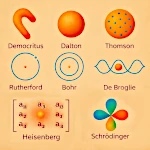 The Atom in All Its Forms: From Ancient Intuition to Quantum Mechanics