

Polonium (Po, Z = 84): The Element of Radioactivity and Danger
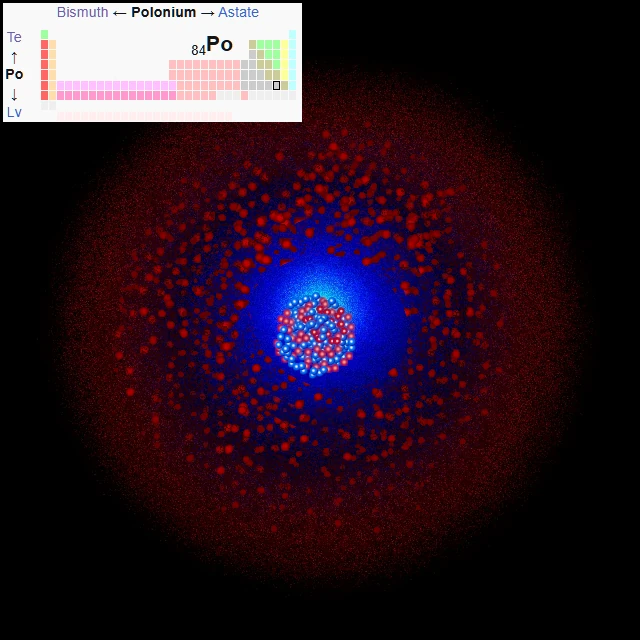
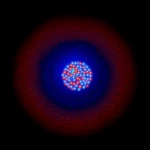
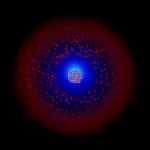
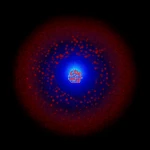
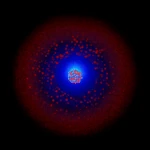
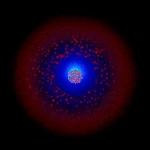
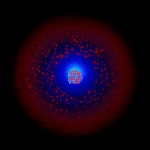
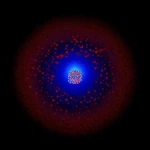
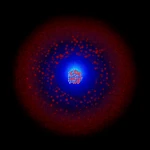
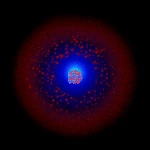
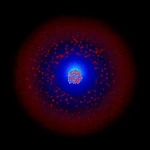
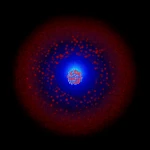
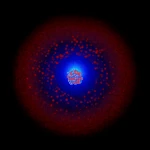
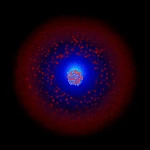
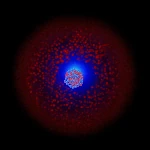
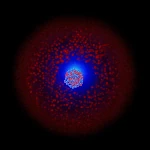
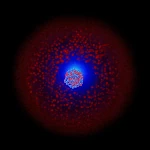
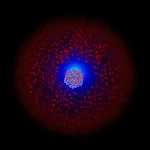
Image description:
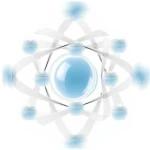
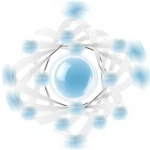
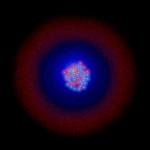
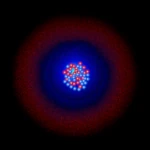
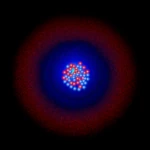
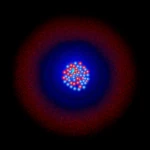
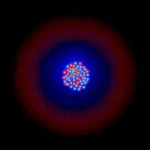
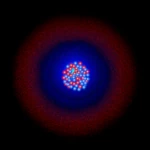
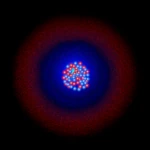
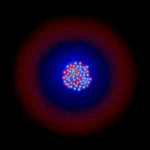
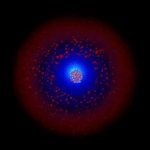
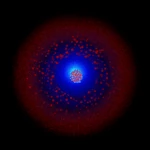
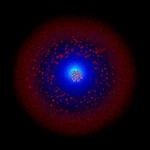
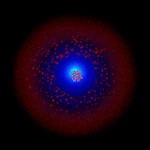
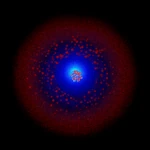
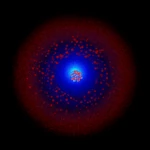
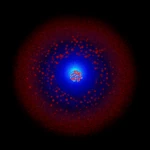
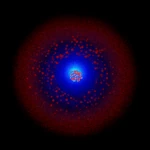
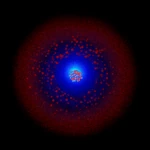
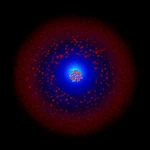
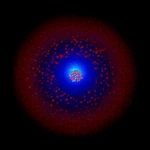
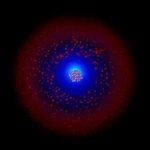
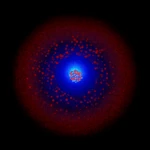
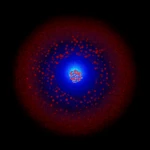
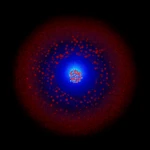
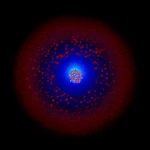
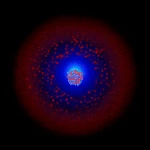
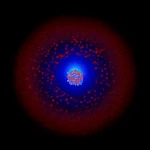
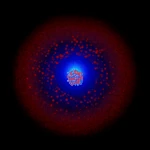
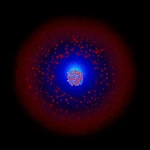
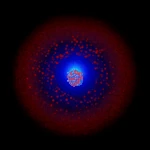
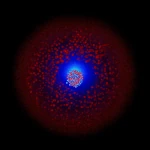
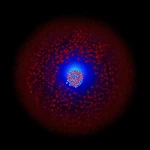
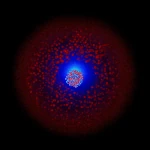
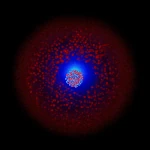
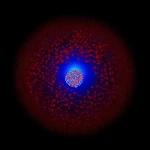
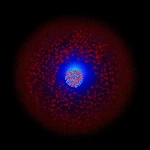
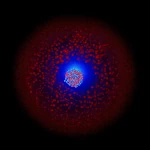
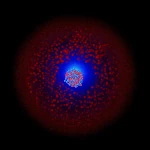
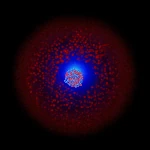
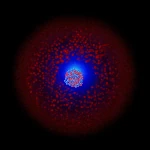
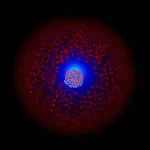
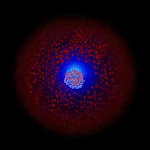
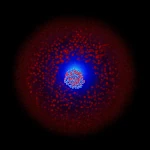
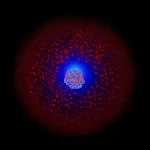
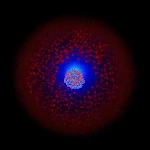
Simplified atomic model of the polonium atom. The most well-known isotope is \(^{210}\mathrm{Po}\)
with its 84 protons, 84 electrons, and 126 neutrons. Background showing radioactive danger symbols and the portrait of Marie Curie.
Image source: astronoo.com (new window)
Role of Polonium in Astrophysics and Radiochronology
A transient element of nucleosynthesis
Polonium is a heavy element produced exclusively by the r-process (rapid neutron capture) during explosive events such as supernovae or neutron star mergers. Due to its radioactive isotopes and relatively short half-lives (the longest, \(^{209}\mathrm{Po}\), has a half-life of only 125.2 years), there is virtually no primordial polonium in the universe. Any polonium present at the formation of the solar system has long since decayed. The polonium found on Earth today is either artificial or results from the decay of uranium and thorium in natural radioactive chains.
Member of natural decay series
Several isotopes of polonium appear as intermediate products in the four primordial radioactive decay chains:
- In the uranium-238 chain (4n+2): \(^{218}\mathrm{Po}\) (Radium A, half-life 3.10 minutes) and \(^{214}\mathrm{Po}\) (Radium C', half-life 164.3 µs).
- In the thorium-232 chain (4n): \(^{216}\mathrm{Po}\) (Thoron A, half-life 0.145 s) and \(^{212}\mathrm{Po}\) (Thorium C', half-life 0.299 µs).
- In the uranium-235 chain (4n+3) or actinium: \(^{215}\mathrm{Po}\) (Actinium A, half-life 1.78 ms) and \(^{211}\mathrm{Po}\) (Actinium C', half-life 0.516 s).
These very short-lived isotopes are constantly produced and disappear in uranium- and thorium-containing minerals, contributing to natural radioactivity. \(^{210}\mathrm{Po}\) (Radium F), with a half-life of 138.376 days, is the longest-lived member of the uranium-238 chain and can accumulate in measurable quantities.
Tracer in geochemistry and oceanography
\(^{210}\mathrm{Po}\) is used as a natural tracer in Earth sciences. Produced by the decay of radon-222 (gas) in the atmosphere, it deposits on terrestrial and oceanic surfaces. Its ratio with its longer-lived "parent," \(^{210}\mathrm{Pb}\) (half-life 22.3 years), allows dating of recent marine sediments (over a few hundred years), studying ocean mixing processes, bioproductivity, and particle transport in the atmosphere.
History of the Discovery of Polonium
Etymology and origin of the name
Polonium was named by its discoverers, Marie and Pierre Curie, in 1898, in homage to Marie's native Poland (then partitioned between the Russian Empire, Austria-Hungary, and Prussia). It was a patriotic and political act, intended to draw attention to the cause of Polish independence, as the country no longer existed on maps. It was the first element named after a country.
Discovery by the Curies
While studying the radioactivity of pitchblende (a uranium ore), Marie Curie noticed that it was higher than could be explained by the uranium content alone. She and her husband Pierre undertook the titanic task of chemical purification of tons of ore. In July 1898, they announced the discovery of a new element, which they named polonium. They characterized it by its intense radioactivity and chemical similarity to bismuth. A few months later, they would discover radium, which was even more radioactive. These discoveries earned them the Nobel Prize in Physics in 1903 (shared with Henri Becquerel).
First isolations and study
Isolating polonium in weighable quantities was extremely difficult due to its low abundance and high radioactivity. It was only after many years of processing ores that microscopic amounts of pure polonium salts were obtained. The first observation of the polonium spectrum was made in 1910. Gram-scale production only became possible with the development of nuclear reactors.
Modern production
Today, polonium-210 is produced artificially in two main ways:
- Neutron irradiation of bismuth-209: In a nuclear reactor, bismuth-209 captures a neutron to become bismuth-210, which decays by beta emission with a half-life of 5.012 days into polonium-210: \(^{209}\mathrm{Bi}(n,\gamma)^{210}\mathrm{Bi} \xrightarrow[\beta^-]{} ^{210}\mathrm{Po}\).
- Chemical separation from radium compounds or uranium ore processing waste (historical method).
Global production is very low, on the order of a few hundred grams per year, mainly in Russia. Its cost is extremely high (hundreds of thousands of dollars per gram for high-purity \(^{210}\mathrm{Po}\)), due to the complexity of its production and separation, and the associated risks.
Structure and Fundamental Properties of Polonium
Classification and atomic structure
Polonium (symbol Po, atomic number 84) is a post-transition metal, located in group 16 (oxygen group or chalcogens) of the periodic table, along with oxygen, sulfur, selenium, tellurium, and livermorium. It is the only element in this group that is a metal (at room temperature). Its atom has 84 protons and, depending on the isotope, 122 to 136 neutrons. The isotope \(^{210}\mathrm{Po}\) has 126 neutrons. Its electronic configuration is [Xe] 4f¹⁴ 5d¹⁰ 6s² 6p⁴, with six valence electrons (6s² 6p⁴).
Physical and radioactive properties
Polonium is a silvery-gray, soft metal, chemically similar to its cousins tellurium and bismuth.
- Intense alpha radioactivity: This is its most striking property. \(^{210}\mathrm{Po}\) emits 5.3 MeV alpha particles with a half-life of 138.376 days. One gram of \(^{210}\mathrm{Po}\) releases about 140 watts of thermal power, making it warm to the touch.
- Decay heat: The specific power is so high that a mass of polonium can reach temperatures of several hundred degrees Celsius, partially melting or damaging its supports.
- High density: 9.32 g/cm³ for the alpha form.
- Low melting point: 254 °C.
- Boiling point: 962 °C.
- Allotropy: Two main allotropic forms: the alpha form (simple cubic) and the beta form (rhombohedral), with a transition at about 75°C.
Its intense radioactivity quickly damages its crystalline structure and causes self-irradiation.
Transformation points
Polonium melts at 254 °C (527 K) and boils at 962 °C (1235 K). Its decay heat can distort these measurements for macroscopic samples.
Chemical reactivity
Chemically, polonium is a fairly reactive metal, similar to tellurium. It dissolves in acids to form Po(IV) solutions (pink) and oxidizes easily in air. It forms compounds in oxidation states -2, +2, +4, and +6, with +4 being the most stable. Its compounds are often colored (e.g., PoCl₄ is yellow, PoBr₄ is red). However, studying its chemistry is extremely difficult and dangerous due to its intense radioactivity.
Summary of physical characteristics of polonium
Density (α-Po): 9.32 g/cm³.
Melting point: 527 K (254 °C).
Boiling point: 1235 K (962 °C).
Crystal structure (α): Simple cubic (unique among elements).
Electronic configuration: [Xe] 4f¹⁴ 5d¹⁰ 6s² 6p⁴.
Main oxidation state: +4.
Table of Polonium Isotopes (main)
| Isotope / Notation | Protons (Z) | Neutrons (N) | Atomic mass (u) | Natural abundance | Half-life / Decay mode | Remarks / Applications |
|---|---|---|---|---|---|---|
| Polonium-208 — \(^{208}\mathrm{Po}\) | 84 | 124 | 207.981246 u | Trace (radiogenic) | 2.898 years (α) | Medium-lived isotope, present in the thorium chain. Can be produced artificially. |
| Polonium-209 — \(^{209}\mathrm{Po}\) | 84 | 125 | 208.982430 u | Trace (radiogenic) | 125.2 years (α, 99.99%; CE, 0.001%) | Isotope with the longest natural half-life. Mainly produced by α decay of \(^{213}\mathrm{Bi}\). |
| Polonium-210 — \(^{210}\mathrm{Po}\) | 84 | 126 | 209.982874 u | Trace (radiogenic) | 138.376 days (α) | The most important and well-known isotope. Intense alpha radioactivity (5.3 MeV). Used in antistatic sources, thermoelectric generators, and infamously as a poison. Produced from \(^{209}\mathrm{Bi}\) by neutron irradiation. |
Electronic Configuration and Electron Shells of Polonium
N.B.:
Electron shells:
How electrons are organized around the nucleus (new window).
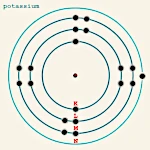
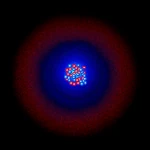
Polonium has 84 electrons distributed over six electron shells. Its electronic configuration [Xe] 4f¹⁴ 5d¹⁰ 6s² 6p⁴ has six valence electrons in the 6th shell (s² p⁴). This can also be written as: K(2) L(8) M(18) N(32) O(18) P(6), or in full: 1s² 2s² 2p⁶ 3s² 3p⁶ 3d¹⁰ 4s² 4p⁶ 4d¹⁰ 4f¹⁴ 5s² 5p⁶ 5d¹⁰ 6s² 6p⁴.
Detailed Structure of Polonium Shells
K shell (n=1): 2 electrons (1s²).
L shell (n=2): 8 electrons (2s² 2p⁶).
M shell (n=3): 18 electrons (3s² 3p⁶ 3d¹⁰).
N shell (n=4): 32 electrons (4s² 4p⁶ 4d¹⁰ 4f¹⁴).
O shell (n=5): 18 electrons (5s² 5p⁶ 5d¹⁰).
P shell (n=6): 6 electrons (6s² 6p⁴).
Valence Electrons and Oxidation States
Polonium has 6 valence electrons (6s² 6p⁴). Its chemistry resembles that of tellurium, but with a greater tendency toward lower oxidation states due to the onset of the inert pair effect. The main oxidation states are:
- Polonium(IV) (Po⁴⁺): The most stable state, analogous to Te(IV). Forms compounds such as dioxide (PoO₂) and tetrachloride (PoCl₄).
- Polonium(II) (Po²⁺): Exists in some compounds but is unstable and reducing.
- Polonium(VI) (Po⁶⁺): Rare and highly oxidizing, as in trioxide (PoO₃) and polonates(VI) (PoO₄²⁻).
- Polonium(-II): As polonide (Po²⁻), in compounds with highly electropositive metals (e.g., Na₂Po).
The chemistry of polonium is poorly explored due to the extreme dangers associated with its handling.
Chemical Reactivity of Polonium
Reaction with air and oxygen
Polonium metal oxidizes rapidly in air to form polonium dioxide (PoO₂), a yellow solid. When heated in air, it can form mixed oxides.
Reaction with water and acids
- Water: Reacts slowly.
- Acids: Dissolves in most acids. With hydrochloric acid, it can form tetrachloride (PoCl₄). Nitric acid oxidizes it to Po(IV) solutions.
Important compounds
Very few polonium compounds have been prepared and studied in detail, always in minute quantities and with extreme precautions.
- Polonium dioxide (PoO₂): The most stable form.
- Polonium tetrachloride (PoCl₄): Yellow solid, volatile and hygroscopic.
- Polonium dihydride (PoH₂): Highly unstable and radioactive gas, analogous to H₂Te.
- Polonides: Compounds with alkali metals (e.g., Na₂Po), highly unstable.
Industrial and Technological Applications of Polonium
- As an intense alpha particle source for nuclear physics research and detector calibration;
- In neutron sources: Mixed with beryllium (α + Be → n), it produces a neutron flux for starting nuclear reactors, neutron activation analysis, or as a portable source (historical and military use);
- As a heat source in radioisotope thermoelectric generators (RTG) for satellites and space probes (historical use, replaced by \(^{238}\mathrm{Pu}\));
- In antistatic sources to eliminate static electricity in the textile, paper, photography, and semiconductor industries (air ionization by alpha particles);
- As an alpha ion source in ionization devices for smoke detectors (very marginal use today, replaced by americium-241);
- As a target for the production of rare isotopes in nuclear physics;
- In research on the properties of heavy metals and actinide chemistry (as a safer chemical analogue for certain elements, although radioactive);
- Notorious use as a poison: Due to its high radioactive toxicity and difficulty of detection (case of former spy Alexander Litvinenko in 2006).
Key Applications: Neutron Sources and Thermoelectric Generators
Neutron sources (Po-Be)
When a high-energy alpha particle (such as that from \(^{210}\mathrm{Po}\)) strikes a beryllium-9 nucleus, a nuclear reaction occurs: \(^9\mathrm{Be} + \alpha \rightarrow \,^{12}\mathrm{C} + n\). This reaction produces a neutron. Polonium-beryllium (Po-Be) sources were therefore portable neutron sources, used:
- For starting nuclear reactors ("priming" source).
- In oil prospecting (neutron logging).
- In neutron activation analysis.
- In nuclear weapons as initiators (historical).
However, the short half-life of \(^{210}\mathrm{Po}\) (138 days) made these sources impractical, requiring frequent replacement. They have been largely replaced by sources using americium-241 or californium-252.
Radioisotope thermoelectric generators (RTG)
The intense decay of \(^{210}\mathrm{Po}\) releases a large amount of heat (140 W/g). This heat can be converted into electricity using thermocouples (Seebeck effect). Polonium-210 was used in some of the first RTGs developed by the Soviets to power equipment in remote locations (beacons, weather stations). However, its short half-life resulted in a rapid decrease in power. For long-duration space missions, it was abandoned in favor of plutonium-238 (half-life 87.7 years).
Toxicology, Radiation Protection, and Hazards
Extreme radioactive toxicity
Polonium-210 is one of the most toxic substances known. Its danger stems from several factors:
- High-energy alpha emission (5.3 MeV): Alpha particles have a very high cell-destroying power but low penetrating power (stopped by a sheet of paper or the outer layer of skin). The danger is therefore mainly from internal contamination (ingestion, inhalation, injury).
- Short half-life: An enormous specific activity (166 TBq/g), meaning that a very small number of atoms can deliver a lethal dose.
- Biological distribution: Once in the body, polonium behaves like its chemical analogue, tellurium. It distributes throughout the body, but with a particular affinity for the liver, kidneys, spleen, and bone marrow. Above all, it concentrates in rapidly renewing tissues.
Lethal dose and symptoms
The median lethal dose (LD50) for humans by ingestion is estimated at only 1 microgram (1 µg) of \(^{210}\mathrm{Po}\), or an activity of about 11 GBq.
Symptoms of acute poisoning (as in the Litvinenko case) appear after a few days and include:
- Nausea, vomiting, abdominal pain.
- Hair loss (alopecia).
- Bone marrow failure (decrease in white blood cells, red blood cells, and platelets) leading to infections and bleeding.
- Liver and kidney damage.
- Death within a few weeks, usually from multi-organ failure or sepsis.
Detection and treatment
Difficult detection: Polonium-210 does not emit significant gamma radiation (only a weak gamma at 803 keV in 0.001% of decays). Direct detection requires a special alpha counter or measurement of radioactivity in excreta (urine, feces). Diagnosis is often delayed.
Limited treatment: There is no specific antidote. Treatment is symptomatic (transfusions, growth factors, antibiotics) and aims to eliminate polonium:
- Chelation: Dimercaptopropane sulfonic acid (DMPS) and Prussian blue (ferric ferrocyanide) have shown some effectiveness in increasing excretion if administered very early.
- Avoiding contamination: Prevention is paramount. Handling requires glove boxes under an inert atmosphere, with appropriate ventilation and shielding.
Environmental contamination
Polonium-210 is naturally present in trace amounts everywhere (soil, water, air) due to decay chains. Higher concentrations are found in uranium ores, phosphate fertilizers (containing uranium), and… tobacco smoke. Tobacco plants absorb polonium present in soils and fertilizers, and it concentrates in the leaves. Smoking is thus a significant source of internal exposure to \(^{210}\mathrm{Po}\) for smokers.
Management, Regulation, and Safety of Polonium
Strict control
Due to its extreme toxicity and potential for malicious use, polonium-210 is subject to very strict international controls. It is classified as a Category 1 radioactive material (the most dangerous) by the International Atomic Energy Agency (IAEA). Its trade, transport, and use are closely monitored. Facilities authorized to handle it must comply with exceptionally high nuclear safety and security standards.
Waste disposal
Waste containing polonium must be packaged to ensure long-term containment, given its 138-day half-life. After a few years of storage in suitable containers, the activity has decreased significantly. The waste is then managed like other short-lived medium-activity radioactive waste.
Outlook
Civilian applications of polonium are today very limited and declining, replaced by other safer or more practical radioisotopes (Am-241, Pu-238, Cf-252). Its main interest remains:
- Fundamental research in the chemistry of heavy elements and nuclear physics.
- A historical reminder of the heroic and dangerous beginnings of radiochemistry.
- A textbook case in radiological toxicology and nuclear safety.
Polonium will forever be associated with the genius and courage of Marie Curie, as well as the sinister shadow of its deadly toxicity.
 The energies required for nuclear fusion and why uranium is a limit
 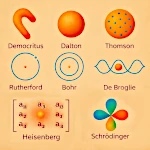 The Atom in All Its Forms: From Ancient Intuition to Quantum Mechanics