

Holmium (Ho, Z = 67): The Magnetic Atom of Medical Lasers

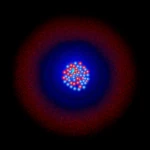
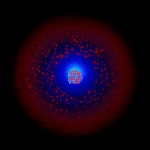
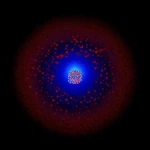
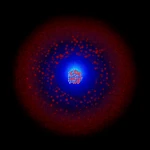
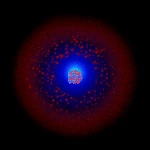
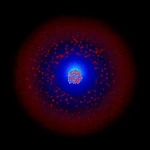
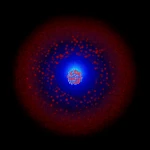
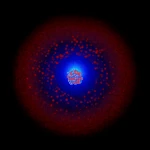
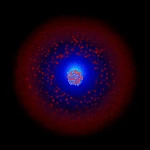
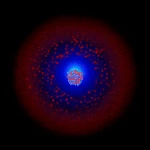
Image description:
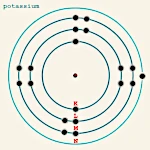
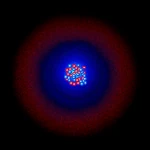
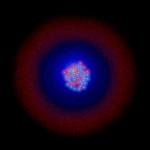
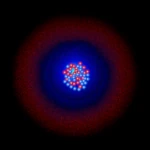
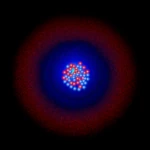
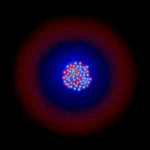
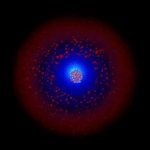
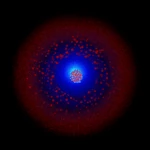
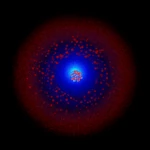
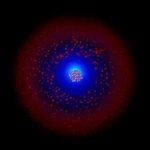
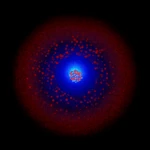
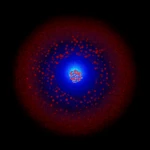
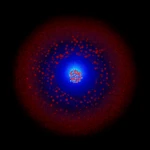
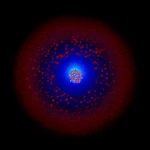
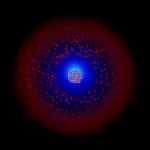
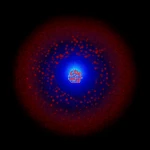
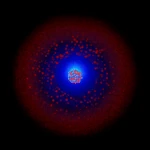
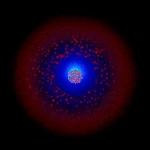
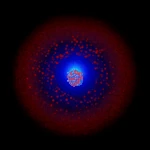
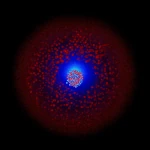
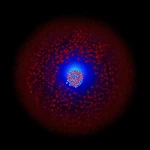
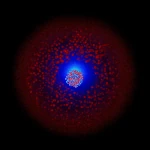
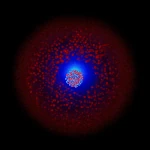
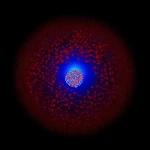
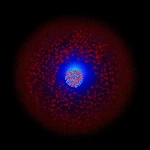
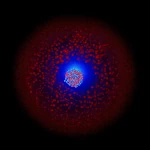
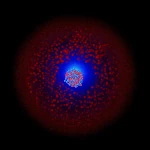
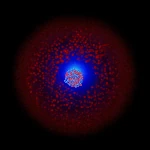
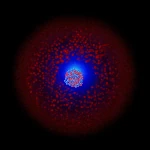
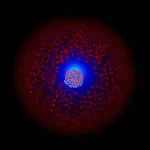
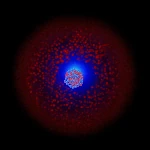
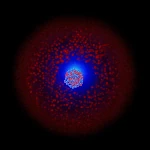
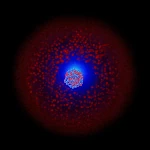
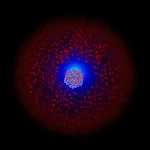
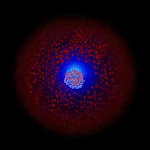
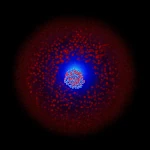
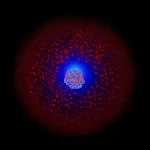
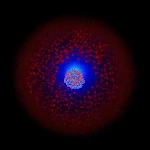
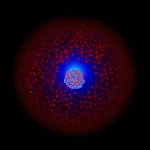
Simplified atomic model of the holmium atom. The only stable isotope is \(\,^{165}\mathrm{Ho}\,\)
with its 67 protons, 67 electrons, and 98 neutrons.
Image source: astronoo.com (new window)
Role of Holmium in Astrophysics and Cosmology
Stellar synthesis of holmium
Holmium is synthesized in stars mainly through the s-process (slow neutron capture) occurring in low- to medium-mass AGB stars (asymptotic giant branch), with a significant contribution from the r-process (rapid neutron capture) during explosive events such as supernovae. Nucleosynthesis models estimate that about 65-75% of solar holmium comes from the s-process, and 25-35% from the r-process. As a lanthanide with an odd number of protons (Ho, Z = 67), it is less abundant than its even-numbered neighbors (dysprosium-66 and erbium-68) according to the Oddo-Harkins rule.
Cosmic abundance and characteristics
The cosmic abundance of holmium is about 5.0×10⁻¹³ times that of hydrogen in number of atoms, making it about 4 times less abundant than dysprosium and one of the least abundant lanthanides along with thulium and lutetium. This relative rarity reflects both its position in the "valley" of heavy rare earth abundances and the fact that it has an odd number of protons, making it less stable and thus less produced in stellar nucleosynthesis processes.
Tracer of neutron capture processes
Holmium is used in astrophysics as an additional tracer to study the ratios between s- and r-processes. The holmium/europium (Ho/Eu) ratio provides complementary information to other lanthanide ratios. Since europium is almost exclusively produced by the r-process, a high Ho/Eu ratio indicates a greater contribution from the s-process. Holmium is also studied in s-process-rich stars (barium stars) to better constrain nucleosynthesis models in AGB stars.
Detection in stellar spectra
Detecting holmium in stellar atmospheres is difficult due to the weakness of its spectral lines, but it has been achieved in some stars using modern high-resolution, high signal-to-noise spectrographs. The lines of the Ho II ion are most commonly used for these analyses. Measured abundances of holmium in stars of different populations (halo, disk) help reconstruct the history of heavy rare earth nucleosynthesis in the Galaxy.
History of the Discovery of Holmium
Etymology and origin of the name
Holmium is named after Holmia, the Latin name for the city of Stockholm, capital of Sweden. This name was chosen to honor the hometown of several chemists who contributed to the discovery of rare earths, as well as the region where the Ytterby mine (source of many rare earths) is located. Like terbium, erbium, and ytterbium, the name recalls the Swedish origins of these discoveries.
Discovery by Marc Delafontaine and Jacques-Louis Soret
Holmium was discovered independently and almost simultaneously in 1878 by two groups of researchers. First, Swiss chemist Marc Delafontaine and Swiss physicist Jacques-Louis Soret observed unknown spectral lines in erbia (erbium oxide) samples and announced the discovery of a new element they called "Element X". Shortly thereafter, Swedish chemist Per Teodor Cleve in Uppsala, working on the same materials, independently isolated holmium and gave it its definitive name.
Work of Per Teodor Cleve
Per Teodor Cleve (1840-1905) is generally credited with the discovery of holmium because he succeeded in separating two new oxides from erbia: a brown one he named holmia (holmium oxide) and a green one he named thulia (thulium oxide). Cleve used repeated fractional crystallization methods and identified the distinct spectral properties of holmium. He demonstrated that it was indeed a new element and not an impurity of known erbium.
Purification and isolation
Isolating holmium in pure form was extremely difficult due to its great chemical similarity with other heavy rare earths, particularly dysprosium and erbium. It was only with the development of ion exchange techniques in the mid-20th century that high-purity holmium became available. The metal itself was first produced in 1911 by reducing holmium chloride with metallic sodium.
Terrestrial presence and production
Holmium is present in the Earth's crust at an average concentration of about 1.3 ppm (parts per million), making it one of the rarest lanthanides, comparable to terbium and thulium. It is about 4 times less abundant than dysprosium. The main ores containing holmium are bastnasite ((Ce,La,Nd,Ho)CO₃F) and monazite ((Ce,La,Nd,Ho,Th)PO₄), where it typically represents 0.05 to 0.1% of the total rare earth content, and xenotime (YPO₄) where it can be slightly more concentrated.
Global production of holmium oxide (Ho₂O₃) is about 10 tons per year, making it one of the least produced rare earths. Due to its rarity and high-value specialized applications, holmium is one of the most expensive rare earths, with typical prices ranging from 1,000 to 2,500 dollars per kilogram of oxide. China dominates production with over 90% of the global total.
Holmium metal is mainly produced by metallothermic reduction of holmium fluoride (HoF₃) with metallic calcium in an inert argon atmosphere. Global annual production of holmium metal is about 1 to 2 tons. Recycling of holmium is still very limited due to the small quantities used and the difficulty of recovering it from complex products, but it could gain importance with the development of medical and laser applications.
Structure and Fundamental Properties of Holmium
Classification and atomic structure
Holmium (symbol Ho, atomic number 67) is the eleventh element in the lanthanide series, belonging to the f-block rare earths of the periodic table. Its atom has 67 protons, 98 neutrons (for the only stable isotope \(\,^{165}\mathrm{Ho}\)) and 67 electrons with the electronic configuration [Xe] 4f¹¹ 6s². This configuration gives holmium exceptional magnetic properties.
Remarkable physical and magnetic properties
Holmium is a silvery, malleable, and relatively soft metal. It has a hexagonal close-packed (HCP) crystal structure at room temperature. Holmium has exceptional magnetic properties: it has the highest magnetic moment of all natural elements (10.6 μB). It is paramagnetic at room temperature and becomes antiferromagnetic below 132 K (-141 °C), then exhibits a complex helical magnetic structure below 20 K (-253 °C). At very low temperatures (below 20 K), it becomes ferromagnetic.
Transformation points and conductivity
Holmium melts at 1474 °C (1747 K) and boils at 2700 °C (2973 K). Like most lanthanides, it has high melting and boiling points. Holmium undergoes an allotropic transformation at 1425 °C where its crystal structure changes from hexagonal close-packed (HCP) to body-centered cubic (BCC). Its electrical conductivity is poor, about 20 times lower than that of copper. Holmium also exhibits giant magnetoresistance at low temperatures.
Chemical reactivity
Holmium is relatively stable in dry air at room temperature, but slowly oxidizes to form a yellowish-brown Ho₂O₃ oxide. It oxidizes more rapidly when heated and burns to form the oxide: 4Ho + 3O₂ → 2Ho₂O₃. Holmium reacts slowly with cold water and more rapidly with hot water to form holmium(III) hydroxide Ho(OH)₃ and release hydrogen. It dissolves easily in dilute mineral acids. The metal must be stored under mineral oil or in an inert atmosphere.
Thermal and magnetic characteristics (summary)
Melting point of holmium: 1747 K (1474 °C).
Boiling point of holmium: 2973 K (2700 °C).
Néel temperature (antiferromagnetic transition): 132 K (-141 °C).
Helical order transition temperature: 20 K (-253 °C).
Crystal structure at room temperature: Hexagonal close-packed (HCP).
Magnetic moment: 10.6 μB (the highest of the natural elements).
Table of Holmium Isotopes
| Isotope / Notation | Protons (Z) | Neutrons (N) | Atomic mass (u) | Natural abundance | Half-life / Stability | Decay / Remarks |
|---|---|---|---|---|---|---|
| Holmium-165 — \(\,^{165}\mathrm{Ho}\,\) | 67 | 98 | 164.930322 u | ≈ 100 % | Stable | Only natural stable isotope of holmium. Has the highest nuclear spin of all stable isotopes (7/2). |
| Holmium-163 — \(\,^{163}\mathrm{Ho}\,\) | 67 | 96 | 162.928736 u | Synthetic | ≈ 4,570 years | Radioactive (EC). Long-lived isotope used in fundamental research. |
| Holmium-166 — \(\,^{166}\mathrm{Ho}\,\) | 67 | 99 | 165.932281 u | Synthetic | ≈ 26.8 hours | Radioactive (β⁻). Beta and gamma emitter, used in nuclear medicine for radiotherapy. |
| Holmium-166m — \(\,^{166m}\mathrm{Ho}\,\) | 67 | 99 | 165.932281 u | Synthetic | ≈ 1,200 years | Metastable nuclear isomer. Intense gamma emitter, used in research and calibration. |
| Holmium-167 — \(\,^{167}\mathrm{Ho}\,\) | 67 | 100 | 166.933133 u | Synthetic | ≈ 3.1 hours | Radioactive (β⁻). Used in research and nuclear medicine. |
Electronic Configuration and Electron Shells of Holmium
N.B.:
Electron shells:
How electrons are organized around the nucleus (new window).
Holmium has 67 electrons distributed over six electron shells. Its electronic configuration [Xe] 4f¹¹ 6s² has eleven electrons in the 4f subshell. This configuration can also be written as: K(2) L(8) M(18) N(18) O(29) P(2), or in full: 1s² 2s² 2p⁶ 3s² 3p⁶ 3d¹⁰ 4s² 4p⁶ 4d¹⁰ 4f¹¹ 5s² 5p⁶ 6s².
Detailed Structure of the Shells
K shell (n=1): contains 2 electrons in the 1s subshell. This inner shell is complete and very stable.
L shell (n=2): contains 8 electrons distributed as 2s² 2p⁶. This shell is complete, forming a noble gas configuration (neon).
M shell (n=3): contains 18 electrons distributed as 3s² 3p⁶ 3d¹⁰. This complete shell contributes to electronic shielding.
N shell (n=4): contains 18 electrons distributed as 4s² 4p⁶ 4d¹⁰. This shell forms a stable structure.
O shell (n=5): contains 29 electrons distributed as 5s² 5p⁶ 4f¹¹ 5d⁰. The eleven 4f electrons give holmium its exceptional magnetic properties.
P shell (n=6): contains 2 electrons in the 6s² subshell. These are the outermost valence electrons of holmium.
Valence Electrons and Oxidation States
Holmium effectively has 13 valence electrons: eleven 4f¹¹ electrons and two 6s² electrons. Holmium exclusively exhibits the +3 oxidation state in its stable compounds. In this state, holmium loses its two 6s electrons and one 4f electron to form the Ho³⁺ ion with the electronic configuration [Xe] 4f¹⁰. This ion has ten electrons in the 4f subshell and exhibits a strong magnetic moment (10.6 μB), the highest of all rare earth ions.
Unlike some lanthanides such as europium or ytterbium, holmium does not form stable +2 or +4 oxidation states under normal conditions. A few holmium(II) compounds have been synthesized under extreme conditions but are very unstable and of laboratory curiosity only. The +3 state is therefore the only chemically and technologically significant one.
The chemistry of holmium is dominated by the +3 state. The Ho³⁺ ion has an ionic radius of 104.1 pm (for coordination number 8) and forms generally pale yellow complexes in aqueous solution. Its exceptional magnetic properties are exploited in magnetic materials and magnetic refrigeration systems. Holmium salts also exhibit luminescence, although less intense than that of other lanthanides such as europium or terbium.
Chemical Reactivity of Holmium
Reaction with air and oxygen
Holmium metal is relatively stable in dry air at room temperature, forming a thin protective layer of Ho₂O₃ oxide. At high temperatures (above 200 °C), it oxidizes rapidly and burns to form the oxide: 4Ho + 3O₂ → 2Ho₂O₃. Holmium(III) oxide is a yellowish-brown solid with a cubic C-type rare earth structure. In fine powder form, holmium is pyrophoric and can spontaneously ignite in air.
Reaction with water and hydroxide formation
Holmium reacts slowly with cold water and more rapidly with hot water to form holmium(III) hydroxide Ho(OH)₃ and release hydrogen gas: 2Ho + 6H₂O → 2Ho(OH)₃ + 3H₂↑. The hydroxide precipitates as a gelatinous, pale yellow to white solid with low solubility. As with other lanthanides, the reaction is not violent but is observable over time.
Reactions with halogens, acids, and other elements
Holmium reacts with all halogens to form the corresponding trihalides: 2Ho + 3F₂ → 2HoF₃ (pale yellow fluoride); 2Ho + 3Cl₂ → 2HoCl₃ (yellow chloride). Holmium dissolves easily in dilute mineral acids (hydrochloric, sulfuric, nitric) with the release of hydrogen and the formation of the corresponding Ho³⁺ salts: 2Ho + 6HCl → 2HoCl₃ + 3H₂↑.
Holmium reacts with hydrogen at moderate temperatures (300-400 °C) to form HoH₂ hydride, then HoH₃ at higher temperatures. With sulfur, it forms Ho₂S₃ sulfide. It reacts with nitrogen at high temperature (>1000 °C) to form HoN nitride, and with carbon to form HoC₂ carbide. Holmium also forms coordination complexes with organic ligands, although this chemistry is less developed than for some other lanthanides.
Exceptional magnetic properties
The most remarkable property of holmium is its exceptional magnetic moment. The Ho³⁺ ion has the highest magnetic moment of all rare earth ions (10.6 μB) due to the optimal combination of its eleven 4f electrons. This strong magnetic moment is exploited in several applications. In addition, holmium metal has the highest magnetic moment of all natural elements. At low temperatures, it exhibits complex magnetic structures (helical) that make it a model material for the study of magnetism in solids.
Industrial and Technological Applications of Holmium
- as a dopant in Ho:YAG solid-state lasers for medical and industrial applications (main application);
- in permanent magnets as an additive to improve magnetic properties;
- as a neutron absorber in nuclear reactors (control rods);
- in magnetocaloric materials for magnetic refrigeration;
- as a dopant in amplifying optical fibers and fiber lasers;
- for very high performance permanent magnets (with other rare earths);
- in electronic ceramics and capacitors;
- as a coloring marker in glasses and ceramics (yellow-pink color);
- for phosphors in some specialized applications;
- in high-strength alloys for special applications;
- as a catalyst in certain chemical reactions;
- for magneto-optical data storage systems;
- in high-sensitivity magnetic field sensors;
- as a standard in mass spectrometry (holmium-165);
- in nuclear medicine (holmium-166) for radiotherapy.
Holmium Lasers: Major Medical and Industrial Application
The Ho:YAG laser (Holmium:Yttrium Aluminium Garnet)
The most important application of holmium is its use as an active ion in solid-state lasers, particularly the Ho:YAG laser. In this laser, Ho³⁺ ions are incorporated into a YAG crystal (yttrium aluminum garnet, Y₃Al₅O₁₂). The Ho:YAG laser emits in the mid-infrared at a wavelength of 2.1 micrometers (2100 nm), which offers unique advantages for medical and industrial applications.
Medical applications of the Ho:YAG laser
The Ho:YAG laser is widely used in minimally invasive surgery, especially in urology:
- Lithotripsy: Fragmentation of kidney and ureteral stones. The 2.1 µm laser is strongly absorbed by water, allowing precise ablation of stones with excellent control and minimal thermal damage to surrounding tissues.
- Prostate surgery: Vaporization and resection of hypertrophic prostate tissue (adenoma).
- General surgery: Cutting and coagulation of soft tissues with effective hemostasis.
- Ophthalmology: Treatment of certain eye conditions.
- Dermatology and aesthetics: Treatment of scars, skin rejuvenation.
Ho:YAG lasers are also used in dentistry and orthopedics (joint surgery). A typical medical laser contains a few grams of holmium in the active crystal.
Advantages of the Ho:YAG laser
- Safety: The 2.1 µm wavelength is strongly absorbed by water, limiting tissue penetration (about 0.4 mm) and reducing collateral damage.
- Precision: Allows controlled layer-by-layer ablation.
- Hemostasis: Effective coagulation of blood vessels up to 0.5 mm in diameter.
- Versatility: Can be used with flexible optical fibers for endoscopic procedures.
- Efficiency: High pulse energy and good optical efficiency.
Industrial applications
Outside of medicine, Ho:YAG lasers are used for:
- Cutting and drilling materials: Plastics, polymers, some metals.
- Marking: Permanent marking on various materials.
- LIDAR: Atmospheric remote sensing (the 2.1 µm wavelength corresponds to an atmospheric transmission window).
- Welding: Welding of thermoplastic materials.
Variants and developments
Variants include Ho:YLF (yttrium lithium fluoride) lasers, holmium-doped fiber lasers, and diode-pumped Ho:YAG lasers (more compact and efficient). Research is ongoing to develop higher power Ho:YAG lasers and integrated systems for new medical applications.
Permanent Magnets and Magnetic Applications
Additive in Nd-Fe-B magnets
Like dysprosium, holmium can be used as an additive in neodymium-iron-boron (Nd-Fe-B) permanent magnets to improve their properties, particularly coercivity (resistance to demagnetization) and thermal stability. Holmium substitutes for neodymium in the crystal structure and, due to its strong magnetic moment and high magnetic anisotropy, increases the energy required to reverse magnetization. However, its use is less common than that of dysprosium due to its higher cost and slightly lower efficiency for certain properties.
Very high performance special magnets
Holmium is used in some very high performance permanent magnets, often in combination with other rare earths such as samarium, terbium, and dysprosium. These magnets are used in military, aerospace, and research applications where performance is more important than cost. Samarium-cobalt (SmCo) magnets can also be doped with holmium to improve certain properties.
Magnetocaloric materials
Due to its strong magnetic moment, holmium is being studied as a component in magnetocaloric materials for magnetic refrigeration. Magnetic refrigeration is an emerging technology that uses the magnetocaloric effect (temperature change of a magnetic material when subjected to a magnetic field) to produce cold. Alloys containing holmium can exhibit a significant magnetocaloric effect, especially at low temperatures.
Nuclear Applications
Neutron absorption
Holmium has a high thermal neutron absorption cross section (about 64 barns for the Ho-165 isotope). This property allows holmium to be used in nuclear reactor control rods, although its use is less common than that of boron, cadmium, or gadolinium due to its cost. Holmium is sometimes used in specialized applications or as a burnable poison in some experimental nuclear fuels.
Nuclear medicine: Holmium-166
The radioactive isotope holmium-166 (⁶⁶Ho) is used in nuclear medicine for radiotherapy. Ho-166 is a beta emitter with a half-life of 26.8 hours and also emits detectable gamma rays. It is used in various forms:
- Radioactive microspheres: For the treatment of liver cancers (radioembolization). Ho-166-loaded microspheres are injected into the hepatic artery and lodge in the small vessels supplying the tumor, delivering a high dose of radiation locally.
- Radioactive chelates: For the treatment of certain tumors and rheumatoid arthritis.
- Implants: In the form of wires or seeds for interstitial radiotherapy.
Ho-166 has the advantage of a relatively short half-life that limits patient exposure, and a beta emission of good energy for effective treatment while emitting gamma rays that allow imaging (theranostics).
Other Applications
Colorant for glasses and ceramics
Holmium compounds give glasses and ceramics a yellow to pink coloration. This property is used in decorative applications and in some optical filters. Holmium is also used as a wavelength standard in UV-Vis spectrophotometers, as its solutions have very sharp absorption bands at specific wavelengths.
Standard in mass spectrometry
Holmium-165 is sometimes used as an internal standard in mass spectrometry for the analysis of rare earths, due to its well-defined atomic mass and the absence of isotopic interferences with most other elements.
Amplifying optical fibers
Holmium-doped optical fibers are used as optical amplifiers in telecommunications, particularly to amplify signals around 2.1 µm. They are also used in fiber lasers for various industrial and medical applications.
Toxicity and Environmental Concerns
Low chemical toxicity
Holmium and its compounds have low chemical toxicity, comparable to other lanthanides. Soluble salts can cause skin, eye, and respiratory irritation. No severe acute toxicity or carcinogenic effects have been demonstrated. The LD50 (median lethal dose) of holmium salts in animals is similar to that of other lanthanides (typically >500 mg/kg). Holmium has no known biological role.
Biodistribution and elimination
Like other lanthanides, holmium preferentially accumulates in the liver and bones in case of exposure, with very slow elimination (biological half-life of several years for the bone fraction). General population exposure is extremely low, mainly limited to workers in the relevant industries.
Radiation protection (radioactive isotopes)
For the Ho-166 isotope used in nuclear medicine, radiation protection precautions are necessary during handling, administration, and waste storage. Medical personnel must follow standard radiation protection protocols for beta/gamma emitters.
Environmental impacts of mining
Environmental impacts are related to rare earth mining in general, and not specifically to holmium. As with other heavy rare earths, the extraction of one kilogram of holmium requires the processing of large amounts of ore, generating significant waste and environmental impacts.
Recycling
Recycling of holmium is very limited due to the small quantities used and the difficulty of recovering it from complex end products (lasers, magnets). However, with the development of medical applications (lasers) and potential increase in demand, recycling could become more important in the future. Recycling techniques would be similar to those used for other rare earths (hydrometallurgy, pyrometallurgy).
Occupational exposure
Occupational exposure occurs in rare earth production plants, laser crystal manufacturing, and medical facilities using Ho:YAG lasers or Holmium-166. Standard precautions for metal dusts and radiation (for Ho-166) apply.
 The energies required for nuclear fusion and why uranium is a limit
 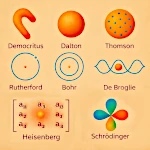 The Atom in All Its Forms: From Ancient Intuition to Quantum Mechanics