

The Atom in All Its Forms: From Ancient Intuition to Quantum Mechanics
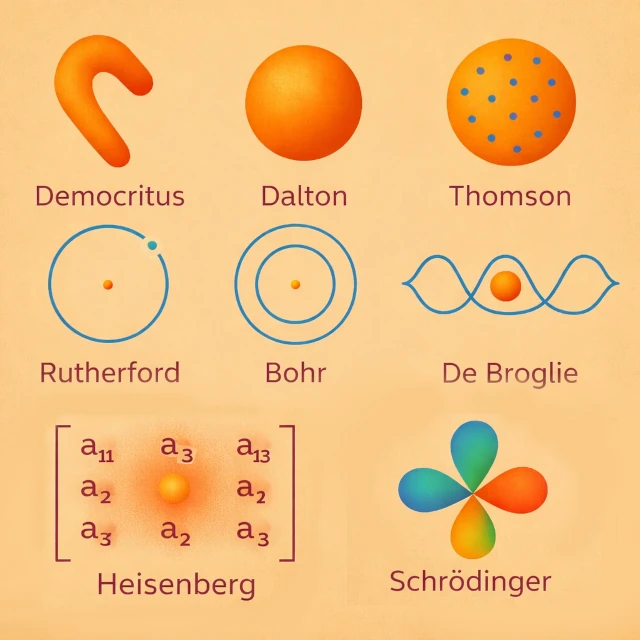
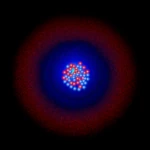
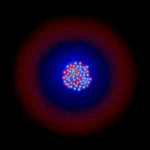
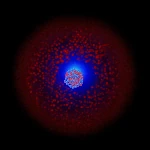
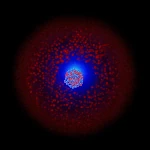
Schematic representation of the evolution of atomic models, from the indivisible atom to quantum orbitals.
Image source: astronoo.com (new window).
Scientific Summary
The article traces the evolution of atomic modeling, from the philosophical intuitions of Democritus (indivisible atom) to probabilistic quantum mechanics. This scientific revolution passes through key models: Dalton (spherical chemical atom), Thomson (electrons dispersed in a positive sphere), Rutherford (compact central nucleus), Bohr (quantized orbits), de Broglie (wave-particle duality), Heisenberg (uncertainty principle, indeterminate trajectories), and Schrödinger (probability clouds, wave function). Each model corrects the limitations of its predecessor, reflecting the shift from classical to quantum physics, where the electron no longer has a defined trajectory but a probability of presence described by atomic orbitals.
How has the modeling of the atom evolved throughout the history of science?
The representation of the atom has undergone a major scientific revolution, moving from a philosophical concept to a probabilistic quantum model. The evolution begins with Democritus (indivisible atom), then Dalton (spherical chemical atom), Thomson ("plum pudding" model with dispersed electrons), Rutherford (compact central nucleus), Bohr (quantized orbits), de Broglie (wave-particle duality, standing waves), Heisenberg (matrix mechanics, uncertainty principle), and Schrödinger (probability clouds, wave function). This succession of models reflects the evolution of physics from classical mechanics to quantum mechanics, where the electron no longer has a defined trajectory but a probability of presence.
Also worth exploring
Continue your exploration of the Universe with these topics:
Philosophical Origins of the Atom
The concept of the atom first appeared in the 5th century BCE with Democritus (c. 460-370 BCE), who postulated, through an essentially intuitive and rational approach, the existence of indivisible particles moving in a void. This proposal was not based on experimental observation, but on a philosophical intuition aimed at resolving the problem of the infinite divisibility of matter. No experiment could then test this hypothesis. The atom was thus conceived as the ultimate unit of matter, without internal structure or measurable properties. For Democritus, the atom had its own shape, which intuitively explained the properties of bodies: for example, hooked atoms interlock and create rough textures, while round or smooth atoms produce fluid or soft substances.
The Middle Ages: Between Aristotelian Continuity and Theological Atomism
In the Middle Ages, there was no physical modeling of the atom in the scientific sense, as European natural thought was largely dominated by the legacy of Aristotle, for whom matter is continuous, infinitely divisible, and structured by the four elements (earth, water, air, and fire). This view excluded the existence of indivisible material units and explicitly opposed ancient atomism. However, in the medieval Islamic world, some currents of rational theology, notably kalām, developed a form of philosophical atomism in which the world is composed of discrete atoms recreated at every instant by divine will. This medieval atomism was based neither on experience nor on mathematical laws, but on a metaphysical intuition aimed at reconciling causality, contingency, and divine omnipotence. Thus, during the Middle Ages, the atom persisted as a speculative or theological concept, without becoming an object of physical description or measurement.
The Birth of the Scientific Atom
At the beginning of the 19th century CE, John Dalton (1766-1844) introduced an atomic theory based on quantitative chemistry. Atoms became chemical and measurable entities, characterized by their mass, and responsible for the laws of conservation. Each chemical element is made up of identical atoms, distinct from those of other elements. For example, in the formation of water, Dalton explained that each molecule results from the combination of two hydrogen atoms and one oxygen atom (H₂O), in accordance with simple and constant proportions. This experimental observation illustrates how atoms govern chemical reactions and their proportions. Visually, one can imagine that Dalton thought of the atom as a compact and homogeneous sphere, without internal structure, just as "a small ball of matter."
Thomson's Model: The "Plum Pudding" Atom
The end of the 19th century CE marked a decisive break in the conception of the atom. In 1897, Joseph John Thomson (1856-1940) discovered the electron, demonstrating that the atom is not indivisible. He then proposed a model in which electrons, carriers of negative charge, are dispersed in a diffuse sphere of positive charge, like raisins in a pudding. This model explained certain electrical properties of atoms, but did not account for the stability of the nucleus observed later.
Rutherford's Model: The Nuclear Atom
In 1911, Ernest Rutherford (1871-1937) interpreted the alpha particle scattering experiment. He demonstrated that the positive charge and most of the mass of the atom are concentrated in a compact central nucleus. Electrons orbit around this nucleus, and the atom becomes a system mostly made up of empty space. This model corrected the limitations of Thomson's model and laid the foundations for subsequent quantum developments.
Niels Bohr's Model: Quantization of the Atom
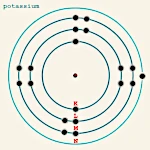
The classical planetary model is unstable according to electromagnetism, because in classical physics, an accelerated charge such as an electron in orbit radiates electromagnetic energy, gradually loses its kinetic energy, and inevitably spirals toward the nucleus. To resolve this contradiction, Niels Bohr (1885-1962) introduced quantized electron orbits in 1913. Electrons can only occupy certain energy levels, explaining the discrete atomic spectra.
Louis de Broglie's Wave Model: Standing Wave
At the beginning of the 20th century CE, Louis de Broglie (1892-1987) proposed a conceptual revolution: the electron, and more generally any material particle, has both a "particle" and a "wave" nature. This idea, called wave-particle duality, suggests that the electron orbiting the nucleus can be described as a "standing wave," whose wavelength is inversely proportional to its momentum: \( \lambda = h / p \), where \( \lambda \) is the wavelength, \( h \) is Planck's constant, and \( p \) is the momentum.
De Broglie's model explains why only certain orbits are stable in Bohr's atom: the electron can only occupy orbits for which its wavelength forms a complete cycle around the nucleus, creating a resonance condition. This concept was an essential step toward "quantum mechanics," as it linked the corpuscular properties of particles to their wave behavior, paving the way for Schrödinger's equation.
Heisenberg's Model: Matrix Quantum Mechanics
In the 1920s CE, Werner Heisenberg (1901-1976) proposed a new approach to the atom based on the principles of quantum mechanics. His model, called "matrix quantum mechanics," did not seek to describe the trajectory of electrons around the nucleus, but only the "observable quantities" such as the energies of atomic levels and the probabilities of transitions between them. Heisenberg introduced the famous "uncertainty principle," which states that it is impossible to know simultaneously and precisely both the position and the momentum of an electron (\( \Delta x \, \Delta p \ge \hbar / 2 \)).
This model radically transformed the understanding of the atom: electrons were no longer seen as particles described by classical orbits, but as entities whose behavior could only be expressed in terms of measurable quantities. Heisenberg's model is very abstract and does not lend itself to a classical illustration of electrons in orbit, unlike Bohr's. But it can still be represented symbolically and pedagogically.
Schrödinger's Quantum Model: Probability Clouds
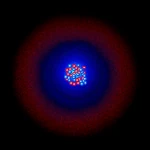
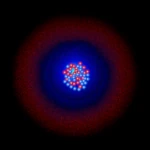
In the early 1920s CE, classical physics could no longer explain the stability of atoms or the discrete spectra observed experimentally. Erwin Schrödinger (1887-1961) then developed a mathematical approach based on wave mechanics. He replaced fixed electron trajectories with a wave function (mathematical function, solution of the Schrödinger equation, representing the probability of the electron's presence), whose squared modulus indicates the probability of the electron's presence in space.
This approach describes electrons as "probability clouds" organized into atomic orbitals (regions of space where the probability of the electron's presence is significant), characterized by quantum numbers defining energy, shape, and orientation. Schrödinger's model accounts for the stability of atoms, atomic spectra, and serves as the foundation for all modern quantum chemistry.
N.B.:
Unlike classical models, the electron does not have a defined trajectory. Quantum mechanics only describes probabilities of presence and energy.
Comparison of Main Atomic Models
| Model | Scientist | Period | Main Feature |
|---|---|---|---|
| Indivisible Atom | Democritus (c. 460-370 BCE) | 5th century BCE | Particle without internal structure |
| Chemical Atom | John Dalton (1766-1844) | 19th century CE | Defined mass, basis of chemical reactions |
| Thomson's Model | Joseph John Thomson (1856-1940) | Late 19th century CE | Electrons embedded in a diffuse positive charge |
| Nuclear Model | Ernest Rutherford (1871-1937) | Early 20th century CE | Central nucleus and peripheral electrons |
| Quantized Model | Niels Bohr (1885-1962) | Early 20th century CE | Discrete energy levels |
| Wave Model | Louis de Broglie (1892-1987) | 20th century CE | Wave-particle duality applied to the electron |
| Matrix Model | Werner Heisenberg (1901-1976) | 20th century CE | Observable quantities, uncertainty principle, indeterminate trajectories |
| Quantum Model | Erwin Schrödinger (1887-1961) | 20th century CE | Wave function and probability orbitals |
FAQ: Everything about atomic models
Why did Rutherford's model replace Thomson's model?
Thomson's "plum pudding" model proposed that negative electrons were dispersed in a sphere of diffuse positive charge. In 1911, Rutherford performed a gold foil experiment scattering alpha particles. He observed that some particles were backscattered, proving the existence of a compact, massive central nucleus containing most of the atom's mass and all its positive charge. Thomson's model could not explain these results, while Rutherford's nuclear model could.
What is the fundamental difference between the Bohr model and the Schrödinger model?
Bohr's model (1913) proposed quantized circular electron orbits, like planets around the Sun, but with discrete energy levels. Schrödinger's model (1920s) replaced these fixed orbits with a wave function whose square gives the probability of presence of the electron. The electron no longer has a defined trajectory but forms "probability clouds" called atomic orbitals. Schrödinger's model is more accurate and serves as the foundation for modern quantum chemistry.
What is wave-particle duality and what is its contribution to atomic modeling?
Proposed by Louis de Broglie in the early 20th century, wave-particle duality states that any material particle (such as an electron) has both particle nature and wave nature, with an associated wavelength λ = h/p (where h is Planck's constant and p is momentum). Applied to the atom, this idea explains why only certain orbits are stable in Bohr's model: the electron can only occupy orbits for which its wavelength forms a complete cycle around the nucleus (resonance condition). This concept paved the way for Schrödinger's equation and quantum mechanics.
 The energies required for nuclear fusion and why uranium is a limit
  The Atom in All Its Forms: From Ancient Intuition to Quantum Mechanics