

Mercury (Hg, Z = 80): The Liquid and Toxic Metal
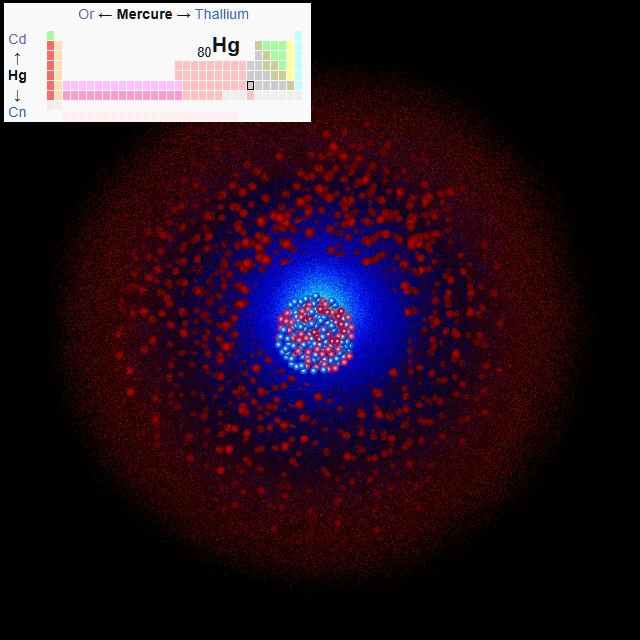
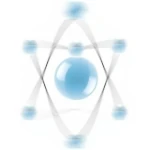
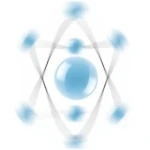
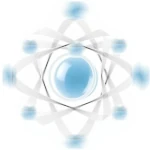
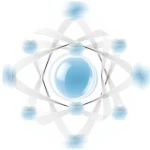
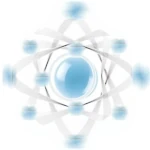
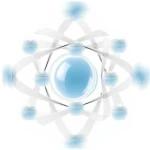
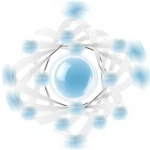
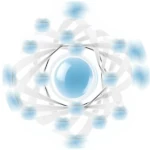
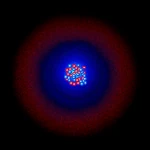
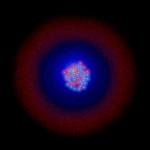
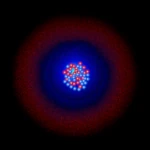
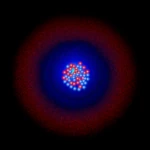
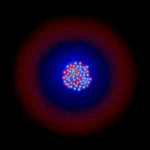
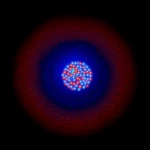
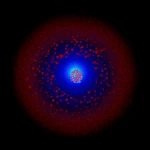
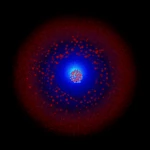
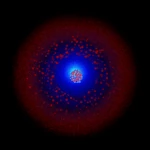
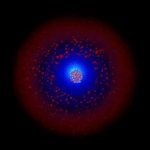
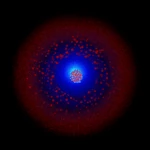
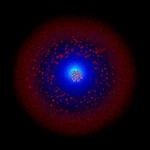
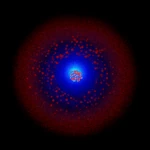
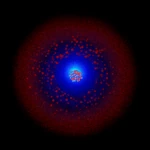
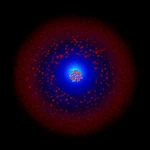
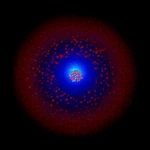
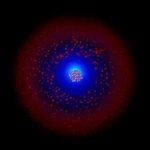
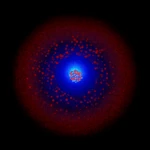
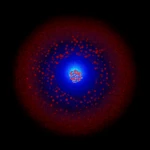
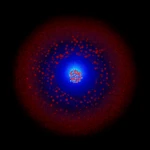
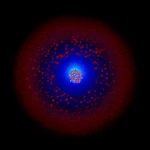
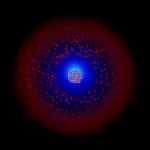
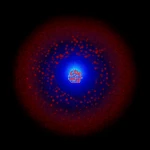
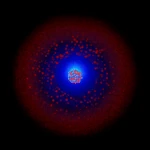
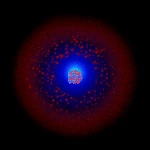
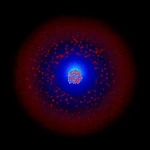
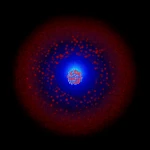
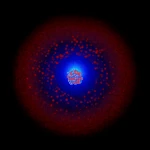
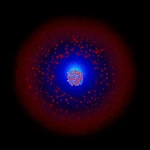
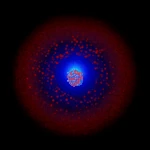
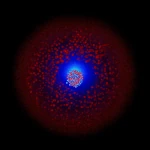
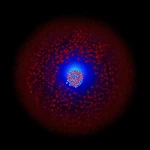
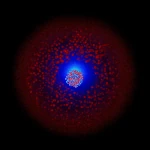
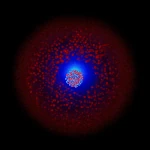
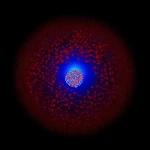
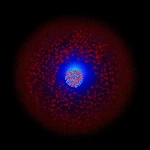
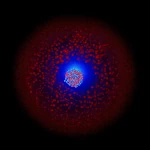
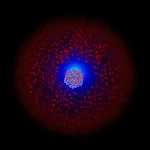
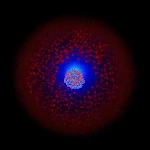
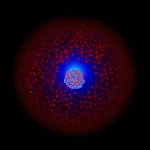
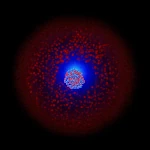
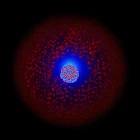
Image description:
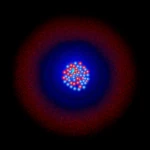
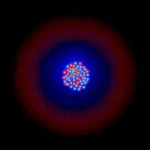
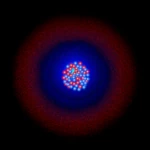
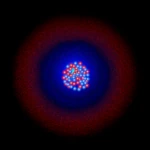
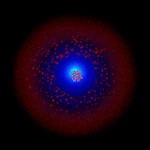
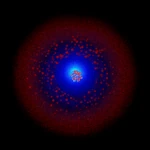
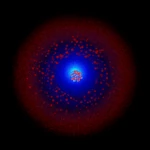
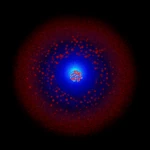
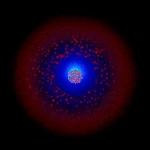
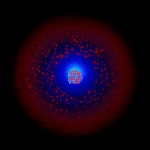
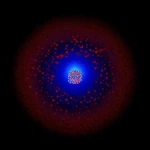
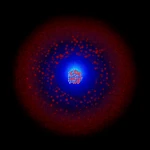
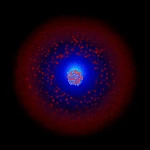
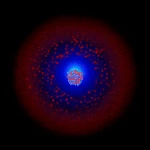
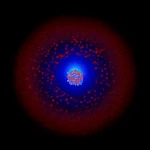
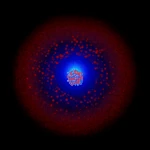
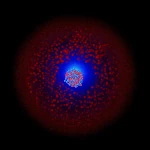
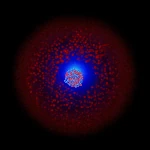
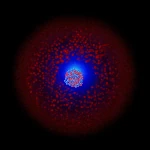
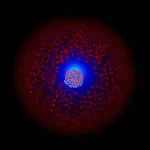
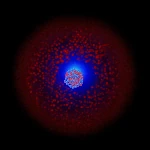
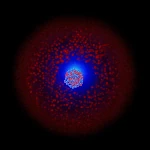
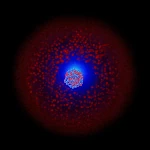
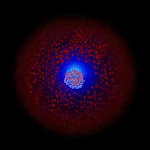
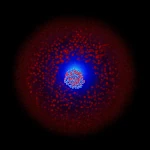
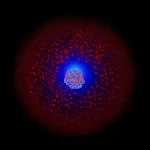
Simplified atomic model of the mercury atom. The main stable isotope is \(^{202}\mathrm{Hg}\)
with its 80 protons, 80 electrons, and 122 neutrons.
Image source: astronoo.com (new window)
Role of Mercury in Astrophysics and Planetology
Stellar synthesis and cosmic volatility
Mercury is a volatile element whose synthesis mainly involves the s-process (slow neutron capture) in asymptotic giant branch (AGB) stars. It belongs to the so-called "moderately volatile" elements, meaning it condenses at relatively low temperatures during planet formation. This volatility partly explains its distribution in the solar system: it is significantly depleted in terrestrial planets (such as Earth) compared to solar abundances, as much of it remained gaseous during accretion and was blown away by the young Sun.
Cosmic and planetary abundance
The cosmic abundance of mercury is about 1.5×10⁻¹¹ times that of hydrogen in number of atoms, making it comparable to selenium and bromine. On Earth, it is relatively rare in the crust (about 0.08 ppm). Its presence on other bodies is intriguing: the planet Mercury (which only shares its name by coincidence) has an exosphere containing traces of atomic mercury, probably released by micrometeorite impacts on its surface. Comets and some ice-rich asteroids may also contain mercury in the form of organomercury compounds or sulfides.
The geochemical cycle of mercury: a terrestrial peculiarity
On Earth, mercury follows a complex cycle involving the atmosphere, oceans, crust, and biosphere. Its elemental form (Hg⁰) is volatile and can travel long distances in the atmosphere before being oxidized and deposited. This global atmospheric transport explains why mercury pollution is a worldwide problem, affecting even the most remote regions such as the Arctic. The study of ice cores allows us to trace the history of mercury emissions linked to human activities (mining, coal combustion) over millennia.
Mercury in Earth's history and mass extinctions
Mercury anomalies have been identified in marine sediments at the boundary of several mass extinction events (Permian-Triassic, Triassic-Jurassic, Cretaceous-Paleogene). These peaks could be linked to massive volcanic activity (traps) that released enormous amounts of volatile mercury into the atmosphere, contributing to the poisoning of ecosystems. Thus, mercury also serves as a geological tracer of major environmental upheavals of the past.
History of the Discovery and Use of Mercury
Etymology and origin of the name
The chemical symbol Hg comes from the Latin "hydrargyrum", itself derived from the ancient Greek ὕδωρ ἄργυρος (hýdōr árgyros), meaning "liquid silver". This name perfectly describes its appearance: a metal as shiny as silver, but liquid. The French name "mercure" comes from the Roman god Mercury (Hermes to the Greeks), the swift messenger of the gods, perhaps in reference to the mobility and volatility of the liquid metal.
Ancient and alchemical uses
Native mercury (in the form of cinnabar, HgS) has been known since antiquity. The Chinese and Egyptians used it as a vermilion pigment and in medicine (often with disastrous consequences). Alchemists attached primordial importance to mercury, which they considered, along with sulfur and salt, as one of the three fundamental principles of matter. They believed it was the key to transmuting metals into gold. Its ability to dissolve gold (forming amalgam) and to evaporate and recondense intact fascinated minds and fueled mystical theories.
From alchemy to modern science
In the 18th century, mercury played a crucial role in the development of thermometry (Fahrenheit and Celsius thermometers) and barometry (Torricelli's experiment, 1643, which demonstrated the existence of atmospheric pressure using a column of mercury). The discovery of its toxic compounds, such as calomel (Hg₂Cl₂) and corrosive sublimate (HgCl₂), also marked the beginnings of pharmaceutical and industrial chemistry.
Deposits and production
The main source of mercury is cinnabar (mercury(II) sulfide, HgS), a scarlet red ore. Major deposits have been exploited in Almadén (Spain, the largest historical mine), Idrija (Slovenia), and Monte Amiata (Italy). Today, primary mining production has significantly decreased due to toxicity and environmental restrictions. China and Kyrgyzstan are among the last significant producers.
Most of the mercury circulating today comes from recycling or is a by-product of other activities:
- Coal combustion (coal contains traces of mercury).
- Production of non-ferrous metals (zinc, lead, gold).
- Chlor-alkali production using mercury cathode cells (a technology being phased out).
Due to its toxicity, mercury trade is strictly regulated by the Minamata Convention (2013).
Structure and Fundamental Properties of Mercury
Classification and atomic structure
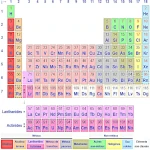
Mercury (symbol Hg, atomic number 80) is a transition metal of the 6th period, located in group 12 of the periodic table, along with zinc and cadmium. Its atom has 80 protons, usually 122 neutrons (for the stable isotope \(^{202}\mathrm{Hg}\)) and 80 electrons with the electronic configuration [Xe] 4f¹⁴ 5d¹⁰ 6s². This configuration with a complete d¹⁰ shell and a complete s² shell is similar to that of noble gases, contributing to its low reactivity in metallic form and its low melting point.
Unique physical properties
Mercury is the only metal liquid at room temperature and pressure. It is a dense, silvery-white, mobile liquid that easily divides into spherical droplets.
- Liquid state: Melting point at -38.83 °C, boiling point at 356.73 °C.
- High density: 13.534 g/cm³ at 20 °C (one liter weighs 13.5 kg).
- Very high surface tension: Forms almost perfect droplets.
- Electrical conductivity: Poor for a metal (about 1/60th that of silver).
- Regular thermal expansion: Used in thermometers.
- Non-wetting: Does not wet glass, leaves a convex meniscus.
In solid state, mercury is malleable and ductile and crystallizes in a rhombohedral structure.
Transformation points
Mercury freezes at -38.8290 °C (234.321 K) and boils at 356.73 °C (629.88 K). Its wide liquid temperature range (nearly 400°C) and its linear expansion made it successful in measuring instruments.
Chemical reactivity
Mercury is a relatively noble metal. It does not react with non-oxidizing acids (dilute HCl, dilute H₂SO₄) but dissolves in nitric acid and aqua regia. It resists oxidation by air at room temperature, but slowly forms a gray oxide film in the presence of ozone. It reacts with halogens, sulfur, and metals to form amalgams.
Summary of physical characteristics
State at 20°C: Liquid.
Melting point: 234.321 K (-38.8290 °C).
Boiling point: 629.88 K (356.73 °C).
Density: 13.534 g/cm³.
Electronic configuration: [Xe] 4f¹⁴ 5d¹⁰ 6s².
Main oxidation states: +1 and +2.
Table of Mercury Isotopes
| Isotope / Notation | Protons (Z) | Neutrons (N) | Atomic mass (u) | Natural abundance | Half-life / Stability | Decay / Remarks |
|---|---|---|---|---|---|---|
| Mercury-196 — \(^{196}\mathrm{Hg}\) | 80 | 116 | 195.96583 u | ≈ 0.15 % | Stable | Rare stable isotope. |
| Mercury-198 — \(^{198}\mathrm{Hg}\) | 80 | 118 | 197.966769 u | ≈ 9.97 % | Stable | Stable isotope. |
| Mercury-199 — \(^{199}\mathrm{Hg}\) | 80 | 119 | 198.968280 u | ≈ 16.87 % | Stable | Stable isotope with nuclear spin I=1/2, used in \(^{199}\mathrm{Hg}\) NMR spectroscopy. |
| Mercury-200 — \(^{200}\mathrm{Hg}\) | 80 | 120 | 199.968326 u | ≈ 23.10 % | Stable | Stable isotope. |
| Mercury-201 — \(^{201}\mathrm{Hg}\) | 80 | 121 | 200.970302 u | ≈ 13.18 % | Stable | Stable isotope. |
| Mercury-202 — \(^{202}\mathrm{Hg}\) | 80 | 122 | 201.970643 u | ≈ 29.86 % | Stable | Most abundant stable isotope. |
| Mercury-204 — \(^{204}\mathrm{Hg}\) | 80 | 124 | 203.973494 u | ≈ 6.87 % | Stable | Stable isotope. |
Electronic Configuration and Electron Shells of Mercury
N.B.:
Electron shells:
How electrons are organized around the nucleus (new window).
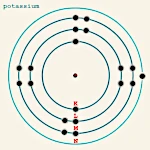
Mercury has 80 electrons distributed over six electron shells. Its electronic configuration [Xe] 4f¹⁴ 5d¹⁰ 6s² has a completely filled 5d shell (10 electrons) and a complete 6s shell (2 electrons), similar to the configuration of a noble gas. This can also be written as: K(2) L(8) M(18) N(32) O(18) P(2), or in full: 1s² 2s² 2p⁶ 3s² 3p⁶ 3d¹⁰ 4s² 4p⁶ 4d¹⁰ 4f¹⁴ 5s² 5p⁶ 5d¹⁰ 6s².
Detailed Structure of the Shells
K shell (n=1): 2 electrons (1s²).
L shell (n=2): 8 electrons (2s² 2p⁶).
M shell (n=3): 18 electrons (3s² 3p⁶ 3d¹⁰).
N shell (n=4): 32 electrons (4s² 4p⁶ 4d¹⁰ 4f¹⁴).
O shell (n=5): 18 electrons (5s² 5p⁶ 5d¹⁰).
P shell (n=6): 2 electrons (6s²).
Valence Electrons and Oxidation States
Mercury has 2 valence electrons (6s²). However, due to the inert pair effect (particular stability of the 6s² electron pair), mercury exhibits a particular chemistry with two stable oxidation states: +1 and +2.
- Mercury(I) (Hg₂²⁺): A very unusual state where mercury forms a diatomic cation with a metal-metal bond: [Hg-Hg]²⁺. Mercury(I) compounds such as calomel (Hg₂Cl₂) therefore always contain two mercury atoms bonded together.
- Mercury(II) (Hg²⁺): The most common and most toxic state. Forms linear complexes (e.g., HgCl₂) and is a soft acid according to HSAB theory, with a strong affinity for "soft" ligands such as sulfur atoms (thiols) or cyanide groups.
Metallic mercury (Hg⁰) is relatively unreactive due to the strength of the Hg-Hg bond in the liquid and the high energy required to promote a 6s electron to a higher level.
Chemical Reactivity of Mercury
Reaction with air and oxygen
Metallic mercury does not oxidize in air at room temperature. When slowly heated to its boiling point, it eventually forms red mercury(II) oxide (HgO): 2Hg + O₂ → 2HgO. This oxide decomposes back into mercury and oxygen above 400°C. In the presence of ozone, a gray oxide film forms on the surface.
Reaction with water and acids
- Water: Insoluble and unreactive.
- Non-oxidizing acids (dilute HCl, dilute H₂SO₄): No reaction (unlike zinc or iron).
- Nitric acid: Dissolves. With dilute nitric acid, it forms mercury(I) nitrate (Hg₂(NO₃)₂). With hot concentrated acid, it forms mercury(II) nitrate (Hg(NO₃)₂).
- Aqua regia: Dissolves to form mercury(II) chloride (HgCl₂).
N.B.:
Formation of amalgams
This is a characteristic property: mercury dissolves many other metals (gold, silver, tin, zinc, sodium) to form amalgams, which are alloys in liquid or pasty state. The gold-mercury amalgam has been widely used in artisanal gold extraction (garimpos). The silver-tin-mercury amalgam was the basis of dental "fillings". Sodium or potassium amalgams are used as powerful reducing agents in organic chemistry.
Reactions with halogens, sulfur, and organic compounds
- Halogens: Reacts cold with chlorine to give HgCl₂ (corrosive sublimate), with bromine to give HgBr₂. Reaction with iodine is slower.
- Sulfur: Mercury is "amalgamated" by sulfur powder, forming black sulfide (metacinnabar HgS). Heating mercury with sulfur gives red cinnabar (HgS).
- Organic compounds: Mercury(II) easily forms covalent bonds with carbon, giving organomercury compounds (e.g., methylmercury CH₃Hg⁺, ethylmercury), which are extremely toxic and bioaccumulative.
Industrial and Technological Applications of Mercury (historical and current)
- In thermometers and barometers (applications in rapid decline for safety reasons and replaced by electronic or alcohol alternatives);
- In tilt switches (liquid mercury establishes perfect electrical contact, without sparking);
- As a cathode in mercury cells for chlorine and caustic soda production (Castner-Kellner process, technology being phased out in favor of membranes);
- As an electrode in primary batteries (mercury oxide and alkaline batteries, now banned or restricted);
- As a catalyst in the chemical industry, particularly for the production of acetaldehyde from acetylene (process now abandoned);
- In artisanal gold extraction (amalgamation), a practice still widespread and a major cause of pollution;
- In dental amalgams ("silver fillings"), whose use is in sharp decline;
- As a working fluid in turbines and certain physics experiments;
- In mercury vapor lamps for public lighting (arc lamps) and fluorescent lamps (neon), being replaced by LEDs;
- As a reference standard in electrochemistry (saturated calomel electrode, SCE);
- As a dense separation liquid in mines (to concentrate heavy ores);
- In the manufacture of mirrors by amalgamation (deposit of tin + mercury on glass);
- As a fixative in taxidermy and tanning (historical use);
- In explosives such as mercury fulminate (Hg(CNO)₂), a sensitive detonator;
- In scientific research, as a target in particle colliders and for certain physics experiments.
Toxicology and Public Health
Forms and routes of exposure
The toxicity of mercury depends strongly on its chemical form:
- Elemental mercury (Hg⁰) vapor: Extremely toxic by inhalation. Mercury vapors are invisible, odorless, and easily pass through the alveolar membrane of the lungs. They then enter the blood and cross the blood-brain barrier, seriously affecting the central nervous system.
- Inorganic mercury(II) compounds (e.g., HgCl₂): Corrosive and toxic to the kidneys. Ingestion causes severe gastrointestinal damage.
- Organomercury compounds (e.g., methylmercury CH₃Hg⁺): The most dangerous. Formed by bacterial biomethylation in aquatic sediments. They are lipophilic, easily cross biological barriers (including the placenta), and accumulate in the food chain, particularly in predatory fish (tuna, swordfish). They are neurotoxic and teratogenic.
Historical diseases and syndromes
- Mad hatter's disease: In the 18th and 19th centuries, hatters used mercury nitrate to felt wool. Chronic inhalation of vapors caused tremors, speech disorders, memory loss, and psychosis. This is the origin of the expression "mad as a hatter" and the character of the Mad Hatter in Alice in Wonderland.
- Minamata disease: Massive methylmercury poisoning in the 1950s in Minamata, Japan. A chemical plant discharged mercury waste into the bay. Methylmercury accumulated in fish and shellfish. Residents who consumed them developed severe neurological symptoms (ataxia, sensory disorders, paralysis, congenital malformations). This environmental disaster led to the Minamata Convention.
- Acrodynia (pink disease): Mercury poisoning in children, historically due to medicines or dental powders containing mercury.
Precautions and treatment
In case of metallic mercury spillage, it is necessary to ventilate intensively, avoid walking on it (to prevent spreading droplets), and use a specific trap (syringe, pipette, sulfur powder) to collect it. Never use a vacuum cleaner (it vaporizes and disperses mercury). Exposure requires urgent medical consultation. Treatment of acute poisoning may use chelators such as DMSA (dimercaptosuccinic acid) or DMPS, which bind to mercury and promote its urinary excretion.
Environment and Pollution
Biogeochemical cycle of mercury
Mercury is a persistent pollutant that follows a complex cycle:
- Emissions: Natural (volcanoes, terrestrial degassing) and anthropogenic (coal combustion, mining, cement production).
- Atmospheric transport: As Hg⁰ vapor, it can remain in the air for more than a year and travel globally.
- Oxidation and deposition: Oxidized to Hg²⁺, it is deposited on soils and oceans by rain.
- Methylation: In anoxic aquatic environments (sediments), bacteria transform Hg²⁺ into methylmercury (CH₃Hg⁺).
- Bioaccumulation and biomagnification: Methylmercury enters plankton and then moves up the food chain, with concentrations that can be multiplied by a million between water and a large predator like tuna.
Impact on ecosystems and human health
Mercury pollution affects wildlife (reduced reproduction in fish-eating birds, neurological disorders in marine mammals). For humans, the main route of exposure is the consumption of contaminated fish. The most at-risk populations are coastal communities, indigenous peoples (Inuit), and pregnant women (methylmercury crosses the placenta and harms fetal neurological development).
Regulation and the Minamata Convention
The Minamata Convention on Mercury, adopted in 2013 and entered into force in 2017, is an international treaty aimed at protecting human health and the environment. It requires:
- The phase-out of mercury-containing products (thermometers, batteries, certain switches).
- Control and reduction of emissions from coal-fired power plants and factories.
- The ban on the use of mercury in artisanal gold mining (with deadlines for developing countries).
- Environmentally sound management of mercury stocks and waste.
Recycling and Waste Management
Need for recovery
Given the toxicity and persistence of mercury, it is imperative to recover and isolate it from the biosphere permanently. Mercury cannot be "destroyed" (the atoms persist), but it can be stabilized in less dangerous forms.
Recycling and disposal processes
- Separate collection: Specific channels exist for thermometers, batteries, compact fluorescent lamps, and other mercury waste.
- Distillation/recovery: Metallic mercury from waste can be purified by vacuum distillation and reused in authorized applications, or stored.
- Stabilization/Solidification: For contaminated solid waste, mercury is immobilized by combining it with sulfur (formation of stable cinnabar) or by incorporating it into a cement or glass matrix.
- Permanent storage: Purified stabilized mercury is stored in secure, geologically stable facilities designed to isolate it for centuries. The EU and the United States have designated long-term storage sites.
Challenges and perspectives
The main challenges are the phase-out of the last uses (certain chemical processes, certain lamps), the remediation of contaminated sites (former factories, mines), and the management of mercury present in products in circulation (millions of thermometers and dental amalgams). Research continues on biological decontamination methods (phytoremediation) and on non-toxic alternatives in all areas where mercury was historically used.
 The energies required for nuclear fusion and why uranium is a limit
 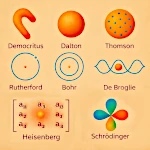 The Atom in All Its Forms: From Ancient Intuition to Quantum Mechanics