

Osmium (Os, Z = 76): The Metal of Extreme Density and Hardness
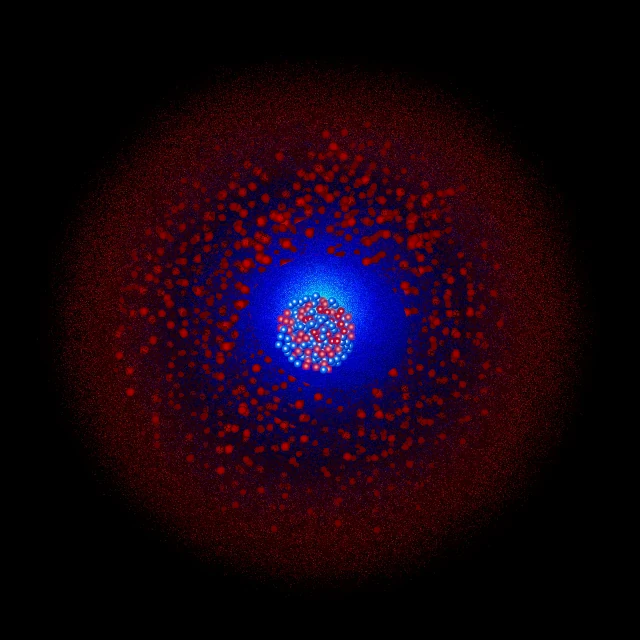
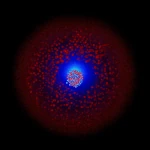
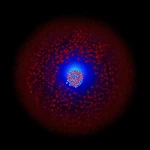
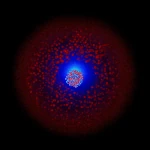
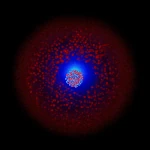
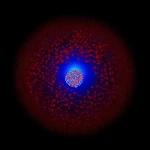
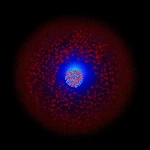
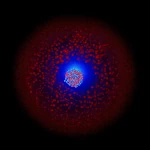
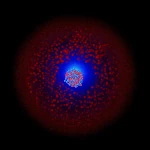
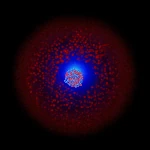
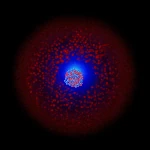
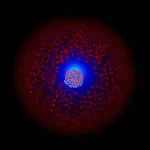
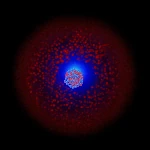
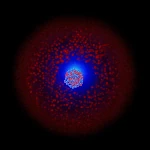
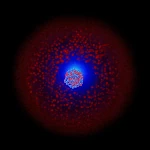
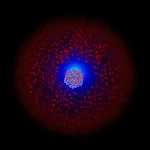
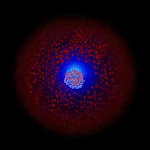
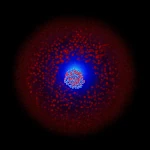
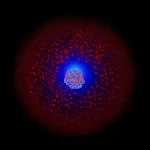
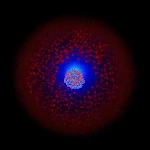
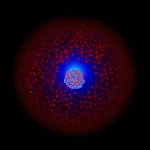
Image description:
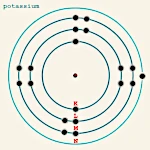
Simplified atomic model of the osmium atom. The main stable isotope is \(\,^{192}\mathrm{Os}\,
with its 76 protons, 76 electrons, and 116 neutrons.
Image source: astronoo.com (new window)
Role of Osmium in Astrophysics and Cosmology
Stellar synthesis of osmium
Osmium is synthesized in stars mainly through the r-process (rapid neutron capture) that occurs during cataclysmic events such as supernovae and neutron star mergers. As a heavy element with an even atomic number (Z=76), it is efficiently produced by this process. Osmium also has a significant contribution from the s-process (slow neutron capture) in AGB stars (asymptotic giants), but the r-process dominates, accounting for 70-80% of its solar abundance. Osmium is part of the "osmium peak" in the production spectrum of heavy elements by neutron capture.
Cosmic abundance and isotopic characteristics
The cosmic abundance of osmium is about 6.0×10⁻¹³ times that of hydrogen in number of atoms, making it comparable in rarity to platinum and gold, and about 2-3 times rarer than tungsten. Osmium has seven natural isotopes, the most abundant being osmium-192 (41.0%). The isotopic abundances of osmium, particularly the ¹⁸⁷Os/¹⁸⁸Os ratio, are of crucial importance in geochemistry and cosmochemistry.
Re-Os dating system in geochemistry and cosmochemistry
The rhenium-osmium isotopic system (¹⁸⁷Re → ¹⁸⁷Os) is one of the most important chronological tools for studying the evolution of the Earth and the solar system. Osmium-187 is the radiogenic isotope produced by the beta decay of rhenium-187 (half-life of 41.6 billion years). The importance of this system lies in the marked geochemical differences between these elements: rhenium is moderately siderophile and chalcophile (prefers sulfides), while osmium is strongly siderophile (prefers metal). These differences create significant fractionations during planetary core formation and geological reservoir differentiation.
Applications to planetary formation and mantle evolution
The Re-Os system is particularly useful for:
- Dating the formation of the Earth's core: By comparing isotopic compositions of the mantle and meteorites.
- Studying the evolution of the Earth's mantle: Os isotopic ratios distinguish primitive mantle from depleted mantle.
- Prospecting for sulfide deposits: Magmatic sulfides concentrate osmium and rhenium.
- Researching the origin of oil: Oils and source rocks have distinct Os signatures.
- Studying meteorite impacts: Impact layers show Os anomalies.
- Dating ultramafic rocks: Which are difficult to date by other methods.
The ¹⁸⁷Os/¹⁸⁸Os ratio is considered one of the most sensitive tracers of interaction between the mantle and the Earth's crust.
History of the Discovery of Osmium
Etymology and origin of the name
Osmium takes its name from the ancient Greek ὀσμή (osmḗ), meaning "smell". This name was chosen by its discoverer, Smithson Tennant, because of the pungent and unpleasant odor of osmium oxide (OsO₄), which resembles ozone or chlorine. Osmium shares this etymology with ozone (O₃), which also has a characteristic odor. It is one of the few elements named after a sensory property.
Discovery by Smithson Tennant
Osmium was discovered in 1803 by the English chemist Smithson Tennant (1761-1815), who also discovered iridium in the same year. Tennant was working on crude platinum from South America, which did not dissolve completely in aqua regia. He noticed that a black insoluble residue remained after treatment. By studying this residue, he identified two new elements: one producing colored salts (which he named iridium, after Iris, the Greek goddess of the rainbow), and the other producing a volatile oxide with a strong odor (which he named osmium).
Early studies and production
Early studies on osmium were difficult due to its great hardness, brittleness, and the toxicity of its volatile oxides. The first relatively pure metallic osmium was produced in 1804 by Tennant. However, it was not until the mid-19th century that more effective methods of production and purification were developed. Osmium was one of the last natural elements to be isolated in pure form, due to the technical challenges posed by its properties.
Terrestrial presence and production
Osmium is one of the rarest natural elements on Earth, with a crustal abundance estimated at about 0.05 ppb (parts per billion). There are no primary osmium mining deposits; it is always recovered as a by-product of the processing of other metals, mainly:
- Platinum ores: Mainly in platinum group deposits (Bushveld in South Africa, Norilsk in Russia)
- Platinum alluvials: Placers where platinum group metals have concentrated
- Nickel and copper ores: Some sulfide deposits contain traces of osmium
World production of osmium is very low, estimated at less than 1 ton per year. The main producers are South Africa, Russia, Canada, and the United States. Due to its extreme rarity, unique properties, and production difficulty, osmium is one of the most expensive metals, with typical prices of $10,000 to $15,000 per kilogram (or much more for certain forms). Demand is limited by niche applications and availability.
Structure and Fundamental Properties of Osmium
Classification and atomic structure
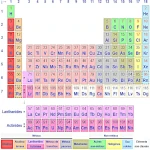
Osmium (symbol Os, atomic number 76) is a transition metal of the 6th period, located in group 8 (formerly VIII) of the periodic table, with iron, ruthenium, and hassium. It belongs to the platinum group metals (platinum, palladium, rhodium, ruthenium, iridium, osmium). Its atom has 76 protons, usually 116 neutrons (for the most abundant isotope \(\,^{192}\mathrm{Os}\)) and 76 electrons with the electronic configuration [Xe] 4f¹⁴ 5d⁶ 6s². This configuration has six electrons in the 5d subshell and two in the 6s.
Exceptional physical properties
Osmium is a bluish-white, shiny, extremely dense, hard, and brittle metal. It holds several records among natural elements:
- Highest density: 22.59 g/cm³ at 20 °C (slightly denser than iridium, 22.56 g/cm³)
- Extreme hardness: 7.0 on the Mohs scale (pure), but osmium-iridium alloys can reach 7.5
- Very high modulus of elasticity: About 550 GPa (one of the stiffest materials)
- Very high melting point: 3033 °C (one of the highest among metals)
Osmium has a hexagonal close-packed (HCP) crystal structure at room temperature, which contributes to its high density and hardness.
Exceptional transformation points
Osmium melts at 3033 °C (3306 K) - one of the highest melting points among metals - and boils at 5012 °C (5285 K). It has good thermal stability and retains its mechanical properties at high temperatures, although it is generally brittle and difficult to work with.
Chemical reactivity
At room temperature, osmium is relatively inert and resistant to corrosion. However, it forms OsO₄ (osmium tetroxide) at moderate temperatures in the presence of oxygen. OsO₄ is a pale yellow crystalline solid at room temperature, but it sublimes (goes directly from solid to gas) at only 40 °C, producing highly toxic vapors with a characteristic odor. Osmium is attacked by molten alkalis in the presence of oxidants, and dissolves in aqua regia and concentrated nitric acid.
Record physical characteristics (summary)
Density: 22.59 g/cm³ - the highest of all natural elements.
Melting point: 3306 K (3033 °C) - among the highest of metals.
Boiling point: 5285 K (5012 °C).
Crystal structure: Hexagonal close-packed (HCP).
Modulus of elasticity: ~550 GPa - extremely stiff.
Hardness: 7.0 on the Mohs scale (pure) - very hard for a metal.
Table of Osmium Isotopes
| Isotope / Notation | Protons (Z) | Neutrons (N) | Atomic mass (u) | Natural abundance | Half-life / Stability | Decay / Remarks |
|---|---|---|---|---|---|---|
| Osmium-184 — \(\,^{184}\mathrm{Os}\,\) | 76 | 108 | 183.952489 u | ≈ 0.02 % | Stable | Lightest stable isotope, very rare in nature. |
| Osmium-186 — \(\,^{186}\mathrm{Os}\,\) | 76 | 110 | 185.953838 u | ≈ 1.59 % | 2.0×10¹⁵ years | Alpha radioactive with extremely long half-life. Considered stable for most applications. |
| Osmium-187 — \(\,^{187}\mathrm{Os}\,\) | 76 | 111 | 186.955750 u | ≈ 1.96 % | Stable | Important radiogenic isotope (product of ¹⁸⁷Re), crucial for Re-Os geochronology. |
| Osmium-188 — \(\,^{188}\mathrm{Os}\,\) | 76 | 112 | 187.955838 u | ≈ 13.24 % | Stable | Reference stable isotope for isotopic measurements (¹⁸⁷Os/¹⁸⁸Os ratio). |
| Osmium-189 — \(\,^{189}\mathrm{Os}\,\) | 76 | 113 | 188.958147 u | ≈ 16.15 % | Stable | Important stable isotope. |
| Osmium-190 — \(\,^{190}\mathrm{Os}\,\) | 76 | 114 | 189.958447 u | ≈ 26.26 % | Stable | Most abundant stable isotope in nature. |
| Osmium-192 — \(\,^{192}\mathrm{Os}\,\) | 76 | 116 | 191.961481 u | ≈ 40.78 % | Stable | Major stable isotope, representing about 41% of the natural mixture. |
Electronic Configuration and Electron Shells of Osmium
N.B.:
Electron shells:
How electrons are organized around the nucleus (new window).
Osmium has 76 electrons distributed over six electron shells. Its electronic configuration [Xe] 4f¹⁴ 5d⁶ 6s² has a completely filled 4f subshell (14 electrons) and six electrons in the 5d subshell. This configuration can also be written as: K(2) L(8) M(18) N(18) O(32) P(8), or in full: 1s² 2s² 2p⁶ 3s² 3p⁶ 3d¹⁰ 4s² 4p⁶ 4d¹⁰ 4f¹⁴ 5s² 5p⁶ 5d⁶ 6s².
Detailed Structure of the Shells
K shell (n=1): contains 2 electrons in the 1s subshell. This inner shell is complete and very stable.
L shell (n=2): contains 8 electrons distributed as 2s² 2p⁶. This shell is complete, forming a noble gas configuration (neon).
M shell (n=3): contains 18 electrons distributed as 3s² 3p⁶ 3d¹⁰. This complete shell contributes to electronic shielding.
N shell (n=4): contains 18 electrons distributed as 4s² 4p⁶ 4d¹⁰. This shell forms a stable structure.
O shell (n=5): contains 32 electrons distributed as 5s² 5p⁶ 4f¹⁴ 5d⁶. The completely filled 4f subshell and the six 5d electrons give osmium its transition metal properties.
P shell (n=6): contains 8 electrons in the 6s² and 5d⁶ subshells.
Valence Electrons and Oxidation States
Osmium effectively has 8 valence electrons: two 6s² electrons and six 5d⁶ electrons. Osmium exhibits a wide range of oxidation states, from -2 to +8, with the +4, +6, and +8 states being the most stable and characteristic.
In the +8 oxidation state, osmium forms OsO₄ (osmium tetroxide), a volatile and highly toxic covalent compound. The +6 state is known in compounds such as OsF₆ (hexafluoride) and osmates(VI). The +4 state is very stable and is found in many compounds such as OsO₂ (osmium dioxide) and osmium(IV) complexes. Osmium also exhibits lower states (+3, +2, +1, 0, -2) in various coordination complexes.
Osmium shares with ruthenium the ability to reach the +8 oxidation state, the highest known for any element along with ruthenium and xenon. This rich oxidation state chemistry, combined with osmium's ability to form multiple bonds with oxygen, halogens, and other ligands, makes it a chemically very interesting element for catalysis and organic synthesis.
Chemical Reactivity of Osmium
Reaction with air and oxygen
At room temperature, metallic osmium is stable in air. However, when heated, it oxidizes to form OsO₄: Os + 2O₂ → OsO₄. This reaction begins at around 200-300 °C. OsO₄ is a pale yellow crystalline solid that sublimes at only 40 °C (goes directly from solid to gas). OsO₄ vapors are extremely toxic, with a characteristic pungent odor that gave the element its name. OsO₄ is a powerful oxidant and reacts with many organic materials.
Reaction with water and acids
Metallic osmium is resistant to most cold acids:
- Hydrochloric acid (HCl): Resistant
- Sulfuric acid (H₂SO₄): Resistant to dilute solutions, attacked by hot concentrated acid
- Nitric acid (HNO₃): Dissolves slowly, forming OsO₄
- Aqua regia: Dissolves, forming various compounds
- Hydrofluoric acid (HF): Resistant
Osmium is attacked by molten alkalis in the presence of oxidants, forming soluble osmates.
N.B.:
Aqua regia, from Latin for "royal water", is a corrosive mixture of concentrated nitric acid (HNO₃) and concentrated hydrochloric acid (HCl), typically in a 1:3 ratio. Its ability to dissolve gold and platinum, metals resistant to the separate acids, is due to the in situ formation of chlorine (Cl₂) and nitrosyl chloride (NOCl), which oxidize these metals into soluble complex ions (such as [AuCl₄]⁻). Used since alchemical times for the purification of precious metals, it remains crucial in metallurgy, microelectronics, and analytical chemistry.
Reactions with halogens and other elements
Osmium reacts with halogens at moderate temperatures to form halides. With fluorine, it forms OsF₆ (hexafluoride, yellow-green liquid) and OsF₄ (tetrafluoride, yellow solid). With chlorine, it forms OsCl₄ (tetrachloride, red-brown solid) and OsCl₃ (trichloride, brown solid). Osmium reacts with sulfur at high temperatures to form OsS₂ sulfide, with phosphorus to form phosphides, and with carbon to form OsC carbide. It also forms silicides, borides, and nitrides.
Osmium tetroxide (OsO₄)
The most important and dangerous osmium compound is tetroxide (OsO₄). Properties:
- Extreme volatility: Sublimes at 40 °C, very dangerous vapors
- Acute toxicity: Severe irritant to eyes, skin, and respiratory tract
- Powerful oxidant: Reacts violently with organic materials
- Staining agent in microscopy: Colors biological tissues black
- Oxidation catalyst: For organic synthesis (oxidation of alkenes to diols)
Despite its toxicity, OsO₄ is used in electron microscopy to fix and stain biological samples, and in organic synthesis as a selective oxidant.
Industrial and Technological Applications of Osmium
- in ultra-hard alloys for extreme applications (pen tips, instrument pivots, electrical contacts);
- as a catalyst in organic chemistry (hydrogenation, oxidation, especially OsO₄ for alkene oxidation);
- for fountain pen nibs and other writing instruments (osmium-iridium alloys);
- in high-performance electrical contacts (switches, relays);
- as a staining agent in electron microscopy (OsO₄ to fix and stain biological tissues);
- for pivots and bearings in precision instruments (chronometers, gyroscopic compasses);
- in medical implants (joint prostheses, pacemakers) for its biocompatibility;
- as a material for sputtering targets in thin film deposition;
- for coatings resistant to extreme wear;
- in jewelry applications (as an alloying element in platinum);
- as a density standard in metrology;
- for filaments in scientific equipment (in alloy with other metals);
- in particle detectors (as target material);
- as a dopant in semiconductors (research);
- for fundamental research in materials science and catalysis.
Ultra-Hard Alloys: Pen Tips and Precision Instruments
Osmium-iridium alloy (osmiridium)
The most famous application of osmium is its use in ultra-hard alloys, particularly the alloy with iridium. Osmiridium is a natural or synthetic alloy usually containing 30-70% osmium with iridium, and sometimes other platinum group metals. These alloys have exceptional properties:
- Extreme hardness: Up to 7.5 on the Mohs scale (diamond = 10)
- Wear resistance: Exceptional, almost unwearable under normal conditions
- Corrosion resistance: Excellent, almost chemically inert
- Dimensional stability: Does not deform over time
Fountain pen nibs
For most of the 20th century, high-quality fountain pen nibs were made of osmiridium. A small osmiridium ball was welded to the tip of the nib (usually 14 or 18 carat gold) to provide a durable writing surface. These nibs could write millions of words without significant wear. Although ballpoint pens have largely replaced fountain pens for everyday use, high-quality fountain pens still use hard metal alloy nibs (often ruthenium, iridium, or osmium).
Other precision instrument applications
- Compass pivots: For marine and gyroscopic compasses
- Recorder needles: For scientific instruments
- Electrical contacts: In precision measuring instruments
- Ball bearings: For applications requiring extreme precision and durability
- Engraving tools: For engraving on glass and hard metal
Catalysis in Organic Chemistry
Osmium tetroxide (OsO₄) as a selective oxidant
Despite its toxicity, OsO₄ is a valuable catalyst in organic synthesis for the asymmetric hydroxylation of alkenes. In the presence of co-oxidants such as N-methylmorpholine N-oxide (NMO) or potassium ferricyanide, OsO₄ catalyzes the conversion of alkenes to vicinal diols (glycols) with high stereoselectivity and regioselectivity. This reaction, known as Upjohn or Sharpless hydroxylation (for the asymmetric version), is crucial for the synthesis of many natural and pharmaceutical compounds.
Catalytic advantages
- Selectivity: Produces almost exclusively syn diols (same stereochemistry)
- Efficiency: High yields with low amounts of catalyst
- Mild conditions: Room temperature, aqueous or organic solvents
- Complementarity: Complements other oxidation methods (epoxidation, etc.)
Hydrogenation catalysis
Osmium complexes, particularly those in lower oxidation states, are studied as catalysts for the hydrogenation of olefins, ketones, and other unsaturated compounds. Although less used than ruthenium or rhodium catalysts, some osmium complexes show interesting activity and selectivity for specific reactions.
Medical and Scientific Applications
Electron microscopy
OsO₄ is used in transmission electron microscopy (TEM) as a fixing and staining agent. It fixes biological structures by crosslinking unsaturated lipids and adding electron density (osmium being a heavy element that scatters electrons well). This allows visualization of cell membranes and other lipid structures with high resolution.
Medical implants
Osmium and its alloys are studied for medical implants due to:
- Biocompatibility: Excellent (for metallic osmium, not OsO₄!)
- Corrosion resistance: Does not corrode in the body
- Hardness: For joints and other wear surfaces
- X-ray visibility: High density allows good visualization
However, the high cost and difficulty of processing limit its use to very specialized applications.
Toxicity and Environmental Concerns
Extreme toxicity of OsO₄
Osmium tetroxide (OsO₄) is extremely toxic:
- Severe irritation: Eyes, skin, respiratory tract (even at very low concentrations)
- Potential blindness: Eye contact can cause permanent damage
- Lung problems: Pulmonary edema, chronic bronchitis
- Kidney damage: In case of chronic exposure
The occupational exposure limit (PEL) for OsO₄ is very low: 0.0002 ppm (0.002 mg/m³) over 8 hours. Extremely careful handling under a fume hood, with full protective equipment, is mandatory.
Toxicity of metallic osmium and other compounds
Pure metallic osmium is much less toxic than OsO₄. Osmium metal dust can cause mechanical irritation but does not have the acute toxicity of OsO₄. Other osmium compounds (halides, lower oxides) have varying toxicities but generally lower than OsO₄.
Waste management
Waste containing osmium, especially OsO₄, must be handled with extreme caution. OsO₄ is usually reduced to less toxic compounds (such as OsO₂) before disposal. Solid waste containing osmium is often treated as hazardous waste.
Recycling
Osmium is recycled from:
- Used catalysts: Containing osmium complexes
- Electronic waste: Contacts and components containing osmium alloys
- Used instruments: Pen nibs, pivots, precision instruments
- Medical waste: Implants, equipment
Recycling is economically attractive due to the high price of osmium, but technically difficult due to the small quantities and dispersion in products. Recycling methods include pyrometallurgical and hydrometallurgical processes.
Occupational exposure
Occupational exposure to osmium occurs mainly in:
- Platinum refineries: Where osmium is produced as a by-product
- Research laboratories: Using OsO₄ or osmium complexes
- Electronics industry: Manufacturing contacts and components
- Instrument manufacturers: Producing pen nibs and precision instruments
Adequate ventilation, chemical hoods, and personal protective equipment (gloves, goggles, respirator if necessary) are essential.
 The energies required for nuclear fusion and why uranium is a limit
 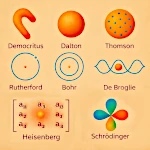 The Atom in All Its Forms: From Ancient Intuition to Quantum Mechanics