

Tungsten (W, Z = 74): The Metal that Defies Fire
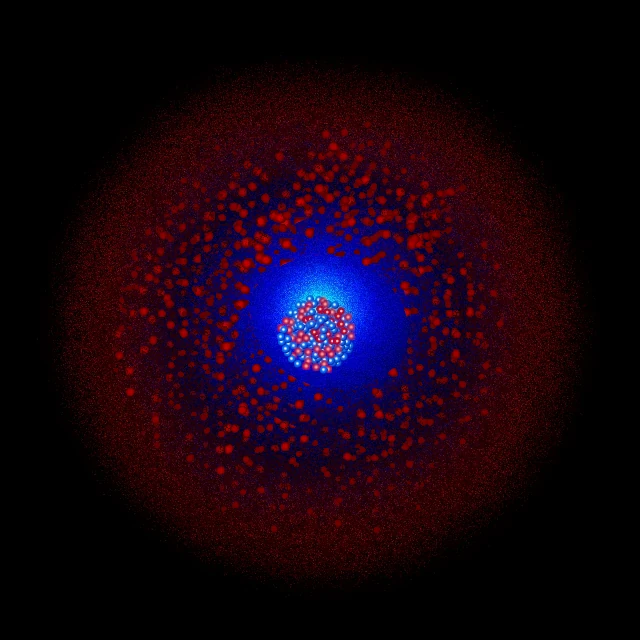
Image description:
Simplified atomic model of the tungsten atom. The main stable isotope is \(\,^{184}\mathrm{W}\,\)
with its 74 protons, 74 electrons, and 110 neutrons.
Image source: astronoo.com (new window)
Role of Tungsten in Astrophysics and Cosmology
Stellar synthesis of tungsten
Tungsten is synthesized in stars mainly through the s-process (slow neutron capture) occurring in low- to medium-mass AGB stars (asymptotic giant branch). As a heavy element with an even atomic number (Z=74), it is efficiently produced by this process. Tungsten also shows significant contribution from the r-process (rapid neutron capture) during explosive events such as supernovae and neutron star mergers. Models estimate that about 50-60% of solar tungsten comes from the s-process, and 40-50% from the r-process. This mixed production makes it an interesting tracer of both nucleosynthesis processes.
Cosmic abundance and isotopic characteristics
The cosmic abundance of tungsten is about 8.0×10⁻¹³ times that of hydrogen in number of atoms, making it slightly more abundant than tantalum (Z=73) but less abundant than hafnium (Z=72). Tungsten has five natural stable isotopes (180, 182, 183, 184, 186), which is unusual for such a heavy element. The isotope W-184 is the most abundant (30.64%), followed by W-186 (28.43%). The isotopic abundances of tungsten are used in geochemistry and cosmochemistry as tracers of processes.
Hf-W dating system in cosmochemistry
The hafnium-tungsten isotopic system (¹⁸²Hf → ¹⁸²W) is one of the most important chronometers for dating the earliest events in the solar system. Hafnium-182 is a short-lived radioactive isotope (half-life of 8.9 million years) that decays into tungsten-182. The importance of this system lies in the fundamental geochemical difference between these two elements: hafnium is lithophile (concentrates in silicates) while tungsten is siderophile (concentrates in metal). Thus, during the formation of a planet's metallic core, tungsten is extracted from the silicate mantle and incorporated into the core.
Applications to early planetary formation
By measuring tungsten-182 anomalies in meteorites and lunar and terrestrial samples, cosmochemists can date the formation of the Earth's core and the differentiation of planetary bodies. Data suggest that the Earth's core formed within the first 30 to 50 million years of the solar system, and that the Moon's differentiation occurred shortly after the giant impact that formed it. The Hf-W system has also been used to date the formation of Mars, Vesta, and other bodies in the solar system.
History of the Discovery of Tungsten
Etymology and dual nomenclature
Tungsten has two names of different origins. The name "tungsten" comes from the Swedish "tung sten" meaning "heavy stone," referring to the high density of the wolframite mineral. The name "wolfram" (and the symbol W) comes from the German "Wolf Rahm" meaning "wolf's foam," a term used by German miners in the Middle Ages who noticed that wolframite interfered with tin smelting, "devouring" the tin like a wolf devours its prey. Today, "tungsten" is used in French and English, while "wolfram" is used in German and several other languages.
Discovery by the Elhuyar brothers
Tungsten was discovered in 1783 by the Spanish brothers Fausto Elhuyar (1755-1833) and Juan José Elhuyar (1754-1796) at the Patriotic Seminary of Vergara in the Spanish Basque Country. They reduced tungsten oxide (WO₃) with charcoal to obtain the impure metal. Their discovery was independent of the earlier work of the Swedish chemist Carl Wilhelm Scheele, who in 1781 had discovered tungstic acid from scheelite (CaWO₄) but had not isolated the metal. The Elhuyar brothers are therefore credited with the first isolation of metallic tungsten.
Early applications and industrial development
Early applications of tungsten were limited due to difficulties in working with it. It was not until the early 20th century that powder metallurgy methods were developed to produce ductile tungsten. A major breakthrough was made in 1903 by the Austrian chemist Alexander Just and the German physicist Franz Skaupy, who developed a process to produce ductile tungsten wire by sintering with additive metals. This development enabled the use of tungsten in electric light bulb filaments, revolutionizing lighting.
Terrestrial presence and production
Tungsten is present in the Earth's crust at an average concentration of about 1.25 ppm (parts per million), making it as abundant as tin or molybdenum. The main tungsten ores are:
- Wolframite: (Fe,Mn)WO₄ - the most important source
- Scheelite: CaWO₄ - named after Carl Wilhelm Scheele
- Ferberite: FeWO₄ (ferrous variety of wolframite)
- Hübnerite: MnWO₄ (manganiferous variety of wolframite)
World tungsten production is about 85,000 to 90,000 tons per year (in WO₃ equivalent). China dominates production with about 80% of the world total, followed by Vietnam, Russia, Bolivia, and Rwanda. Tungsten is considered a strategic and critical metal by many countries due to its importance for defense and industry. Prices typically range from 25 to 50 dollars per kilogram for WO₃ concentrate.
Structure and Fundamental Properties of Tungsten
Classification and atomic structure
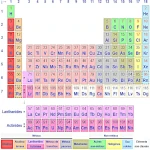
Tungsten (symbol W, atomic number 74) is a transition metal of the 6th period, located in group 6 (formerly VIB) of the periodic table, along with chromium and molybdenum. Its atom has 74 protons, usually 110 neutrons (for the most abundant isotope \(\,^{184}\mathrm{W}\)) and 74 electrons with the electronic configuration [Xe] 4f¹⁴ 5d⁴ 6s². This configuration has four electrons in the 5d subshell and two in the 6s, characteristic of group 6 transition metals.
Exceptional physical properties
Tungsten is a steel-gray, shiny, very dense (19.25 g/cm³), hard metal with the highest melting point of all metals (3422 °C). It has a body-centered cubic (BCC) crystal structure at room temperature. Tungsten has a very high modulus of elasticity (about 411 GPa), making it very rigid. Its electrical conductivity is good (about 30% that of copper) and its thermal conductivity is moderate. Tungsten retains its mechanical properties at high temperatures better than almost any other metal.
Exceptional transformation points
Tungsten melts at 3422 °C (3695 K) - the highest melting point of all metals - and boils at 5555 °C (5828 K). It has the lowest vapor pressure of all metals at high temperatures, making it ideal for high-temperature vacuum applications. Tungsten does not undergo allotropic transformations below its melting point, retaining its body-centered cubic structure until melting.
Chemical reactivity
At room temperature, tungsten is relatively inert and resistant to corrosion due to a thin protective oxide layer. It reacts with oxygen at high temperatures to form WO₃. Tungsten resists most acids but is attacked by mixtures of nitric and hydrofluoric acids. It reacts with halogens, carbon, boron, nitrogen, and sulfur at high temperatures to form various compounds.
Thermal and physical characteristics (summary)
Melting point of tungsten: 3695 K (3422 °C) - the highest of all metals.
Boiling point of tungsten: 5828 K (5555 °C).
Density: 19.25 g/cm³ - very dense, comparable to gold.
Crystal structure at room temperature: Body-centered cubic (BCC).
Modulus of elasticity: 411 GPa - very rigid.
Hardness: 7.5 on the Mohs scale (pure).
Table of Tungsten Isotopes
| Isotope / Notation | Protons (Z) | Neutrons (N) | Atomic mass (u) | Natural abundance | Half-life / Stability | Decay / Remarks |
|---|---|---|---|---|---|---|
| Tungsten-180 — \(\,^{180}\mathrm{W}\,\) | 74 | 106 | 179.946704 u | ≈ 0.12 % | 1.8×10¹⁸ years | Alpha radioactive with extremely long half-life. Considered stable for most applications. |
| Tungsten-182 — \(\,^{182}\mathrm{W}\,\) | 74 | 108 | 181.948204 u | ≈ 26.50 % | Stable | Stable isotope, final product of hafnium-182 decay (Hf-W dating system). |
| Tungsten-183 — \(\,^{183}\mathrm{W}\,\) | 74 | 109 | 182.950223 u | ≈ 14.31 % | Stable | Stable isotope with nuclear spin 1/2, used in NMR spectroscopy. |
| Tungsten-184 — \(\,^{184}\mathrm{W}\,\) | 74 | 110 | 183.950931 u | ≈ 30.64 % | Stable | Most abundant stable isotope in nature. |
| Tungsten-186 — \(\,^{186}\mathrm{W}\,\) | 74 | 112 | 185.954364 u | ≈ 28.43 % | Stable | Stable isotope, second most abundant in the natural mixture. |
Electronic Configuration and Electron Shells of Tungsten
N.B.:
Electron shells:
How electrons are organized around the nucleus (new window).
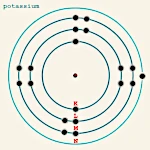
Tungsten has 74 electrons distributed over six electron shells. Its electronic configuration [Xe] 4f¹⁴ 5d⁴ 6s² has a completely filled 4f subshell (14 electrons) and four electrons in the 5d subshell. This configuration can also be written as: K(2) L(8) M(18) N(18) O(32) P(6), or in full: 1s² 2s² 2p⁶ 3s² 3p⁶ 3d¹⁰ 4s² 4p⁶ 4d¹⁰ 4f¹⁴ 5s² 5p⁶ 5d⁴ 6s².
Detailed Structure of the Shells
K shell (n=1): contains 2 electrons in the 1s subshell. This inner shell is complete and very stable.
L shell (n=2): contains 8 electrons distributed as 2s² 2p⁶. This shell is complete, forming a noble gas configuration (neon).
M shell (n=3): contains 18 electrons distributed as 3s² 3p⁶ 3d¹⁰. This complete shell contributes to electronic screening.
N shell (n=4): contains 18 electrons distributed as 4s² 4p⁶ 4d¹⁰. This shell forms a stable structure.
O shell (n=5): contains 32 electrons distributed as 5s² 5p⁶ 4f¹⁴ 5d⁴. The completely filled 4f subshell and the four 5d electrons give tungsten its transition metal properties.
P shell (n=6): contains 6 electrons in the 6s² and 5d⁴ subshells.
Valence Electrons and Oxidation States
Tungsten effectively has 6 valence electrons: two 6s² electrons and four 5d⁴ electrons. Tungsten exhibits several oxidation states, from -2 to +6, with the +6 and +4 states being the most stable and common.
In the +6 oxidation state, tungsten loses its two 6s electrons and four 5d electrons to form the W⁶⁺ ion with the electronic configuration [Xe] 4f¹⁴. This ion is diamagnetic and is found in compounds such as WO₃ (tungsten trioxide) and tungstates (WO₄²⁻). In the +4 state, tungsten forms compounds such as WO₂ (tungsten dioxide) and WCl₄ (tungsten tetrachloride).
Tungsten also has a rich chemistry of lower states and clusters. For example, in cluster compounds such as [W₆Cl₈]Cl₄, tungsten is in an average oxidation state of +2. Tungsten(0) exists in carbonyl complexes such as W(CO)₆. This diversity of oxidation states, combined with tungsten's ability to form multiple bonds with oxygen and other elements, makes it a chemically very rich and useful element in catalysis.
Chemical Reactivity of Tungsten
Reaction with air and oxygen
At room temperature, tungsten is stable in air due to a thin protective oxide layer. At high temperatures (above 400 °C), it gradually oxidizes: 2W + 3O₂ → 2WO₃. Oxidation becomes rapid above 800 °C. Tungsten(VI) oxide (WO₃) is a yellow-green solid that sublimes at 1700 °C. To protect tungsten from oxidation at high temperatures, it is often coated with tungsten silicide (WSi₂) or used in an inert atmosphere or vacuum.
Reaction with water and acids
Tungsten resists water and water vapor up to moderate temperatures. It resists most cold acids but is attacked by:
- Mixture of nitric and hydrofluoric acid: Rapid attack
- Aqua regia: Slow attack
- Hydrogen peroxide: Oxidizes to tungstic acid
- Oxidizing alkaline solutions: Especially in alkaline fusion (Na₂O₂, NaOH + NaNO₃)
Tungsten dissolves in strong bases in the presence of oxidants to form soluble tungstates.
Reactions with halogens and other elements
Tungsten reacts with halogens at high temperatures to form hexahalides: W + 3F₂ → WF₆ (colorless gas); W + 3Cl₂ → WCl₆ (blue-black solid). It reacts with carbon at high temperatures (>1400 °C) to form tungsten carbide WC (melting point 2870 °C) or W₂C, with nitrogen to form tungsten nitride WN, with boron to form tungsten boride WB, and with sulfur to form tungsten sulfide WS₂ (lamellar structure similar to graphite, used as a solid lubricant).
Exceptional melting point
Tungsten's most remarkable property is its extremely high melting point (3422 °C), the highest of all metals. This property is due to the strong metallic bonding resulting from the contribution of 5d electrons to the conduction band and the compact body-centered cubic structure. Tungsten also retains its mechanical strength at high temperatures better than most other materials. These properties make it the material of choice for very high temperature applications.
Industrial and Technological Applications of Tungsten
- in incandescent light bulb filaments and electronic tubes (major historical application);
- for cutting and machining tools (tungsten carbide - "hard metal") - current dominant application (~60% of consumption);
- in heavy alloys for military applications (penetrators, armor);
- as electrodes for TIG welding (Tungsten Inert Gas);
- for filaments and X-ray targets in X-ray tubes;
- in high-performance electrical contacts (circuit breakers, switches);
- as an alloying element in steels and superalloys (high-speed steels, maraging steels);
- for heat shields and high-temperature furnace components;
- in nuclear applications (radiation shields, divertor materials in tokamaks);
- as a catalyst in chemistry (tungsten sulfide for hydrodesulfurization);
- for counterweights and applications requiring high density (aeronautics, sports);
- in electrical contacts for automobiles;
- as a dopant in semiconductors;
- for wear and corrosion resistant coatings;
- in aerospace applications (rocket engine nozzles, heat shields).
Light Bulb Filaments: The Lighting Revolution
History and importance
Tungsten revolutionized lighting in the early 20th century when it replaced carbon and osmium filaments in incandescent bulbs. Before tungsten, filaments had a very limited lifespan and low light efficiency. The introduction of ductile tungsten filament in 1910 by William D. Coolidge of General Electric made it possible to produce more durable, brighter, and more efficient bulbs. This innovation was so important that tungsten became synonymous with electric lighting for nearly a century.
Ideal properties for filaments
- Very high melting point: Allows the filament to be heated to high temperatures (typically 2500-3000 K) to produce white light without melting.
- Low vapor pressure: Minimizes filament evaporation, increasing its lifespan.
- Appropriate electrical resistivity: Neither too high nor too low for practical use.
- Ductility: Can be drawn into very fine wires (down to 10-20 µm in diameter).
- Stability: Retains its properties for thousands of hours of operation.
Evolution and decline
Tungsten filament bulbs dominated lighting for most of the 20th century. Successive improvements included filaments with controlled crystalline structure, the introduction of halogen gases (halogen bulbs) to reduce tungsten evaporation, and reflective coatings to improve efficiency. However, in the 21st century, incandescent bulbs have been largely replaced by more efficient technologies (LED, fluorescent) for energy efficiency reasons. Nevertheless, some specialized applications (projectors, ovens, scientific equipment) continue to use tungsten filaments.
Tungsten Carbide: The "Hard Metal"
Industrial importance
The most important current application of tungsten is tungsten carbide (WC), often called "hard metal." Tungsten carbide accounts for about 60% of global tungsten consumption. It combines the hardness and wear resistance of carbides with some toughness, creating an ideal material for cutting and machining tools.
Manufacturing and properties
Tungsten carbide is produced by powder metallurgy: tungsten and carbon powders are mixed, pressed into the desired shape, and sintered at high temperature (1400-1600 °C). Often, a metal binder (usually 5-15% cobalt) is added to improve toughness. The resulting material has exceptional properties:
- Extreme hardness: 9 on the Mohs scale (comparable to corundum)
- Wear resistance: Very high even at high temperatures
- High modulus of elasticity: 600-700 GPa (almost double that of steel)
- Thermal stability: Retains its properties up to 500-600 °C
Applications of tungsten carbide
- Cutting tools: Milling cutters, drills, turning inserts for machining metals, plastics, wood.
- Mining tools: Drill bits, bucket teeth.
- Construction tools: Saw blades, compaction rollers.
- Wear-resistant components: Wire guides, dies, drawing dies.
- Jewelry: Tungsten carbide rings and wedding bands (very scratch resistant).
Military and Defense Applications
Kinetic penetrators
Tungsten heavy alloys (WHA), typically containing 90-97% tungsten with nickel and iron or copper as binders, are used as kinetic penetrators in anti-tank ammunition. These projectiles use their very high density (17-19 g/cm³) and mechanical strength to pierce armor. Advantages over depleted uranium penetrators include the absence of radioactive toxicity and environmental controversy.
Armor and protection
Tungsten is also used in composite armor to protect against projectiles and shrapnel. Its high density allows it to effectively absorb kinetic energy. Tungsten-based alloys and composites are used in bulletproof vests, vehicle armor, and protection for strategic installations.
Electronic and Electrical Applications
TIG Welding
Tungsten is the standard material for electrodes in TIG (Tungsten Inert Gas) welding. Tungsten electrodes, often doped with thorium, cerium, lanthanum, or zirconium, have a high melting point, low wear, and good electron emission. They allow the creation and maintenance of a stable electric arc at very high temperatures (up to 10,000 °C) without melting.
Electrical contacts
Tungsten or tungsten-copper/tungsten-silver alloy electrical contacts are used in circuit breakers, switches, and other high-performance electrical equipment. Tungsten provides resistance to electric arcs and erosion, while copper or silver ensures electrical conductivity.
Semiconductor devices
Tungsten is used in semiconductors as a barrier material (diffusion barrier) and for interconnections. Its high melting temperature and low diffusivity in silicon make it an ideal material for preventing metal diffusion in semiconductor devices. Tungsten is also used as a gate material in transistors and as a contact material.
Nuclear Applications
Radiation shields
Due to its high density and high atomic number (Z=74), tungsten is an excellent absorber of X-rays and gamma rays. It is used in radiation shielding in medical (radiology), industrial (gammagraphy), and nuclear applications. Tungsten alloys are used for containers of radioactive materials and nuclear reactor shields.
Nuclear fusion applications
In experimental fusion reactors (tokamaks), tungsten is used as a material for the divertor, the part of the reactor that must withstand the most intense heat and particle fluxes. Its high melting temperature, low tritium retention, and good thermal conductivity make it the material of choice for this extreme application.
Toxicity and Environmental Concerns
Low chemical toxicity
Metallic tungsten and its insoluble compounds have low chemical toxicity. Metallic tungsten is considered biologically inert. However, some soluble tungsten compounds, particularly tungstates, have moderate toxicity. Recent studies suggest that tungsten could interfere with the metabolism of molybdenum (an essential element) due to their chemical similarities.
Environmental issues related to extraction
The extraction and processing of tungsten can generate environmental impacts:
- Mine waste: Processing residues may contain heavy metals and chemicals.
- Erosion and sedimentation: Related to mining activities.
- Use of chemicals: Processing often uses acids and solvents that must be managed properly.
- Energy consumption: The production of tungsten metal is energy-intensive due to the high temperatures required.
Recycling
Tungsten is widely recycled, with an estimated rate of 30-40%. Recycling sources include:
- Production waste: Scrap, dust, sludge from carbide and metallurgy plants.
- Used tools: Drills, carbide cutting inserts.
- Used catalysts: From chemical processes.
- Military scrap: Ammunition and armor.
Recycling is economically attractive due to the value of tungsten and helps reduce pressure on mining resources. Recycling methods include chemical processes (acid attack, alkaline fusion) and pyrometallurgical processes.
Occupational exposure
Occupational exposure to tungsten occurs in mines, processing plants, tool and equipment manufacturers. The main routes of exposure are inhalation of dust and fumes. Studies on workers exposed to tungsten and tungsten carbide have shown potential lung effects, often associated with cobalt used as a binder in carbides. Ventilation and respiratory protection precautions are therefore necessary.
 The energies required for nuclear fusion and why uranium is a limit
 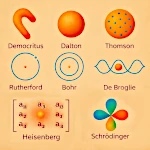 The Atom in All Its Forms: From Ancient Intuition to Quantum Mechanics