

Lead (Pb, Z = 82): The Heavy Metal of Civilization and Toxicity
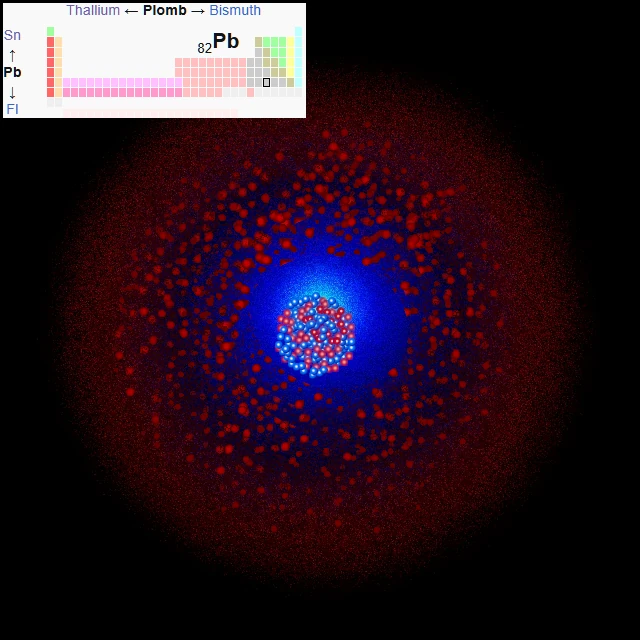
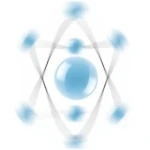
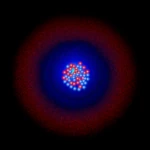
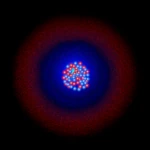
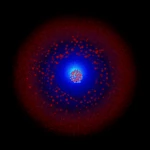
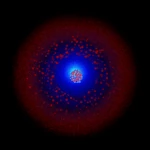
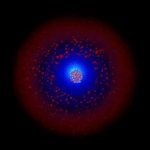
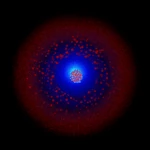
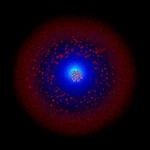
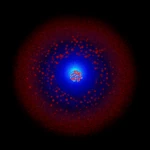
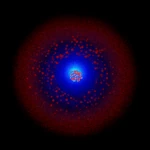
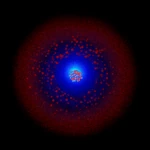
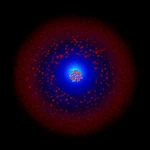
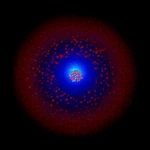
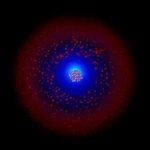
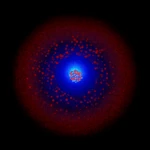
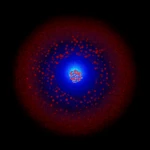
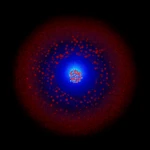
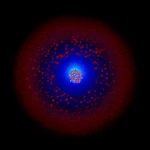
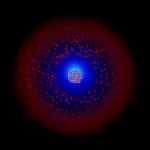
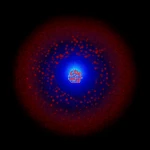
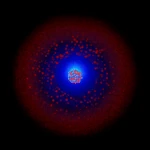
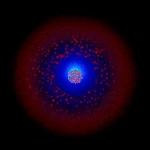
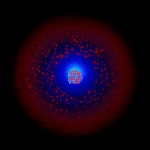
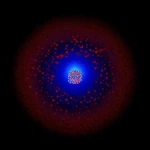
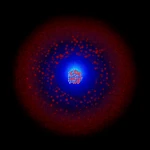
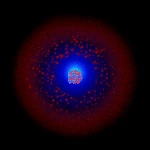
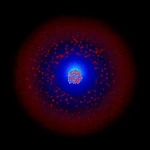
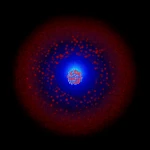
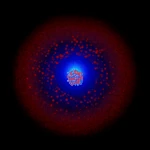
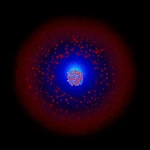
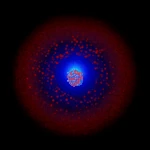
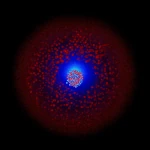
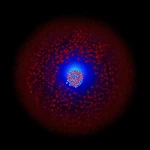
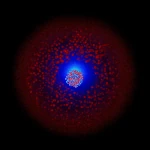
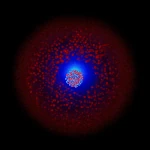
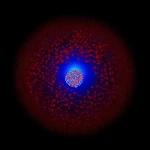
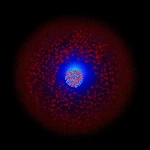
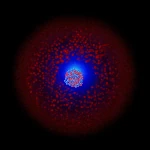
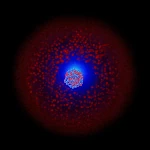
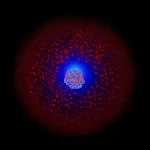
Image description:
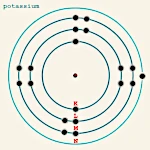
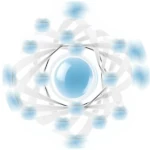
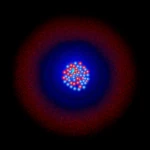
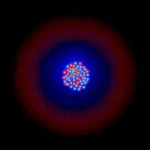
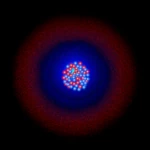
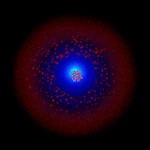
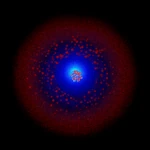
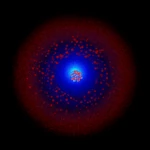
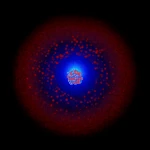
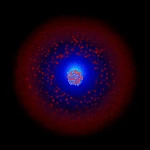
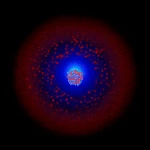
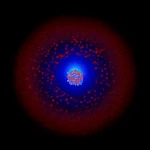
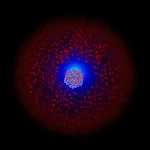
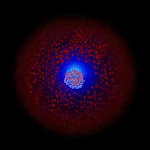
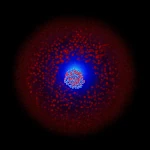
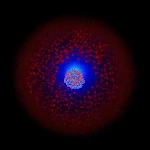
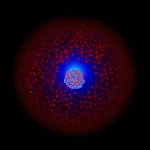
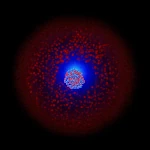
Simplified atomic model of the lead atom. The most abundant stable isotope is \(^{208}\mathrm{Pb}\)
with its 82 protons, 82 electrons, and 126 neutrons.
Image source: astronoo.com (new window)
Role of Lead in Astrophysics and Geochronology
Endpoint of radioactive decay chains
Lead plays a unique cosmological and geological role: it is the stable endpoint of three of the four main natural radioactive decay chains. The stable isotopes of lead are the final products of the decay of uranium and thorium:
- \(^{238}\mathrm{U}\) (half-life 4.47 Ga) → \(^{206}\mathrm{Pb}\) (Lead-206)
- \(^{235}\mathrm{U}\) (half-life 0.70 Ga) → \(^{207}\mathrm{Pb}\) (Lead-207)
- \(^{232}\mathrm{Th}\) (half-life 14.0 Ga) → \(^{208}\mathrm{Pb}\) (Lead-208)
The fourth stable isotope, \(^{204}\mathrm{Pb}\), is not radiogenic; it is called "primordial" and has been present since the formation of the solar system. Thus, almost all the lead on Earth today was formed by the radioactive decay of heavier elements over billions of years.
The ultimate geological clock
These decays make the uranium/thorium-lead isotopic system one of the most powerful and widely used geological clocks. By measuring the ratios \(^{206}\mathrm{Pb}/^{238}\mathrm{U}\), \(^{207}\mathrm{Pb}/^{235}\mathrm{U}\), and \(^{207}\mathrm{Pb}/^{206}\mathrm{Pb}\) in a rock or mineral (such as zircon), geochronologists can accurately date events ranging from the formation of the solar system (4.567 Ga) to recent geological processes a few million years old. This method established the age of the Earth at about 4.54 billion years.
Witness to the evolution of the Earth's crust and ancient pollution
Lead isotopic ratios also serve as a geochemical tracer. Since different geological reservoirs (mantle, continental crust, ore deposits) have distinct lead isotopic signatures, the origin of magmas, sediments, or even historical atmospheric pollution (the lead isotopic signatures of 1970s car exhaust differ from those of Roman mines) can be traced.
Cosmic abundance and synthesis
The cosmic abundance of lead is about 1.0×10⁻¹¹ that of hydrogen. It is synthesized in stars mainly by the s-process (slow neutron capture) in AGB stars, with a significant contribution from the r-process during supernovae. It is the heaviest stable element efficiently produced by the s-process, making it an abundance peak in the element spectrum. Its doubly magic nucleus (Z=82, complete proton shell) gives it exceptional stability.
History of Lead Use
Etymology and symbolism
The chemical symbol Pb comes from the Latin "plumbum", which also gave us the words "plumber" and "plumbing". In alchemy, lead was associated with the planet Saturn and symbolized heaviness, melancholy, and the raw material to be transmuted into gold (the goal of the "Great Work").
Antiquity and the Roman Empire
Lead is one of the first metals worked by humans, along with copper and gold. Its ease of extraction (simple reduction of the galena ore, PbS) and its properties (malleable, fusible, corrosion-resistant) made it a material of choice for the Romans. They used it massively for:
- Water pipes (aqueducts, pipes): The word "plumbing" comes directly from this.
- Reservoirs and bathtubs.
- Storage for wine and food: Lead acetate ("sugar of lead"), formed by the reaction of lead with acidic wine, gave a sweet taste but was extremely toxic.
- Cosmetics (white lead-based makeup, lead carbonate).
- Solder for pipes and iron objects.
Some historians suggest that chronic lead poisoning (saturnism) may have contributed to the decline of the Roman elite, affecting fertility and intellectual abilities.
From the Middle Ages to the Industrial Revolution
The use of lead continued: cathedral roofs and stained glass, printing type, ammunition (bullets, shot), paint pigments (white lead for white, lead chromate for yellow), and weights. The Industrial Revolution greatly increased its production and uses, especially with the advent of lead paint and leaded gasoline in the 20th century.
Deposits and production
The main lead ore is galena (PbS), a cubic metallic gray mineral often associated with sphalerite (ZnS) and silver. The main producing countries are China (about half of world production), Australia, the United States, Peru, and Mexico. Annual mining production is about 4.5 million tons. A significant portion (over 50%) now comes from recycling, especially from batteries.
The price of lead is moderate and generally follows economic cycles and demand from the automotive industry (for batteries).
Structure and Fundamental Properties of Lead
Classification and atomic structure
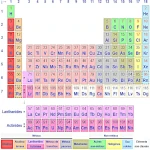
Lead (symbol Pb, atomic number 82) is a post-transition element, located in group 14 (carbon group) of the periodic table, along with carbon, silicon, germanium, and tin. It is the heaviest and most metallic member of this group. Its atom has 82 protons, usually 125 to 126 neutrons (for isotopes \(^{207}\mathrm{Pb}\) and \(^{208}\mathrm{Pb}\)), and 82 electrons with the electronic configuration [Xe] 4f¹⁴ 5d¹⁰ 6s² 6p². It has four valence electrons (6s² 6p²).
Physical properties
Lead is a bluish-gray, dense, soft, malleable metal with a low melting point.
- High density: 11.34 g/cm³ at 20 °C.
- Very soft: Can be scratched with a fingernail. Hardness of 1.5 on the Mohs scale.
- Malleability and ductility: Good, can be rolled into sheets or drawn into wire.
- Low melting point: 327.5 °C (easy to melt and cast).
- Low conductivity: Poor conductor of electricity (about 1/10 that of silver) and heat.
- Opacity to radiation: Excellent absorption of X-rays and gamma rays, hence its use in radiation shielding.
Lead crystallizes in a face-centered cubic (FCC) structure.
Transformation points
Lead melts at 327.46 °C (600.61 K) and boils at 1749 °C (2022 K). Its wide temperature range in the solid state and ease of molding have historically facilitated its use.
Chemical reactivity
Lead is a rather unreactive metal due to the formation of a protective layer of oxide, carbonate, or sulfate on its surface. It resists atmospheric corrosion and attack by many chemical agents, especially concentrated sulfuric acid (used in batteries). However, it is attacked by nitric and acetic acids.
Summary of physical characteristics
Density: 11.34 g/cm³.
Melting point: 600.61 K (327.46 °C).
Boiling point: 2022 K (1749 °C).
Crystal structure: Face-centered cubic (FCC).
Electronic configuration: [Xe] 4f¹⁴ 5d¹⁰ 6s² 6p².
Main oxidation states: +2 and +4.
Table of Lead Isotopes
| Isotope / Notation | Protons (Z) | Neutrons (N) | Atomic mass (u) | Natural abundance | Half-life / Stability | Decay / Remarks |
|---|---|---|---|---|---|---|
| Lead-204 — \(^{204}\mathrm{Pb}\) | 82 | 122 | 203.973044 u | ≈ 1.4 % | Stable | Only stable non-radiogenic isotope. "Primordial" isotope, used as a reference in geochronology calculations. |
| Lead-206 — \(^{206}\mathrm{Pb}\) | 82 | 124 | 205.974465 u | ≈ 24.1 % | Stable | Stable final product of \(^{238}\mathrm{U}\) decay. Major radiogenic isotope. |
| Lead-207 — \(^{207}\mathrm{Pb}\) | 82 | 125 | 206.975897 u | ≈ 22.1 % | Stable | Stable final product of \(^{235}\mathrm{U}\) decay. Crucial for \(^{207}\mathrm{Pb}/^{206}\mathrm{Pb}\) dating. |
| Lead-208 — \(^{208}\mathrm{Pb}\) | 82 | 126 | 207.976652 u | ≈ 52.4 % | Stable | Stable final product of \(^{232}\mathrm{Th}\) decay. Most abundant and heaviest stable isotope known (doubly magic nucleus). |
Electron Configuration and Electron Shells of Lead
N.B.:
Electron shells:
How electrons are organized around the nucleus (new window).
Lead has 82 electrons distributed over six electron shells. Its electronic configuration [Xe] 4f¹⁴ 5d¹⁰ 6s² 6p² has four valence electrons in the 6th shell (s² p²), like carbon or silicon, but with marked relativistic effects that make the 6s² pair very inert ("inert pair effect"). This can also be written as: K(2) L(8) M(18) N(32) O(18) P(4), or in full: 1s² 2s² 2p⁶ 3s² 3p⁶ 3d¹⁰ 4s² 4p⁶ 4d¹⁰ 4f¹⁴ 5s² 5p⁶ 5d¹⁰ 6s² 6p².
Detailed Structure of Shells
K shell (n=1): 2 electrons (1s²).
L shell (n=2): 8 electrons (2s² 2p⁶).
M shell (n=3): 18 electrons (3s² 3p⁶ 3d¹⁰).
N shell (n=4): 32 electrons (4s² 4p⁶ 4d¹⁰ 4f¹⁴).
O shell (n=5): 18 electrons (5s² 5p⁶ 5d¹⁰).
P shell (n=6): 4 electrons (6s² 6p²).
Valence Electrons and Oxidation States
Lead has 4 valence electrons (6s² 6p²). However, due to the inert pair effect, the +2 oxidation state (where only the 6p² pair is lost) is more stable and common than the +4 state (which would require losing the 6s² pair as well, which is stabilized).
- Lead(II) (Pb²⁺): The predominant state. Lead(II) compounds are generally ionic and water-soluble (e.g., lead(II) nitrate, lead(II) acetate), contributing to their toxicity. They often form complexes.
- Lead(IV) (Pb⁴⁺): Exists but is a powerful oxidant and less stable. Found in covalent compounds such as lead dioxide (PbO₂, used in batteries) or tetraethyl lead (former anti-knock agent).
- Elemental state (Pb⁰): The metal itself.
This chemistry contrasts with that of carbon, where the +4 state is the rule, illustrating the evolution of properties within a periodic table group.
Chemical Reactivity of Lead
Reaction with air and oxygen
Freshly cut lead has a metallic luster that quickly tarnishes in air, forming a thin gray layer of lead(II) oxide (PbO) and basic lead carbonate (2PbCO₃·Pb(OH)₂), which protects it from further oxidation. When heated in air, it first forms litharge (PbO, yellow), then at higher temperatures, red lead (Pb₃O₄), a historical pigment.
Reaction with water and acids
- Pure and soft water: Lead resists corrosion because it forms an insoluble protective layer. However, soft, acidic, or oxygen-rich water can slowly corrode it, releasing toxic Pb²⁺ ions into the water. This is the problem with old pipes.
- Acids:
- Hydrochloric acid (HCl): Attack is limited by the formation of insoluble lead(II) chloride (PbCl₂).
- Sulfuric acid (H₂SO₄): Concentrated, it forms an insoluble protective layer of lead(II) sulfate (PbSO₄), making lead ideal for battery casings.
- Nitric acid (HNO₃): Easily dissolves it, forming soluble lead(II) nitrate, Pb(NO₃)₂.
- Acetic acid (vinegar): Attacks it, especially in the presence of oxygen, forming soluble lead(II) acetate, the toxic and sweet "sugar of lead".
Important compounds
- Lead(II) oxide (PbO): Litharge (yellow) or massicot (red). Used in glass, ceramics, batteries.
- Lead dioxide (PbO₂): Brown-black powder, powerful oxidant, component of the positive plate in lead-acid batteries.
- Red lead (Pb₃O₄): Bright red pigment, anti-corrosion for metals.
- Basic lead carbonate (2PbCO₃·Pb(OH)₂): White lead, a highly toxic historical pigment.
- Lead chromate (PbCrO₄): Chrome yellow pigment.
- Lead sulfate (PbSO₄): White, insoluble, forms on the electrodes of discharged batteries.
- Tetraethyl lead (Pb(C₂H₅)₄): Anti-knock additive for gasoline, now banned.
Industrial and Technological Applications of Lead (Past and Present)
- Main component of lead-acid batteries (automotive starter, backup power): the largest current application (≈80% of consumption);
- In electrical cables for protective sheathing (declining use);
- As radiation shielding against X-rays and gamma rays (hospitals, laboratories, nuclear power plants);
- In plumbing (pipes, solder): major historical use, now banned for drinking water in most countries;
- In paint pigments (white lead, red lead, chrome yellow): banned or strictly regulated;
- As an anti-knock additive in gasoline (tetraethyl lead): progressively banned since the 1970s;
- In ammunition (bullets, shot);
- As an alloying element: in solders (tin-lead, now lead-free for electronics), low-melting alloys, and printing type;
- In the manufacture of crystal glass (lead oxide improves brilliance and sonority);
- As a stabilizer in PVC plastics (declining use);
- In counterweights (wheel balancing, boat keels);
- As a material for roofs and stained glass;
- In pyrotechnics (certain lead compounds);
- As a vibration and noise absorber;
- Historically, in cosmetics and remedies (disastrous use).
Key Applications: Batteries and Radiation Protection
Lead-acid batteries
Invented in 1859 by Gaston Planté, it is the first rechargeable battery. Its success lies in its reliability, low cost, and high capacity to deliver intense currents.
Principle:
Negative electrode: Spongy lead (Pb).
Positive electrode: Lead dioxide (PbO₂).
Electrolyte: Sulfuric acid (H₂SO₄) at ~30%.
Discharge reaction: Pb + PbO₂ + 2H₂SO₄ → 2PbSO₄ + 2H₂O
Applications are ubiquitous: vehicle starting (SLI), backup power (UPS), electric vehicles (traction), off-grid photovoltaic systems. The recycling of these batteries is very efficient (>99% in developed countries).
Radiation protection
The high density and atomic number of lead make it an ideal shield against ionizing radiation. It effectively absorbs X-rays and gamma rays. It is used in the form of:
- Plates and bricks for the walls of radiology rooms.
- Aprons, gloves, and mobile screens for medical personnel.
- Containers for the transport of radioactive sources ("lead" drums).
- Lead glass for control room windows.
Toxicology and Public Health: Saturnism
Mechanism of toxicity
Lead is a cumulative toxin with no known biological function. It interferes with many enzymatic processes by substituting for other essential metal ions, particularly calcium (Ca²⁺) and zinc (Zn²⁺). Its main targets are:
- Nervous system: In children, it irreversibly damages brain development, leading to cognitive deficits (lower IQ), behavioral and attention disorders. In adults, it causes neuropathies.
- Hematopoietic system: It inhibits heme synthesis, leading to anemia.
- Kidneys: Causes nephropathies.
- Cardiovascular system: Associated with hypertension.
- Bones: It accumulates in bones, from which it can be released later (during pregnancy, breastfeeding, or osteoporosis).
Routes of exposure
- Ingestion: Main route in children. Household dust contaminated with flaking lead paint, polluted soils, water from old pipes, certain traditional remedies or cosmetics.
- Inhalation: Welding fumes, industrial dust, leaded gasoline vapors (historical).
- Transplacental: Lead crosses the placental barrier, affecting the fetus.
Thresholds and regulations
There is no demonstrated safe threshold, especially for children. The WHO considers a blood lead level (BLL) above 5 µg/dL in children to be concerning. Health authorities recommend the "precautionary principle": reduce exposure as much as possible.
Environment and Pollution
Sources of pollution
- Historical: Combustion of leaded gasoline (global atmospheric emissions), old paints, metallurgical industries.
- Current: Metal smelting and recycling, certain mining activities, coal combustion, shooting ranges, fishing weights (lead sinkers).
Environmental cycle
Lead emitted into the atmosphere deposits on soils and waters. It is not very mobile in most soils and accumulates in the surface layers. In acidic environments, it can become more mobile and contaminate groundwater. It does not degrade; its persistence is millennial.
Disasters and polluted sites
Notable cases include the city of Kabwe in Zambia (pollution from the old lead mine), the West Dallas neighborhood in the United States (former smelter), and the widespread contamination from leaded gasoline, whose fallout is measurable in polar ice and lake sediments worldwide.
Recycling and Regulation
Battery recycling
This is a model of the circular economy. Used batteries are collected, crushed, and the components are separated. The lead is remelted and refined to produce secondary lead of identical quality to primary lead. This process uses up to 80% less energy than mining.
Regulation and phase-out
Given its proven toxicity, strict international regulations have been implemented:
- Ban on leaded gasoline: Completed in most countries (the last country, Algeria, banned it in 2021).
- Ban on lead paints: For domestic use in most developed countries since the 1970s-80s. The Rotterdam Convention regulates its trade.
- Replacement of lead pipes: Mandatory in new constructions, programs to replace old ones.
- RoHS Directive: Restricts the use of lead in electrical and electronic equipment (lead-free solder).
- International conventions: The Basel Convention governs transboundary movements of lead-containing waste.
Remediation and management of contaminated sites
Remediation is complex and costly. Methods include excavation and burial of contaminated soils, stabilization/solidification (locking lead in a matrix), or phytoremediation (use of accumulator plants, such as certain ferns).
Perspectives
Lead illustrates the paradox of a useful but dangerous material. The goal is to:
- Containment and elimination of existing sources (paints, pipes, soils).
- Substitution in remaining applications (long-term research for alternatives to lead-acid batteries).
- Closed-loop management for unavoidable applications (batteries, radiation protection) via 100% recycling.
- Monitoring and prevention to protect vulnerable populations, especially children.
The history of lead is a powerful warning about the need to assess the long-term impacts of technologies before their mass diffusion.
 The energies required for nuclear fusion and why uranium is a limit
 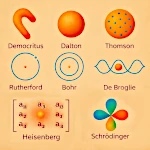 The Atom in All Its Forms: From Ancient Intuition to Quantum Mechanics