

氢(H,Z=1):一种无形却影响深远的元素
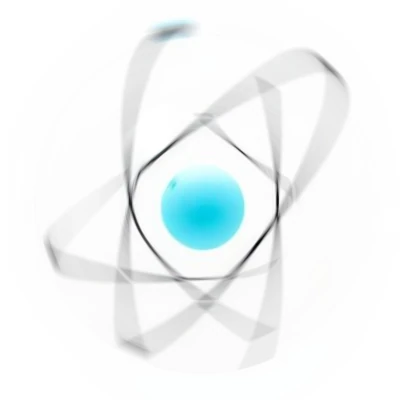
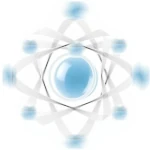
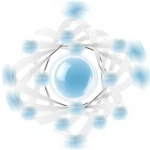
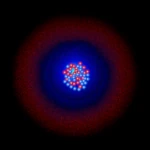
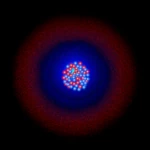
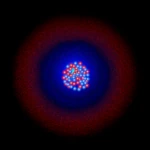
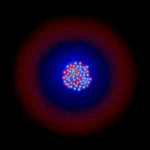
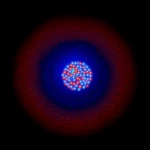
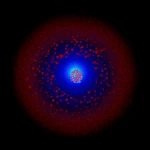
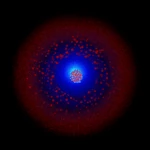
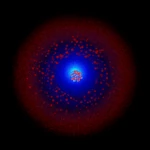
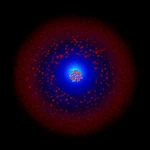
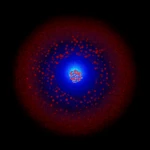
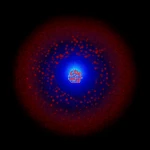
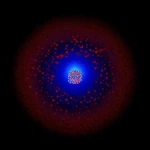
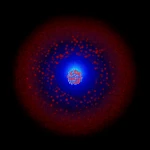
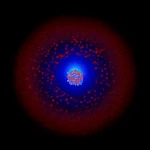
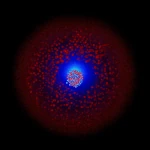
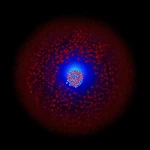
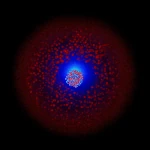
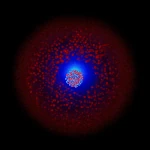
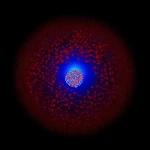
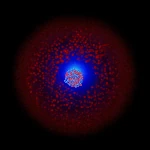
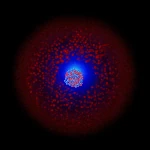
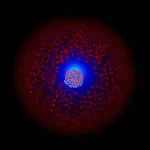
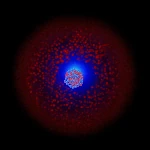
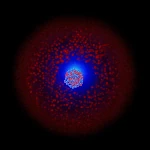
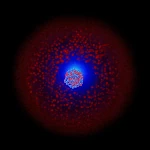
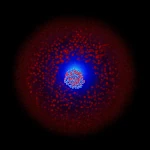
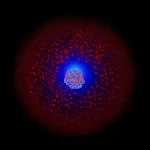
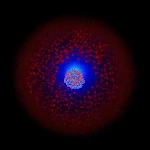
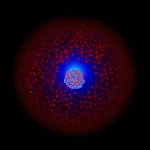
Simplified atomic model of the hydrogen atom.
Image source: astronoo.com (新窗口)
氢气的发现历史
As early as the 17th century, chemists observed that a flammable gas was released during the reaction of a metal with an acid. In 1766, 亨利·卡文迪许 (1731-1810) isolated this gas and called it "flammable air," demonstrating that it produced water when burned. In 1783, 安托万·拉瓦锡 (1743-1794) correctly interpreted Cavendish's results and demonstrated that water is a compound, not an element. He named this gas 氢 (from the Greek 水 = water and 基因 = create).
结构与基本性质
Hydrogen (symbol H, atomic number 1) is the simplest chemical element, consisting of a single proton and electron, known as protium (¹H).
Other isotopes exist: deuterium \(\,^{2}\mathrm{H}\), tritium \(\,^{3}\mathrm{H}\), \(\,^{4}\mathrm{H}\)…
At room temperature, hydrogen exists as a diatomic gas (H₂), extremely light (density ≈ 0.08988 g/L), colorless, odorless, and highly flammable.
The temperature at which the liquid and solid states of hydrogen can coexist in equilibrium (melting point): 13.99 K (−259.16 °C).
The temperature at which it transitions from liquid to gas (boiling point): 20.271 K (−252.879 °C).
氢同位素表
| 同位素 / 符号 | 质子 (Z) | 中子(N) | 原子质量(u) | 天然丰度 | 半衰期/稳定性 | 衰变/备注 |
|---|---|---|---|---|---|---|
| 氕 — \(\,^{1}\mathrm{H}\,\) | 1 | 0 | 1.007825 u | ≈ 99.985% | 稳定的 | 原子核缩减为一个质子;原子氢的基础。 |
| 氘 — \(\,^{2}\mathrm{H}\) (D) | 1 | 1 | 2.014102 u | ≈ 0.0156% | 稳定 | 一个质子 + 一个中子;束缚核,用于核磁共振和聚变。 |
| 氚——\(\,^{3}\mathrm{H}\)(T) | 1 | 2 | 3.016049 u | 追踪 | 12.32年 | 放射性β⁻衰变生成³He。在反应堆中产生,用于氘-氚聚变。 |
| 极端中子同位素——\(\,^{4}\mathrm{H},\,^{5}\mathrm{H},\,^{6}\mathrm{H},\,^{7}\mathrm{H}\) | 1 | 3 — 6 | — (共鸣) | 非自然的 | \(10^{-22}\) — \(10^{-21}\) 秒 | 实验室中观察到极不稳定的状态;立即通过中子发射衰变。 |
电子构型与电子壳层
注意::
Electron shells: 电子如何在原子核周围排列 (新窗口).
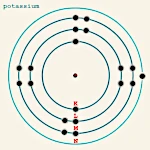
氢只有1个电子分布在一个电子壳层中。其完整电子排布为:1s¹,位于K壳层。氢是元素周期表中最简单的元素。
壳层的详细结构
K壳层 (n=1): Contains only 1 electron in the 1s sub-shell. This single shell is incomplete, as it can hold up to 2 electrons. Therefore, 1 electron is missing to saturate this first shell and reach the stable configuration of helium.
价电子与氧化态
The single electron (1s¹) is the 价电子 of hydrogen. This configuration explains its unique chemical properties:
By losing its 1s electron, hydrogen forms the H⁺ ion (oxidation state +1), which is actually just an isolated proton. This state is common in acids and aqueous solutions.
By gaining 1 electron, hydrogen forms the hydride ion H⁻ (oxidation state -1), present in metallic hydrides such as NaH or LiH, thus adopting the stable configuration of helium [He].
The oxidation state 0 corresponds to dihydrogen H₂, its natural molecular form, where two hydrogen atoms share a pair of electrons forming a simple covalent bond.
氢的电子构型只有一个1s电子,这使其在元素周期表中占据独特且模糊的位置。这种结构赋予它特殊的性质:氢既能失去电子(类似碱金属),也能获得电子(类似卤素),表现出双重化学行为。然而,与碱金属不同,氢在常温常压下是非金属,主要形成共价键而非离子键。H⁺离子极小(仅为一个质子),在溶液中从未以孤立形式存在,始终与水分子结合形成水合氢离子H₃O⁺。
氢气(H₂)是一种无色、无味、极轻的气体(已知最轻的分子),且高度易燃。它与氧气燃烧仅生成水,因此是一种理想的清洁燃料。氢能与几乎所有非金属形成共价键,并能形成氢键——这种虽弱但对许多生物和化学现象至关重要的相互作用。
氢气的重要性绝对基础且普遍:氢是宇宙中最丰富的元素(约占重子质量的75%),是恒星的主要成分,在恒星内部聚变为氦并释放太阳能;它对所有有机化学和生命至关重要,存在于水H₂O、所有有机化合物、酸和碱中;氢键稳定了DNA和蛋白质的结构,并决定了水的独特性质;工业上,氢气被大量用于哈伯-博世法生产氨NH₃(肥料的基础)、石油精炼(加氢)、甲醇生产以及许多化学品的合成;氢气被视为未来脱碳经济的能源载体:燃料电池将氢气转化为电能,唯一副产品是水,氢动力汽车正在发展,氢气可储存过剩的可再生能源;在冶金中,氢气用作还原剂;自然界存在三种同位素:氕¹H(99.98%)、氘²H或D(0.02%,用作示踪剂和核聚变)、氚³H或T(放射性,用于测年和聚变研究)。
化学反应活性
Hydrogen is a powerful reducing agent and forms chemical bonds with many elements: halogens, oxygen, sulfur, metals, etc. It forms hydrides and can act as an acid (proton donor) or a base (proton acceptor) depending on the context. Hydrogen is involved in the reduction of metal oxides by releasing a proton when acting as an 酸, and in the hydrogenation of organic compounds by capturing a proton when acting as a 基础.
氢气的工业与技术应用
- 生产氨,一种用于肥料的基础产品;
- 清洁并提高炼油厂燃料的质量;
- 在燃料电池中,氢气被直接转化为电能;
- 作为超冷燃料来推进火箭;
- 作为一种旨在减少二氧化碳排放的经济体中的清洁能源;
- 例如,在制造人造黄油的过程中,对油脂进行氢化处理;
- 生产甲醇,用于塑料、溶剂和化学品;
- 作为化学还原剂,用于转化某些金属或非金属化合物;
- 作为接近零排放车辆(汽车、公交车、火车或船只)的燃料;
- 储存太阳能或风能产生的多余电力;
- 在低温学及极低温材料研究领域;
- 作为核聚变项目中的实验燃料(氘和氚);
- 在核磁共振成像中,使用氘同位素追踪特定分子或用于氘代溶剂中。
- 作为防止敏感化合物氧化的保护气体。
在天体物理学和宇宙学中的作用
Hydrogen accounts for about 75% of the baryonic mass of the universe. It was synthesized in large quantities during the Big Bang. In stars, it serves as fuel for thermonuclear fusion reactions via the proton-proton cycle or the CNO cycle. In the interstellar medium, it is found in 原子 (H I), 分子 (H₂), or 电离的 (H⁺) forms. Its 21 cm line is a major tool in radio astronomy for mapping the galactic structure.
氢原子是最简单的量子系统,也是检验量子力学和量子电动力学(QED)预测的模型。其电子光谱已被精确测量,可用于约束基本常数,并探索这些常数随时间或空间变化的假说。
注::
The 21 cm line is a 无线电信号 emitted by neutral hydrogen in space.
It occurs when a slight change in the orientation of the spins of the proton and electron in the hydrogen atom releases a photon.
Although this transition is rare and very weak, it is very useful for astronomers to "see" the distribution of hydrogen in our galaxy and nearby galaxies, as it easily passes through dust clouds that block visible light.
 核聚变所需的能量以及为什么铀是一个极限
 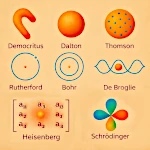 原子的各种形态:从古代直觉到量子力学