

锑(Sb,Z=51):被忽视的战略性准金属
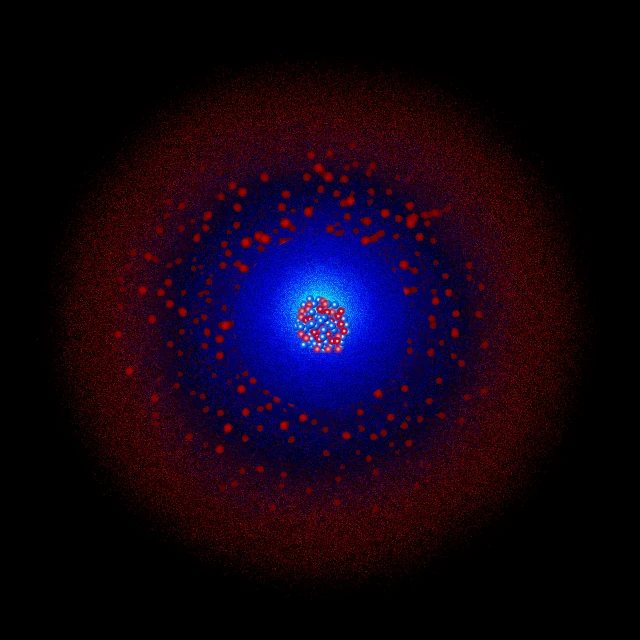
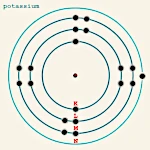
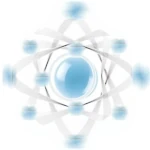
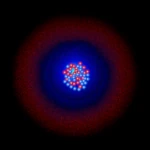
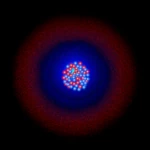
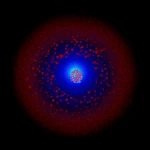
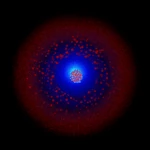
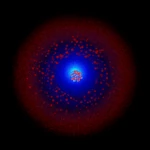
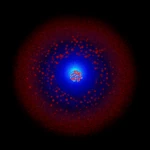
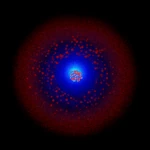
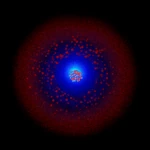
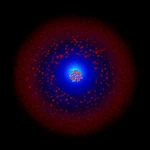
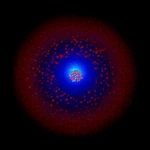
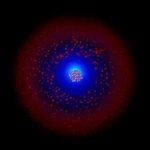
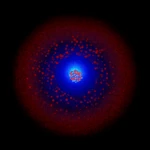
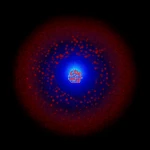
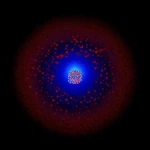
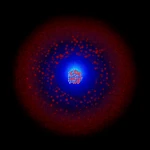
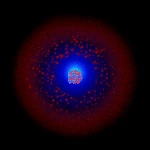
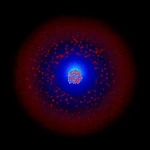
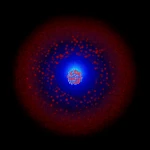
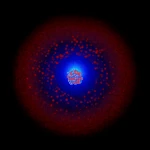
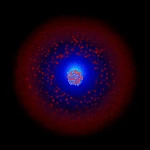
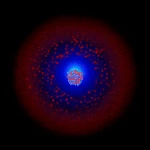
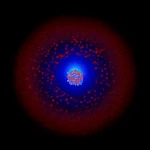
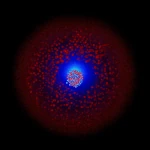
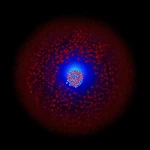
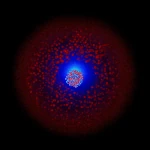
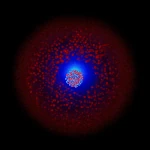
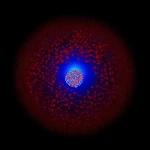
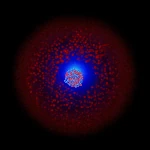
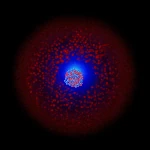
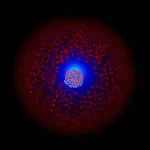
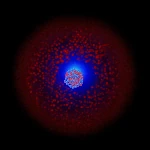
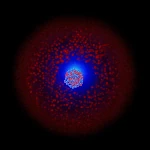
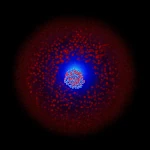
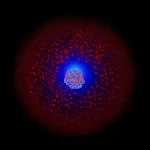
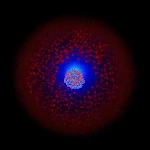
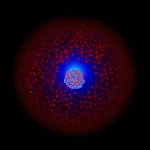
Image description: Simplified atomic model of the antimony atom. The stable isotope is \(\,^{121}\mathrm{Sb}\,\)
with its 51 protons, 51 electrons, and 70 neutrons.
Image source:
astronoo.com (新窗口)
在天体物理学和宇宙学中的作用
锑的恒星合成
Antimony is synthesized in stars mainly through the 慢速中子俘获过程 (slow neutron capture) in asymptotic giant branch (AGB) stars, with minor contributions from the r-process (rapid neutron capture) during supernovae and neutron star mergers. The two stable isotopes of antimony are produced by these processes.
宇宙中极其稀少的丰度
锑在宇宙中的丰度极低,其原子数量约为氢的3×10⁻¹¹倍,是宇宙中最稀有的元素之一。这种极端稀有性可由多个因素解释:锑具有奇数个质子(Sb,Z=51),使其稳定性低于偶数原子序数元素,且位于核稳定性曲线的不利区域。
困难的频谱观测
中性锑(Sb I)和电离锑(Sb II)的光谱线在恒星光谱中极难观测,因为该元素的宇宙丰度非常低。然而,在少数富含s过程元素的特殊化学恒星中已检测到锑的痕迹,从而得以研究演化中的AGB恒星中的核合成过程。
锑的发现历史
古代用途与词源
Antimony has been known since antiquity, although it was often confused with other substances. The Egyptians used natural antimony sulfide (stibnite, Sb₂S₃) as early as 3000 BCE as black eye cosmetic (kohl). The Babylonians and Assyrians also used antimony in cosmetics and dyes. The name 锑 probably derives from the Arabic ithmid(一种眼药粉) or al-'ithmid, referring to stibnite.
名称的由来与象征意义
A popular etymology sometimes attributes the name to a Latin combination 反僧侣 (against monks), suggesting that antimony was toxic to monks, but this origin is likely apocryphal. The chemical symbol Sb comes from the Latin 锑, the ancient name for stibnite.
中世纪与炼金术知识
Metallic antimony was known in the Middle Ages, although its preparation was shrouded in alchemical mystery. The German Benedictine monk 巴西尔·瓦伦丁 (1394-1450) described (uncertain dates, 15th century) in his alchemical writings various preparations of antimony and its properties. His work "The Triumphant Chariot of Antimony" (published around 1604) detailed methods of purification and medicinal uses of antimony.
现代科学认知
The recognition of antimony as a distinct chemical element occurred gradually in the 18th century. 安托万·拉瓦锡 (1743-1794) included it in his list of chemical elements in 1789. Antimony was produced industrially in significant quantities from the 19th century, mainly for metallurgy and pigments.
陆地存在与生产(注释)
锑在地壳中的平均浓度约为0.2 ppm,属于相对稀有的元素,其丰度约为锡的十分之一,但却是银的十倍。主要锑矿石为辉锑矿(Sb₂S₃),含锑量约71%。次要矿石包括锑华(Sb₂O₃)、方锑矿(立方晶系Sb₂O₃)以及红锑矿(Sb₂S₂O)。
世界生产与战略问题(笔记)
全球锑年产量约为15万至18万吨。中国占全球总产量的60%-70%,主导着生产,其次是俄罗斯、塔吉克斯坦、玻利维亚和南非。这种生产高度集中于中国的状况,使锑成为一种极具战略价值且易受地缘政治动荡影响的材料。
关键状态与回收(注释)
欧盟、美国及其他主要经济体将锑视为关键材料,因其对消防安全和电池制造至关重要,且其生产在地理上高度集中。目前锑的回收利用率较低,仅占供应量的10%-15%,主要从废旧铅酸电池中回收。由于锑在合金中的稀释效应以及回收技术难度,其回收率受到限制。
结构与基本性质
分类与原子结构
锑(符号Sb,原子序数51)是元素周期表第15族的类金属,与氮、磷、砷、铋同族。其原子含有51个质子,通常有70个中子(对应最丰富的同位素\(\,^{121}\mathrm{Sb}\)),以及51个电子,电子构型为[Kr] 4d¹⁰ 5s² 5p³。
外观与物理性质
锑是一种具有金属光泽的银灰色固体,但其性质介于金属和非金属之间,因此被归类为准金属。其密度为6.69克/立方厘米,属于中等重量。锑的晶体结构为菱形,与砷类似。它性脆易碎,容易研磨成粉末,无法进行轧制或拉丝。
转变温度与独特性能
Antimony melts at 631°C (904 K) and boils at 1587 °C (1860 K). A unique and valuable property of antimony is that it expands upon solidification (volumetric expansion of about 1.7%), a rare behavior shared with water, bismuth, and gallium. This property was historically exploited for the manufacture of sharp and precise printing type.
导电性与耐腐蚀性
锑是热和电的不良导体,这是准金属的典型特性。其电阻约为铜的400倍。锑在室温下能良好抵抗大气腐蚀,但在潮湿空气中会缓慢氧化。
热特性与膨胀(总结)
Melting point of antimony: 904 K (631 °C).
Boiling point of antimony: 1860 K (1587 °C).
Antimony expands by about 1.7% upon solidification, a rare and valuable property.
锑同位素表
| 同位素 / 符号 | 质子(Z) | 中子(N) | 原子质量(u) | 天然丰度 | 半衰期 / 稳定性 | 衰变 / 备注 |
|---|---|---|---|---|---|---|
| 锑-121 — \(\,^{121}\mathrm{Sb}\,\) | 51 | 70 | 120.903815 u | ≈ 57.21% | 稳定 | 锑的最丰富的稳定同位素,占总量的半数以上。 |
| 锑-123 — \(\,^{123}\mathrm{Sb}\,\) | 51 | 72 | 122.904214 u | ≈ 42.79% | 稳定 | 锑的第二种稳定同位素,占总量的五分之二以上。 |
| 锑-124 — \(\,^{124}\mathrm{Sb}\,\) | 51 | 73 | 123.905935 u | 合成 | ≈ 60.2 天 | 放射性(β⁻)。核反应堆中的活化产物,用作示踪剂。 |
| 锑-125 — \(\,^{125}\mathrm{Sb}\,\) | 51 | 74 | 124.905253 u | 合成的 | ≈ 2.76 年 | 放射性(β⁻)。裂变和活化产物,用于工业射线照相。 |
锑的电子构型与电子层
注意::
Electron shells:
电子如何围绕原子核组织 (新窗口).
锑有51个电子,分布在五个电子层中。其完整电子排布为:1s² 2s² 2p⁶ 3s² 3p⁶ 3d¹⁰ 4s² 4p⁶ 4d¹⁰ 5s² 5p³,简化形式为:[Kr] 4d¹⁰ 5s² 5p³。该排布也可写作:K(2) L(8) M(18) N(18) O(5)。
壳层的详细结构
K壳层 (n=1): contains 2 electrons in the 1s subshell. This inner shell is complete and very stable.
L壳层(n=2): contains 8 electrons distributed as 2s² 2p⁶. This shell is also complete, forming a noble gas configuration (neon).
M层(n=3): contains 18 electrons distributed as 3s² 3p⁶ 3d¹⁰. This complete shell contributes to the electronic screen.
N层(n=4): contains 18 electrons distributed as 4s² 4p⁶ 4d¹⁰. The complete 4d subshell is particularly stable.
O壳层(n=5): contains 5 electrons distributed as 5s² 5p³. These five electrons are the valence electrons of antimony.
价电子与氧化态
Antimony has 5 价电子: two 5s² electrons and three 5p³ electrons. The main oxidation states are -3, +3, and +5. The +3 state is the most common, where antimony loses its three 5p³ electrons, appearing in compounds such as antimony trioxide (Sb₂O₃) and antimony trichloride (SbCl₃).
+5价态存在于更氧化的化合物中,例如五氧化二锑(Sb₂O₅)和五氯化锑(SbCl₅),但这些化合物不如锑(III)的化合物稳定。-3价态出现在金属锑化物(如GaSb、InSb)中,此时锑作为电子受体,形成Sb³⁻离子。金属锑对应氧化态0。
化学反应活性
与空气和氧气的反应
锑在室温下空气中相对稳定,会缓慢氧化形成一层薄薄的保护性氧化层。在高温(超过400°C)下,锑在空气中燃烧,发出明亮的白色火焰,生成三氧化二锑(Sb₂O₃),并以白色烟雾形式释放:4Sb + 3O₂ → 2Sb₂O₃。历史上,这种白色烟雾曾被用于制造戏剧效果。
与卤素和酸的反应
锑与卤素反应生成三卤化物或五卤化物:2Sb + 3Cl₂ → 2SbCl₃(三氯化锑)或 2Sb + 5Cl₂ → 2SbCl₅(五氯化锑)。三氯化锑是一种发烟吸湿性液体,用于化学合成。锑能抵抗非氧化性酸,但可溶于浓硝酸和王水。
与碱和硫化合物的反应
在熔融强碱中,锑会反应生成锑酸盐。三硫化二锑(Sb₂S₃),即天然矿物辉锑矿,是一种呈暗灰色金属光泽的重要化合物。历史上曾被用作颜料、化妆品及药物。
锑的工业与技术应用
- 在阻燃剂(三氧化二锑 Sb₂O₃)中用于塑料、纺织品和电子产品——占需求的60%;
- 作为铅酸电池铅合金中的硬化剂(含2-5%锑);
- 在弹药和子弹中(使用铅锑合金以增加硬度);
- 用于红外探测器的化合物半导体(InSb、GaSb);
- 作为聚对苯二甲酸乙二醇酯(PET)生产中的催化剂;
- 在减摩合金(巴氏合金)中用于轴承和轴套;
- 用于凸版印刷的铅字(铅-锑-锡合金)
- 作为玻璃、陶瓷和搪瓷中的着色剂和遮光剂;
- 在电子领域用于高温焊料;
- 在某些抗寄生虫药物和利什曼病治疗中;
- 作为塑料和涂料中的稳定剂和颜料;
- 用于热电和珀尔帖冷却装置。
阻燃剂:主导应用领域
主要用途及作用机制
锑的主要应用是作为卤系阻燃剂的增效剂,即三氧化二锑(Sb₂O₃),约占全球需求的60%。虽然三氧化二锑本身并非有效的阻燃剂,但它能与溴系或氯系化合物协同作用,显著抑制高分子材料的燃烧。
化学防护机制
该机制涉及在高温下形成挥发性三卤化锑(SbCl₃、SbBr₃),这些物质在气相中干扰火焰的自由基反应,从而有效灭火。这种锑-卤素组合特别高效且经济,能够使塑料、纺织品、泡沫和电子设备符合消防安全标准。
具体应用与环境问题
一台典型电视机在其塑料部件中含有5-10克三氧化二锑,一台电脑则含有3-5克,由此产生了巨大的需求。然而,由于卤系阻燃剂带来的环境和健康问题(毒性、生物累积性、焚烧时产生二噁英),其在某些应用领域逐渐受到限制,进而影响了锑的需求。
锑和铅电池
在电池合金中的作用
锑的第二大应用是作为铅酸电池中铅合金的硬化剂。在铅中添加2-5%的锑可显著提高其硬度、机械强度和铸造性能,这些特性对于电池正极栅格至关重要,因为其需在数年内承受腐蚀和机械应力。
技术优势与劣势
铅锑电池在高温下性能更优,且使用寿命比无锑电池更长。然而,它们存在自放电更快、耗水量(水解)更大的问题,需要定期维护。现代汽车电池常采用无锑的铅钙合金,以减少维护需求。
持久的工业应用
工业电池、重型启动电池、电信设备以及牵引电池(如叉车、潜艇)仍主要采用铅锑合金,因其性能更优。该应用约占全球锑需求的20%-25%。
毒性与环境问题
分类与健康风险
锑及其化合物根据化学形态表现出中度至高度毒性。三氧化二锑(Sb₂O₃)被国际癌症研究机构(IARC)列为可能对人类致癌的物质(2B类)。暴露主要通过冶金及加工行业中的粉尘吸入发生。
急性和慢性健康影响
急性接触锑会导致眼睛、皮肤和呼吸道刺激、恶心及呕吐。长期接触可能引发肺部(尘肺病)、心血管和皮肤问题。其影响与砷相似,但通常程度较轻。
环境污染与监管
锑在环境中积累,尤其是在矿山和冶炼厂附近的土壤中。工业来源的锑污染以及废物淋溶导致的水体污染在一些地区构成问题。饮用水标准通常将限值设定为5-6微克/升。
 核聚变所需的能量以及为什么铀是一个极限
 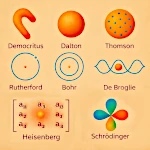 原子的各种形态:从古代直觉到量子力学