

铯(Cs,Z = 55):最活泼的金属与时间守护者
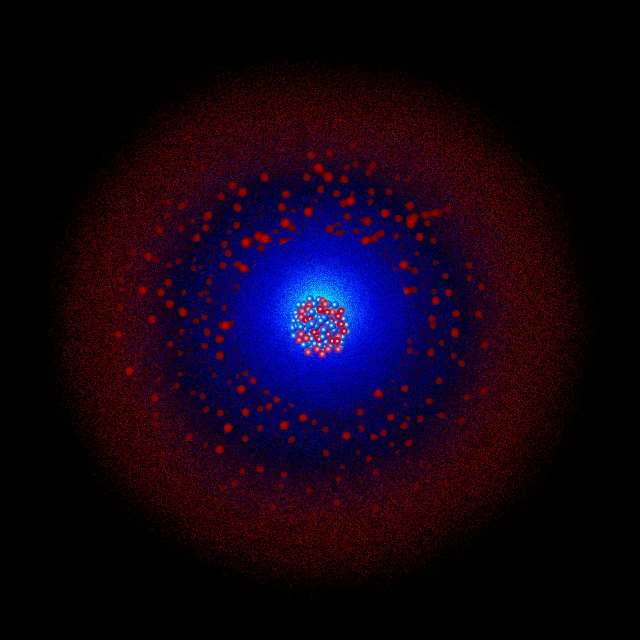
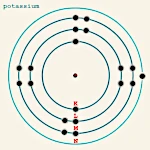
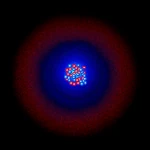
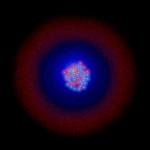
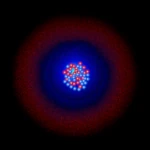
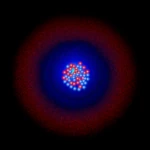
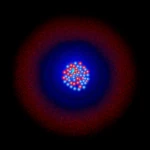
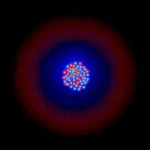
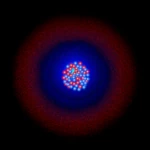
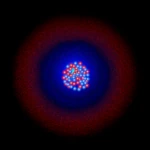
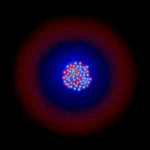
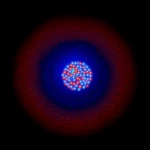
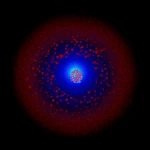
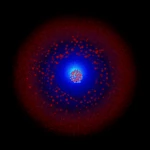
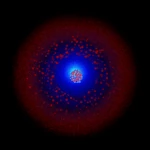
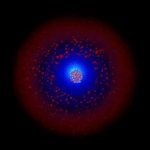
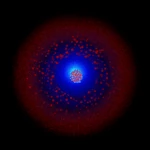
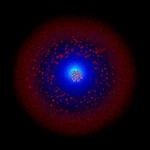
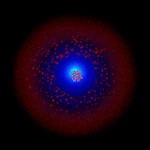
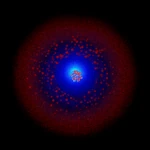
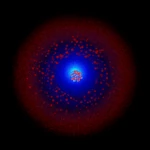
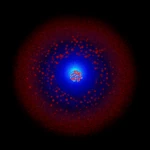
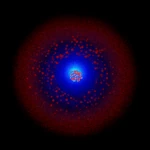
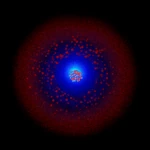
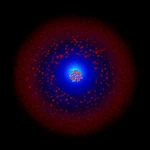
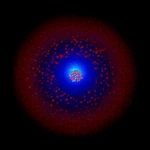
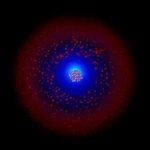
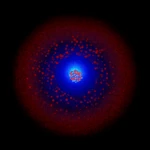
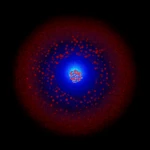
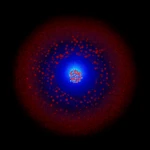
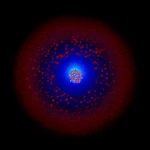
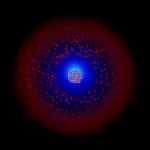
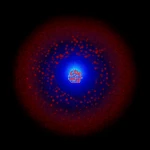
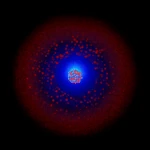
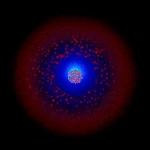
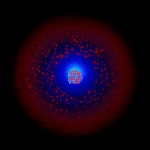
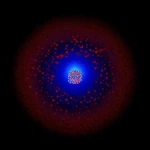
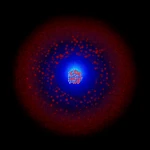
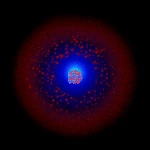
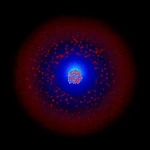
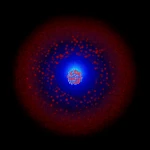
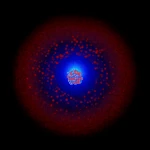
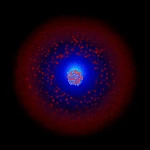
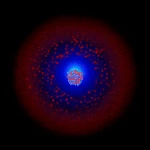
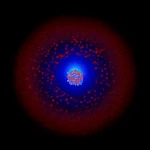
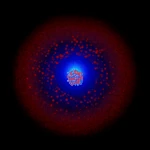
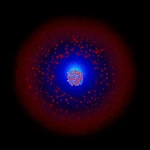
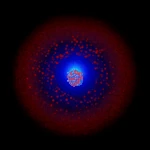
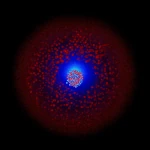
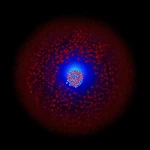
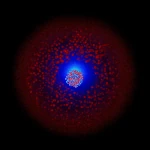
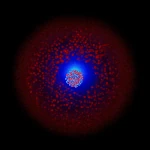
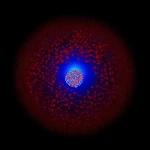
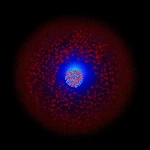
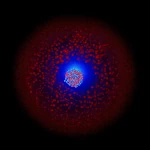
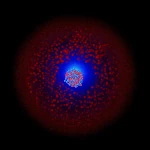
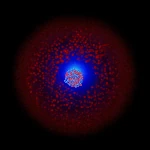
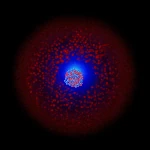
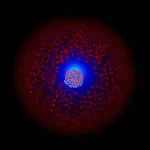
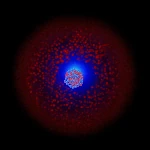
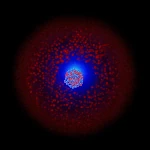
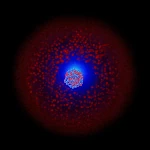
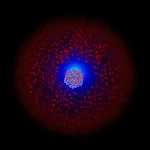
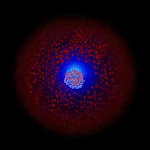
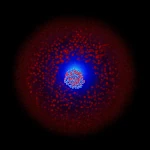
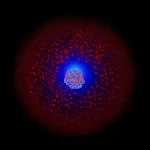
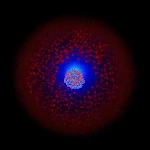
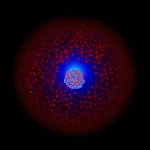
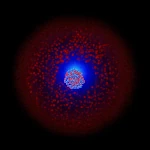
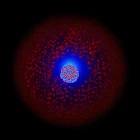
Simplified atomic model of the cesium atom with its fifty-five protons and fifty-five electrons.
The most abundant isotope is \(\,^{133}\mathrm{Cs}\,\) with 55 protons, 55 electrons, and 78 neutrons.
Image source: astronoo.com (新窗口)
从恒星到行星:星际介质中的铯
铯的宇宙丰度与起源
Cesium is a rare element in the universe, primarily produced by 恒星核合成 during the advanced stages of stellar evolution. As a heavy element with atomic number 55, cesium requires neutron capture processes to be synthesized, making it much less abundant than lighter elements such as hydrogen, helium, carbon, or oxygen.
恒星作为铯工厂:s过程与r过程
Cesium is mainly produced by two nucleosynthesis processes: the s 过程 (slow neutron capture) in asymptotic giant branch (AGB) stars and the r过程 (rapid neutron capture) during supernova explosions and neutron star mergers. In the s process, barium and lanthanum nuclei gradually capture neutrons to form cesium in the outer layers of AGB stars, where thermal pulses create favorable conditions. The r process, occurring in cataclysmic environments with extremely high neutron flux, rapidly produces neutron-rich isotopes that subsequently decay to stable \(\,^{133}\mathrm{Cs}\). These stars enrich the interstellar medium with cesium through their intense stellar winds and supernova ejecta.
星际介质中的铯化学
在星际介质中,铯主要以中性或电离原子形式(Cs、Cs⁺)存在。由于其电离势较低(在所有稳定元素中最低),铯在低密度区域易被周围紫外线辐射电离。通过其特征吸收线,已在部分冷恒星及少数致密星际云的光谱中探测到原子铯。与较轻元素不同,铯在典型星际条件下不会形成稳定分子,尽管在极冷致密环境中理论上可能存在氢化铯(CsH)。
同位素:核过程的示踪剂
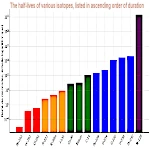
铯只有一种天然稳定同位素\(\,^{133}\mathrm{Cs}\),占天然铯的100%。然而,核裂变过程及重元素衰变会自然产生多种放射性铯同位素。\(\,^{137}\mathrm{Cs}\)(半衰期30.17年)和\(\,^{134}\mathrm{Cs}\)(半衰期2.06年)是重要的裂变产物,可用于沉积物定年、土壤侵蚀研究以及检测人为放射性污染(核试验、核事故)。这些同位素在环境中的存在为20世纪和21世纪的核事件提供了精确的时间标记。
行星与地球化学作用
在行星系统中,铯以痕量形式存在于岩石和矿物中。 在地球上,铯富集于某些矿物中,例如铯榴石(一种铝和铯的硅酸盐矿物),这是铯的主要商业来源。 由于其高离子半径和独特的电荷,铯在地球化学中表现为不相容元素,在分异过程中优先富集于岩浆液体中,并集中于花岗伟晶岩中。 研究铯在地球岩石和陨石中的分布,有助于理解行星分异过程及大陆地壳的演化。
铯的发现历史
Cesium was discovered in 1860 by German chemists 罗伯特·本生 (1811-1899) and 古斯塔夫·基尔霍夫 (1824-1887) at the University of Heidelberg. This remarkable discovery was made possible by the new technique of 光谱学 they had developed, allowing the identification of chemical elements by their characteristic spectral lines. By analyzing the mineral water from Dürkheim with a spectroscope, they observed two intense bright blue lines (at 455.5 nm and 459.3 nm) that did not correspond to any known element. These distinct blue lines allowed them to isolate a new alkali element, which they named 铯, from the Latin caesius(凯修斯) meaning "sky blue," in reference to the characteristic color of its spectral lines.
Bunsen isolated pure cesium metal in 1881 by electrolysis of molten cesium cyanide, revealing an extremely soft metal with a golden-silver color that melts at just 28.5 °C (just above room temperature). The discovery of cesium marked a triumph of analytical spectroscopy and demonstrated the power of this new method to identify elements present in minute quantities. The following year, in 1861, Bunsen and Kirchhoff also discovered rubidium using the same spectroscopic technique.
技术说明:铯与秒的定义
注意::
铯-133 plays a fundamental role in the modern definition of time.
Since 1967, the second, the base unit of time in the International System of Units (SI), has been defined by the frequency of the hyperfine transition of the cesium-133 atom: one second corresponds exactly to 9,192,631,770 periods of the radiation emitted during this transition.
Cesium atomic clocks, developed in the 1950s, exploit this extremely stable transition to measure time with extraordinary precision (a few seconds of error over millions of years).
These clocks constitute the global reference for International Atomic Time (TAI) and Coordinated Universal Time (UTC), synchronizing GPS navigation systems, telecommunications, electrical networks, and financial transactions.
The most advanced cesium atomic clocks (atomic fountains) now achieve uncertainties of less than one second over 300 million years, making cesium the ultimate keeper of our time measurement.
结构与基本性质
Cesium (symbol Cs, atomic number 55) is an alkali metal in group 1 of the periodic table, consisting of fifty-five protons, usually seventy-eight neutrons (for the single stable isotope), and fifty-five electrons.
The only natural stable isotope is cesium-133 \(\,^{133}\mathrm{Cs}\) (100% natural abundance).
At room temperature, cesium is a soft metal with a golden-silver color, soft enough to be cut with a knife like butter.
Cesium has the lowest melting point of all metals except mercury and gallium, melting at just 28.5 °C.
In warm weather, cesium can therefore be liquid at room temperature.
It is also the most reactive and electropositive alkali metal, reacting violently and exploding on contact with cold water and even ice.
Metallic cesium has a density of about 1.93 g/cm³, making it a relatively light metal despite its high atomic number.
The temperature at which liquid and solid states can coexist (melting point): 301.59 K (28.44 °C).
The temperature at which it transitions from liquid to gas (boiling point): 944 K (671 °C).
铯同位素表
| 同位素 / 符号 | 质子(Z) | 中子(N) | 原子质量(u) | 天然丰度 | 半衰期/稳定性 | 衰变 / 备注 |
|---|---|---|---|---|---|---|
| 铯-133 — \(\,^{133}\mathrm{Cs}\,\) | 55 | 78 | 132.905452 u | 100% | 稳定 | 唯一稳定同位素;用于原子钟定义秒(9,192,631,770赫兹)。 |
| 铯-134 — \(\,^{134}\mathrm{Cs}\,\) | 55 | 79 | 133.906718 u | 非自然的 | 2.0648年 | 放射性β⁻和γ;裂变及中子活化产物;用于核医学及追踪核事故的伽马发射体。 |
| 铯-135 — \(\,^{135}\mathrm{Cs}\,\) | 55 | 80 | 134.905977 u | 非自然的 | 230万年 | 放射性β⁻;长寿命裂变产物;在核废料管理中具有重要意义。 |
| 铯-137 — \(\,^{137}\mathrm{Cs}\,\) | 55 | 82 | 136.907089 u | 非自然的 | 30.17年 | 放射性β⁻和γ;主要裂变产物(约6%);主要环境示踪剂;用于放射治疗和沉积物定年;核事故(切尔诺贝利、福岛)中的重大关注对象。 |
| 其他同位素——\(\,^{112}\mathrm{Cs}-\,^{132}\mathrm{Cs},\,^{136}\mathrm{Cs},\,^{138}\mathrm{Cs}-\,^{151}\mathrm{Cs}\) | 55 | 57-77, 81, 83-96 | — | 非自然的 | 微秒 — 13天 | 人工生产的放射性同位素;用于核研究;部分通过反应堆和核爆炸产生。 |
电子排布与电子层
注意::
Electron shells: 电子如何围绕原子核组织 (新窗口).
铯有55个电子,分布在六个电子壳层中。其完整电子排布为:1s² 2s² 2p⁶ 3s² 3p⁶ 3d¹⁰ 4s² 4p⁶ 4d¹⁰ 5s² 5p⁶ 6s¹,或简写为:[Xe] 6s¹。该排布也可写作:K(2) L(8) M(18) N(18) O(8) P(1)。
壳体的详细结构
K层(n=1): contains 2 electrons in the 1s subshell. This inner shell is complete and very stable.
L层(n=2): contains 8 electrons distributed as 2s² 2p⁶, forming a complete and stable shell.
M壳层(n=3): contains 18 electrons distributed as 3s² 3p⁶ 3d¹⁰, forming a complete shell.
N壳层(n=4): contains 18 electrons distributed as 4s² 4p⁶ 4d¹⁰, forming a complete shell.
O壳层 (n=5): contains 8 electrons distributed as 5s² 5p⁶, forming a complete shell.
P壳层 (n=6): contains only 1 electron in the 6s subshell. This single valence electron, far from the nucleus and strongly shielded by the inner shells, is extremely weakly bound and easily lost, explaining the exceptional reactivity of cesium.
铯的性质与重要性
铯是第1族(碱金属)元素,其最外层仅有1个价电子(6s¹)。在所有稳定元素中,该电子距原子核最远,具有最大的原子半径(约265 pm)和最低的电离能(3.89 eV),这使得铯成为所有稳定金属中电正性最强、反应活性最高的元素。6s电子结合极为微弱,极易被移除,形成具有稳定氙型电子构型的Cs⁺离子。这一特性解释了铯与水、氧气甚至冰发生剧烈反应的原因。
铯具有高度专业化和战略性的应用。其最重要的用途是铯-133原子钟,其中\(\,^{133}\mathrm{Cs}\)的超精细跃迁定义了秒长,并构成了国际原子时的基础。铯光电管利用其低电离电位来探测红外光。铯还用于空间离子推进系统、有机化学中的催化剂、高密度石油钻井液(甲酸铯)以及特种玻璃。放射性\(\,^{137}\mathrm{Cs}\)则应用于放射治疗、工业灭菌,并作为环境示踪剂研究侵蚀与沉积作用。
化学反应活性
最外层价电子:极端反应活性
铯具有单个价电子(6s¹),由于其原子半径极大(所有元素中最大)以及众多内层电子壳层的显著屏蔽效应,该电子是所有稳定元素中结合最松散的。其第一电离能(3.89 eV)是所有稳定元素中最低的,这使得铯成为电正性最强、化学性质最活泼的元素。铯极易失去其价电子,形成具有稳定氙型电子构型的Cs⁺离子。这种极端的失电子能力解释了其与水(甚至与-116°C的冰)发生爆炸性反应的原因。
剧烈反应及铯化合物
铯与水及空气中的水分会发生剧烈且自发的反应,生成氢氧化铯(CsOH)和氢气,同时释放足够的热量引燃氢气并引发爆炸。该反应极为剧烈,因此金属铯必须储存在矿物油中,或密封于充满惰性气体(氩气)的安瓿瓶内。 铯与氧气也能迅速反应,生成多种氧化物:氧化铯(Cs₂O)、过氧化铯(Cs₂O₂),尤其是超氧化铯(CsO₂)。 铯几乎能与所有非金属形成离子化合物:卤化铯(CsF、CsCl、CsBr、CsI)、硫化铯(Cs₂S)、氮化铯(Cs₃N)和碳化铯(Cs₂C₂)。 氢氧化铯(CsOH)是已知最强的碱,其碱性甚至超过氢氧化钠和氢氧化钾。
卓越的物理特性
金属铯具有独特的物理性质。它是继汞(熔点28.44°C)之后熔点最低的稳定金属,几乎在室温下即可熔化。其质地极软,可用刀轻易切割,并呈现带有金色光泽的银白色特征。对于如此重的元素而言,其密度相对较低(1.93 g/cm³),这归因于其较大的原子尺寸和松散堆积的体心立方晶体结构。铯具有高导电性,且热膨胀系数在所有金属中名列前茅。
铯的工业与技术应用
- 在铯-133原子钟中,它们定义了秒并构成了全球时间基准;
- 作为校准GPS导航系统和电信设备的频率标准;
- 在红外敏感的光电管和光电倍增管中;
- 用于卫星和空间探测器的离子推进(使用电离铯);
- 在高密度石油钻井液(甲酸铯)中用于稳定深井;
- 作为有机合成中的催化剂,以促进某些化学反应;
- 在特种光学玻璃和光纤中用于提高折射率;
- 用于生产超灵敏铯蒸气磁力计;
- 在夜视设备和图像增强器中;
- 作为放射治疗中用于治疗某些癌症的铯-137来源;
- 用于医疗设备和食品的伽马射线工业灭菌;
- 作为环境示踪剂,用于研究土壤侵蚀与沉积;
- 在原子物理研究和量子计量学中;
- 用于计量实验室的频率标准;
- 在激光冷却装置和磁光阱中;
- 作为某些辐射探测闪烁体的组成部分;
- 用于制造实验性有机太阳能电池;
- 在放射性同位素热电发生器(RTG)中使用铯-137;
- 作为热离子阴极中的掺杂剂,用于改善电子发射;
- 用于通过人为铯-137进行地质和环境年代测定。
 核聚变所需的能量以及为什么铀是一个极限
 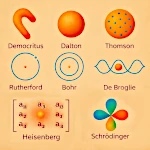 原子的各种形态:从古代直觉到量子力学