

核素的半衰期:对放射性与年代测定的意义
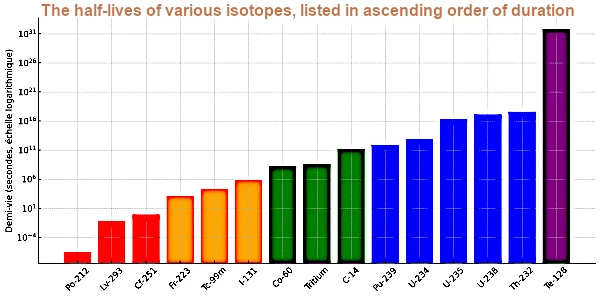
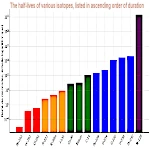
Semi-logarithmic graph representing the half-lives of several isotopes, ranked in increasing order of duration, from Polonium to Tellurium. The logarithmic scale allows visualization of the enormous differences, ranging from microseconds to more than 10²⁴ seconds. Image source: astronoo.com (新窗口)
什么是半衰期?
The 半衰期 or radioactive period of a radioactive isotope is the time required for half of the nuclei in a sample to decay. It is a characteristic quantity of an unstable nucleus and a probabilistic measure of its stability. The half-life is independent of the amount of material or external conditions (temperature, pressure, etc.) because radioactive decay is a purely quantum process, governed by the laws of quantum mechanics.
解释
短半衰期意味着快速衰变(极不稳定的元素)。长半衰期则表示元素更为稳定。
所有元素都有半衰期吗?
No, not all chemical elements have a measurable half-life, because 一些同位素是稳定的。. For example, carbon-12 (12C), oxygen-16 (16O), or iron-56 (56Fe) do not decay spontaneously, even over timescales comparable to the age of the Universe. On the other hand, 放射性元素 such as uranium, thorium, or polonium have one or more unstable forms (isotopes) with half-lives ranging from microseconds to billions of years.
半衰期的物理定义
放射性半衰期,通常记作 \( T_{1/2} \),是指一个化学元素(更确切地说,是一种放射性核素)的样本中,一半原子核自发衰变所需的时间。它是衡量原子核稳定性的指标。
对于在 \( t = 0 \) 时刻含有 \( N_0 \) 个原子核的样本,放射性衰变定律为:\( N(t) = N_0 \cdot e^{-\lambda t} \)
- \(\lambda\) 是衰变常数(单位为 \( \text{s}^{-1} \))。
- \( t \) 是经过的时间
- \( N(t) \) 是时间 \( t \) 时剩余原子核的数量。
半衰期 \( T_{1/2} \) 与 \( \lambda \) 的关系为:\( T_{1/2} = \frac{\ln(2)}{\lambda} \)
同位素半衰期或放射性周期表
| 元素 | 同位素 | 半衰期(秒) | 半衰期(可读形式) |
|---|---|---|---|
| 钋 | Po-212 | 0.0000003 | 0.3 微秒 |
| 锂 | Lv-293 | 0.061 | 61毫秒 |
| 锎 | Cf-251 | 0.9 | 0.9秒 |
| 钫 | Fr-223 | 1320 | 22分钟 |
| 锝 | 锝-99m | 21600 | 6 h |
| 碘 | I-131 | 693,728 | 8.02 天 |
| 钴 | 钴-60 | 166,824,000 | 5.27年 |
| 氢 | 氚 | 388,435,680 | 12.32年 |
| 碳 | C-14 | 180,622,080,000 | 5730年 |
| 钚 | 钚-239 | 760,585,760,000 | 24,100年 |
| 铀 | U-234 | 7,740,138,000,000 | 245,500年 |
| 铀 | 铀-235 | 22,174,070,000,000 | 7.03亿年 |
| 铀 | U-238 | 141,379,620,000,000 | 44.68亿年 |
| 钍 | 钍-232 | 443,538,150,000,000 | 140.5亿年 |
| 碲 | Te-128 | 6.945×10²⁴ | 2.2×10²⁴秒(约7×10¹⁶年) |
比较图(对数刻度)
该图展示了选定同位素的半衰期,按递增顺序排列。对数坐标轴使人们能够直观地看到从微秒到超过10²⁴秒的巨大差异。
 核聚变所需的能量以及为什么铀是一个极限
 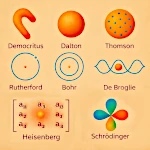 原子的各种形态:从古代直觉到量子力学