

钐(Sm,Z = 62):源于星辰的地球磁石
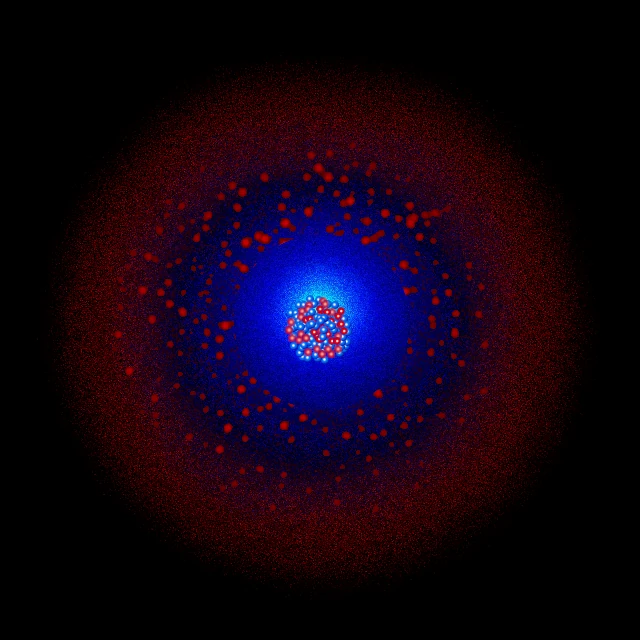
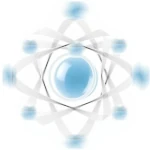
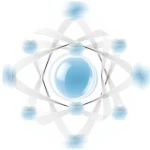
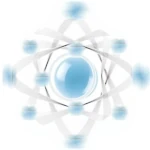
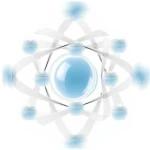
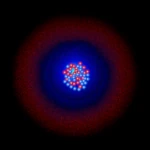
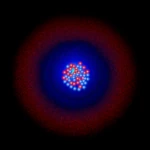
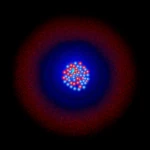
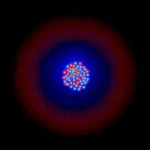
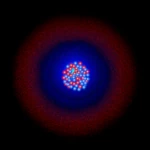
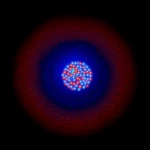
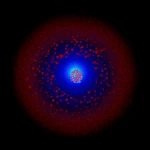
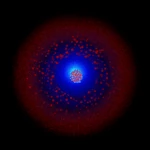
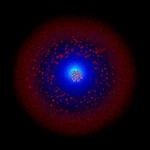
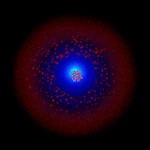
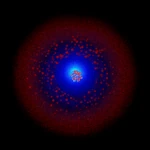
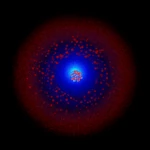
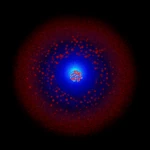
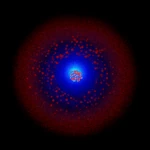
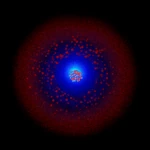
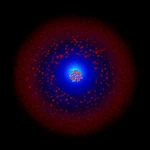
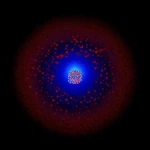
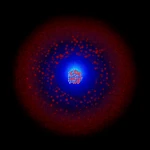
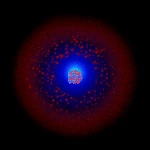
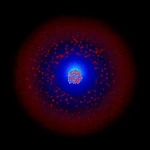
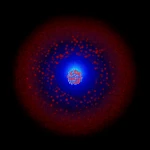
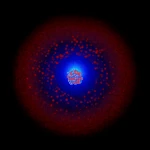
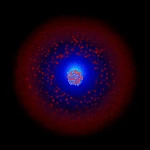
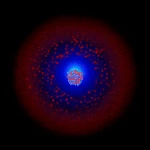
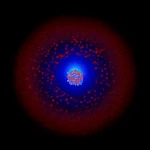
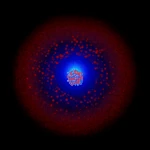
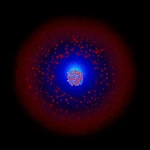
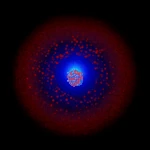
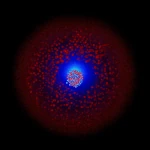
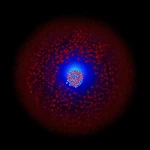
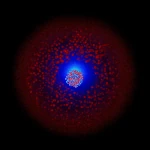
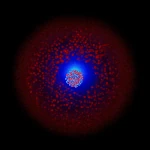
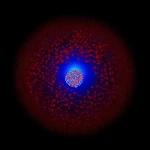
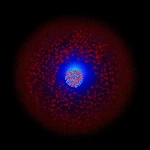
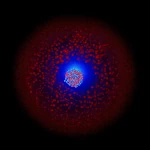
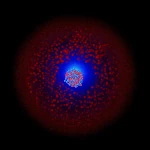
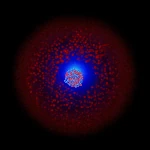
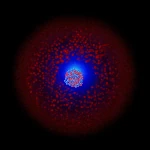
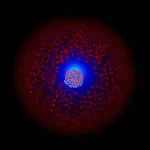
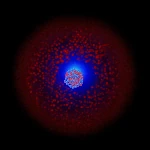
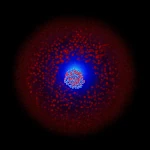
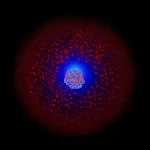
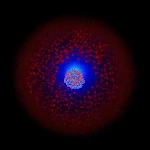
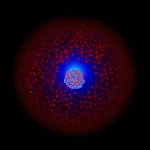
Simplified atomic model of the samarium atom. The most abundant isotope is \(\,^{152}\mathrm{Sm}\,\) with its 62 protons, 62 electrons, and 90 neutrons.
Image source: astronoo.com (新窗口)
钐在天体物理学和宇宙学中的作用
Samarium is an element produced mainly by the 慢中子俘获过程(s-过程) in asymptotic giant branch (AGB) stars. A fraction is also synthesized by the 快速中子捕获过程(r-过程) during cataclysmic events such as neutron star mergers or supernovae.
The abundance of samarium in stars is a valuable indicator for astronomers. The abundance ratio between samarium and other elements produced by similar processes (such as neodymium or europium) helps trace the history of nucleosynthesis in our galaxy. Measuring samarium abundances in old, metal-poor stars helps understand the relative efficiency of the s and r processes in the early universe. Furthermore, the radioactive isotope 146Sm (half-life of 68 million years) existed at the beginning of the solar system. Its past presence, detected by its decay products in meteorites, is used as a 用于测定行星分异时间的计时器 and the formation of the cores of terrestrial planets like Earth and Mars.
钐元素的发现历史
The history of samarium begins with the analysis of a rare mineral, samarskite, identified in the Urals around 1847 and named after Russian Colonel Vassili Samarski (1803-1870). The Swiss chemist 让·查尔斯·加利萨德·德·马里尼亚克 (1817-1894) was the first to observe unknown spectral lines in this mineral in 1853, suggesting the presence of a new element. However, it was the French chemist 保罗-埃米尔·勒科克·德布瓦博德朗 (1838-1912) who, in 1879, succeeded in isolating an oxide of a new element from samarskite. He confirmed his discovery by spectroscopy and named this element 钐 after the original mineral. This was the first identification of a rare earth element from this mineral, paving the way for the discovery of other lanthanides.
注意::
Samarium does not occur in its native state. It is mainly extracted from ores such as monazite and bastnäsite, which contain a mixture of rare earths. Its abundance in the Earth's crust is about 7 ppm, which is higher than that of elements like tin. The separation of samarium from other lanthanides, a complex process due to their very similar chemical properties, is achieved by modern techniques such as ion exchange or solvent extraction.
结构与基本性质
Samarium (symbol Sm, atomic number 62) is an element of the lanthanide series, belonging to the rare earth group. Its atom has 62 protons, usually 90 neutrons (for the most abundant isotope \(\,^{152}\mathrm{Sm}\)) and 62 electrons with the electronic configuration [Xe] 4f⁶ 6s².
At room temperature, samarium is a silvery, relatively hard and brittle solid metal. It is a moderately dense element (density ≈ 7.52 g/cm³) and exhibits slight magnetism at room temperature.
Melting point (liquid state) of samarium: 1,345 K (1,072 °C).
Boiling point (gaseous state) of samarium: 2,067 K (1,794 °C).
钐同位素一览表
| 同位素 / 符号 | 质子(Z) | 中子(N) | 原子质量(u) | 天然丰度 | 半衰期/稳定性 | 衰减 / 备注 |
|---|---|---|---|---|---|---|
| 钐-152 — \(\,^{152}\mathrm{Sm}\,\) | 62 | 90 | 151.919732 u | ≈ 26.75% | 稳定 | 最丰富的稳定同位素。 |
| 钐-154 — \(\,^{154}\mathrm{Sm}\,\) | 62 | 92 | 153.922209 u | ≈ 22.75% | 稳定 | 第二种稳定同位素。 |
| 钐-147 — \(\,^{147}\mathrm{Sm}\,\) | 62 | 85 | 146.914898 u | ≈ 14.99% | 1.06 × 10¹¹ 年 | 放射性,α发射体。地质测年(Sm-Nd)的基础。 |
| 钐-149 — \(\,^{149}\mathrm{Sm}\,\) | 62 | 87 | 148.917185 u | ≈ 13.82% | 稳定的 | 稳定同位素。它是一种强效中子毒物。 |
| 钐-150 — \(\,^{150}\mathrm{Sm}\,\) | 62 | 88 | 149.917276 u | ≈ 7.38% | 稳定的 | 稳定同位素。 |
| 钐-144 — \(\,^{144}\mathrm{Sm}\,\) | 62 | 82 | 143.912006 u | ≈ 3.07% | 稳定的 | 最轻的稳定同位素。 |
| 钐-153 — \(\,^{153}\mathrm{Sm}\,\) | 62 | 91 | 152.922097 u | 合成 | 46.3小时 | β⁻发射体。用于核医学治疗骨痛。 |
钐的电子排布与电子壳层
注意::
Electron shells: 电子如何围绕原子核组织 (新窗口).
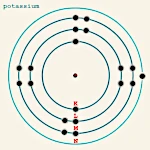
钐有62个电子,分布在六个电子壳层中。其完整电子排布为:1s² 2s² 2p⁶ 3s² 3p⁶ 3d¹⁰ 4s² 4p⁶ 4d¹⁰ 5s² 5p⁶ 4f⁶ 6s²,或简写为:[Xe] 4f⁶ 6s²。该排布也可写作:K(2) L(8) M(18) N(24) O(8) P(2)。
壳层的详细结构
K壳层 (n=1): 2 electrons (1s²).
L层(n=2): 8 electrons (2s² 2p⁶).
M层 (n=3): 18 electrons (3s² 3p⁶ 3d¹⁰).
N层(n=4): 24 electrons (4s² 4p⁶ 4d¹⁰ 4f⁶). The 4f subshell, partially filled with 6 electrons, is responsible for the unique magnetic and optical properties of samarium.
O壳层 (n=5): 8 electrons (5s² 5p⁶).
P壳层(n=6): 2 electrons (6s²).
价电子与氧化态
The valence electrons of samarium are mainly the 2 electrons 6s², but the 6 electrons 4f also actively participate in chemical bonding. This configuration leads to several possible oxidation states.
The most common and stable oxidation state is +3 (Sm³⁺), where the atom loses its two 6s² electrons and one 4f electron, reaching a particularly stable [Xe] 4f⁵ configuration (half-filled f subshell).
The oxidation state +2 (Sm²⁺) is also known and relatively stable for a lanthanide, where the atom loses only its two 6s² electrons to give [Xe] 4f⁶. Sm²⁺ is a powerful reducing agent.
This duality (+2/+3) gives samarium a rich chemistry, used in reduction applications in organic synthesis.
化学反应活性
钐是一种相对活泼的金属。它在空气中会缓慢失去光泽,表面形成氧化物(Sm₂O₃)。粉末状的钐可能自燃。它与水反应释放氢气,但速度比碱土金属慢。钐易溶于稀酸。在中等温度下,钐能与大多数非金属(卤素、氢、氮、硫)反应。其水溶液化学性质主要由Sm³⁺离子主导,该离子能形成稳定的络合物,并呈现特征性的淡黄色。
钐的工业和技术应用
- in permanent magnets 钐钴(SmCo₅、Sm₂Co₁₇) for aircraft engines, generators, sensors, and critical systems (high temperature, stability);
- as a neutron absorber (149Sm) in the control rods of some nuclear reactors;
- 在催化领域,特别是二碘化钐(SmI₂),一种在有机合成中强效且具有选择性的还原剂;
- 在掺钐晶体中用于半导体激光器和光放大器;
- 作为玻璃和陶瓷中的掺杂剂,用于改变其光学性能;
- in nuclear medicine, the isotope 153Sm is used in the form of lexidronam to relieve pain related to bone metastases;
- 在微机电系统(MEMS)的传感器和执行器中;
- 用于屏幕和某些显示设备中的荧光粉掺杂;
- as an isotopic tracer (147Sm/144Nd) in geochemistry and petrology for rock dating;
- 在伽马辐射探测器的校准中。
 核聚变所需的能量以及为什么铀是一个极限
 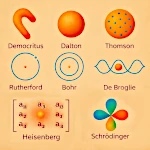 原子的各种形态:从古代直觉到量子力学