

砹(At,Z = 85):元素周期表中的幽灵
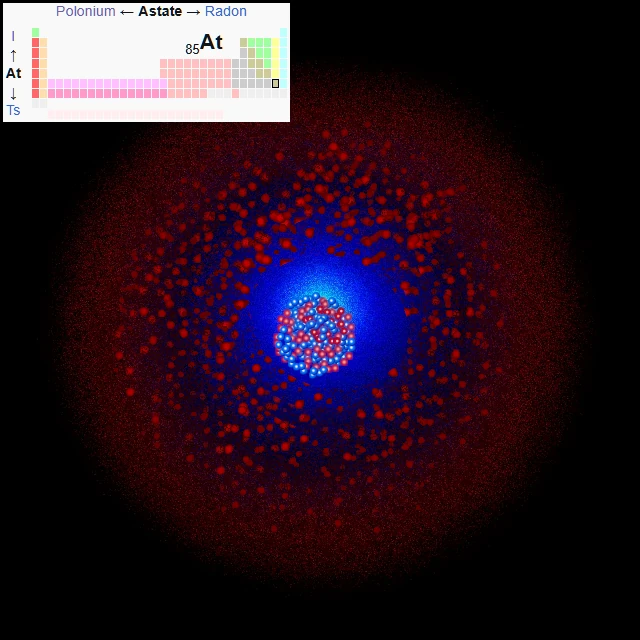
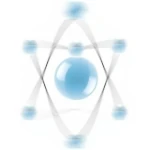
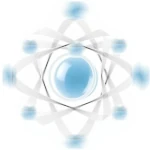
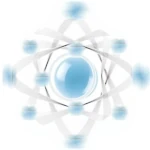
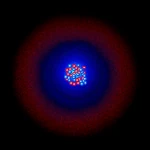
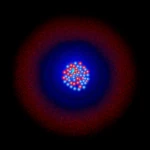
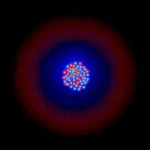
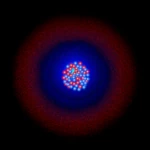
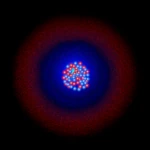
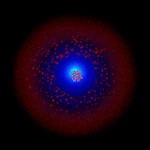
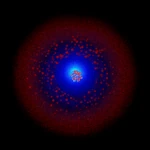
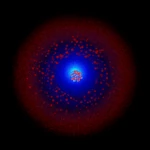
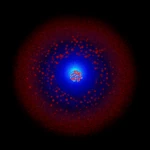
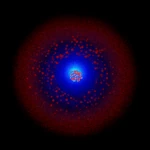
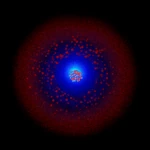
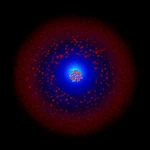
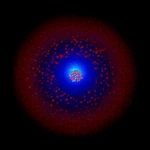
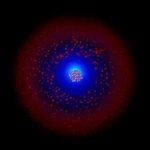
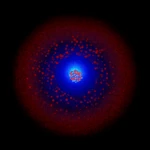
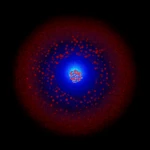
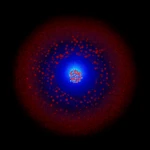
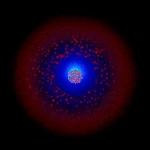
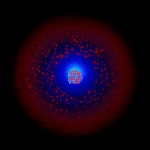
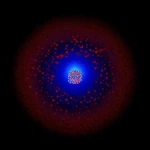
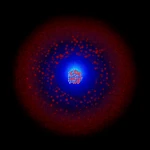
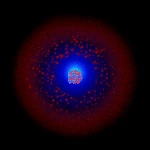
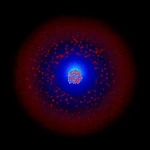
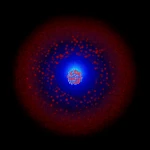
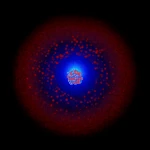
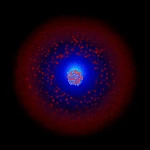
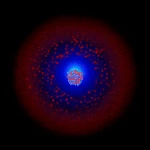
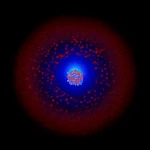
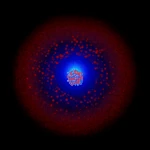
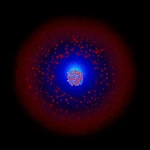
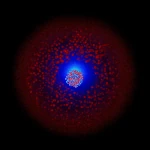
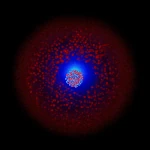
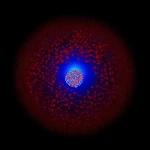
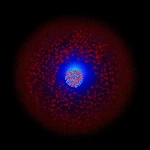
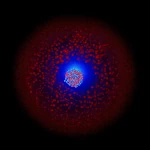
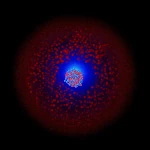
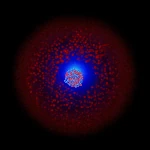
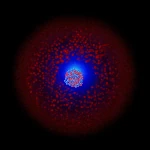
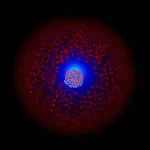
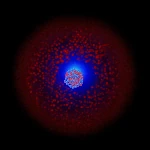
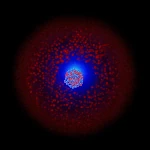
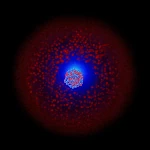
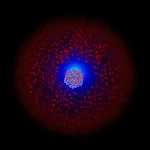
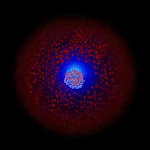
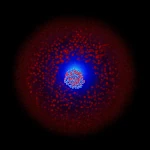
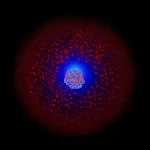
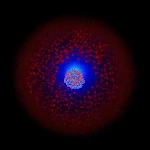
Image description:
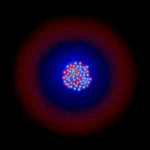
Simplified atomic model of the astatine atom. The most studied isotope is \(^{211}\mathrm{At}\)
with its 85 protons, 85 electrons, and 126 neutrons. Background evoking rarity and instability.
Image source: astronoo.com (新窗口)
砹在天体物理学和放射化学中的作用
最稀有的天然元素
Astatine holds a unique record: it is the 最稀有的天然元素 on Earth. Estimates suggest that the total amount of astatine present in the Earth's crust at any given time is less than 30克. This extreme rarity is due to the fact that all its isotopes are radioactive with very short half-lives. The longest-lived, astatine-210, has a half-life of only 8.1 hours. Thus, any primordial astatine present during the formation of the Earth has long since decayed. The astatine present today is constantly 重新创建 as an intermediate decay product in the natural uranium and thorium decay chains, but it disappears almost immediately.
衰变链成员
砹的几种同位素出现在铀和钍的衰变链中,通过其母体元素钋或铋的β衰变形成。例如:
- In the 铀-235链(4n+3): \(^{219}\mathrm{Rn}\) (Actinon) decays by alpha emission to \(^{215}\mathrm{Po}\), which decays by beta (99.99977%) to \(^{215}\mathrm{At}\) (half-life 0.10 ms), which decays almost instantaneously.
- In the 铀-238衰变链(4n+2): \(^{218}\mathrm{Po}\) (Radium A) decays by beta (0.02%) to \(^{218}\mathrm{At}\) (half-life 1.5 s).
这些同位素以极微量产生,且寿命极短,无法累积。
宇宙散裂产生的产物
Apart from radioactive decay, astatine can be produced naturally, in even smaller quantities, by 宇宙散裂: when high-energy cosmic rays strike heavier nuclei such as lead or bismuth in the Earth's crust, they can fragment them and produce exotic nuclei, including astatine.
重核稳定性研究对象
砹位于元素周期表中核稳定性极低的区域。对其同位素(尤其是具有"幻数"中子的同位素,如含126个中子的\(^{211}\mathrm{At}\))的研究,有助于核物理学家完善核结构模型,并理解重核稳定性的极限。
砹元素的发现历史
预测与寻找“类碘”元素
The existence of astatine was predicted by 德米特里·门捷列夫 as early as the creation of his periodic table in 1869. He gave it the provisional name of "eka-碘", predicting that it would be a halogen heavier than iodine, with similar chemical properties but a higher atomic mass and probably metallic characteristics. The search for this missing element mobilized several chemists for decades, without success, due to its extreme instability.
科森、麦肯齐和塞格雷(1940年)的合成发现
Astatine was finally artificially produced in 1940 by a team of researchers at the University of California, Berkeley: 戴尔·R·科森、肯尼斯·罗斯·麦肯齐和埃米利奥·塞格雷. They bombarded a bismuth-209 target with alpha particles accelerated in Berkeley's 60-inch cyclotron. The nuclear reaction produced astatine-211:
\(^{209}\mathrm{Bi} + \alpha \, (^{4}\mathrm{He}) \rightarrow \,^{211}\mathrm{At} + 2n\)
They identified it by its characteristic radioactivity and initially named it "alabamine" (symbol Ab), but this name was not retained.
确认其自然存在及最终名称
After World War II, in 1943, 贝尔塔·卡利克与特劳德·贝尔纳特 succeeded in identifying traces of astatine (the isotopes \(^{218}\mathrm{At}\) and \(^{219}\mathrm{At}\)) in natural decay products of uranium and thorium, thus confirming that it does exist in nature, albeit in infinitesimal quantities. The final name, 砹 (derived from the Greek astatos, αστατος, meaning "unstable"), was proposed by the discoverers and adopted, emphasizing its most striking property.
现代生产
如今,砹完全通过人工方式生产,主要借助粒子加速器(回旋加速器)。最常见的生产方法包括:
- 用α粒子轰击铋-209: The historical method, still in use. It mainly produces astatine-211, the most interesting isotope for medicine.
- 轰击钍或铀靶材 with high-energy protons (spallation).
- 氡的中子辐照: Less common.
Global production is extremely low, on the order of 每年几微克到几毫克, mainly in specialized research laboratories (United States, Russia, Europe, Japan). Its cost is astronomical (millions of dollars per gram, if one could even accumulate a gram), and there is no "market" in the conventional sense.
砹的结构与基本性质
分类与原子结构
Astatine (symbol At, atomic number 85) is an element of group 17, the 卤素. It is the heaviest and most radioactive member of this family, which includes fluorine, chlorine, bromine, iodine, and tennessine. Its atom has 85 protons and, depending on the isotope, 116 to 140 neutrons. The most used isotope, \(^{211}\mathrm{At}\), has 126 neutrons. Its electronic configuration is [Xe] 4f¹⁴ 5d¹⁰ 6s² 6p⁵, with seven valence electrons (6s² 6p⁵).
假设且极端的物理性质
Due to its instability and the tiny amounts ever produced (it is estimated that less than a millionth of a gram of elemental astatine has ever been synthesized in total), most of its physical properties have 从未被直接测量过 on a macroscopic sample. They are deduced from theoretical calculations, extrapolations from halogen group trends, and studies on infinitesimal quantities.
- 物理状态: Predicted to be a 准金属或金属固体 at room temperature, unlike iodine, which is a molecular solid. It might have a black metallic appearance.
- 熔点和沸点: Estimated at around 302 °C and 337 °C, respectively (very uncertain values).
- 强放射性: All its isotopes are radioactive. Astatine-211 emits alpha particles (100%) of 5.87 MeV with a half-life of 7.214 hours.
- 衰变热: Like polonium, a macroscopic amount would be very hot and self-destruct by radiolysis.
转化点数(估计值)
Estimated melting point: ~575 K (~302 °C).
Estimated boiling point: ~610 K (~337 °C).
化学反应活性(推导得出)
Chemically, astatine is expected to behave like a 卤素, but with marked differences due to its weight and relativistic effects. It is expected to be the 最不活泼的卤素 and to exhibit metallic character (tendency to form cations, At⁺). Its possible oxidation states range from -1 to +7, with -1, +1, +3, +5, and +7 being plausible.
主要特征(预估及确认)
Atomic number: 85.
Group: 17 (Halogens).
Electronic configuration: [Xe] 4f¹⁴ 5d¹⁰ 6s² 6p⁵.
Physical state (20°C): Solid (predicted).
Radioactivity: All isotopes are radioactive.
Key medical isotope: \(^{211}\mathrm{At}\) (half-life 7.2 h, α emitter).
砹同位素表(主要)
| 同位素 / 符号 | 质子(Z) | 中子(N) | 原子质量(u) | 生产/发生 | 半衰期 / 衰变模式 | 备注/应用 |
|---|---|---|---|---|---|---|
| 砹-210 — \(^{210}\mathrm{At}\) | 85 | 125 | 209.987148 u | 合成/天然痕量 | 8.1小时(α,99.8%;CE,0.2%) | 半衰期最长的同位素(但α纯度低于\(^{211}\mathrm{At}\))。 |
| 砹-211 — \(^{211}\mathrm{At}\) | 85 | 126 | 210.987496 u | 合成(α在Bi-209上) | 7.214小时(α,100%) | 最重要的同位素. Pure high-energy alpha emitter (5.87 MeV). Ideal half-life for medicine (therapy). Target of choice for research. |
| 砹-217 — \(^{217}\mathrm{At}\) | 85 | 132 | 216.992420 u | 产生于 \(^{225}\mathrm{Ac}\) 的衰变链中 | 32.3 毫秒(α,99.99%) | 锕-225的衰变产物,用于靶向α疗法(TAT)。其衰变链可产生三个α粒子。 |
| 砹-218 — \(^{218}\mathrm{At}\) | 85 | 133 | 217.995350 u | 自然痕迹(铀-238衰变链) | 1.5秒(α,99.9%;β⁻,0.1%) | 非常短暂的自然同位素。 |
| 砹-219 — \(^{219}\mathrm{At}\) | 85 | 134 | 218.996590 u | 自然衰变链(铀-235链) | 56秒(α,97%;β⁻,3%) | 天然同位素,在天然砹中半衰期最长。 |
砹的电子排布与电子层结构
注意::
Electron shells:
电子如何围绕原子核组织 (新窗口).
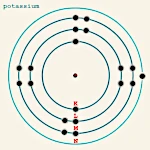
砹的85个电子分布在六个电子壳层中。其电子构型为[Xe] 4f¹⁴ 5d¹⁰ 6s² 6p⁵,第六壳层(s² p⁵)有七个价电子,这是卤素元素的特征构型。该构型也可表示为:K(2) L(8) M(18) N(32) O(18) P(7),或完整形式:1s² 2s² 2p⁶ 3s² 3p⁶ 3d¹⁰ 4s² 4p⁶ 4d¹⁰ 4f¹⁴ 5s² 5p⁶ 5d¹⁰ 6s² 6p⁵。
详细的壳体结构
K壳层(n=1): 2 electrons (1s²).
L壳层 (n=2): 8 electrons (2s² 2p⁶).
M层(n=3): 18 electrons (3s² 3p⁶ 3d¹⁰).
N壳层(n=4): 32 electrons (4s² 4p⁶ 4d¹⁰ 4f¹⁴).
O壳层 (n=5): 18 electrons (5s² 5p⁶ 5d¹⁰).
P壳层 (n=6): 7 electrons (6s² 6p⁵).
价电子与氧化态
Astatine has 7 价电子 (6s² 6p⁵). Like other halogens, it tends to gain an electron to achieve the stable configuration of the noble gas (radon), thus forming the 砹离子(At⁻). This is the -1 oxidation state, which should be the most stable. However, due to its large size and relativistic effects, astatine shows a strong tendency to exist in 正氧化态, unlike lighter halogens. The +1 (At⁺), +3 (AtO⁻ or At³⁺), +5 (AtO₃⁻), and +7 (AtO₄⁻) states are possible and have been observed in trace compounds. This chemistry is more similar to that of iodine than to chlorine or bromine.
砹的化学反应活性(痕量研究)
在原子尺度上研究的化学
The chemistry of astatine has never been studied with visible samples. It is explored using 放射化学示踪 techniques: the behavior of a few atoms or molecules labeled by the radioactivity of astatine in ultra-dilute solutions is tracked. This allows the determination of properties such as partition coefficients, redox potentials, or the stability of different complexes.
卤素行为与类金属倾向
研究证实,砹的行为与卤素相似。
- It forms 卤素互化物 (e.g., AtI, AtBr).
- 它像其他卤素一样,可以用有机溶剂提取。
- 它与碘化银(AgI)共沉淀。
但它也显示出差异:
- It is more easily 减少的 than iodine (standard potential At/At⁻ lower than I₂/I⁻).
- It shows an 对金属结构的亲和力, suggesting a metallic character.
- It has a 水解倾向 and form oxyanions (astatite, AtO⁻) more markedly.
研究过的化合物(痕量)
- 元素砹(At₂): The diatomic molecule At₂ is predicted but never isolated.
- 氢砹酸(HAt): Predicted to be a strong acid, but very unstable (decomposes into At⁰ and H₂).
- 砹化物(At⁻盐): Such as NaAt or AgAt (analogous to AgI).
- 含氧阴离子: Astatite (AtO⁻), astatate (AtO₃⁻), perastatate (AtO₄⁻).
- 有机砹化合物: Crucial for medicine. Molecules such as 甲基砹 (CH₃At) or astatobenzenes have been prepared and studied in traces for their biological behavior.
砹的应用:几乎仅限于医学领域
靶向α疗法(TAT)使用砹-211
This is the most promising and practically the only application. Astatine-211 is a 纯α发射体 ideal for targeted internal radiotherapy:
- 局部沉积能量: The alpha particle (5.87 MeV) has a very short range in tissues (50-80 µm, or a few cell diameters). It deposits all its energy in a tiny sphere, destroying the target cell with a very high relative biological effectiveness (RBE), while sparing surrounding healthy cells.
- 最佳半衰期: 7.2 hours. Long enough to allow chemical synthesis, purification, conjugation to a vector, and administration to the patient. Short enough to limit patient and handler exposure, and for the activity to disappear rapidly after treatment.
- 无寄生伽马辐射: Unlike some other alpha emitters (e.g., \(^{225}\mathrm{Ac}\)), \(^{211}\mathrm{At}\) does not emit significant gammas, simplifying radiation protection and reducing the dose to non-target tissues.
靶向挑战:生物共轭物
To guide astatine-211 to the tumor, it must be covalently and stably attached to a vector molecule that specifically recognizes cancer cells. These 生物共轭物 are major chemical challenges because the At-C (carbon-astatine) bond is relatively weak and sensitive to deastatination (loss of the astatine atom). The vectors studied include:
- 单克隆抗体 (mAbs): Very specific, but large (slow circulation).
- 小分子: Such as PSMA inhibitors (for prostate cancer) or peptides.
- 纳米颗粒: For passive targeting.
临床研究领域
\(^{211}\mathrm{At}\)的临床前和临床试验(I/II期)主要关注:
- 白血病 (particularly acute myeloid leukemia).
- 前列腺癌 (via PSMA).
- 卵巢癌 and 胶质母细胞瘤.
- 肿瘤性脑膜炎 (direct intrathecal injection).
初步结果令人鼓舞,显示出抗肿瘤疗效且毒性有限。
其他应用(非常边缘化)
- 基础研究: In radiochemistry and nuclear physics to study the properties of superheavy elements and nuclear structure.
- 追踪: In halogen chemistry for mechanism studies (at trace scale).
毒理学、辐射防护及砹的危害
极端放射性毒性(如钋)
Astatine-211 shares with polonium-210 an 摄入情况下的极端放射性毒性, due to its high-energy alpha emission. Its danger is even greater in some respects:
- 甲状腺亲和性: As a halogen, astatine is chemically similar to iodine and has a strong tendency to accumulate in the 甲状腺. Even minimal incorporation would lead to intense and destructive alpha irradiation of this vital organ.
- 一般分布: In other chemical forms, it distributes to the liver, spleen, and lungs.
- 更短的半衰期: The specific activity is even higher than that of \(^{210}\mathrm{Po}\), making weighable amounts even more dangerous.
操作与辐射防护
Handling of astatine-211 is done exclusively in 高安全性实验室(P3级别) equipped with sealed glove boxes under controlled atmosphere (nitrogen or argon). Protection against alpha emissions is simple (gloves, box), but prevention of incorporation (inhalation of vapors, ingestion, skin contact) is paramount. All operations are designed to work with activities on the order of gigabecquerels (GBq) in minuscule volumes.
污染情况下的处理方法
There is no specific antidote. Prevention is the only effective strategy. In case of suspected contamination, emergency measures (decontamination, monitoring of excreta) and administration of 稳定碘 (to saturate the thyroid and limit astatine uptake) could be considered, although their efficacy is unproven.
砹的管理、监管与前景展望
严格控制
与钋及其他第一类放射性物质一样,砹-211受国际原子能机构(IAEA)最严格的核安全与安保法规约束。其运输受到高度管制(遵循放射性物质ADR/RID法规)。全球仅有少数实验室获准生产与操作该物质。
生产与供应:一个瓶颈
The main obstacle to the development of astatine-211 therapies is its 限量生产. It requires a medium-energy cyclotron (~30 MeV) with a dedicated beamline for bismuth bombardment. The chemical separation of astatine from molten bismuth (distillation method) or in solution is complex and must be rapid. Developing more efficient production methods and logistics to deliver the isotope to hospitals within hours of production is an active area of research.
未来展望
The future of astatine is almost entirely linked to 治疗诊断核医学:
- 生物共轭物的优化: Develop new, more stable, and faster labeling methods.
- 高级临床试验: Move from phases I/II to phase III to demonstrate clinical efficacy and obtain marketing authorizations.
- 产量增加: Network cyclotrons and standardize procedures.
- 基础研究: Better understand the chemistry of astatine to improve its use.
砹,这个元素周期表中的“幽灵”,因此可能从实验室里的新奇事物转变为拯救生命的精准治疗工具,体现了放射性元素的悖论:将破坏力转化为治愈的力量。
 核聚变所需的能量以及为什么铀是一个极限
 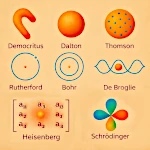 原子的各种形态:从古代直觉到量子力学