

钫(Fr,Z = 87):难以捉摸的碱金属
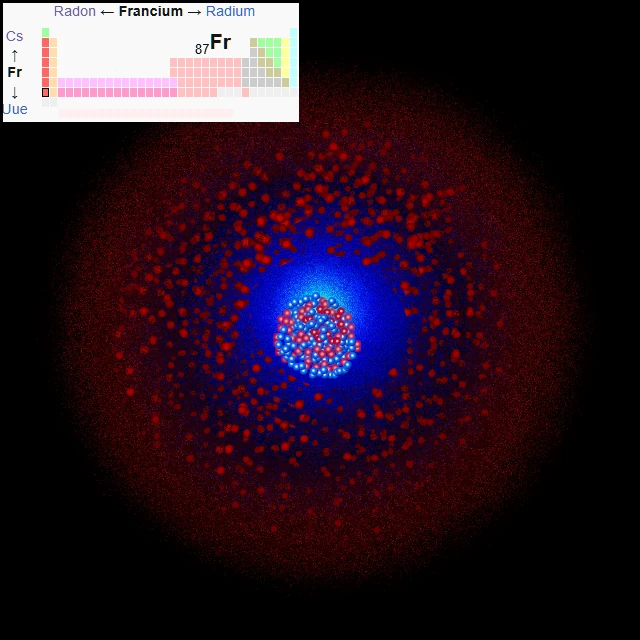
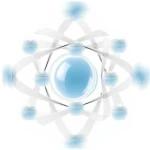
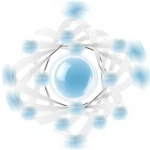
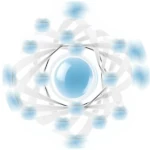
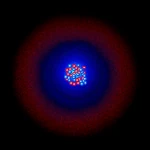
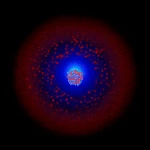
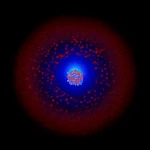
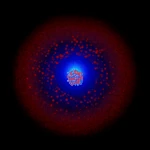
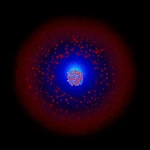
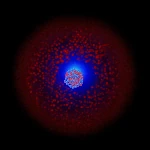
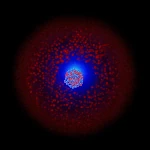
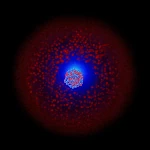
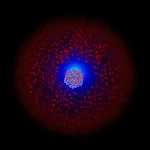
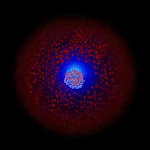
Image description:
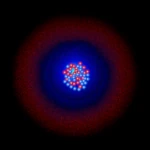
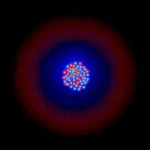
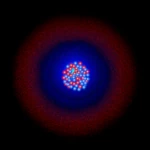
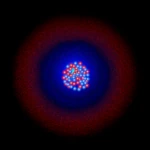
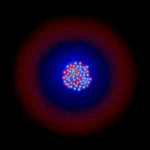
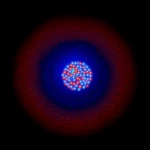
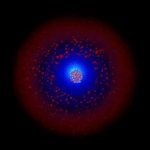
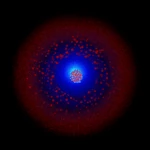
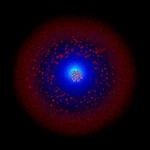
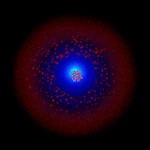
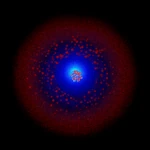
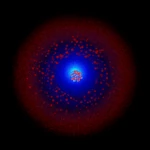
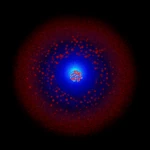
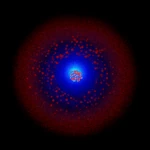
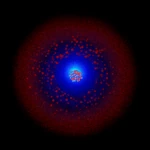
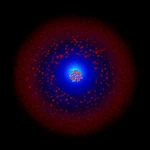
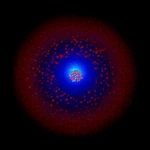
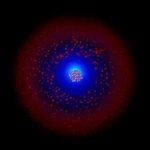
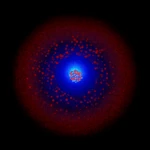
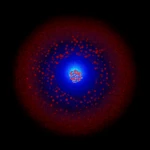
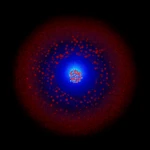
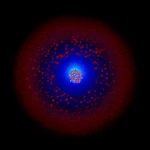
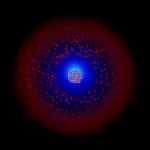
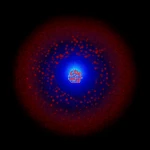
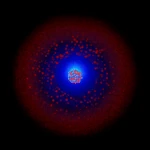
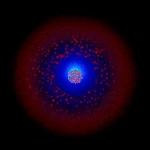
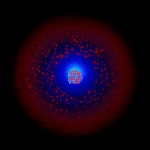
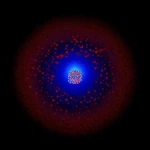
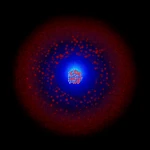
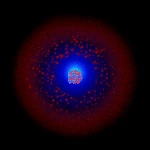
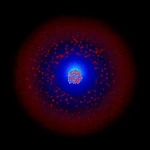
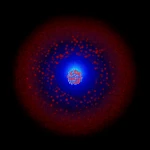
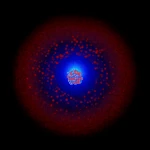
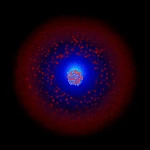
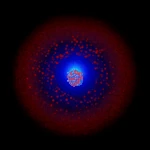
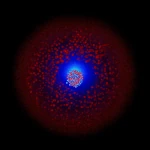
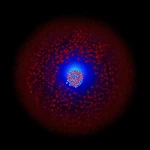
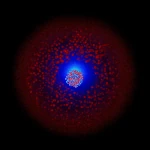
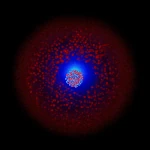
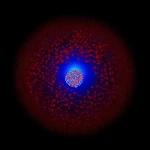
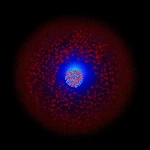
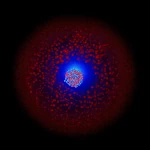
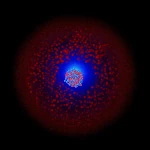
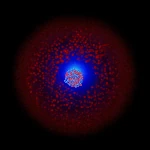
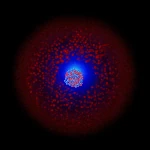
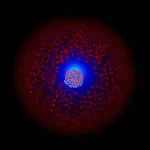
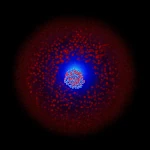
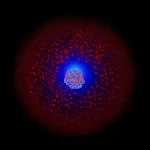
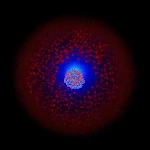
Simplified atomic model of the francium atom. The most stable isotope is \(^{223}\mathrm{Fr}\)
with its 87 protons, 87 electrons and 136 neutrons. Background evoking its fleeting production in an accelerator.
Image source: astronoo.com (新窗口)
钫在天体物理学与放射性中的作用
核合成中的短暂元素
Francium is an element produced exclusively by the r-过程 (rapid neutron capture) during extreme astrophysical events such as supernovae or neutron star mergers. However, because all its isotopes are radioactive with very short half-lives (the most stable, \(^{223}\mathrm{Fr}\), has a half-life of only 22.00 minutes), 没有原始钫元素 remains in the universe since the formation of the solar system. All francium produced at that time decayed billions of years ago. The francium present on Earth today (in infinitesimal quantities) is constantly recreated in two ways:
- 作为衰变产物 in the uranium and thorium chains (mainly \(^{223}\mathrm{Fr}\) from actinium-227 in the uranium-235 chain).
- 通过人工核反应 in particle accelerators.
最稳定的同位素:钫-223
\(^{223}\mathrm{Fr}\) (historically called AcK, for "actinium K") is the natural francium isotope with the longest half-life. It decays with a half-life of 22.00 minutes mainly by beta-minus decay (99.994%) to radium-223, and very weakly (0.006%) by alpha emission to astatine-219. Its presence is linked to secular equilibrium with its parent, actinium-227 (half-life 21.772 years). It is estimated that at any given time, less than one 克 of francium-223 is present in the entire Earth's crust, dispersed in uranium ores.
核物理与原子物理实验室
Despite (or because of) its extreme instability, francium is a fascinating object of study for physicists. As the 最后的碱, it has a single valence electron in an s orbital (7s¹), which makes it a "simple" atom from a quantum mechanical point of view, but with very pronounced relativistic effects due to the strong nuclear charge. Precise measurement of its atomic properties (energy levels, moments, hyperfine structure) allows testing with great precision the predictions of 量子电动力学(QED) in intense electromagnetic fields. These tests contribute to the search for new physics beyond the Standard Model.
钫元素的发现历史
寻找“类铯”元素
The existence of element 87, an alkali heavier than cesium, was predicted by 德米特里·门捷列夫 who named it "类-铯". Its search was arduous and marked by several false discoveries in the early 20th century (such as "virginium" or "moldavium"), because its expected chemical properties (extreme reactivity, great instability) made it elusive.
玛格丽特·佩里(1939年)的发现
The discovery goes to French physicist and chemist 玛格丽特·佩里 (1909-1975), then assistant to 玛丽·居里 at the Radium Institute (Paris). In 1939, while purifying a sample of actinium-227, she noticed an abnormal radioactive activity (beta emission) that could not be attributed to any known isotope. After months of meticulous chemical analyses, she demonstrated that this activity was due to a new element, produced by alpha decay of actinium-227 (1.38% branch):
\(^{227}\mathrm{Ac} \xrightarrow[\alpha]{} ^{223}\mathrm{Fr}\)
She confirmed that it was indeed the missing last alkali, and gave it the name 钫 in honor of her country, France, thus following the tradition of the Curies (polonium) and Debierne (actinium). Her thesis, defended in 1946, consolidated this discovery. Marguerite Perey was the first woman elected to the Academy of Sciences (1962), but not to the French Academy.
早期对钫的研究及人工制备
对钫的研究受限于自然界中极其微量的存在。20世纪70至80年代,粒子加速器的发展使得通过诸如\(^{197}\mathrm{Au} + ^{18}\mathrm{O} \rightarrow \,^{210}\mathrm{Fr} + 5n\)等反应,能够生产出数量更多(尽管在宏观尺度上仍属微量)的重同位素。这为更深入的物理研究铺平了道路。
现代生产钫的方法
Today, francium is produced exclusively artificially in a few specialized laboratories around the world (Stony Brook in the United States, TRIUMF in Canada, RIKEN in Japan, etc.). The most common method uses an accelerated 氧-18束流 at about 100 MeV to bombard a 金-197 target. The fusion-evaporation reaction produces heavy francium isotopes (such as \(^{210}\mathrm{Fr}\) to \(^{213}\mathrm{Fr}\)), which are then extracted, separated and trapped in experimental devices as individual atoms or small clouds.
The quantities produced are so small that they are measured in 每秒原子数 (typically \(10^4\) to \(10^6\) atoms/s), and never in grams. It is therefore impossible to have a visible or manipulable sample of metallic francium.
钫的结构与基本性质
分类与原子结构
Francium (symbol Fr, atomic number 87) is an element of group 1, that of 碱金属. It is the heaviest and most radioactive member of this family, which includes lithium, sodium, potassium, rubidium, cesium and the very recent nihonium (probably not alkali). Its atom has 87 protons and, depending on the isotope, 123 to 150 neutrons. The natural isotope \(^{223}\mathrm{Fr}\) has 136 neutrons. Its electron configuration is [Rn] 7s¹, with a single valence electron in the 7s shell.
以下是中文翻译: 钫的假设物理性质
Due to the impossibility of obtaining a macroscopic quantity, most of the physical properties of francium have 从未被直接测量过. They are deduced by extrapolation of alkali group trends, theoretical calculations and spectroscopic studies on individual atoms.
- 物理状态: Predicted to be a 固体金属 at room temperature, probably soft and silvery in color (like other alkalis), which would oxidize instantly in air.
- 熔点和沸点: Estimated very low, around 27 °C (melting) and 677 °C (boiling). Francium could therefore melt in the hand, like gallium, but in practice, the heat of its radioactivity would make it hot.
- 密度: Estimated around 2.4 g/cm³.
- 强放射性: All its isotopes are radioactive. The decay heat of a macroscopic sample would vaporize and destroy it quickly.
- 电负性: The lowest of all elements (estimated ~0.7 on the Pauling scale), which would make it the most electropositive metal, and therefore the most reactive.
转化点数(估算)
Estimated melting point: ~300 K (~27 °C).
Estimated boiling point: ~950 K (~677 °C).
These values are very uncertain.
主要特征(预估与确认)
Atomic number: 87.
Group: 1 (Alkali metals).
Electron configuration: [Rn] 7s¹.
Oxidation state: +1 (exclusive).
Most stable isotope: \(^{223}\mathrm{Fr}\) (T½ = 22.00 min).
Appearance (predicted): Silvery metal, extremely reactive.
钫同位素表(精选)
| 同位素 / 符号 | 质子(Z) | 中子(N) | 原子质量(u) | 生产/发生 | 半衰期 / 衰变模式 | 备注 |
|---|---|---|---|---|---|---|
| 钫-212 — \(^{212}\mathrm{Fr}\) | 87 | 125 | 212.012秒 | 合成 | 20.0分钟(β⁻,99.45%;α,0.55%) | 中等寿命的合成同位素。 |
| 钫-221 — \(^{221}\mathrm{Fr}\) | 87 | 134 | 221.014秒 | 自然痕量(Np-237链) | 4.9分钟(α,99.65%;β⁻,0.35%) | 存在于含有镎-237的矿石中,含量极微。 |
| 钫-222 — \(^{222}\mathrm{Fr}\) | 87 | 135 | 222.017秒 | 合成 | 14.2分钟(β⁻) | 合成同位素。 |
| 钫-223 — \(^{223}\mathrm{Fr}\) | 87 | 136 | 223.019736 u | 天然(铀-235链)与合成 | 22.00分钟(β⁻,99.994%;α,0.006%) | 最稳定的天然同位素. Discovered by Marguerite Perey. Longest half-life. Used for certain studies. |
钫的电子排布与电子壳层
注意::
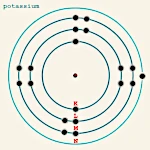
Electron shells:
电子如何围绕原子核组织排列 (新窗口).
钫有87个电子,分布在七个电子壳层中。其电子排布 [Rn] 7s¹ 极为简单:由氡(一种稀有气体)的排布加上7s壳层中的一个额外电子组成。也可写作:K(2) L(8) M(18) N(32) O(18) P(8) Q(1),或完整形式:1s² 2s² 2p⁶ 3s² 3p⁶ 3d¹⁰ 4s² 4p⁶ 4d¹⁰ 4f¹⁴ 5s² 5p⁶ 5d¹⁰ 6s² 6p⁶ 7s¹。
Francium的详细壳层结构
K层(n=1): 2 electrons (1s²).
L壳层(n=2): 8 electrons (2s² 2p⁶).
M层 (n=3): 18 electrons (3s² 3p⁶ 3d¹⁰).
N层(n=4): 32 electrons (4s² 4p⁶ 4d¹⁰ 4f¹⁴).
O壳层(n=5): 18 electrons (5s² 5p⁶ 5d¹⁰).
P壳层 (n=6): 8 electrons (6s² 6p⁶).
Q壳层 (n=7): 1 electron (7s¹).
钫的价电子与原子性质
Francium has a single 价电子 (7s¹). This electron is very far from the nucleus and is weakly bound due to the significant shielding created by the 86 electrons of the inner shells (noble gas configuration). Consequently:
- 极低的第一电离能: Estimated at about 393 kJ/mol (4.07 eV), which would be the lowest of all elements. It would lose its valence electron with extreme ease.
- 巨大的原子半径: Estimated at about 270 pm, the largest of all elements (excluding predictions for super-heavy elements).
- 强烈的相对论效应: For the 7s electron, which reaches speeds close to that of light as it approaches the +87 charged nucleus. These effects contract and stabilize the 7s orbital, strongly influencing energy levels and chemical properties.
这些特性使钫成为极端碱金属的典型代表:电正性最强、反应性最高,且其化学性质主要由Fr⁺离子主导。
钫的化学性质(通过外推及痕量研究)
Fr⁺离子的假定化学性质
Like other alkalis, francium would exist chemically only in the +1 oxidation state. The Fr⁺ ion would be the largest alkali cation, with an estimated ionic radius of 180 pm. Its chemistry in aqueous solution would be simple and similar to that of cesium (Cs⁺), but with some differences:
- 高溶解度: All Fr⁺ salts would be highly soluble in water (no poorly soluble salt known or expected).
- 弱络合能力: Due to its low charge density, it would form weak complexes.
- 与铯盐共沉淀: This is the historical chemical method used by Perey and still used to separate francium from other elements in complex mixtures. Francium coprecipitates with poorly soluble cesium salts such as 高氯酸铯 (CsClO₄) or 酒石酸氢铯.
元素的极端特性
如果能分离出金属态的钫,它将具有爆炸性反应活性。
- 与水反应: Much more violent than that of cesium, producing francium hydroxide (FrOH) and hydrogen, with enough heat to ignite the latter.
- 与空气的反应: Would oxidize instantly, probably forming a superoxide (FrO₂?).
- 与卤素的反应: Violent, forming the corresponding halides (FrF, FrCl, etc.).
实际上,这些反应永远无法在可见的样本上观察到。
微量化学研究
The chemistry of francium is studied by 放射化学示踪 and 冷阱中冷原子的光谱学 techniques. The behavior of a few atoms is monitored (by their radioactivity) in ion exchange columns or during coprecipitations. These studies confirmed that its behavior is very close to that of cesium, with perhaps a slight difference in partition coefficients due to its larger size.
钫的应用
Francium has 严格来说,没有实际应用 outside of fundamental research, due to its extreme rarity and instability. Its "applications" are therefore limited to the field of pure science:
- 量子电动力学(QED)的测试: High-precision measurement of transitions between energy levels in the francium atom (notably the 7s → 8s transition) allows testing QED predictions in very intense electromagnetic fields, where relativistic and nuclear structure effects are maximal. Any discrepancy between theory and experiment could indicate "new physics".
- 核结构研究: Measurement of nuclear moments (spin, magnetic moment, quadrupole moment) of different francium isotopes provides valuable information on the structure of heavy nuclei far from stability.
- 原子捕获与冷却技术的发展: Working with francium, produced atom by atom, has driven the development of sophisticated magneto-optical trapping (MOT), laser cooling and single atom manipulation methods. These techniques have spin-offs for other fields (atomic clocks, quantum computers).
- 基础对称性研究: Francium is a candidate for searching for an 电子电偶极矩 (EDM). Detection of an EDM would violate CP symmetry and could explain the predominance of matter over antimatter in the universe. The sensitivity of these experiments is enhanced with heavy atoms like francium.
毒理学与辐射防护
放射性毒性
与任何β/α辐射体一样,进入体内的钫会具有毒性。然而,这种风险纯属理论上的:
- 无自然暴露风险: Natural quantities are infinitesimal and dispersed.
- 有限的研究风险: In laboratories, the quantities handled are so small (a few atoms at a time) that the radiological risk is negligible compared to that of other radioisotopes. The main precaution is to prevent incorporation in case of an accident on the production target (which contains other radioelements).
- 生物行为: Like cesium, francium (as Fr⁺) would be distributed throughout the body, particularly in muscles, and would be excreted by the kidneys.
安全操作规范
操作在受控核实验室中进行,配备离子束屏蔽装置以及管理活化靶材的流程。分离化学操作在手套箱或封闭容器内完成。
前景与结论
钫将永远是一种实验室元素,一种处于稳定边缘的科学奇观。它的价值在于它教会我们关于基本物理定律的知识。当前和未来的研究旨在:
- 提高光谱测量的精度 to further constrain QED.
- 生产并研究更多奇异同位素 of francium, at the limit of nuclear stability.
- 进行对称性破缺的精确实验 (EDM search).
 核聚变所需的能量以及为什么铀是一个极限
 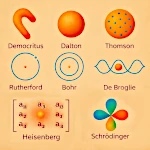 原子的各种形态:从古代直觉到量子力学