

氡(Rn,Z = 86):家庭放射性气体
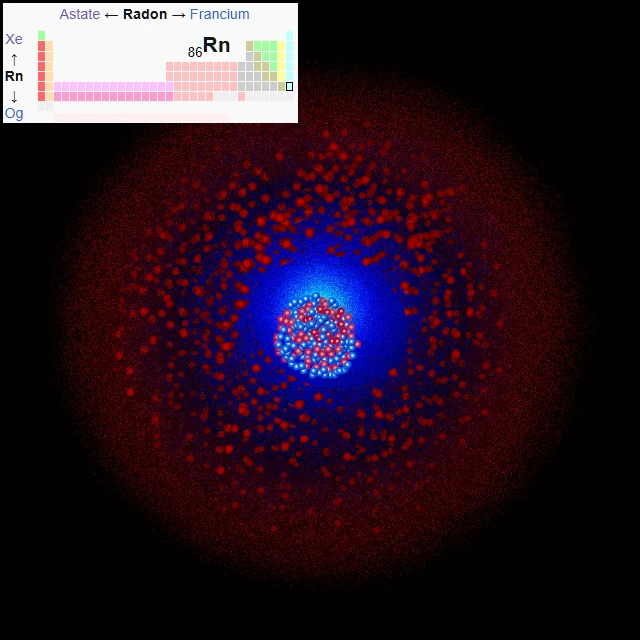
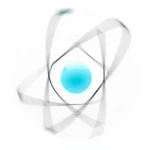
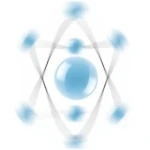
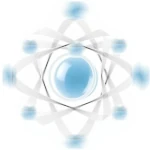
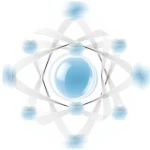
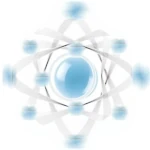
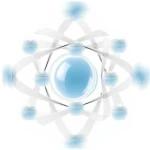
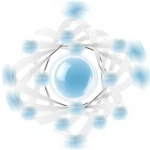
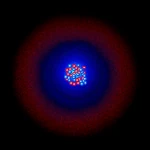
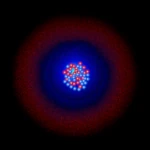
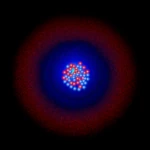
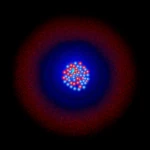
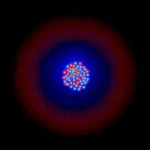
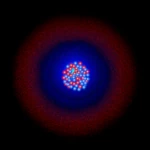
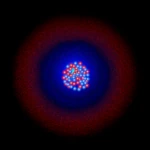
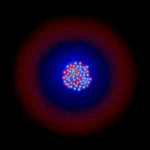
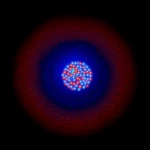
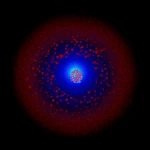
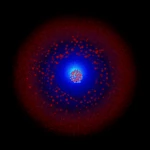
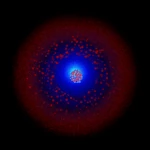
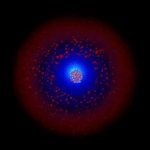
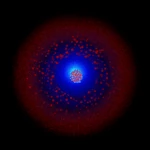
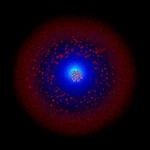
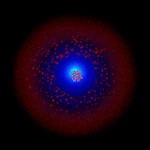
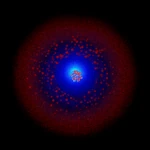
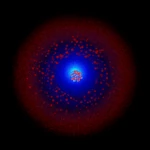
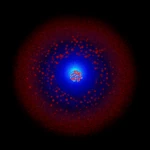
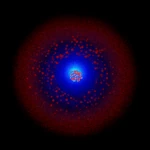
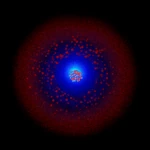
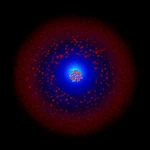
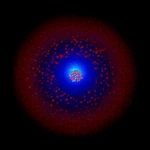
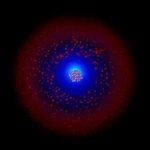
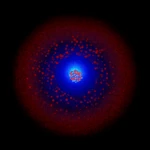
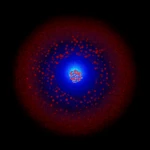
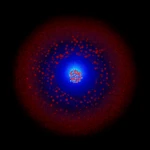
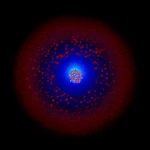
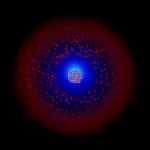
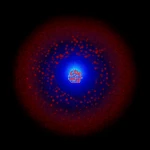
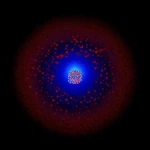
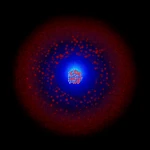
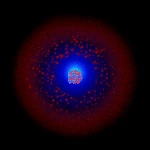
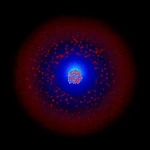
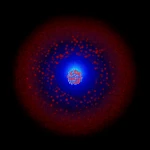
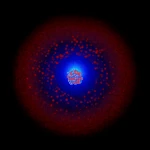
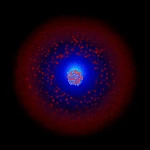
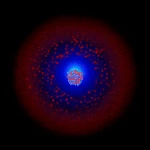
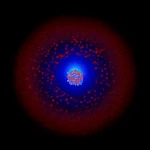
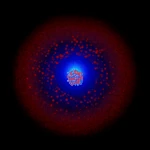
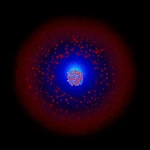
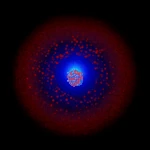
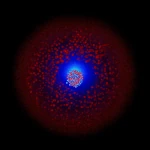
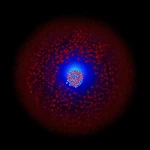
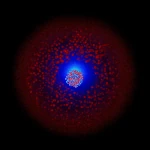
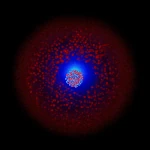
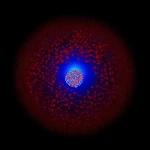
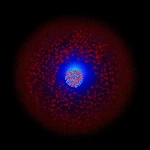
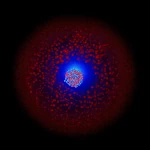
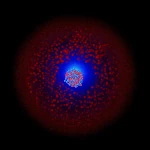
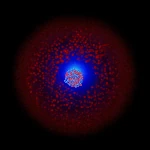
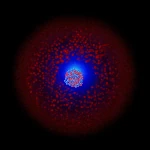
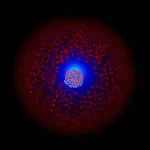
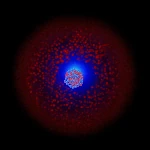
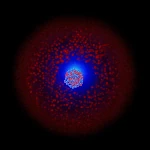
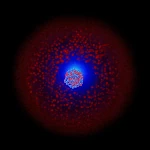
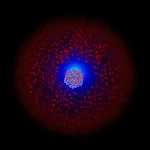
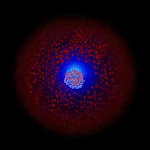
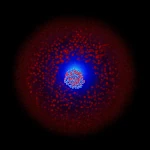
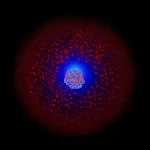
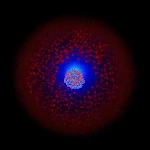
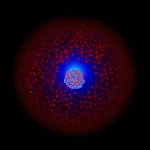
Image description:
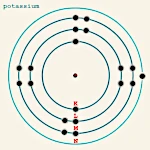
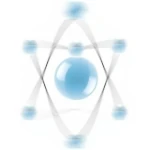
Simplified atomic model of the radon atom. The most important natural isotope is \(^{222}\mathrm{Rn}\)
with its 86 protons, 86 electrons, and 136 neutrons.
Image source: astronoo.com (新窗口)
氡在地球物理学中的作用及其作为环境示踪剂的应用
铀和钍的衰变产物
Radon is a gaseous element continuously produced in the Earth's crust by the 镭的放射性衰变, itself derived from the uranium-238, uranium-235, and thorium-232 chains. It is the only naturally radioactive noble gas under normal conditions. Three natural isotopes are significant, each corresponding to these chains:
- 氡-222(\(^{222}\mathrm{Rn}\)): Member of the 铀-238 chain (4n+2 series). Half-life of 3.8235 days. It is by far the most abundant and important for public health, as its half-life allows it to migrate from the soil to the atmosphere.
- 氡-220(\(^{220}\mathrm{Rn}\),“钍射气”): Member of the 钍-232 chain (4n series). Half-life of 55.6 seconds. Much less mobile, it poses a danger mainly in industrial environments (monazite sand processing).
- 氡-219(\(^{219}\mathrm{Rn}\),“锕射气”): Member of the 铀-235 chain (4n+3 series). Half-life of 3.96 seconds. Its presence is negligible due to the low abundance of U-235 and its very short half-life.
地球化学与土壤逸气
Radon-222 formed in radium-containing minerals can, depending on soil porosity and water content, 扩散到表面 and be released into the atmosphere. This flux, called 氡析出, varies significantly depending on geology (granitic and uranium-rich shales >sedimentary rocks), season, atmospheric pressure, and humidity. Measuring this flux is used in geophysics for:
- 铀矿床勘探: Radon anomalies can indicate the presence of deep ores.
- 活动地震断层研究: Variations in radon flux can precede earthquakes (studied seismic precursor, but not reliable).
- 火山学: Monitoring volcanic activity.
在海洋学和大气科学中,示踪剂
Once in the atmosphere, radon-222 (an inert gas) is transported by winds. Since it decays with a known half-life, its decrease with distance from its continental source (oceans produce very little) allows the study of 气团混合时间 between continents and oceans. In oceans, dissolved radon (produced by radium in sediments) serves as a tracer for vertical mixing processes and air-sea exchanges.
氡气的发现历史
名称的词源与起源
The name "radon" is derived from 镭, its direct parent in the decay chain. The isotope \(^{222}\mathrm{Rn}\) was initially called "镭辐射" or simply "散发" (denoted Em) by its discoverers, as it "emanated" from radium. Later, when isotopes from thorium and actinium were discovered, they were named 钍射气(Tn) and 锕射气(An), respectively. The generic name "radon" (symbol Rn) for element 86 was officially adopted in 1923.
弗里德里希·恩斯特·多恩发现氡(1900年)
Radon-222 was discovered in 1900 by the German physicist 弗里德里希·恩斯特·多恩. While studying radium compounds newly discovered by the Curies, he noticed that radium emitted a radioactive gas. He demonstrated that this gas, which he called "radium emanation," was itself radioactive and transformed into other solid elements. This discovery was crucial for understanding radioactive decay series.
威廉·拉姆齐和罗伯特·怀特洛-格雷的分离与研究
In 1908, the Scottish chemist 威廉·拉姆齐爵士 (already discoverer of the noble gases argon, krypton, xenon, and neon) and his assistant 罗伯特·惠特洛-格雷 succeeded in isolating radon, measuring its density, and proving it was the 已知稀有气体中最重的. They managed to condense enough to observe its emission spectrum, confirming its status as an element. Ramsay received the Nobel Prize in Chemistry in 1904 for his work on inert gases, even before the discovery of radon.
健康风险认知(20世纪)
As early as the 1920s, radon was suspected of causing the high incidence of lung cancer among uranium miners (notably in the Joachimsthal mines in Czechoslovakia and later in New Mexico). However, it was not until the 1980年代 that epidemiological studies (such as those on American miners) firmly established the link between radon exposure and lung cancer. In the 1990s, awareness spread to 国内风险, transforming radon from a scientific curiosity into a major public health issue.
存在与来源
氡气无处不在,但其浓度差异很大。
- 第一手资料: 土壤和底土 (granitic rocks, black shales, certain sandstones, uranium-rich glacial moraines).
- 二手资料:
- 地下水 (wells, springs) that can release radon during use (showering, washing).
- 建筑材料 derived from natural rocks (granite, pumice, certain concretes).
- 未经处理的天然气 (may contain radon that concentrates in combustion appliances).
氡本身并非“生产”而来;它由自然衰变持续产生,需在其积聚处加以管理。
氡的结构与基本性质
分类与原子结构
Radon (symbol Rn, atomic number 86) is an element of group 18, the 稀有气体 (or rare gases). It is the heaviest and only naturally radioactive member of this group under normal conditions (oganesson, Z=118, is synthetic). Its atom has 86 protons and, depending on the isotope, 131 to 150 neutrons. The isotope \(^{222}\mathrm{Rn}\) has 136 neutrons. Its electronic configuration is [Xe] 4f¹⁴ 5d¹⁰ 6s² 6p⁶, with a complete p valence shell (6 electrons), making it a chemically inert gas.
物理性质
氡是一种无色、无味、无臭的稀有气体。
- 气态: At room temperature and pressure.
- 气体密度: Very high for a gas (9.73 g/L at 0°C), about 8 times that of air. It therefore tends to accumulate in the lower parts of buildings (basements, ground floors).
- 熔点: -71 °C (202 K).
- 沸点: -61.7 °C (211 K). It is the noble gas with the highest melting and boiling points, due to its high mass and polarizability.
- 阿尔法放射性: \(^{222}\mathrm{Rn}\) decays by alpha emission (5.49 MeV) into polonium-218 (RaA), with a half-life of 3.8235 days.
在固态形式下,氡因其放射性而呈现黄橙色。
变换点
Radon melts at 202 K(-71 °C) and boils at 211 K(-61.7 °C). It can be liquefied relatively easily by cooling.
化学反应活性(极低,但存在)
As a noble gas, radon is extremely inert. However, due to its large size and high polarizability, it is the 最活泼的稀有气体. Theoretical calculations predict it could form a few unstable compounds, such as 氟化氡(RnF₂) and possibly oxides or clathrate complexes. In practice, only solid-state compounds, highly unstable and radioactive, have been obtained in minute quantities (clathrates with water or hydrocarbons). Its chemistry has little practical application.
氡的物理特性概述
State (20°C, 1 atm): Colorless gas.
Density (gas, 0°C): 9.73 g/L (8.1 x air).
Melting point: 202 K (-71 °C).
Boiling point: 211 K (-61.7 °C).
Electronic configuration: [Xe] 4f¹⁴ 5d¹⁰ 6s² 6p⁶.
Radioactivity: Main isotope \(^{222}\mathrm{Rn}\), α, T½=3.82 days.
氡同位素表(天然)
| 同位素 / 符号 | 质子(Z) | 中子(N) | 原子质量(u) | 母链 | 半衰期 / 衰变模式 | 备注/重要性 |
|---|---|---|---|---|---|---|
| 氡-222 — \(^{222}\mathrm{Rn}\) | 86 | 136 | 222.017578 u | 铀-238(4n+2) | 3.8235天(α) | 最重要的同位素. Half-life long enough to migrate from soil and accumulate in buildings. Mainly responsible for domestic health risk. |
| 氡-220 — \(^{220}\mathrm{Rn}\)(钍射气) | 86 | 134 | 220.011394 u | 钍-232(4n) | 55.6秒(α) | 半衰期极短,限制了其在远离源头处的积累。主要对处理富钍材料(独居石砂、陶瓷)的行业构成危险。 |
| 氡-219 — \(^{219}\mathrm{Rn}\)(锕射气) | 86 | 133 | 219.009480 u | 铀-235(4n+3) | 3.96秒(α) | 因其超短半衰期及U-235丰度极低(0.72%),对公众健康的影响可忽略不计。 |
氡的电子排布与电子壳层
注意::
Electron shells:
电子如何围绕原子核组织 (新窗口).
氡的86个电子分布在六个电子壳层上。其电子排布为[Xe] 4f¹⁴ 5d¹⁰ 6s² 6p⁶,价电子层(6p)完全填满,因此具有极高的化学稳定性和稀有气体特性。该排布也可写作:K(2) L(8) M(18) N(32) O(18) P(8),或完整形式:1s² 2s² 2p⁶ 3s² 3p⁶ 3d¹⁰ 4s² 4p⁶ 4d¹⁰ 4f¹⁴ 5s² 5p⁶ 5d¹⁰ 6s² 6p⁶。
壳层的详细结构
K壳层 (n=1): 2 electrons (1s²).
L壳层(n=2): 8 electrons (2s² 2p⁶).
M层(n=3): 18 electrons (3s² 3p⁶ 3d¹⁰).
N壳层(n=4): 32 electrons (4s² 4p⁶ 4d¹⁰ 4f¹⁴).
O壳层(n=5): 18 electrons (5s² 5p⁶ 5d¹⁰).
P壳层 (n=6): 8 electrons (6s² 6p⁶).
价电子与化学惰性
Radon has 8 价电子 in its outer shell (6s² 6p⁶), achieving the stable 字节 configuration. This saturated electronic structure makes it extremely reluctant to form classical covalent bonds. Its first ionization potential is relatively low for a noble gas (10.75 eV), but still too high for easy chemistry. Any attempt to form compounds (such as RnF₂) requires very strong oxidants like fluorine, and the resulting compounds are thermodynamically unstable and decompose rapidly.
This inertia is crucial for its 环境行为: once formed in the soil, radon does not react with minerals or water; it diffuses freely as an atomic gas. In the lungs, it does not chemically interact with tissues; its danger is purely radiological.
环境行为与公共健康
通往肺部的路径
- 土壤中的生产: Decay of radium-226 → Radon-222.
- 迁移: Radon gas diffuses through soil pores. Pressure differences (house depression, chimney effect) draw it through cracks, joints, and pipe passages.
- 进入与积累: It enters the building and, being heavy, can accumulate in lower levels and poorly ventilated rooms.
- 吸入: Occupants breathe radon and its decay products (Po-218, Pb-214, etc.) suspended in the air.
真正的罪魁祸首:固体衰变产物
The radon gas itself, once inhaled, is largely exhaled. The danger comes from its 固体和放射性衰变产物:
- \(^{218}\mathrm{Po}\)(镭A,α,半衰期=3.1分钟)
- \(^{214}\mathrm{Pb}\)(RaB,β/γ,半衰期=26.8分钟)
- \(^{214}\mathrm{Bi}\)(RaC,β/γ,半衰期=19.9分钟)
- \(^{214}\mathrm{Po}\)(镭C',α,半衰期=164微秒)
这些颗粒(通常带电)会附着于环境气溶胶或灰尘上。一旦被吸入,它们会沉积在呼吸道中,尤其是支气管内。其在肺组织中的α和β衰变会直接辐射上皮细胞,造成DNA损伤,从而可能引发癌症。
氡的健康风险:确定致癌物(IARC 1类)
The International Agency for Research on Cancer (IARC) classifies radon as a 某些人类致癌物. It is the 肺癌的第二大原因 after smoking, and the 非吸烟者中的主要原因. It is estimated that about 3 to 14% of lung cancers worldwide are attributable to radon, corresponding to tens of thousands of deaths annually. The risk is multiplicative with smoking: a smoker exposed to radon has a much higher risk of lung cancer than the sum of individual risks.
测量、参考水平与法规
测量单位
- 贝克勒尔每立方米(Bq/m³): SI unit. 1 Bq/m³ = 1 decay per second in a cubic meter of air. This is the unit used for air concentrations.
- 皮居里每升 (pCi/L): Historical unit still used in the United States. 1 pCi/L = 37 Bq/m³.
参考水平与行动
卫生部门设定了建议采取纠正措施的阈值:
- WHO: Recommends a 参考水平为100 Bq/m³. Below 300 Bq/m³, simple reduction actions are possible. Above, mitigation is necessary.
- 欧盟: Directive 2013/59/Euratom sets a 参考水平为300 Bq/m³ for existing buildings and a design target of 200 Bq/m³ for new constructions.
- 美国(EPA): Recommends action if the concentration exceeds 148 Bq/m³ (4 pCi/L).
室外平均浓度通常为5至15 Bq/m³。在室内,受影响最严重的区域浓度范围可从低于10 Bq/m³到超过10,000 Bq/m³不等。
测量方法
- 被动式活性炭检测器: Small pots exposed for 2 to 7 days, then analyzed in the laboratory by gamma scintillation. Inexpensive, for screening.
- 被动式核径迹探测器(CR-39): A plastic film is exposed for 1 to 12 months. The tracks left by alpha particles are counted after chemical etching. Reference method for long-term integrated measurement.
- 连续电子探测器: Electronic devices (ionization chamber, scintillation cell) providing real-time or short-term readings. Useful for identifying entry paths and verifying the effectiveness of work.
氡的(非常有限的)应用
- 历史上的放射治疗(“氡籽”): In the early 20th century, tiny radon capsules (gold or glass) were implanted directly into tumors for local irradiation. Practice abandoned in favor of more practical isotopes (iridium-192, iodine-125).
- 水文与地质研究: As a natural tracer to study underground flows, water-soil-rock interactions, and aquifer dynamics.
- 大气研究: As a tracer to quantify air-sea exchanges and tropospheric mixing.
- 基础研究: In nuclear physics for the study of alpha decays and heavy nuclei.
- 温泉疗法(氡温泉): Some thermal stations (notably in Austria, Germany, Japan) use naturally radon-rich waters for baths, claiming beneficial effects against joint pain (rheumatism). This practice, called "low-dose radiotherapy," is 极具争议的 from a scientific and health perspective, as it deliberately exposes patients to a known carcinogen. It is not recognized by conventional medicine.
缓解与预防
既有建筑改造策略
目标是降低氡浓度。按效果和成本排序的技术包括:
- 改善通风: Regular airing (simple but ineffective in winter, energy-intensive).
- 密封下部结构: Sealing cracks, joints, and pipe passages with appropriate sealants.
- 主动式土壤降压系统(SDS): 最有效的方法. A pipe is inserted under the slab or in the fill, connected to a small fan that draws radon from under the house and releases it outside, far from openings. This creates a depression under the slab, reversing the radon entry flow.
- 控制性机械通气(CMV)通过吹气法: Maintaining slight overpressure in the building to prevent radon entry.
新建建筑中的预防措施
- 选址: Avoid high radon potential areas if possible, or adapt techniques.
- 防氡屏障: Install a sealed membrane under the foundation slab.
- 通风砾石层: Under the slab, to facilitate gas evacuation.
- SDS预装备: Install necessary ducts during construction, in case an active system is needed later.
法规与意识
氡潜势图绘制
Many countries have established 氡潜势图 based on geology and measurements. In France, the IRSN has published a municipal map classifying communes into 3 potential categories. These maps are used to prioritize information actions and monitoring obligations (schools, workplaces in high-potential areas).
法律义务
- 买家和租户须知: Obligation to measure and inform in certain areas (e.g., in France in areas with significant potential).
- 工作场所监控: Mandatory in public buildings (ERP) located in basements or ground floors in risk areas, and in certain industries (spas, cellars, etc.).
- 建筑专业人士培训: To integrate mitigation techniques.
前景
氡气问题是一个完全可以识别和管理的环境健康问题。当前的挑战是:
- 公众与卫生专业人员的意识: Radon remains poorly known.
- 测量与缓解技术的改进与标准化.
- 系统性地纳入建筑规范 for new homes in risk areas.
- 研究: To better understand the spatial and temporal variability of concentrations, and refine risk models, especially interactions with other indoor pollutants.
氡,一种看不见的天然气体,完美地说明了地质现象如何直接对人群健康产生影响,以及科学和法规如何结合以减轻这种风险。
 核聚变所需的能量以及为什么铀是一个极限
 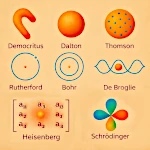 原子的各种形态:从古代直觉到量子力学