

汞(Hg,Z = 80):液态且有毒的金属
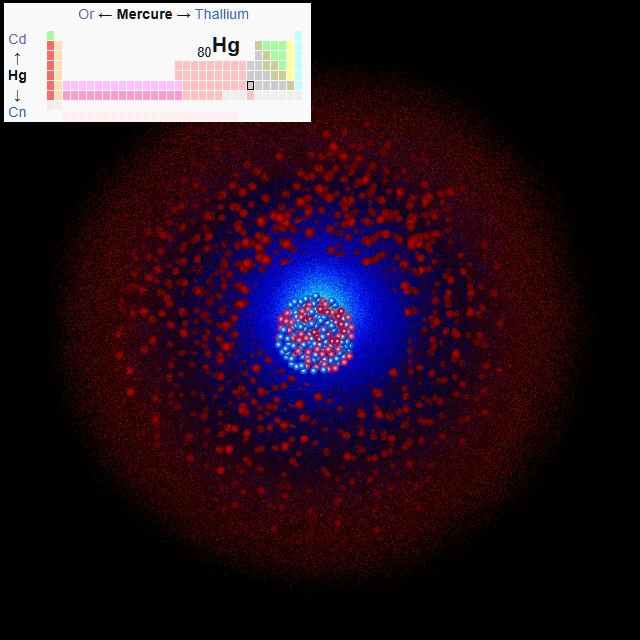
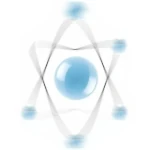
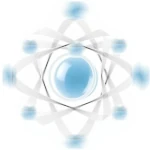
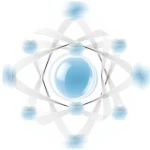
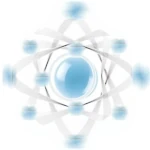
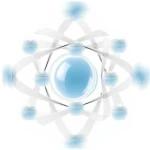
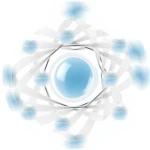
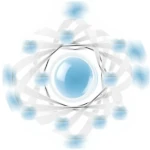
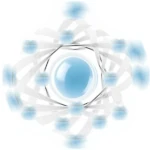
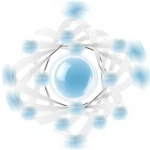
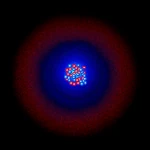
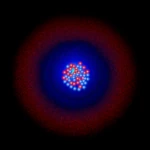
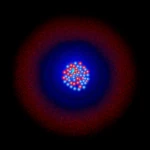
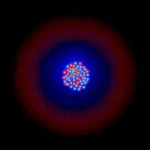
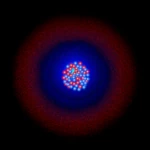
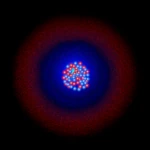
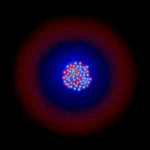
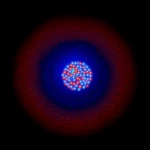
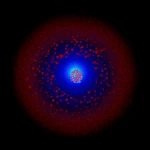
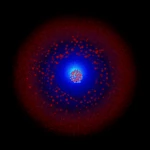
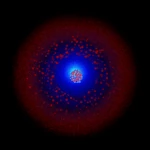
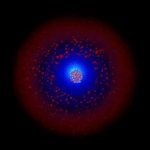
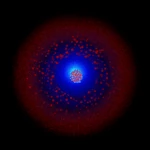
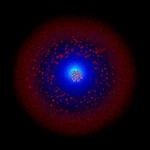
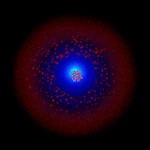
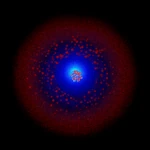
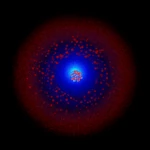
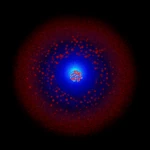
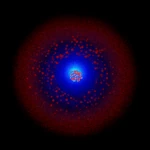
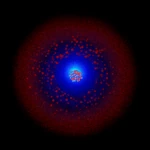
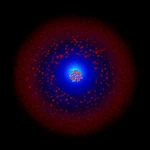
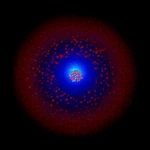
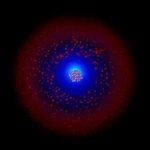
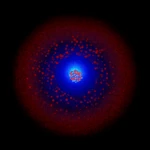
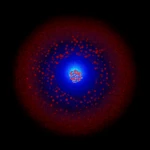
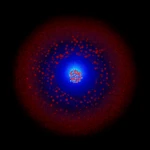
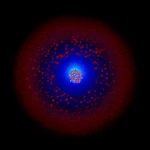
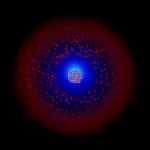
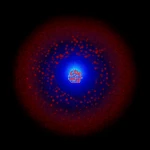
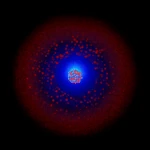
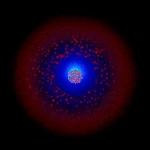
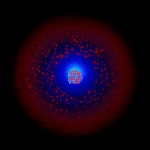
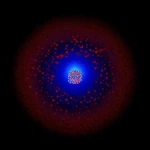
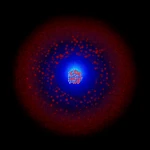
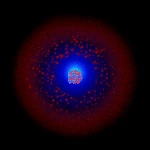
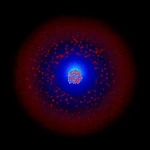
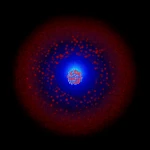
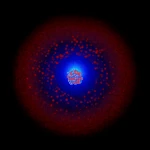
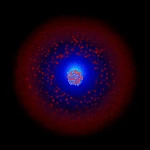
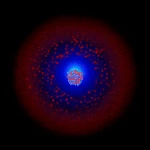
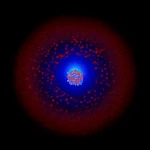
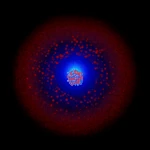
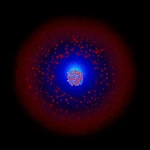
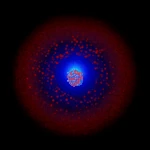
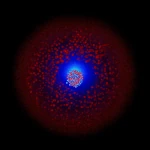
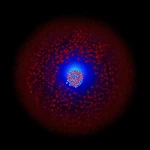
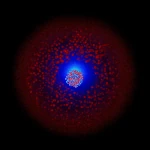
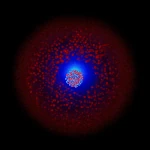
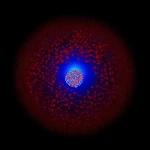
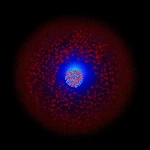
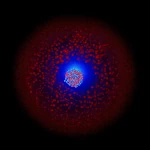
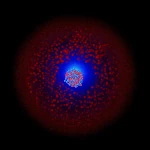
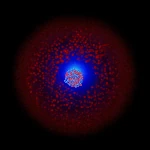
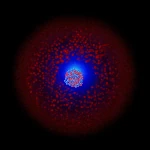
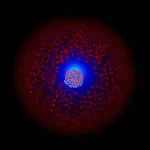
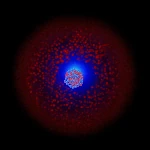
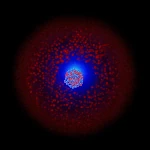
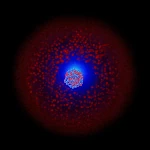
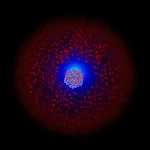
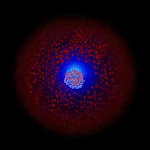
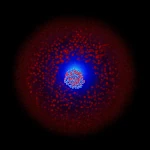
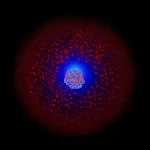
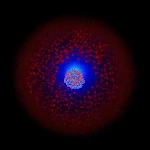
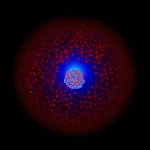
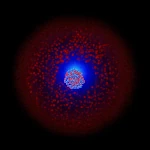
Image description:
Simplified atomic model of the mercury atom. The main stable isotope is \(^{202}\mathrm{Hg}\)
with its 80 protons, 80 electrons, and 122 neutrons.
Image source: astronoo.com (新窗口)
水星在天体物理学与行星学中的作用
恒星合成与宇宙波动
Mercury is a volatile element whose synthesis mainly involves the s-过程 (slow neutron capture) in asymptotic giant branch (AGB) stars. It belongs to the so-called "moderately volatile" elements, meaning it condenses at relatively low temperatures during planet formation. This volatility partly explains its distribution in the solar system: it is significantly depleted in terrestrial planets (such as Earth) compared to solar abundances, as much of it remained gaseous during accretion and was blown away by the young Sun.
宇宙与行星的丰度
汞在宇宙中的丰度约为氢原子数的1.5×10⁻¹¹倍,与硒和溴的含量相当。在地球上,地壳中汞的含量相对稀少(约0.08 ppm)。它在其他天体上的存在令人着迷:水星(仅名称巧合)的外逸层中含有微量原子态汞,可能是微陨石撞击其表面释放的。彗星和一些富含冰的小行星也可能以有机汞化合物或硫化物的形式含有汞。
汞的地球化学循环:一种陆地特性
On Earth, mercury follows a complex cycle involving the atmosphere, oceans, crust, and biosphere. Its elemental form (Hg⁰) is volatile and can travel long distances in the atmosphere before being oxidized and deposited. This 全球大气输送 explains why mercury pollution is a worldwide problem, affecting even the most remote regions such as the Arctic. The study of ice cores allows us to trace the history of mercury emissions linked to human activities (mining, coal combustion) over millennia.
地球历史上的汞与大规模灭绝
Mercury anomalies have been identified in marine sediments at the boundary of several mass extinction events (Permian-Triassic, Triassic-Jurassic, Cretaceous-Paleogene). These peaks could be linked to 大规模的火山活动 (traps) that released enormous amounts of volatile mercury into the atmosphere, contributing to the poisoning of ecosystems. Thus, mercury also serves as a geological tracer of major environmental upheavals of the past.
汞的发现与使用历史
名称的词源与起源
The chemical symbol Hg comes from the Latin "汞", itself derived from the ancient Greek 水银 (hýdōr árgyros), meaning "liquid silver". This name perfectly describes its appearance: a metal as shiny as silver, but liquid. The French name "mercure" comes from the Roman god Mercury (Hermes to the Greeks), the swift messenger of the gods, perhaps in reference to the mobility and volatility of the liquid metal.
古代与炼金术用途
天然汞(以朱砂HgS的形式存在)自古便为人所知。中国人和埃及人将其用作朱红色颜料及药材(常引发灾难性后果)。炼金术士视汞为根本元素,与硫磺、盐并列为构成物质的三大基本原理。他们相信汞是点石成金的关键——其溶解黄金(形成汞齐)的能力,以及挥发后完整冷凝的特性,令世人着迷,更催生了诸多神秘理论。
从炼金术到现代科学
18世纪,水银在温度测量(华氏与摄氏温度计)和气压测量(托里拆利实验,1643年通过水银柱证明大气压存在)的发展中发挥了关键作用。其有毒化合物如甘汞(Hg₂Cl₂)和升汞(HgCl₂)的发现,也标志着制药化学与工业化学的开端。
存款与生产
The main source of mercury is 朱砂 (mercury(II) sulfide, HgS), a scarlet red ore. Major deposits have been exploited in Almadén (Spain, the largest historical mine), Idrija (Slovenia), and Monte Amiata (Italy). Today, primary mining production has significantly decreased due to toxicity and environmental restrictions. 中国 and 吉尔吉斯斯坦 are among the last significant producers.
Most of the mercury circulating today comes from 回收利用 or is a 副产品 of other activities:
- 煤炭燃烧(煤炭中含有微量汞)。
- 有色金属(锌、铅、金)的生产。
- 使用汞阴极电池的氯碱生产(一种正在逐步淘汰的技术)。
由于其毒性,汞的贸易受到《水俣公约》(2013年)的严格管制。
汞的结构与基本性质
分类与原子结构
汞(符号Hg,原子序数80)是第六周期的过渡金属,位于元素周期表第12族,与锌和镉同族。其原子含有80个质子,通常有122个中子(对应稳定同位素\(^{202}\mathrm{Hg}\)),以及80个电子,电子排布为[Xe] 4f¹⁴ 5d¹⁰ 6s²。这种具有完整d¹⁰壳层和完整s²壳层的排布与稀有气体相似,使其金属形态反应活性低,且熔点较低。
独特的物理性质
Mercury is the 唯一在常温常压下呈液态的金属. It is a dense, silvery-white, mobile liquid that easily divides into spherical droplets.
- 液态: Melting point at -38.83 °C, boiling point at 356.73 °C.
- 高密度: 13.534 g/cm³ at 20 °C (one liter weighs 13.5 kg).
- 非常高的表面张力: Forms almost perfect droplets.
- 电导率: Poor for a metal (about 1/60th that of silver).
- 常规热膨胀: Used in thermometers.
- 非润湿性: Does not wet glass, leaves a convex meniscus.
在固态下,汞具有延展性和可塑性,并以菱面体结构结晶。
变换点
Mercury freezes at -38.8290 摄氏度 (234.321 K) and boils at 356.73 °C (629.88 K). Its wide liquid temperature range (nearly 400°C) and its linear expansion made it successful in measuring instruments.
化学反应活性
汞是一种相对惰性的金属。它不与非氧化性酸(稀盐酸、稀硫酸)反应,但可溶于硝酸和王水。在室温下,汞能抵抗空气氧化,但在臭氧存在下会缓慢形成灰色氧化膜。它能与卤素、硫及金属反应生成汞齐。
物理特性总结
State at 20°C: Liquid.
Melting point: 234.321 K (-38.8290 °C).
Boiling point: 629.88 K (356.73 °C).
Density: 13.534 g/cm³.
Electronic configuration: [Xe] 4f¹⁴ 5d¹⁰ 6s².
Main oxidation states: +1 and +2.
汞同位素表
| 同位素 / 符号 | 质子(Z) | 中子(N) | 原子质量(u) | 天然丰度 | 半衰期/稳定性 | 衰变/备注 |
|---|---|---|---|---|---|---|
| 汞-196 — \(^{196}\mathrm{Hg}\) | 80 | 116 | 195.96583 u | ≈ 0.15% | 稳定的 | 稀有稳定同位素。 |
| 汞-198 — \(^{198}\mathrm{Hg}\) | 80 | 118 | 197.966769 u | ≈ 9.97% | 稳定的 | 稳定同位素。 |
| 汞-199 — \(^{199}\mathrm{Hg}\) | 80 | 119 | 198.968280 u | ≈ 16.87% | 稳定 | 核自旋I=1/2的稳定同位素,用于\(^{199}\mathrm{Hg}\)核磁共振波谱分析。 |
| 汞-200 — \(^{200}\mathrm{Hg}\) | 80 | 120 | 199.968326 u | ≈ 23.10% | 稳定的 | 稳定同位素。 |
| 汞-201 — \(^{201}\mathrm{Hg}\) | 80 | 121 | 200.970302 u | ≈ 13.18% | 稳定的 | 稳定同位素。 |
| 汞-202 — \(^{202}\mathrm{Hg}\) | 80 | 122 | 201.970643 u | ≈ 29.86% | 稳定 | 最丰富的稳定同位素。 |
| 汞-204 — \(^{204}\mathrm{Hg}\) | 80 | 124 | 203.973494 u | ≈ 6.87% | 稳定 | 稳定同位素。 |
汞的电子排布与电子壳层
注意::
Electron shells:
电子如何围绕原子核组织 (新窗口).
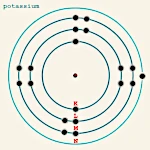
汞有80个电子,分布在六个电子壳层中。其电子排布为[Xe] 4f¹⁴ 5d¹⁰ 6s²,其中5d壳层完全填满(10个电子),6s壳层也完全填满(2个电子),类似于稀有气体的构型。这也可以表示为:K(2) L(8) M(18) N(32) O(18) P(2),或完整写法:1s² 2s² 2p⁶ 3s² 3p⁶ 3d¹⁰ 4s² 4p⁶ 4d¹⁰ 4f¹⁴ 5s² 5p⁶ 5d¹⁰ 6s²。
壳层的详细结构
K壳层(n=1): 2 electrons (1s²).
L壳层(n=2): 8 electrons (2s² 2p⁶).
M层(n=3): 18 electrons (3s² 3p⁶ 3d¹⁰).
N壳层(n=4): 32 electrons (4s² 4p⁶ 4d¹⁰ 4f¹⁴).
O壳层 (n=5): 18 electrons (5s² 5p⁶ 5d¹⁰).
P壳层(n=6): 2 electrons (6s²).
价电子与氧化态
Mercury has 2 价电子 (6s²). However, due to the inert pair effect (particular stability of the 6s² electron pair), mercury exhibits a particular chemistry with two stable oxidation states: +1 and +2.
- 汞(I) (Hg₂²⁺): A very unusual state where mercury forms a 双原子 cation with a metal-metal bond: [Hg-Hg]²⁺. Mercury(I) compounds such as calomel (Hg₂Cl₂) therefore always contain two mercury atoms bonded together.
- 汞(II) (Hg²⁺): The most common and most toxic state. Forms linear complexes (e.g., HgCl₂) and is a soft acid according to HSAB theory, with a strong affinity for "soft" ligands such as sulfur atoms (thiols) or cyanide groups.
金属汞(Hg⁰)相对不活泼,这是因为液态中Hg-Hg键的强度较高,且将6s电子激发到更高能级需要较高能量。
汞的化学反应活性
与空气和氧气的反应
金属汞在室温下不会在空气中氧化。当缓慢加热至沸点时,最终会形成红色的氧化汞(II)(HgO):2Hg + O₂ → 2HgO。这种氧化物在400°C以上会分解回汞和氧气。在臭氧存在下,表面会形成一层灰色的氧化膜。
与水及酸的反应
- 水: Insoluble and unreactive.
- 非氧化性酸 (dilute HCl, dilute H₂SO₄): No reaction (unlike zinc or iron).
- 硝酸: Dissolves. With dilute nitric acid, it forms mercury(I) nitrate (Hg₂(NO₃)₂). With hot concentrated acid, it forms mercury(II) nitrate (Hg(NO₃)₂).
- 王水: Dissolves to form mercury(II) chloride (HgCl₂).
注意::
汞齐的形成
This is a characteristic property: mercury dissolves many other metals (gold, silver, tin, zinc, sodium) to form 汞齐, which are alloys in liquid or pasty state. The gold-mercury amalgam has been widely used in artisanal gold extraction (garimpos). The silver-tin-mercury amalgam was the basis of dental "fillings". Sodium or potassium amalgams are used as powerful reducing agents in organic chemistry.
与卤素、硫和有机化合物的反应
- 卤素: Reacts cold with chlorine to give HgCl₂ (corrosive sublimate), with bromine to give HgBr₂. Reaction with iodine is slower.
- 硫: Mercury is "amalgamated" by sulfur powder, forming black sulfide (metacinnabar HgS). Heating mercury with sulfur gives red cinnabar (HgS).
- 有机化合物: Mercury(II) easily forms covalent bonds with carbon, giving 有机汞化合物 (e.g., methylmercury CH₃Hg⁺, ethylmercury), which are extremely toxic and bioaccumulative.
汞的工业和技术应用(历史与现状)
- In 温度计 and 气压计 (applications in rapid decline for safety reasons and replaced by electronic or alcohol alternatives);
- In 倾斜开关 (liquid mercury establishes perfect electrical contact, without sparking);
- As a cathode in 汞电池 for chlorine and caustic soda production (Castner-Kellner process, technology being phased out in favor of membranes);
- 作为原电池中的电极(汞氧化物电池和碱性电池,现已禁止或限制使用);
- 作为化学工业中的催化剂,特别是用于从乙炔生产乙醛(该工艺现已废弃);
- In 手工采金 (amalgamation), a practice still widespread and a major cause of pollution;
- In 牙科汞合金 ("silver fillings"), whose use is in sharp decline;
- As a working fluid in 涡轮机 and certain physics experiments;
- In 汞蒸气灯 for public lighting (arc lamps) and fluorescent lamps (neon), being replaced by LEDs;
- 作为电化学中的参考标准(饱和甘汞电极,SCE);
- 作为矿井中的高密度分离液(用于富集重矿石);
- In the manufacture of 镜子 by amalgamation (deposit of tin + mercury on glass);
- 作为动物标本剥制术和鞣制工艺中的固定剂(历史用途);
- In 爆炸物 such as mercury fulminate (Hg(CNO)₂), a sensitive detonator;
- 在科学研究中,作为粒子对撞机中的靶标以及某些物理实验的对象。
毒理学与公共卫生
暴露途径与方式
The toxicity of mercury depends strongly on its 化学形式:
- 元素汞(Hg⁰)蒸气: Extremely toxic by inhalation. Mercury vapors are invisible, odorless, and easily pass through the alveolar membrane of the lungs. They then enter the blood and cross the blood-brain barrier, seriously affecting the central nervous system.
- 无机汞(II)化合物(如HgCl₂): Corrosive and toxic to the kidneys. Ingestion causes severe gastrointestinal damage.
- 有机汞化合物(例如甲基汞 CH₃Hg⁺): The most dangerous. Formed by bacterial biomethylation in aquatic sediments. They are lipophilic, easily cross biological barriers (including the placenta), and accumulate in the food chain, particularly in predatory fish (tuna, swordfish). They are neurotoxic and teratogenic.
历史疾病与综合征
- 疯帽匠病: In the 18th and 19th centuries, hatters used mercury nitrate to felt wool. Chronic inhalation of vapors caused tremors, speech disorders, memory loss, and psychosis. This is the origin of the expression "mad as a hatter" and the character of the Mad Hatter in Alice in Wonderland.
- 水俣病: Massive methylmercury poisoning in the 1950s in Minamata, Japan. A chemical plant discharged mercury waste into the bay. Methylmercury accumulated in fish and shellfish. Residents who consumed them developed severe neurological symptoms (ataxia, sensory disorders, paralysis, congenital malformations). This environmental disaster led to the Minamata Convention.
- 肢端疼痛症(红皮病): Mercury poisoning in children, historically due to medicines or dental powders containing mercury.
预防措施与治疗
In case of metallic mercury spillage, it is necessary to 彻底通风, avoid walking on it (to prevent spreading droplets), and use a specific trap (syringe, pipette, sulfur powder) to collect it. Never use a vacuum cleaner (it vaporizes and disperses mercury). Exposure requires urgent medical consultation. Treatment of acute poisoning may use 螯合剂 such as DMSA (dimercaptosuccinic acid) or DMPS, which bind to mercury and promote its urinary excretion.
环境与污染
汞的生物地球化学循环
汞是一种持久性污染物,遵循复杂的循环过程:
- 排放: Natural (volcanoes, terrestrial degassing) and anthropogenic (coal combustion, mining, cement production).
- 大气输送: As Hg⁰ vapor, it can remain in the air for more than a year and travel globally.
- 氧化与沉积: Oxidized to Hg²⁺, it is deposited on soils and oceans by rain.
- 甲基化: In anoxic aquatic environments (sediments), bacteria transform Hg²⁺ into methylmercury (CH₃Hg⁺).
- 生物累积与生物放大: Methylmercury enters plankton and then moves up the food chain, with concentrations that can be multiplied by a million between water and a large predator like tuna.
对生态系统和人类健康的影响
Mercury pollution affects wildlife (reduced reproduction in fish-eating birds, neurological disorders in marine mammals). For humans, the main route of exposure is the 食用受污染鱼类. The most at-risk populations are coastal communities, indigenous peoples (Inuit), and pregnant women (methylmercury crosses the placenta and harms fetal neurological development).
《水俣公约》及其监管
The 水俣公约, adopted in 2013 and entered into force in 2017, is an international treaty aimed at protecting human health and the environment. It requires:
- 含汞产品(温度计、电池、某些开关)的逐步淘汰。
- 控制和减少燃煤电厂和工厂的排放。
- 禁止在手工采金中使用汞(对发展中国家设定了最后期限)。
- 对汞库存和废物进行无害环境管理。
回收与废物管理
恢复需求
Given the toxicity and persistence of mercury, it is imperative to 恢复并隔离 it from the biosphere permanently. Mercury cannot be "destroyed" (the atoms persist), but it can be stabilized in less dangerous forms.
回收与处置过程
- 单独收集: Specific channels exist for thermometers, batteries, compact fluorescent lamps, and other mercury waste.
- 蒸馏/回收: Metallic mercury from waste can be purified by vacuum distillation and reused in authorized applications, or stored.
- 稳定化/固化: For contaminated solid waste, mercury is immobilized by combining it with sulfur (formation of stable cinnabar) or by incorporating it into a cement or glass matrix.
- 永久存储: Purified stabilized mercury is stored in secure, geologically stable facilities designed to isolate it for centuries. The EU and the United States have designated long-term storage sites.
挑战与展望
The main challenges are the 逐步淘汰 of the last uses (certain chemical processes, certain lamps), the 污染场地修复 (former factories, mines), and the management of 流通产品中的汞 (millions of thermometers and dental amalgams). Research continues on biological decontamination methods (phytoremediation) and on non-toxic alternatives in all areas where mercury was historically used.
 核聚变所需的能量以及为什么铀是一个极限
 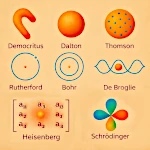 原子的各种形态:从古代直觉到量子力学