

钼(Mo,Z = 42):高性能钢的关键金属
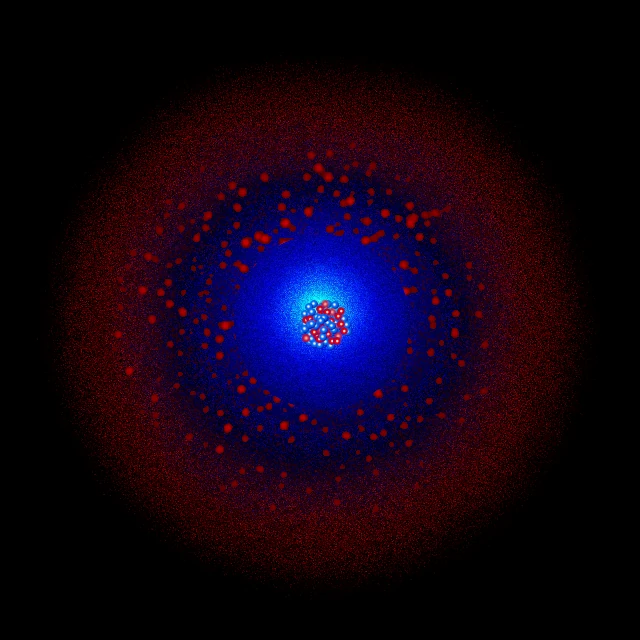
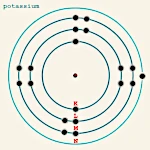
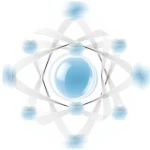
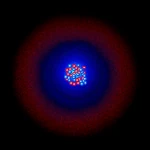
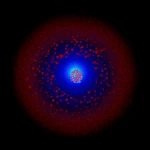
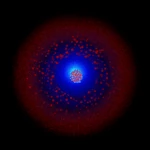
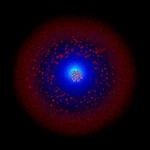
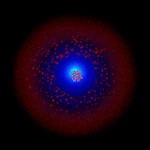
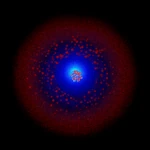
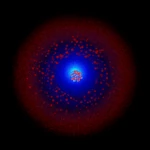
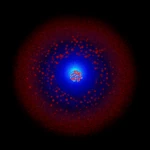
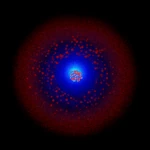
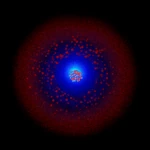
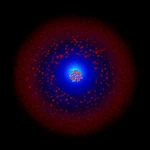
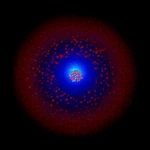
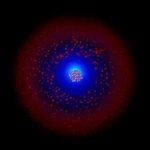
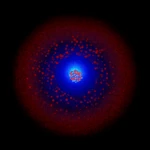
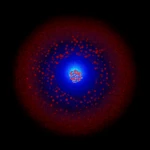
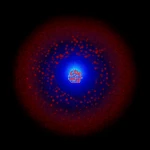
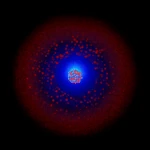
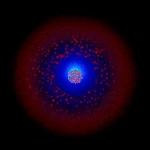
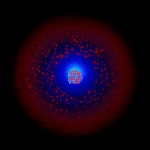
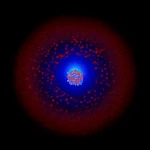
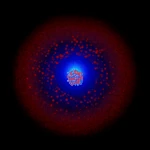
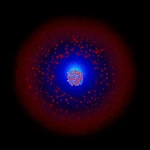
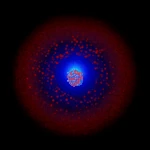
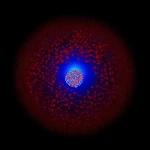
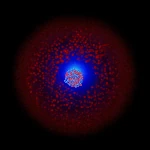
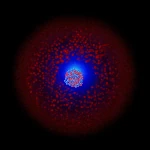
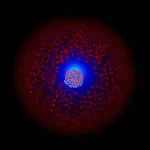
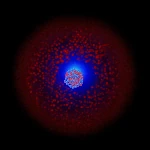
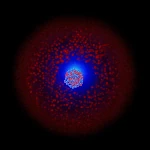
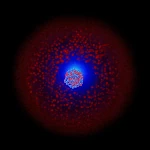
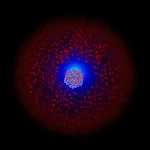
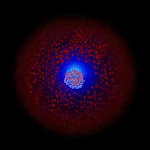
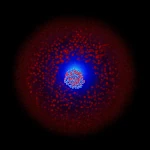
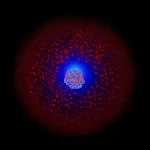
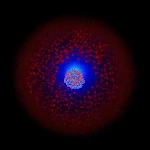
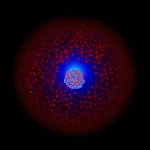
Image description: Simplified atomic model of the molybdenum atom. The most abundant isotope is \(\,^{98}\mathrm{Mo}\,\)
with its 42 protons, 42 electrons, and 56 neutrons.
Image source:
astronoo.com (新窗口)
钼的发现历史
Molybdenum gets its name from the Greek word 钼, meaning lead, because the mineral molybdenite (MoS₂) was long confused with galena (lead sulfide) and graphite due to their similar dark gray appearance and greasy texture. It was not until 1778 that the Swedish chemist 卡尔·威廉·舍勒 (1742-1786), famous for discovering oxygen, chlorine, and several other elements, demonstrated that molybdenite was distinct from lead and graphite and contained a new element.
Scheele succeeded in obtaining molybdenum oxide (MoO₃) by treating molybdenite with nitric acid, but he did not manage to isolate the metal itself. In 1781, his compatriot 彼得·雅各布·耶尔姆 (1746-1813), a Swedish metallurgist and chemist, succeeded in isolating molybdenum metal for the first time by reducing molybdenum oxide with carbon: MoO₃ + 3C → Mo + 3CO. The metal obtained was impure but marked the official discovery of molybdenum as an element.
For more than a century, molybdenum remained essentially a laboratory curiosity without practical applications. It was not until the early 20th century, with the development of alloy steels for armaments during World War I, that the importance of molybdenum was recognized. In 1913, the German company Krupp developed the first molybdenum steels for armor and cannons, revealing that small amounts of molybdenum dramatically improved the strength and toughness of steels at high temperatures.
结构与基本性质
钼(符号Mo,原子序数42)是元素周期表第6族的过渡金属。其原子含有42个质子,通常有56个中子(对应最丰富的同位素\(\,^{98}\mathrm{Mo}\)),以及42个电子,电子构型为[Kr] 4d⁵ 5s¹。
钼是一种闪亮的银灰色金属,外观与不锈钢相似。其密度为10.28 g/cm³,因此相对较重。钼在室温下质地坚硬且具有延展性,可轧制成薄板或拉制成丝。其硬度会因冷加工而显著增加。
Molybdenum crystallizes in a body-centered cubic (bcc) structure at all temperatures. It is a refractory metal with a very high melting point of 2623 °C (2896 K), the sixth highest melting point of all elements after carbon, tungsten, rhenium, osmium, and tantalum. It boils at 4639 °C (4912 K).
钼具有优异的热导率(20°C时为138 W/m·K),接近铜的热导率,且电导率高。其热膨胀系数极低(4.8×10⁻⁶ K⁻¹),使其成为高温下需要尺寸稳定性的应用场景的理想材料。
Melting point of molybdenum: 2896 K (2623 °C).
Boiling point of molybdenum: 4912 K (4639 °C).
Molybdenum has the highest
elastic modulus after tungsten among all pure metals.
钼同位素表
| 同位素 / 符号 | 质子 (Z) | 中子(N) | 原子质量(u) | 天然丰度 | 半衰期/稳定性 | 衰变 / 备注 |
|---|---|---|---|---|---|---|
| 钼-92 — \(\,^{92}\mathrm{Mo}\,\) | 42 | 50 | 91.906811 u | ≈ 14.65% | 稳定的 | 天然钼中最稳定的轻同位素。 |
| 钼-94 — \(\,^{94}\mathrm{Mo}\,\) | 42 | 52 | 93.905088 u | ≈ 9.19% | 稳定的 | 天然钼中第二稀有的稳定同位素。 |
| 钼-95 — \(\,^{95}\mathrm{Mo}\,\) | 42 | 53 | 94.905842 u | ≈ 15.87% | 稳定 | 天然钼中第三丰富的稳定同位素。 |
| 钼-96 — \(\,^{96}\mathrm{Mo}\,\) | 42 | 54 | 95.904680 u | ≈ 16.67% | 稳定的 | 天然钼中第四丰富的稳定同位素。 |
| 钼-97 — \(\,^{97}\mathrm{Mo}\,\) | 42 | 55 | 96.906022 u | ≈ 9.60% | 稳定的 | 第五稳定同位素。具有用于核磁共振波谱的核自旋。 |
| 钼-98 — \(\,^{98}\mathrm{Mo}\,\) | 42 | 56 | 97.905408 u | ≈ 24.39% | 稳定的 | 钼的最丰富同位素,占总量的近四分之一。 |
| 钼-100 — \(\,^{100}\mathrm{Mo}\,\) | 42 | 58 | 99.907477 u | ≈ 9.63% | ≈ 7.1 × 10¹⁸ 年 | 放射性(β⁻β⁻)。极慢的双β衰变,被视为准稳定态。 |
| 钼-99 — \(\,^{99}\mathrm{Mo}\,\) | 42 | 57 | 98.907712 u | 合成 | ≈ 65.9 小时 | 放射性(β⁻)。主要裂变产物。用于医学成像的锝-99m的来源。 |
钼的电子构型与电子壳层
注意::
Electron shells:
电子如何围绕原子核组织 (新窗口).
钼有42个电子,分布在五个电子壳层中。其完整电子排布为:1s² 2s² 2p⁶ 3s² 3p⁶ 3d¹⁰ 4s² 4p⁶ 4d⁵ 5s¹,或简写为:[Kr] 4d⁵ 5s¹。该排布也可写作:K(2) L(8) M(18) N(13) O(1)。
壳层的详细结构
K层(n=1): contains 2 electrons in the 1s subshell. This inner shell is complete and very stable.
L层(n=2): contains 8 electrons distributed as 2s² 2p⁶. This shell is also complete, forming a noble gas configuration (neon).
M壳层(n=3): contains 18 electrons distributed as 3s² 3p⁶ 3d¹⁰. This complete shell contributes to the electronic screen.
N壳层(n=4): contains 13 electrons distributed as 4s² 4p⁶ 4d⁵. The five 4d electrons are valence electrons.
O壳层(n=5): contains 1 electron in the 5s subshell. This electron is also a valence electron.
价电子与氧化态
Molybdenum has 6 价电子: five 4d⁵ electrons and one 5s¹ electron. The configuration [Kr] 4d⁵ 5s¹ with the half-filled 4d subshell is particularly stable. The most common oxidation state is +6, where molybdenum forms compounds such as molybdenum trioxide (MoO₃) and molybdates (MoO₄²⁻). The +5, +4, +3, +2, and 0 states also exist in various compounds.
钼(VI)在钼的化学性质中占主导地位,尤其是在含氧化合物中。二硫化钼(MoS₂)中钼呈+4价态,是一种用作固体润滑剂的重要化合物。钼的有机金属配合物表现出多种氧化态和结构。
化学反应活性
在室温下,块状钼因表面形成薄薄的保护性氧化层而在空气中相对稳定。它在潮湿空气中氧化缓慢,在600°C以上时氧化加速。高温(超过700°C)下,钼在氧气中燃烧生成白色三氧化钼:2Mo + 3O₂ → 2MoO₃。三氧化钼易升华,形成特征性的白色烟雾。
钼在室温下能抵抗多种酸的腐蚀,但会被浓硝酸和王水侵蚀。在有氧化剂存在的条件下,它会与碱性溶液反应生成钼酸盐。卤素在高温下会侵蚀钼,形成多种卤化物(如MoF₆、MoCl₅、MoBr₃)。
钼在高温下形成碳化物(Mo₂C、MoC)和氮化物(MoN、Mo₂N),这些均为高硬度难熔陶瓷,可用作切削材料。二硫化钼(MoS₂)具有类似石墨的层状结构,使其具备优异的润滑性能,尤其在有机润滑剂失效的真空环境中表现突出。
钼的工业与技术应用
- 作为不锈钢、工具钢和建筑钢中的合金(约占用途的80%);
- 在用于飞机涡轮机和发电厂的镍基高温合金中;
- 作为二硫化钼(MoS₂)高性能固体润滑剂,适用于极端环境;
- 在石油加氢脱硫和氨生产的催化过程中。
- 在感应炉电极和高温加热元件中;
- 用于真空和惰性气氛炉的坩埚、支架及组件;
- 作为微电子领域薄膜沉积用的溅射靶材;
- 在白炽灯丝和高温电子元件中;
- 用于X射线管(钼-锝合金旋转阳极)
- 在核医学中作为通过钼-99产生锝-99m的来源;
- 用于陶瓷和涂料的橙色和红色颜料(钼酸铅);
- 作为农业肥料中的必需微量元素;
- 用于耐腐蚀和耐磨涂层;
- 在特种玻璃和焊接电极的制造中。
钢冶金中的钼
全球约80%的钼产量用于制造钢铁合金。钼能显著改善钢材性能:提高强度和硬度,增强淬透性(深层硬化能力),在高温下保持强度,并大幅提升不锈钢的耐腐蚀性。
含2-4%钼的奥氏体和双相不锈钢(316型、317型及双相钢)在含氯环境中表现出卓越的抗点蚀和缝隙腐蚀性能。这类钢材在化工、石油、海洋及制药行业中至关重要。钼能稳定铬氧化物的钝化层,并防止局部腐蚀。
含1-10%钼的工具钢即使在高温下也能保持硬度和锋利度(红硬性现象)。这些高速钢(HSS)可在不损失性能的情况下实现高速加工。含钼的微合金结构钢在保持优异焊接性的同时,具有较高的机械强度。
生物学作用与医学应用
钼是所有生物体必需的微量元素。在人体中,它是多种重要酶的辅助因子,包括黄嘌呤氧化酶(嘌呤代谢)、醛氧化酶和亚硫酸盐氧化酶(亚硫酸盐解毒)。钼在这些酶中以钼-蝶呤辅因子(Moco)的形式存在。
成人每日对钼的需求量约为45微克。人类极少出现钼缺乏症,因为钼广泛存在于日常饮食中(豆类、全谷物、绿色蔬菜、坚果)。严重缺乏可能导致严重的神经系统疾病。钼的毒性较低,但长期过量摄入会干扰铜的代谢。
在核医学中,钼-99(半衰期66小时)是锝-99m(半衰期6小时)的来源,后者是全球诊断成像领域应用最广泛的放射性同位素。钼-99通过核反应堆中铀-235的裂变产生,并通过锝发生器(俗称"锝牛")分发至医院。全球每年进行的锝-99m成像检查超过4000万例。
在天体物理学和宇宙学中的作用
Molybdenum is synthesized in stars by several nucleosynthesis processes. Molybdenum isotopes are produced mainly by the 慢中子过程 (slow neutron capture) in asymptotic giant branch (AGB) stars, with contributions from the r-process (rapid neutron capture) during supernovae and neutron star mergers. Molybdenum-92 and molybdenum-94 are also produced by the p-process (proton capture).
钼在宇宙中的丰度(按原子数计)约为氢的2×10⁻⁹倍。钼的七种天然同位素反映了不同核合成过程的相对贡献,使其成为理解这些恒星机制的关键元素。
原始陨石中钼的同位素变化提供了早期太阳系非均质性的信息。部分陨石显示出钼-95和钼-97的过剩,表明太阳星云不同区域中s过程和r过程的贡献存在差异。这些同位素异常有助于追溯行星物质的起源与演化。
注意::
Molybdenum is present in the Earth's crust at an average concentration of about 0.00012% by mass (1.2 ppm),
making it relatively rare. The main ore is molybdenite (MoS₂) containing about 60% molybdenum. Other sources include powellite (CaMoO₄) and
wulfénite (PbMoO₄). The main deposits are found in China, the United States, Chile, Peru, and Canada.
中国主导全球钼生产,供应量约占40%,智利和美国紧随其后。全球钼年产量约为30万吨(以钼含量计)。钼的提取来源包括原生辉钼矿矿床,或作为斑岩铜矿中铜提取的副产品。
金属钼是通过在高温下用氢气还原氧化钼(MoO₃)生产的:MoO₃ + 3H₂ → Mo + 3H₂O,随后通过粉末冶金烧结获得致密部件。钼铁(含钼60-75%的铁钼合金)则通过铝热法生产,并直接用于钢铁制造。钼的价格随经济周期大幅波动,通常每公斤钼含量在25至40美元之间。
 核聚变所需的能量以及为什么铀是一个极限
 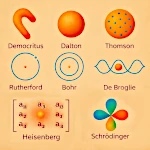 原子的各种形态:从古代直觉到量子力学