金(Au,Z=79):永恒与财富之金属
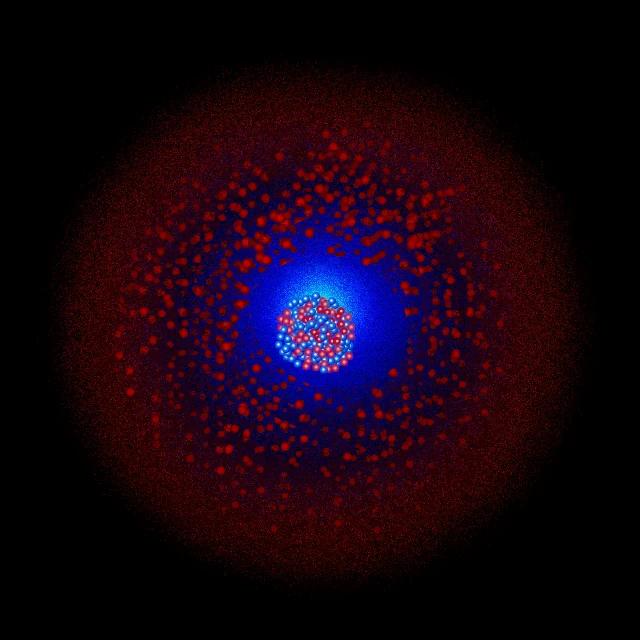
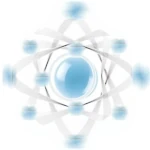
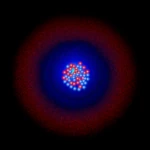
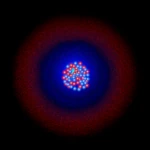
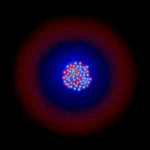
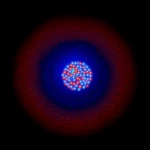
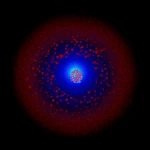
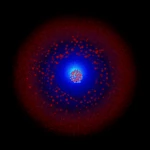
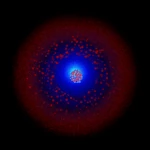
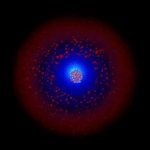
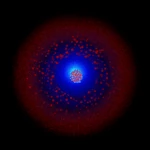
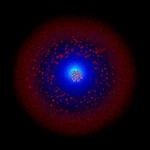
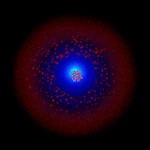
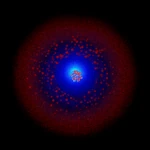
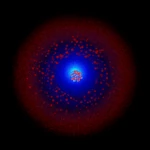
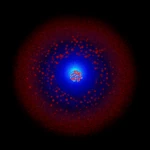
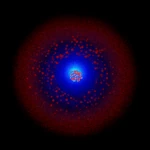
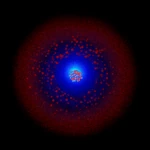
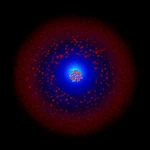
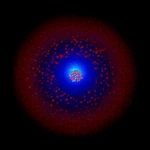
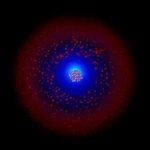
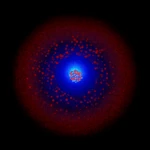
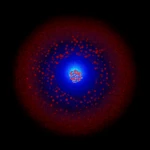
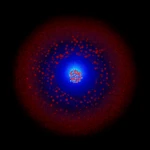
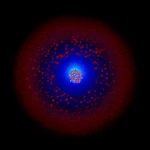
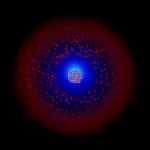
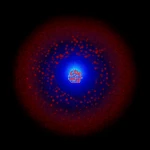
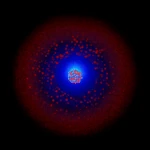
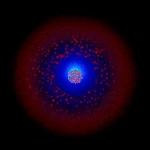
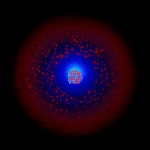
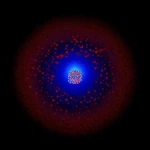
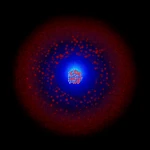
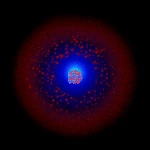
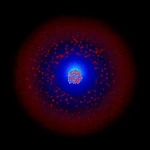
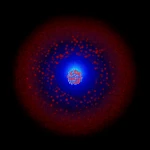
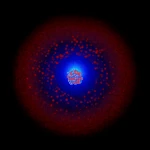
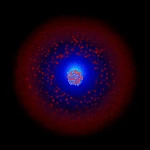
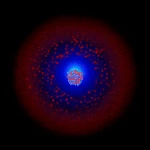
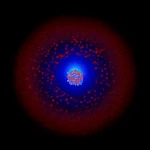
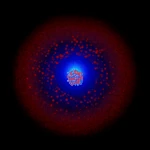
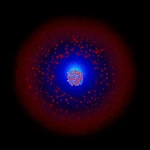
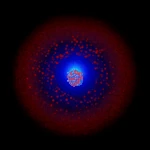
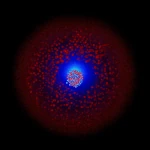
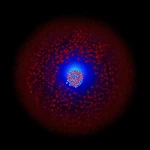
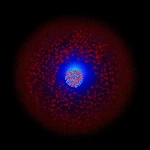
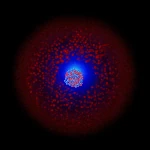
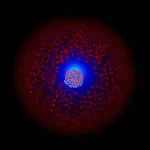
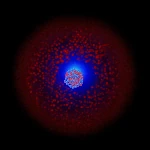
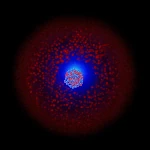
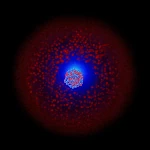
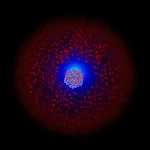
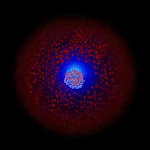
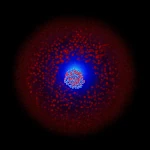
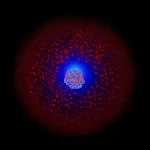
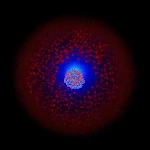
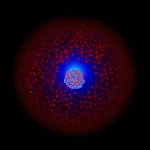
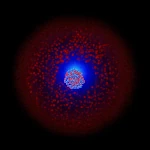
Image description:
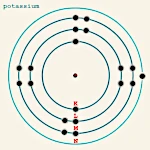
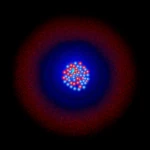
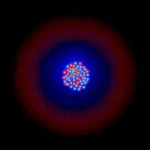
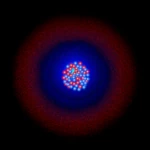
Simplified atomic model of the gold atom. The main stable isotope is \(^{197}\mathrm{Au}\)
with its 79 protons, 79 electrons, and 118 neutrons.
Image source: astronoo.com (新窗口)
黄金在天体物理学和宇宙化学中的作用
灾变事件中的合成作用
Gold is one of the most prestigious elements produced by the universe. Unlike iron or silicon, it cannot be synthesized in the cores of ordinary stars by nuclear fusion. Its creation requires extreme conditions, primarily the r过程 (rapid neutron capture). This process occurs during some of the most violent events in the cosmos:
- 中子星合并: Now considered the main source of gold in the universe. When two neutron stars collide, phenomenal amounts of neutron-rich matter are ejected, allowing the rapid synthesis of heavy elements such as gold, platinum, and uranium.
- II型超新星(核心坍缩): The shock waves generated during the explosion of massive stars briefly create intense neutron fluxes, enabling the r-process.
- 磁旋转超新星: A particular type of supernova with extreme magnetic fields and rotation, also capable of producing elements via the r-process.
每一件黄金首饰中都包含着数十亿年前宇宙剧烈事件中锻造的原子。
宇宙丰饶与地球稀有
The cosmic abundance of gold is about 1.0×10⁻¹² that of hydrogen in number of atoms, making it about 比铂金稀有6倍 and thousands of times rarer than iron. Its rarity on Earth is further accentuated by its 亲铁元素 nature (affinity for iron). During the differentiation of the Earth into layers (core, mantle, crust), most of the gold present in the primitive planet migrated to the iron core. The gold we mine today likely comes from a 后期添加 of chondritic material (meteorites) after the formation of the core, which "repainted" the Earth's surface with precious metals.
金作为地球化学示踪剂
金元素在地壳岩石中的分布遵循与热液、岩浆及沉积作用相关的复杂规律。金异常是矿产勘探的主要指示标志。通过研究金的同位素比值(特别是\(^{197}\mathrm{Au}/^{195}\mathrm{Pt}\)),可揭示矿床成因及大陆形成过程。
黄金的发现与使用历史
词源与象征意义
The chemical symbol Au comes from the Latin “aurum”, meaning "shining dawn" or "light of dawn". This term evokes the characteristic color and luster of the metal. In almost all cultures, gold has symbolized purity, divinity, power, and immortality, due to its unalterability. Its name in various languages (gold, oro, zoloto) resonates with wealth and prestige.
古代黄金
Gold is the first metal known and used by humanity, dating back to the 铜石并用时代 (Copper Age), around 5000-4000 BCE. It was found in its native state in rivers, making it easy to recover without complex metallurgy. The Egyptians used it for sumptuous purposes (Tutankhamun's mask, tombs), the Mesopotamians used it in jewelry and trade, and pre-Columbian cultures (Incas, Aztecs) revered it as the "sweat of the sun".
炼金术与寻金之旅
For centuries, alchemy sought to transform "base" metals (such as lead) into gold using the philosopher's stone. Although chemically futile, this quest nevertheless laid the foundations for modern experimental chemistry. The understanding that gold was a 基本化学元素 (incapable of being created or destroyed by chemical means) was a crucial step in the development of science.
大淘金热
新矿藏的发现多次颠覆了全球经济:加利福尼亚(1848年)、澳大利亚(1851年)、克朗代克(1896年)、南非(威特沃特斯兰德,1886年)。这些淘金热加速了领土殖民化,推动了采矿技术的发展,并影响了国际货币流动。
存款与现代生产
黄金以不同形式存在:
- 天然金: In nuggets, flakes, or inclusions in quartz veins (lodes). This is the historical form.
- 冲积矿床(砂矿): Detrital gold concentrated by erosion in river sands.
- “卡林型”或“不可见金”矿床: Gold is finely disseminated in sedimentary rocks, often associated with arsenic and sulfur.
- 斑岩矿床: Associated with magmatic intrusions.
The main producing countries are 中国 (the world's leading producer), 澳大利亚, 俄罗斯, the 美国, and 加拿大. Annual mining production is about 3,000至3,500吨. South Africa, once the leader, has seen its production decline. Recycling (old jewelry, electronic waste) represents an additional important source. The price of gold, set on the London and New York markets, fluctuates according to geopolitical, economic, and monetary factors.
金的结构与基本性质
分类与原子结构
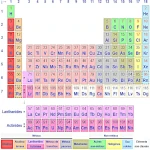
金(符号Au,原子序数79)是第六周期的过渡金属,位于元素周期表第11族,与铜和银同属一族,并与之具有某些化学相似性(即"货币金属"族)。其原子含有79个质子,通常有118个中子(对应稳定同位素\(^{197}\mathrm{Au}\)),以及79个电子,电子排布为[Xe] 4f¹⁴ 5d¹⁰ 6s¹。这种具有完整d¹⁰壳层和单个s电子的构型,是其颜色与特性的根源。
特征物理性质
黄金是一种亮黄色的金属,密度很大,极具延展性和可塑性,并且是优良的导体。
- 独特的黄色: Unique among pure metals, due to relativistic electronic transitions (Einstein effects).
- 高密度: 19.32 g/cm³ at 20 °C.
- 优异的延展性和可塑性: 1 gram of gold can be hammered into a 1 m² sheet (gold leaf 0.1 µm thick) or drawn into a wire over 2 km long.
- 优秀导体 of heat and electricity (third after silver and copper).
- 不可改变性: Resists oxidation and corrosion under normal conditions.
- 贵金属的适中熔点: 1064.18 °C.
金以面心立方(FCC)结构结晶。
转化点
Gold melts at 1064.18 °C (1337.33 K) and boils at 2970 °C (3243 K). Its relatively low melting point facilitated its processing from antiquity.
化学反应活性(极低)
Gold is the 最高贵的金属 along with platinum and a few others. It is practically inert under ambient conditions:
- 空气和氧气: No reaction at any temperature.
- 水: No reaction.
- 简单酸类: Insoluble in hydrochloric, sulfuric, nitric, or hydrofluoric acid, even when concentrated.
- 王水: The only common reagent capable of dissolving it, forming chloroauric acid (HAuCl₄).
- 含氧条件下碱性氰化物: Forms soluble complexes [Au(CN)₂]⁻. This is the basis of cyanidation, the main method for extracting gold from low-grade ores.
- 卤素: Reacts with chlorine to form AuCl₃ and with bleach.
- 水星: Forms an amalgam (liquid alloy), historically used in mining extraction.
物理特性概述
Density: 19.32 g/cm³.
Melting point: 1337.33 K (1064.18 °C).
Boiling point: 3243 K (2970 °C).
Crystal structure: Face-centered cubic (FCC).
Electronic configuration: [Xe] 4f¹⁴ 5d¹⁰ 6s¹.
Main oxidation states: +1 and +3.
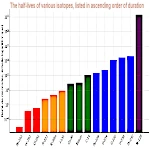
金同位素表
| 同位素 / 符号 | 质子(Z) | 中子(N) | 原子质量(u) | 天然丰度 | 半衰期/稳定性 | 衰变/备注 |
|---|---|---|---|---|---|---|
| 金-197 — \(^{197}\mathrm{Au}\) | 79 | 118 | 196.966569 u | ≈ 100% | 稳定 | 金唯一的天然稳定同位素,属单同位素元素。其核特性(低中子俘获截面)使其可用作核反应堆靶材及医用放射性同位素的生产原料。 |
| 金-195(人造) | 79 | 116 | 194.9650 u | 0 % | 186.09天 | 通过电子捕获产生放射性。用于研究领域。 |
| 金-198(人造) | 79 | 119 | 197.9668 u | 0 % | 2.69517天 | 放射性β⁻。历史上曾用于放射治疗(金-198颗粒用于前列腺癌)。 |
| 金-199(人造) | 79 | 120 | 198.9683 u | 0 % | 3.139天 | 放射性β⁻。用于研究及生产汞-199。 |
金的电子排布与电子壳层
注意::
Electron shells:
电子如何围绕原子核组织 (新窗口).
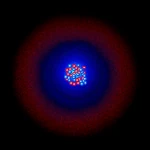
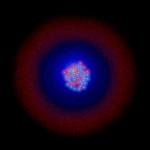
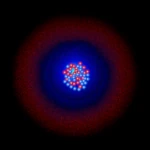
金元素拥有79个电子,分布在六个电子层中。其电子构型[Xe] 4f¹⁴ 5d¹⁰ 6s¹具有一个特性:5d亚层完全填满(10个电子),而单个电子占据6s层。这也可以表示为:K(2) L(8) M(18) N(32) O(18) P(1),或完整形式:1s² 2s² 2p⁶ 3s² 3p⁶ 3d¹⁰ 4s² 4p⁶ 4d¹⁰ 4f¹⁴ 5s² 5p⁶ 5d¹⁰ 6s¹。
壳层的详细结构
K壳层(n=1): 2 electrons (1s²).
L壳层(n=2): 8 electrons (2s² 2p⁶).
M层(n=3): 18 electrons (3s² 3p⁶ 3d¹⁰).
N壳层(n=4): 32 electrons (4s² 4p⁶ 4d¹⁰ 4f¹⁴).
O壳层 (n=5): 18 electrons (5s² 5p⁶ 5d¹⁰).
P壳层 (n=6): 1 electron (6s¹).
价电子与氧化态
Gold has 11 价电子 if we count the electrons in the 5d and 6s shells (10+1). Chemically, gold is less reactive than copper or silver in its group. Its most common oxidation states are +1 (gold(I) or aurous compounds) and +3 (gold(III) or auric compounds).
- 金(I) (Au⁺): Often present in linear complexes, such as gold(I) cyanide K[Au(CN)₂] used in electroplating. Gold(I) compounds are often unstable and tend to disproportionate into Au(0) and Au(III).
- 金(III) (Au³⁺): The most stable and common state. Forms square planar complexes, such as chloroauric acid (HAuCl₄) or gold(III) chloride (AuCl₃).
- 胶体状态(纳米颗粒中的Au⁰): Gold nanoparticles (1-100 nm) exhibit unique optical properties (red, purple colors) due to surface plasmon resonance, absent in bulk gold.
金还可以形成不寻常的氧化态,如+5甚至-1(如CsAu等碱金属金化物)。
金的化学反应活性
与空气和氧气的反应
金在所有温度下对氧气、氮气、二氧化碳及其他大气气体完全呈惰性。它不会形成氧化物,这解释了为何出土的古代金器完好无损,毫无锈蚀或腐蚀痕迹。
与水及酸的反应
黄金不溶于所有简单酸。这一特性正如谚语所言:"坚不可摧如黄金"。
Its only major chemical weakness is 王水 (a 1:3 mixture of concentrated nitric and hydrochloric acids). The reaction produces tetrachloroauric(III) acid, HAuCl₄:
Au + HNO₃ + 4 HCl → HAuCl₄ + NO + 2 H₂O
金也能在氧气存在下溶解于氰化钠或氰化钾的水溶液中,形成可溶性的二氰合金(I)配合物[Au(CN)₂]⁻。这就是氰化法的原理,用于从极低品位的矿石中提取金。
N.B. :
与卤素及其他元素的反应
- 氯: Reacts at moderate temperature to form AuCl₃ (gold(III) chloride).
- 溴和碘: React to form AuBr₃ and AuI (the latter is unstable).
- 氟: Reacts to form AuF₃ and AuF₅ (gold(V) fluoride is a very powerful oxidant).
- 硫和硒: Do not react directly, but gold sulfides and selenides can be prepared by other means.
- 水星: Easily forms an amalgam (liquid alloy) at room temperature. This property was used to recover gold from auriferous sands (amalgamation).
重要化合物
- 氯金酸 (HAuCl₄): Yellow-red liquid, main precursor for electroplating and nanoparticle synthesis.
- 氰化亚金钾(K[Au(CN)₂]): Very toxic white salt, electrolyte for gold plating.
- 金纳米粒子(Au⁰): Colloidal suspensions with vivid colors (red, purple) depending on size and shape, used in biomedicine and catalysis.
- 三氯化金 (AuCl₃): Red solid, chlorinating agent in organic synthesis.
黄金的工业与技术应用
- In 珠宝与金匠工艺 (about 50% of global demand), in the form of alloys with silver, copper, palladium (karats);
- As a 价值储存与货币 (ingots, investment coins, central bank reserves);
- In 电子学 for contacts, connectors, and high-reliability integrated circuits (corrosion resistance, excellent conductivity);
- As a protective and conductive coating (镀金) on electronic components, medals, and space equipment;
- In 牙科学 for crowns, bridges, and inlays (gold-palladium-silver alloys);
- In 纳米技术与生物医学: gold nanoparticles for imaging (contrast), detection (biosensors), photothermal therapy for cancer, and drug delivery;
- As a 催化剂 in the chemical industry, especially for the selective oxidation of carbon monoxide (CO) and the production of vinyl chloride;
- In 玻璃与陶瓷 as a pigment (colloidal gold red or "ruby gold") and for mirror-effect or heated glazing;
- For 键合线 in microprocessors and memory chips;
- In 太空设备 as a reflective coating on helmet visors, satellites, and the James Webb Space Telescope (sunshield);
- As a 参考标准 in electrochemistry (saturated calomel electrode, often with a gold contact);
- In 药房: gold salts (chrysotherapy) for the treatment of rheumatoid arthritis (declining use);
- In 导电油墨 for printed electronics and flexible circuits;
- For 瓷器与玻璃上的装饰 (gilding);
- In 基础研究: as a target for the production of heavy nuclei in nuclear physics.
关键应用:珠宝、电子和医疗
珠宝与克拉
Pure gold (24 karats) is too soft for jewelry. It is 合金化的 with other metals to increase its hardness and change its color:
- 黄金: Alloy with silver and copper.
- 白金: Alloy with palladium, nickel, or silver, often rhodium-plated for a bright white finish.
- 玫瑰/红金: Higher copper content.
- 绿金: Alloy with silver.
纯度(成色)以开(1开 = 1/24)或千分比(例如,750/1000金 = 18开)表示。
高可靠性电子设备
黄金的卓越特性使其成为高端电子产品中不可或缺的材料。
- 电导率: Excellent, with very low resistance even at thin thicknesses.
- 耐腐蚀性: Gold contacts do not corrode, ensuring reliable connection for decades, even in humid environments.
- 易于粘合: Easily soldered and deposited by electroplating.
它用于主板连接器、计算机芯片(键合线)、手机触点以及可靠性至关重要的军事和航天设备中。
金纳米颗粒在生物医学中的应用
This is one of the most promising fields. Gold nanoparticles (1-100 nm) exhibit unique optical properties (表面等离子体共振): they strongly absorb and scatter light in the visible and near-infrared range. Applications:
- 诊断影像: Contrast agent for optical coherence tomography (OCT) or photoacoustic imaging.
- 光热疗法: Injected nanoparticles accumulate in tumors. When illuminated by a near-infrared laser (which penetrates tissues), they locally heat up and destroy cancer cells.
- 药物递送载体: Nanoparticles can be functionalized to deliver chemotherapy drugs directly to the tumor.
- 快速诊断测试: Such as in pregnancy tests or biosensors, where the color change of nanoparticle aggregates indicates a positive result.
经济与金融角色
黄金作为货币与避险资产
For millennia, gold has served as the basis for monetary systems (gold standard). Although demonetized today, it remains the 避险资产 par excellence:
- 抵御通货膨胀: Its value tends to increase when the purchasing power of paper currencies falls.
- “避险”资产: In times of geopolitical or financial crisis, investors turn to gold.
- 投资组合多元化: Gold has a low correlation with stocks and bonds.
各国央行持有巨额黄金储备(总计约3.5万吨),以此作为稳定的保障。
黄金市场
黄金价格每日在伦敦进行两次定盘(伦敦黄金定盘价),并在纽约商品交易所(COMEX)等交易所持续交易。此外,还存在庞大的实物市场(金条、金币)以及衍生金融产品(交易所交易基金、期货)。
毒理学、环境与回收
毒性
Bulk metallic gold is 惰性且无毒. It can be worn, touched, and even ingested (gold leaf in pastry) without danger. However:
- 可溶性金盐: Compounds such as gold(III) chloride (AuCl₃) are corrosive and toxic.
- 提取过程中使用的氰化物: Extremely toxic to humans and the environment, requiring very strict management.
- 金疗法: Injectable gold salts for rheumatoid arthritis can have serious side effects (dermatitis, nephropathy, myelosuppression).
- 纳米颗粒: Their potential long-term toxicity is the subject of in-depth studies, although gold is biocompatible.
采矿的环境影响
Gold mining, especially 手工和小规模采矿(ASM), can have devastating impacts:
- 使用汞: Amalgamation releases mercury into the environment, contaminating waterways and causing poisoning (Minamata disease) in local populations.
- 氰化物的使用: Leaks from leaching ponds can contaminate groundwater.
- 森林砍伐、水土流失、生态系统破坏.
- 采矿废物(尾矿、残渣): Often contain arsenic and other heavy metals.
“公平黄金”倡议及其他认证试图推动更负责任的采矿实践。
回收利用
Gold is the recycling champion: 每年使用的黄金中近30%来自回收。. It can be recycled indefinitely without loss of quality. Sources include:
- 旧首饰 (the most important source).
- 废弃电气电子设备(WEEE): Increasingly important "urban mines" (phones, computers).
- 牙科和医疗废物.
- 工业废弃物 (electroplating sludge, used catalysts).
回收由精炼厂完成,他们熔化废料,通过电解或化学处理提纯黄金,再将其重铸为高纯度金锭(999.9/1000)。
Outlook
黄金仍将是一种战略性材料。
- 新兴技术: Its role in nanomedicine, green catalysis, and quantum electronics could grow.
- 太空探索: M-type (metallic) asteroids could contain astronomical amounts of gold and other precious metals, opening a distant but fascinating perspective.
- 持久的文化与金融价值: The universal appeal of gold, a symbol of eternity and success, shows no sign of fading.
 核聚变所需的能量以及为什么铀是一个极限
 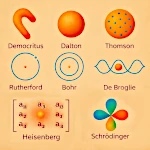 原子的各种形态:从古代直觉到量子力学