

锕(Ac,Z = 89):锕系元素中的关键元素
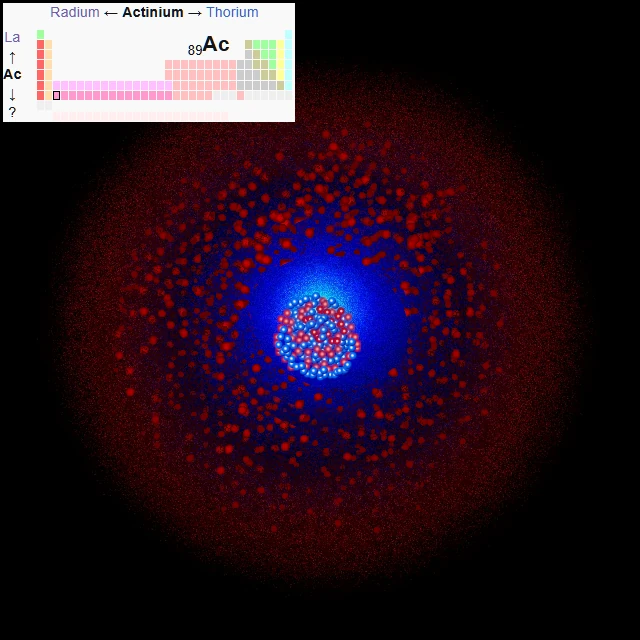
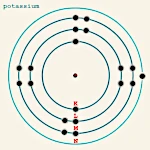
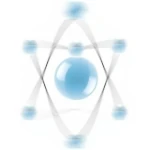
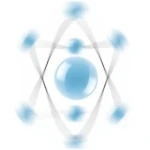
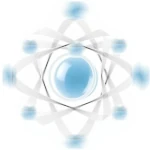
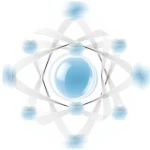
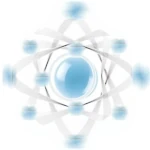
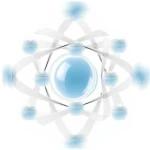
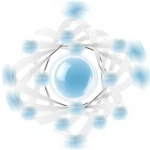
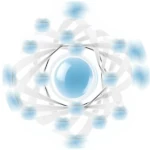
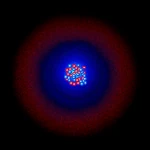
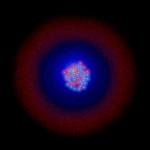
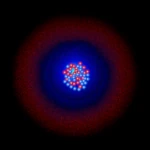
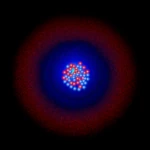
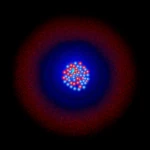
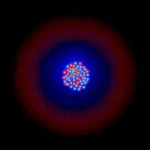
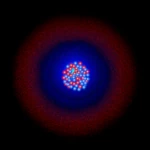
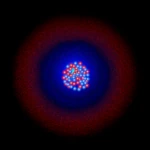
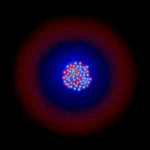
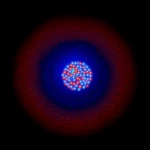
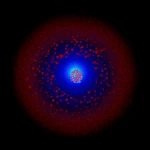
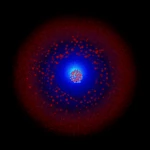
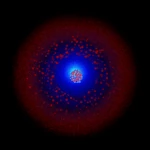
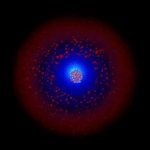
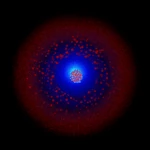
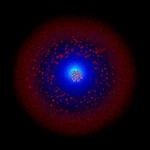
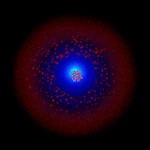
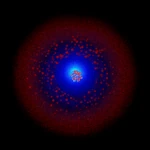
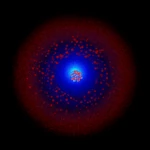
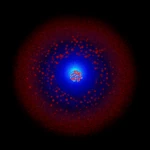
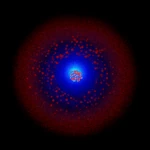
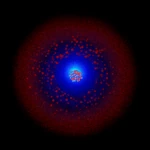
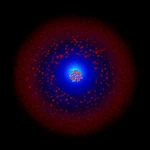
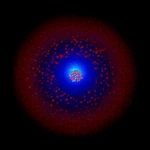
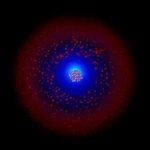
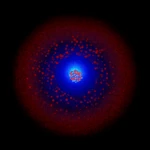
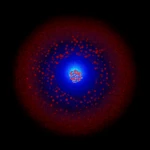
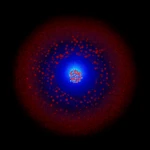
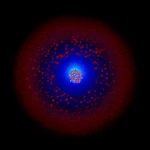
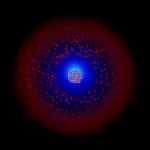
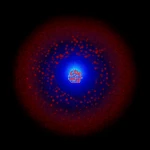
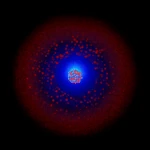
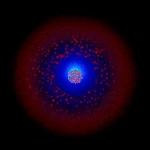
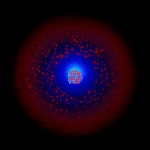
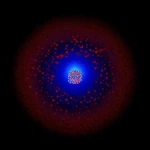
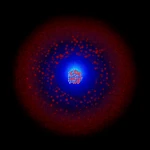
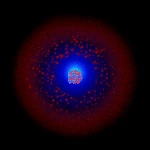
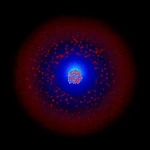
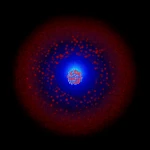
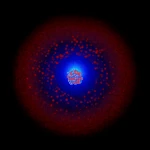
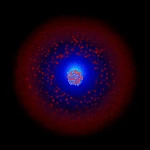
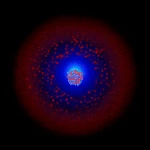
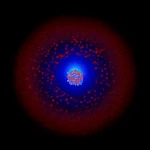
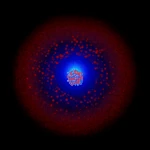
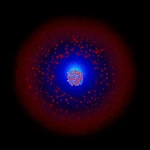
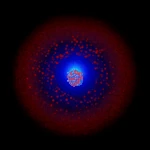
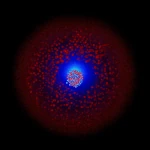
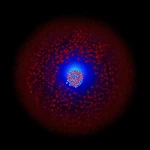
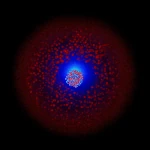
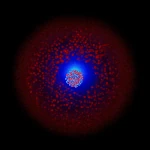
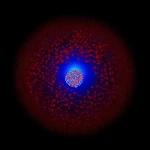
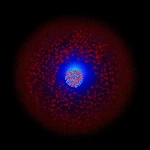
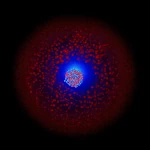
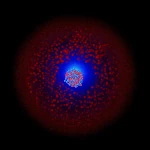
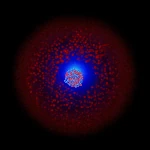
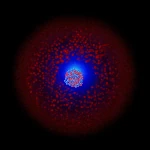
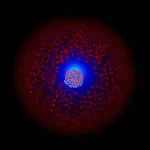
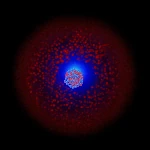
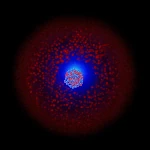
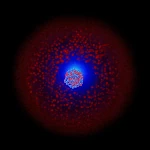
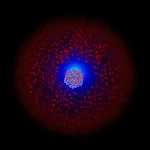
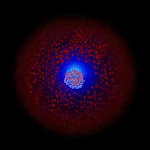
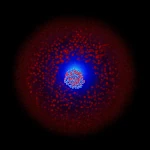
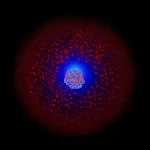
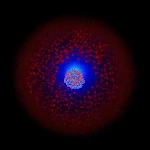
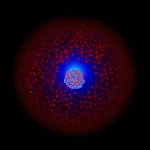
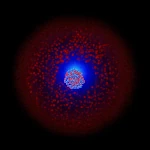
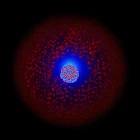
Simplified atomic model of the actinium atom.
The isotope shown is \(\,^{227}\mathrm{Ac}\,\) with its 89 protons, 89 electrons, and 138 neutrons.
Image source: astronoo.com (新窗口)
锕在天体物理学和宇宙化学中的作用
Actinium is not produced in significant quantities by classical stellar processes. It is a heavy and radioactive chemical element that forms mainly during extreme astrophysical processes such as 中子星合并 (r-process) or supernova explosions. In these environments, light atomic nuclei rapidly capture a succession of neutrons to form heavy and unstable isotopes that then decay into elements of the actinide series, including actinium. Unlike aluminum-26, which serves as a cosmic "chronometer," actinium isotopes have half-lives that are too short (the most stable is 227Ac with 21.772 years) to be detected in interstellar space. However, their existence in the solar system is attested by their trace presence in uranium ores, where they are continuously produced by the decay chains of uranium and thorium.
锕的发现历史
Actinium was discovered in 1899 by the French chemist 安德烈-路易·德比埃纳 (1874-1949). He isolated it from pitchblende (a uranium ore), after noticing that the radioactivity of certain residues was stronger than that of uranium itself. He named the new element "actinium" (from the Greek 肌动蛋白, ray) because of its luminescence and radioactive properties. In 1902, 弗里德里希·奥斯卡·吉塞尔 (1852-1927) independently discovered the same element, which he initially called "emanium." However, priority was given to Debierne. It took several decades before macroscopic and pure samples of metallic actinium were produced, due to its extreme rarity (it represents about 0.2 ppm in pitchblende) and the difficulty of separating it from other elements in the ore, particularly lanthanum, with which it shares many chemical properties. In 1947, researchers at Oak Ridge National Laboratory finally succeeded in isolating and characterizing pure metallic actinium.
注意::
Actinium was long the "lost element." Its early discovery in 1899 was quickly overshadowed by that of radium (1898), which captivated the attention of the public and scientists due to its intense radioactivity and promising medical applications. Actinium, rarer and less intense, remained in the shadows for decades. It was only much later, with the advent of nuclear physics and the development of radiochemistry, that its importance as the "founding father" of the actinide series and its unique properties were fully recognized. Its isotope 227Ac, in particular, is a major source of alpha particles in radioisotope thermoelectric generators (RTGs) used for deep space missions.
锕的结构与基本性质
Actinium (symbol Ac, atomic number 89) is the first element of the actinide series in the periodic table. Its atom has 89 protons, 89 electrons, and a variable number of neutrons depending on the isotope. It shares chemical similarities with 镧, located just above in group 3, to the point of often being considered its radioactive analog. In its pure metallic state, actinium is a silvery and soft solid, with a face-centered cubic (FCC) crystal structure. Its density is about 10.07 g/cm³. It exhibits significant radioactivity: all its isotopes are unstable. It spontaneously forms an oxide layer (Ac₂O₃) in air and readily reacts with halogens.
Melting point: ≈ 1323 K (1050 °C).
Boiling point: ≈ 3473 K (3200 °C, estimated).
锕的主要同位素
| 同位素 / 符号 | 质子(Z) | 中子(N) | 原子质量(u) | 天然丰度 | 半衰期/稳定性 | 主要衰变模式/备注 |
|---|---|---|---|---|---|---|
| 锕-227 — \(\,^{227}\mathrm{Ac}\,\) | 89 | 138 | 227.027752 u | 铀中的痕量 | 21.772年 | β– (98.62%) and α (1.38%). Most abundant natural isotope. Major source of 227Th and 223Ra for medical applications. |
| 锕-228 — \(\,^{228}\mathrm{Ac}\,\) | 89 | 139 | 228.031021 u | (钍中的)痕量 | 6.15小时 | β– at 100%. Formed in the decay chain of thorium-232. Used as a tracer in research. |
| 锕-225 — \(\,^{225}\mathrm{Ac}\,\) | 89 | 136 | 225.023230 u | 非天然的(合成的) | 10.0天 | α at 100% (four successive α decays). Produced from radium-229. Key element in 靶向α疗法 (TAT) against cancer. |
| 锕-226 — \(\,^{226}\mathrm{Ac}\,\) | 89 | 137 | 226.026098 u | 非自然的 | 29.37小时 | β– (83%) and ε (17%). Intermediate isotope produced in the laboratory for nuclear physics studies. |
锕的电子构型与电子壳层
注::
Electron shells: 电子如何围绕原子核组织 (新窗口).
Actinium has 89 electrons. Its ground state electronic configuration is [Rn] 6d1 7s2. This means it has the electronic core of radon (Rn, Z=86) and places its last three electrons in the 6d and 7s orbitals. This configuration can also be written in a simplified manner: K(2) L(8) M(18) N(32) O(18) P(9) Q(2). Its single 6d electron explains its chemical similarities with lanthanum ([Xe] 5d1 6s2).
价电子与氧化态
Actinium has three valence electrons (configuration 6d1 7s2). Like other group 3 elements (scandium, yttrium, lanthanum), it exhibits almost exclusively the +3 氧化态 (Ac3+ ion). In this state, it loses its three valence electrons to achieve a stable noble gas electronic configuration ([Rn]). There are practically no actinium compounds in the +2 or +1 oxidation states, due to the high stability of the trivalent ion.
溶液中锕的化学性质
In aqueous solution, the Ac3+ ion is the only stable state. It forms hydrated complexes, and its salts (such as AcCl3 or Ac(NO3)3) are generally water-soluble, except with certain anions (fluorides, phosphates, oxalates). Its chemistry is extremely similar to that of lanthanum (La3+), making their chemical separation very difficult. This is explained by their almost identical ionic radius and the same charge. Separation therefore relies almost exclusively on subtle differences in the stability constants of complexes or on radiochemical separation methods exploiting the decay of its isotopes.
放射性及其对物质的影响
The intense radioactivity of actinium has major practical consequences. In solid compounds, the alpha particles emitted by decay cause 自辐照 that gradually damages the crystal lattice, changes the color of salts (from white to brown or black), and can even release gases (helium from alpha particles). In solution, radiolysis (breaking of water molecules by radiation) generates radical species and can alter the pH. These effects must be carefully considered for the storage and handling of this element.
锕的化学反应活性
Metallic actinium is a powerful reducing agent. It oxidizes rapidly in air to form actinium(III) oxide, Ac2O3. It reacts with non-oxidizing mineral acids (such as HCl) by releasing hydrogen and forming the corresponding Ac(III) salts. Its reactivity is comparable to that of alkaline earth metals, but its handling is complicated by its radioactivity. It forms halides (AcX3), oxides, hydroxides, and salts with most common anions. Its chemistry is entirely dominated by the +3 state, and it does not show the variety of oxidation states observed in heavier actinides (such as uranium or plutonium).
锕的应用
- In 核医学: The isotope 225Ac is a valuable alpha emitter for 靶向α疗法 (TAT). Its high-energy alpha particles (a few MeV) have a very short range (a few cell diameters), allowing the destruction of cancer cells with surgical precision while sparing neighboring healthy tissues. It is used in clinical trials to treat advanced cancers (prostate, leukemias, etc.).
- As a 中子源: Mixed with beryllium, actinium-227 (via its descendants such as francium-223 or polonium-215) can be used as a compact neutron source via (α,n) reactions.
- In 放射性同位素热电发生器 (RTGs): The heat released by the decay of 227Ac is studied as a potential energy source for space probes or remote installations, due to its relatively long half-life.
- In 基础研究: Study of the chemical and physical properties of the early actinides, serving as a point of comparison to understand the behavior of transuranic elements.
- As a 地质年代标志: The 231Pa/235U ratio (where 231Pa is a descendant of 235U via 231Th and 231Ac) is used to date marine sediments and manganese nodules.
- For 同位素生产: It is the primary source for the production of 227Th and 223Ra (Radium-223, Xofigo®), another alpha-emitting radiopharmaceutical used in oncology.
生产、可用性与经济方面
Actinium is one of the rarest natural elements. It is estimated that there are only a few 克 of natural actinium-227 in the Earth's crust at any given time, mainly in uranium ores such as pitchblende. Its industrial production is therefore extremely limited and costly. The main source is the 镭-226的中子辐照 in a nuclear reactor, according to the reaction: 226Ra(n,γ)227Ra → (β–, 42.2 min) → 227Ac. The subsequent chemical separation of actinium from radium and fission products is a major challenge in radiochemistry. Actinium-225, even rarer, is mainly produced by 辐照钍-232 with high-energy protons in a particle accelerator, or by extraction from thorium-229 generators (itself derived from uranium-233). Its cost can reach several hundred thousand dollars per milligram, making it one of the most valuable materials in the world.
处理、危害与预防措施
Actinium is a 高放射性和高毒性 element. Its handling requires suitable facilities (sealed glove boxes under inert atmosphere, lead or concrete shielded cells) and specialized training in radiation protection. The main hazards come from: 1. 外部照射: Alpha, beta, and gamma emissions from its isotopes and their descendants. 2. 内部污染: If inhaled or ingested, it permanently fixes in the bones (like calcium and strontium), irradiating neighboring tissues and potentially inducing cancers or bone marrow damage. Its annual limit on intake (ALI) is extremely low. It is stored in solid inert form, in sealed and shielded containers, often protected from air to prevent dust formation.
 核聚变所需的能量以及为什么铀是一个极限
 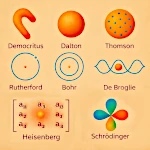 原子的各种形态:从古代直觉到量子力学