

镧(La,Z = 57):稀土元素的旗手
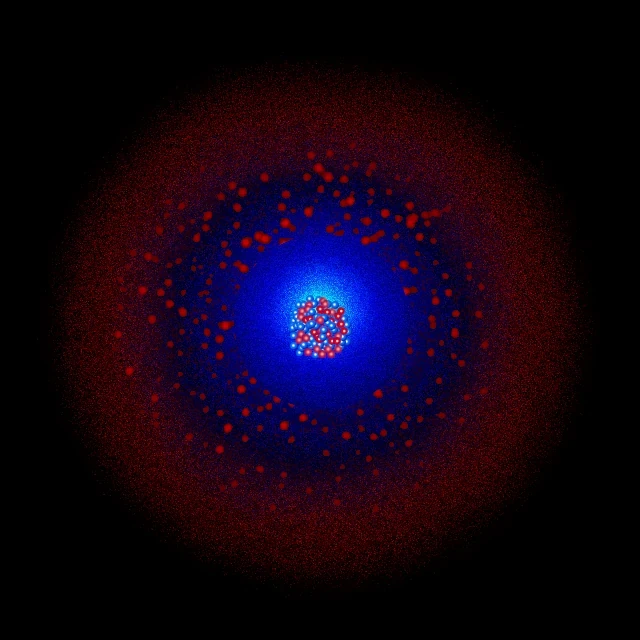
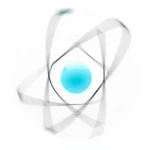
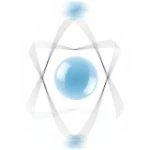
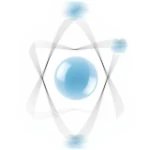
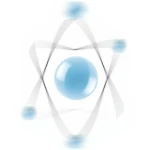
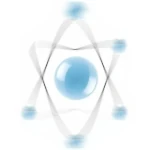
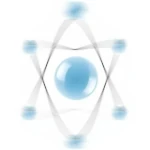
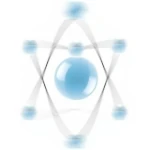
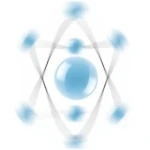
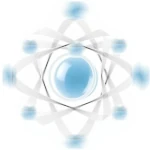
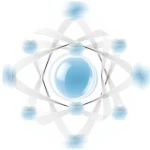
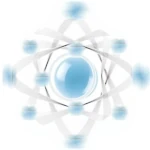
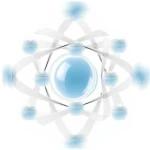
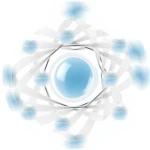
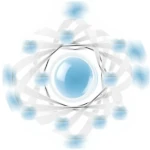
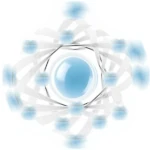
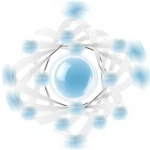
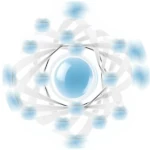
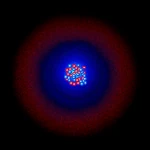
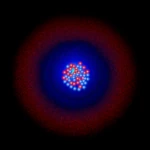
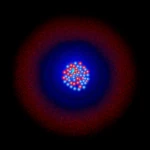
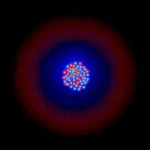
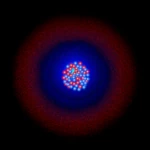
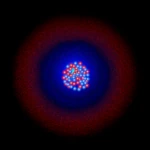
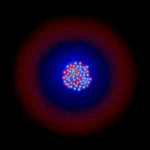
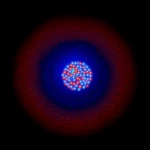
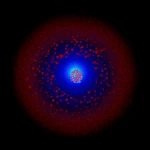
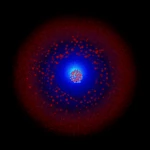
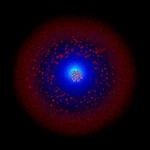
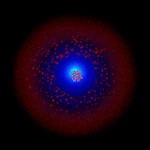
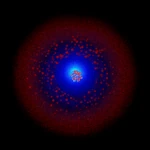
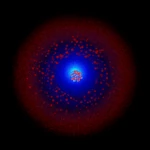
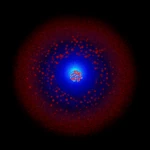
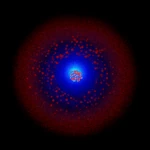
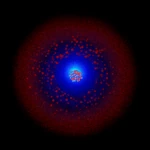
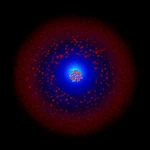
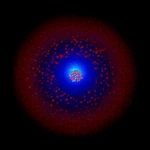
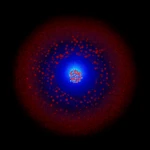
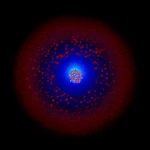
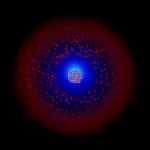
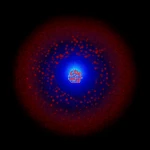
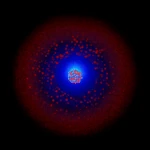
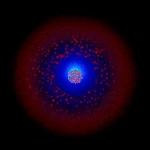
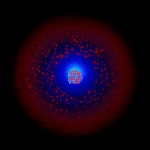
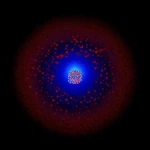
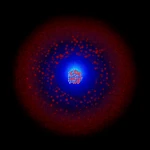
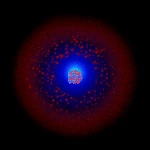
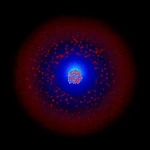
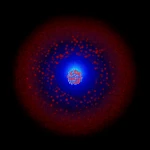
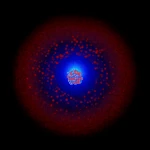
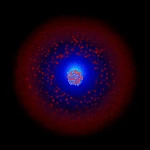
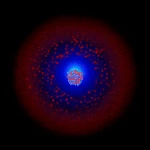
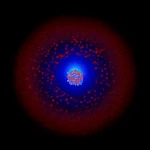
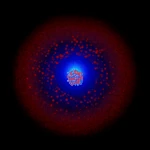
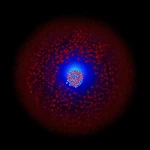
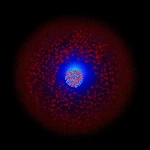
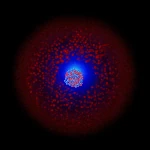
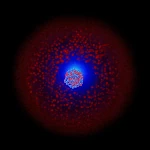
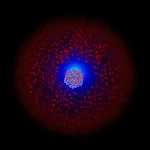
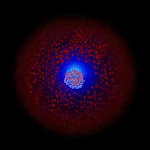
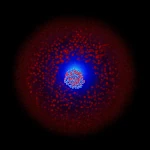
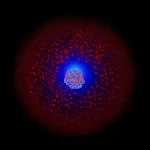
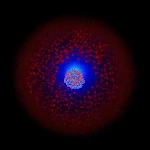
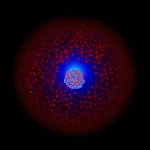
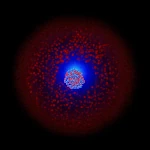
Image description:
Simplified atomic model of the lanthanum atom. The main stable isotope is \(^{139}\mathrm{La}\)
with its 57 protons, 57 electrons, and 82 neutrons.
Image source: astronoo.com (新窗口)
镧在天体物理学和宇宙化学中的作用
镧的恒星合成
Lanthanum is an element produced mainly by the s-过程 (slow neutron capture) in asymptotic giant branch (AGB) stars. It is the first element in the lanthanide series (rare earths), and its synthesis marks the beginning of the filling of the 4f electronic subshell. It is also produced in significant quantities by the r-过程 (rapid neutron capture) during explosive events such as supernovae and neutron star mergers. The relative contribution of the s and r processes to its solar abundance is about 70% for the s-process and 30% for the r-process, making it a good tracer of nucleosynthesis conditions.
宇宙丰度与分布
镧在宇宙中的丰度(按原子数计)约为氢的2.0×10⁻¹¹倍,显著高于金、铂等重元素,但低于铁。它是与铈、钕并列的最丰富的稀土元素之一。其恒星光谱特征可用于测定稀土丰度及恒星金属丰度,尤其适用于富含慢中子俘获过程元素的老年恒星。
地球化学与行星学中的示踪剂
在地球科学中,以镧为参照元素的稀土元素丰度比是强有力的诊断工具。稀土元素的"谱图"(球粒陨石标准化图解)能揭示部分熔融、分离结晶或陨石蚀变等地质过程。作为最轻的稀土元素,镧比其更重的同类元素相对更不相容(更倾向于岩浆液相)。这种系统性变化使得追溯岩石和行星的历史成为可能。
镧在太阳系形成中的作用
球粒陨石被视为太阳系的原始构建单元,其稀土元素丰度与太阳几乎相同,其中镧元素作为校准基准。某些分异型陨石(如钙长辉长无球粒陨石)中的稀土异常现象,印证了早期行星分异过程。钡和镧的同位素研究也有助于理解太阳系前核合成的时间序列。
镧的发现历史
名字的词源与起源
Lanthanum takes its name from the ancient Greek verb 我错了 (lanthánō), which means "to be hidden, to escape notice". This name was chosen by its discoverer, Carl Gustaf Mosander, in 1839, because the element was "hidden" (or difficult to separate) in a cerite mineral, from which cerium had already been extracted. This choice reflects the historical difficulty in isolating rare earths, which are very similar chemically to each other.
卡尔·古斯塔夫·莫桑德发现
In 1839, the Swedish chemist 卡尔·古斯塔夫·莫桑德 (1797-1858) was working on cerium oxide, supposed to be pure. By treating cerium nitrate with a dilute acid and heating it, he obtained a new earthy-colored oxide, which he named "lanthana". He had thus isolated lanthanum, discovering at the same time that the "cerium" of the time was actually a mixture of at least two elements: cerium and lanthanum. This discovery marked the beginning of the systematic separation of rare earths.
首次净化与确认
纯镧金属的分离是一项艰巨的任务,因其高反应性及与其他稀土元素的相似性。1923年,H. 克雷默斯和R. 史蒂文斯通过电解熔融氯化物混合物首次制得相对纯净的金属。直到20世纪中期离子交换和溶剂萃取技术的发展,高纯度镧的生产才实现工业化。
陆地存在与生产
镧不存在于自然状态。它存在于许多稀土矿物中,主要有:
- 氟碳铈矿 (Ce,La)CO₃F: The main current source, rich in lanthanum and cerium.
- 独居石 (Ce,La,Th)PO₄: An important source, often associated with mineral sands.
- 洛帕石 and 褐帘石: Other secondary sources.
The main producing countries are 中国 (which largely dominates production and refining), the 美国 (Mountain Pass mine), 澳大利亚, and 俄罗斯. Annual production is on the order of several tens of thousands of tons (in oxide equivalent). Although classified among the "rare earths", lanthanum is relatively abundant in the Earth's crust (about 35 ppm), more than lead or tin. Its price is moderate for a rare earth, but subject to fluctuations depending on Chinese export policy and technological demand.
镧的结构与基本性质
分类与原子结构
Lanthanum (symbol La, atomic number 57) is an inner transition element, traditionally placed as the first element of the 镧系元素 series (rare earths) in the periodic table, although its electronic configuration does not have a 4f electron (this subshell is empty). It belongs to group 3 with scandium and yttrium. Its atom has 57 protons, usually 82 neutrons (for the stable isotope \(^{139}\mathrm{La}\)), and 57 electrons with the electronic configuration [Xe] 5d¹ 6s². This configuration with a 5d electron distinguishes it from the following lanthanides that fill the 4f subshell.
物理性质
镧是一种银白色、具有延展性、可塑性强且相当柔软的金属。它非常活泼,在空气中会迅速氧化。
- 密度: 6.162 g/cm³ at 20 °C (relatively light for a transition metal).
- 熔点: 918 °C (moderately high).
- 沸点: 3464 °C (very high).
- 晶体结构: Double hexagonal close-packed (DH) at room temperature. Transforms into face-centered cubic (FCC) above 310 °C.
- 特征氧化态: +3
转变点与同素异形
Lanthanum has a melting point of 918 °C (1191 K) and a boiling point of 3464 °C (3737 K). It exists in two allotropic forms: the α form (double hexagonal close-packed) stable up to 310 °C, and the β form (face-centered cubic) stable from 310 °C to the melting point. This transition affects its mechanical and electrical properties.
化学反应活性
镧是一种电正性很强且活泼的金属,类似于碱土金属。它在空气中迅速氧化生成La₂O₃。与水(甚至冷水)反应释放氢气并形成La(OH)₃。它易溶于大多数稀无机酸(HCl、H₂SO₄、HNO₃),生成相应的La³⁺盐并释放氢气(与HNO₃反应时则生成氮氧化物)。
物理特性概述
Density: 6.162 g/cm³.
Melting point: 1191 K (918 °C).
Boiling point: 3737 K (3464 °C).
Crystal structure (at 20°C): Double hexagonal close-packed (DH).
Main oxidation state: +3.
Electronic configuration: [Xe] 5d¹ 6s².
镧同位素表
| 同位素 / 符号 | 质子(Z) | 中子(N) | 原子质量(u) | 天然丰度 | 半衰期 / 稳定性 | 衰变/备注 |
|---|---|---|---|---|---|---|
| 镧-138 — \(^{138}\mathrm{La}\) | 57 | 81 | 137.907112 u | ≈ 0.090% | 1.02×10¹¹年 | 原始放射性。通过电子捕获(66%)衰变为\(^{138}\mathrm{Ba}\),通过β⁻衰变(34%)衰变为\(^{138}\mathrm{Ce}\)。该同位素用于La-Ba和La-Ce地质年代学。 |
| 镧-139 — \(^{139}\mathrm{La}\) | 57 | 82 | 138.906353 u | ≈ 99.910% | 稳定 | 稳定且主要的同位素。几乎代表所有天然镧。用作同位素测量的参考。 |
镧的电子排布与电子壳层
注意::
Electron shells:
电子如何围绕原子核组织 (新窗口).
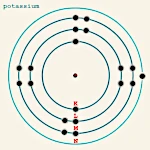
镧拥有57个电子,分布在六个电子壳层中。其电子排布[Xe] 5d¹ 6s²具有一个特殊性:4f亚层为空(0个电子),而一个电子占据5d亚层,同时6s壳层有两个电子。这也可写作:K(2) L(8) M(18) N(18) O(9) P(2),或完整形式:1s² 2s² 2p⁶ 3s² 3p⁶ 3d¹⁰ 4s² 4p⁶ 4d¹⁰ 5s² 5p⁶ 5d¹ 6s²。这种非典型排布(5d¹而非4f¹)使其成为镧系元素中的特例。
壳层的详细结构
K层(n=1): contains 2 electrons (1s²).
L壳层(n=2): contains 8 electrons (2s² 2p⁶).
M壳层 (n=3): contains 18 electrons (3s² 3p⁶ 3d¹⁰).
N层(n=4): contains 18 electrons (4s² 4p⁶ 4d¹⁰). The 4f subshell is empty.
O壳层(n=5): contains 9 electrons (5s² 5p⁶ 5d¹).
P壳层 (n=6): contains 2 electrons (6s²).
价电子与氧化态
Lanthanum has 3 价电子: the two 6s² electrons and the 5d¹ electron. It easily loses these three electrons to reach the stable configuration of xenon (Xe), which explains its unique and very stable oxidation state: +3 (La³⁺). La³⁺ ions are colorless (no f electrons) and have a large ionic radius, which strongly influences their coordination chemistry and geochemical behavior (strong incompatible character).
与某些镧系元素不同,镧几乎不呈现+2或+4氧化态,因为La²⁺(4f¹)或La⁴⁺(4f⁻¹)的电子构型极不稳定。因此其化学性质主要由三价阳离子La³⁺主导,形成典型的离子化合物(氧化物、氢氧化物、卤化物、盐类)。
镧的化学反应活性
与空气和氧气的反应
镧金属在室温下空气中迅速氧化,形成一层La₂O₃。加热时,它会剧烈燃烧生成相同的氧化物:4La + 3O₂ → 2La₂O₃。La₂O₃是一种白色碱性氧化物,能与水反应生成La(OH)₃,并容易吸收空气中的二氧化碳形成碳酸盐。
与水及酸的反应
镧与冷水反应,与热水反应更迅速,释放氢气并生成不溶性La(OH)₃:2La + 6H₂O → 2La(OH)₃ + 3H₂。它迅速溶于稀无机酸(HCl、H₂SO₄、HNO₃)中,生成相应的La³⁺盐并释放氢气(与HNO₃反应时除外,此时会形成氮氧化物)。
与卤素及其他非金属的反应
镧与所有卤素反应生成三卤化物:2La + 3X₂ → 2LaX₃(X = F, Cl, Br, I)。氟化镧(LaF₃)在水中尤其难溶。它还能在高温下与氮反应生成LaN,与碳反应生成LaC₂,与硫反应生成La₂S₃,与氢反应生成LaH₂/LaH₃。
重要化合物
- 氧化镧(III) (La₂O₃): White basic oxide, used in special glasses and as a catalyst.
- 氯化镧(III) (LaCl₃): White hygroscopic solid, precursor for metal production and used in spectroscopy (in discharge lamps).
- 硝酸镧(III) (La(NO₃)₃): Water-soluble, used in glasses and pigments.
- 碱式碳酸盐: Forms in air, with the approximate formula La₂O₂CO₃.
镧的工业与技术应用
- As a major additive in 流化催化裂化(FCC)催化剂 for petroleum refining;
- In the anodes of 镍氢(NiMH)电池 for hybrid vehicles and electronic devices;
- As an alloying component with magnesium (混合稀土) for lighter flints and lightweight alloys;
- In the manufacture of 特种光学玻璃 (camera lenses, telescopes) for high refractive index and low dispersion;
- For 荧光粉与发光体 (especially in fluorescent tubes and old screens);
- As a dopant in 闪烁体 (LaBr₃:Ce) for gamma ray detectors;
- In the electrodes of 碳弧灯 (movie projectors, studio lighting);
- As a material for 铁电陶瓷 (such as lanthanum titanate) in electronics;
- In catalysts for 氢气生产 by fuel reforming;
- As a 磷酸盐陷阱 in water treatment and medicine (for hyperphosphatemia);
- 在某些合金的耐腐蚀涂层中;
- 作为钢和铸铁合金中的改性剂;
- 在多相催化中用于各种化学合成;
- In research on 高温超导体 (lanthanum cuprates);
- 用于天然气净化(吸收H₂S和CO₂)。
关键应用:能源与石油化工
催化裂化催化剂 (FCC)
This is the largest application of lanthanum. 氧化镧 (La₂O₃) is added to zeolites (zeolite Y) used in fluid catalytic cracking (FCC) units in refineries. Its role is twofold:
- 稳定晶体结构 of the zeolite at high temperature and in the presence of steam, extending its lifespan.
- 提高催化活性 by increasing the acidity of the sites, which improves the yield of high-quality gasoline.
如果没有镧,石油精炼的效率将显著降低。
镍氢(NiMH)电池
Lanthanum-based alloys (such as LaNi₅ or more complex rare earth alloys, "mischmetal") constitute the material of the 负极 (anode) of NiMH batteries. These alloys reversibly absorb and desorb large amounts of hydrogen. NiMH batteries, safer and more environmentally friendly than Ni-Cd, have equipped generations of hybrid vehicles (such as the Toyota Prius), cordless tools, and electronic devices. Although supplanted by Li-ion in many areas, they remain important for certain applications.
氢气的生产与储存
LaNi₅ alloys are also studied for 固态储氢 due to their ability to absorb it. In addition, lanthanum oxide is used in catalysts for hydrogen production by steam reforming of methane or biofuels.
先进材料中的应用
高性能光学玻璃
Lanthanum oxide (La₂O₃) is an essential component of certain optical glasses called "high rare earth content" or "lanthanum glasses". These glasses have a 非常高的折射率 and a 低色散(阿贝数). These properties allow the manufacture of high-performance, lightweight, and compact objective lenses, correcting chromatic aberrations. They are found in professional camera lenses, telescopes, microscopes, and photolithography instruments.
闪烁体与探测
掺铈溴化镧(LaBr₃:Ce) is a revolutionary scintillator material. It converts gamma or X radiation into visible light with 卓越的能量分辨率, far superior to that of classical scintillators (NaI:Tl). It is used in the detection of radioactive materials (security, geophysics), medical imaging, and nuclear physics.
电子陶瓷
钛酸镧(La₂Ti₂O₇) and derived materials exhibit interesting ferroelectric or piezoelectric properties for capacitors, sensors, and non-volatile memories.
混合稀土金属及合金
什么是混合稀土金属?
混合稀土 (from German "Mischmetall", "mixed metal") is a natural rare earth alloy, typically containing about 50% cerium, 25-40% lanthanum, 10-15% neodymium, and small amounts of other rare earths and iron. It is an economical by-product of rare earth refining. Lanthanum contributes to its malleability and pyrophoric properties.
混合稀土的应用
- 打火机火石: Mischmetal, mixed with iron and magnesium, produces sparks by friction. This is the major historical application.
- 镁合金: Small additions of mischmetal (<1%) improve the tensile strength, ductility, and creep resistance of magnesium alloys, used in aerospace and automotive.
- 钢和铸铁用添加剂: It deoxidizes and desulfurizes molten metal, improving malleability and strength.
- 灯丝: Historically used in incandescent lamp filaments.
毒理学、环境与展望
毒性及注意事项
Lanthanum and its compounds are considered to have 低至中等毒性, especially compared to other heavy metals. However:
- 粉尘与烟雾: Inhalation of lanthanum compound dusts can irritate the respiratory tract (hard metal pneumoconiosis).
- 全身毒性: At high doses, La³⁺ ions can interfere with calcium metabolism, as they have a similar ionic radius and can substitute for it in certain biological processes (blocking calcium channels).
- 特定化合物: Handling lanthanum oxide (fine powder) or soluble salts requires standard precautions (goggles, gloves, dust mask).
金属本身在细粉状态下具有自燃性,必须在惰性气氛中处理。
环境影响与循环
镧在自然环境中以低浓度存在。稀土的开采和提炼可能产生含有镧及其他元素的废料(如尾矿、加工污泥),有时这些废料还伴随矿石(如独居石)中天然存在的放射性物质(钍、铀)。此类废料的管理是重大的环境问题。由于镧在土壤中迁移性低且毒性较小,它不被视为主要污染物。
回收利用
随着镧使用量的增长,其回收利用变得至关重要。主要的潜在回收来源包括:
- 使用过的FCC催化剂: Complex but economically interesting recovery.
- 废弃镍氢电池: Recycling channels are developing to recover rare earths (La, Ce, Nd, Pr).
- 电子废弃物: Optical glasses, screens, magnets.
- 使用过的闪烁体和灯具.
回收在技术上是可行的(通过湿法冶金工艺),但常受限于收集、物流以及经济可行性的波动。
未来展望
镧仍然是能源转型中的战略性元素:
- 清洁能源: Its role in catalysts for hydrogen production and biofuel refining could grow.
- 储能: Research on new generation batteries (metal-air batteries where lanthanum could play a role).
- 先进材料: Development of new scintillators, glasses, and ceramics.
- 农业: Studies on the stimulating effect of low doses of lanthanum on the growth of certain plants (hormesis).
主要挑战仍在于实现中国以外的供应多元化、提高利用效率以及建立完善的回收渠道。
 核聚变所需的能量以及为什么铀是一个极限
 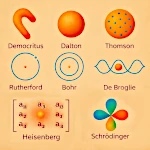 原子的各种形态:从古代直觉到量子力学