

镭(Ra,Z = 88):在黑暗中发光的元素
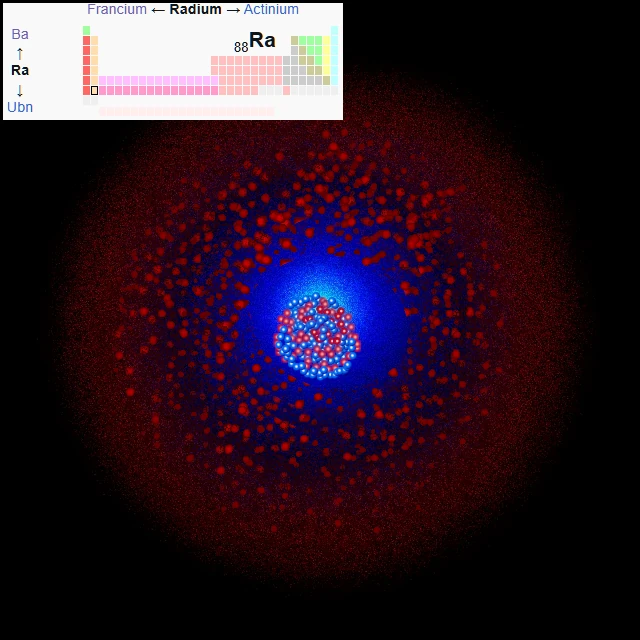
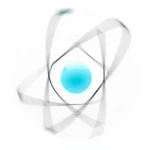
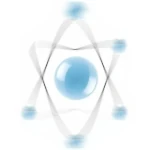
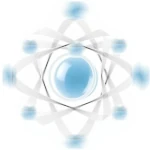
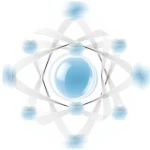
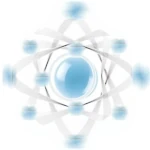
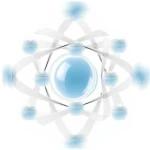
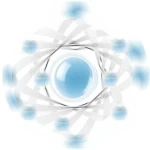
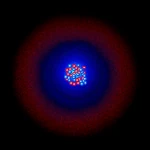
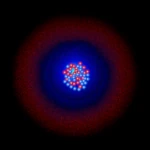
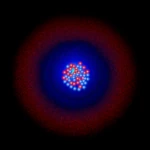
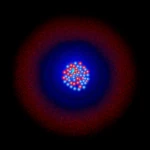
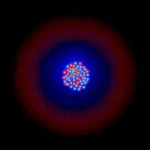
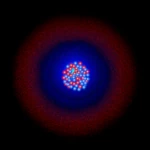
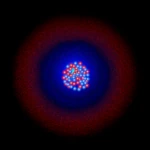
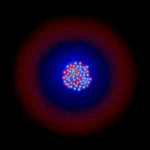
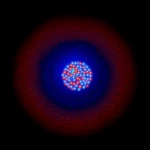
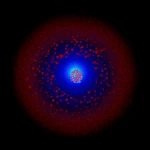
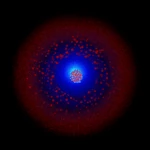
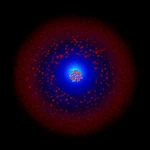
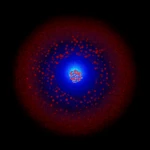
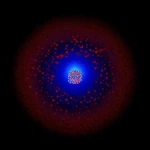
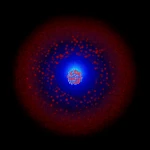
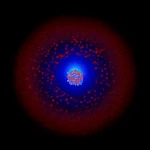
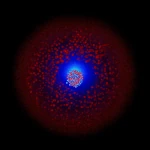
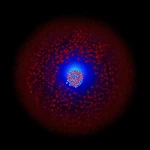
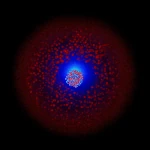
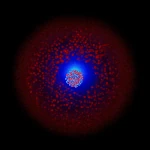
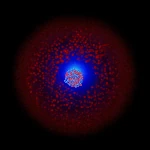
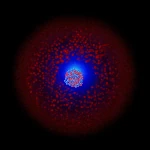
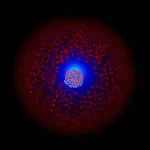
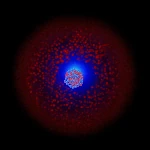
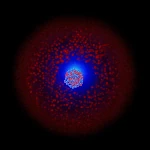
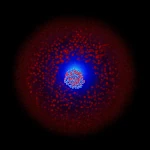
Image description:
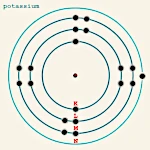
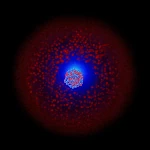
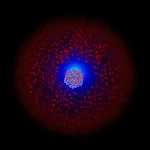
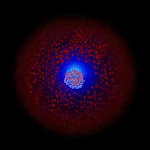
Simplified atomic model of the radium atom.
The most stable isotope is \(^{226}\mathrm{Ra}\) with its 88 protons, 88 electrons, and 138 neutrons.
Image source: astronoo.com (新窗口)
镭在地球物理学与放射性年代学中的作用
铀衰变链的关键成员
Radium is a crucial intermediate element in the 铀-238衰变链 (4n+2 series). It is produced by the alpha decay of thorium-230 (ionium) and itself decays into radon-222 by alpha emission. Several radium isotopes exist in different chains, but the most important is 镭-226 (half-life 1600 years), which is in secular equilibrium with uranium-238 in ancient minerals. Its presence and relative abundance are therefore directly related to the uranium content of the environment.
海洋沉积物的地质年代学与定年
The 铀-钍/镭 isotopic system is used to date geological processes on timescales ranging from a few years to about 500,000 years. The \(^{226}\mathrm{Ra}/^{230}\mathrm{Th}\) ratio is particularly useful for dating 海洋碳酸盐 (corals, concretions) and recent oceanic sediments. Since radium is more soluble than thorium, it is leached from continents and transported to the oceans. Measuring its activity in sediment cores allows the reconstruction of sedimentation rates and past climate changes.
海洋与次表层环流示踪
Radium has four natural isotopes with different half-lives (\(^{223}\mathrm{Ra}\), 11.4 days; \(^{224}\mathrm{Ra}\), 3.66 days; \(^{226}\mathrm{Ra}\), 1600 years; \(^{228}\mathrm{Ra}\), 5.75 years). This "string" of isotopes with decreasing timescales makes it an 适用于不同尺度过程的理想示踪剂:
- \(^{228}\mathrm{Ra}\) 和 \(^{226}\mathrm{Ra}\): Trace large-scale oceanic circulations and continental inputs over decades to millennia.
- \(^{224}\mathrm{Ra}\) 和 \(^{223}\mathrm{Ra}\): Perfect for studying rapid coastal processes such as groundwater mixing in the ocean, water-sediment exchanges, or estuarine dynamics on timescales of days to weeks.
家庭氡的自然来源
Radium-226 present in soils and rocks is the 氡-222的直接来源, a radioactive gas that migrates into buildings. The radium content of a soil is therefore the main determinant of the radon potential of a region.
镭的发现史与黄金时代
名字的词源与起源
The name "镭" was chosen by its discoverers, 皮埃尔和玛丽·居里, and derives from the Latin word "半径", meaning "ray". This name celebrates the most striking property of the new element: its intense 放射性, which manifests itself by the emission of invisible but detectable "rays". The Curies had already named "polonium"; "radium" completed the pair of radioactive elements they had extracted from pitchblende (a uranium ore).
居里夫妇的发现(1898年)
In 1898, following the work of 亨利·贝克勒尔 (1852-1903) on uranium, 玛丽·居里 (1867-1934) discovered that 沥青铀矿 (a uranium ore) was much more radioactive than pure uranium. She deduced, with her husband Pierre, the presence of unknown, more radioactive elements. After months of titanic and physically grueling work in a rudimentary shed, they managed to separate two new elements: first polonium (July 1898), then 镭 (December 1898). They announced it to the Academy of Sciences on December 26, 1898. The definitive proof and isolation of radium in the form of pure chloride (RaCl₂) would not come until 1902, after the treatment of several tons of ore.
金属镭的分离
Pure metallic radium was first isolated in 1910 by 玛丽·居里 in collaboration with 安德烈-路易·德比埃纳 (1874-1949), by electrolysis of molten radium chloride on a mercury cathode, followed by distillation of the mercury. This success consolidated Marie Curie's international fame, who received a 第二个诺贝尔奖 (this time in Chemistry) in 1911, becoming the first person to win two Nobels in different disciplines.
“镭狂热”:全球热潮(1910-1930)
The extraordinary properties of radium—its intense radioactivity, spontaneous luminescence (due to the excitation of air or impurities), and decay heat—made it a true 科学和商业界的知名人士. It was attributed almost miraculous virtues, leading to a craze:
- 医学: Creation of "近距离放射治疗" (use of radiation to treat cancers). Appearance of "medical" radium products (creams, mineral waters, suppositories) promising youth and vitality.
- 行业: Manufacture of luminous paints with radium (zinc sulfide + radium) for watch dials, instrument panels, and signs.
- 大众文化: Radium became a symbol of modernity and power, present in songs, advertisements, and even product names.
这一时期展现了人们对新技术的迷恋与其危险性认知之间的鸿沟。
存款与生产
Radium does not exist in its native state. It is present in minute quantities (about 1 part per 10¹¹) in 铀 ores, mainly pitchblende (UO₂) and carnotite (K₂(UO₂)₂(VO₄)₂·3H₂O). Historically, the richest mines were in 约阿希姆斯塔尔 (now the Czech Republic) and the 比属刚果. Extraction was extremely difficult and costly: hundreds of tons of ore had to be processed to obtain one gram of radium, making it the most expensive substance in the world (up to $120,000 per gram in the 1910s, equivalent to several million today).
如今,镭已不再被有意生产。医学上使用的少量镭来自历史库存,或作为核废料处理的副产品产生。其需求几乎已消失。
镭的结构与基本性质
分类与原子结构
Radium (symbol Ra, atomic number 88) is an element of group 2, the 碱土金属. It is the heaviest and most radioactive member of this family, which includes beryllium, magnesium, calcium, strontium, and barium. Its atom has 88 protons and, depending on the isotope, 135 to 150 neutrons. The most stable isotope, \(^{226}\mathrm{Ra}\), has 138 neutrons. Its electronic configuration is [Rn] 7s², with two valence electrons in the 7s shell.
物理与放射性特性
镭是一种银白色的碱土金属,在空气中会因氧化和氮化作用迅速变黑。其性质主要从钡的性质推断而来,但因强烈的放射性而变得复杂。
- 强烈的α放射性: Radium-226 emits alpha particles of 4.78 MeV with a half-life of 1600 years. One gram of radium-226 has an activity of 3.7×10¹⁰ Bq (1 curie, the historical unit defined from it).
- 衰变热: A macroscopic amount of radium is warm to the touch (about 0.1 watt per gram for \(^{226}\mathrm{Ra}\)).
- 发光: Radium salts cause certain materials (such as zinc sulfide) to glow and ionize the surrounding air, making it conductive and producing a faint glow.
- 高密度: Estimated at about 5.5 g/cm³.
- 熔点: Estimated at 700 °C.
- 沸点: Estimated at 1737 °C.
在固态形式下,它以体心立方结构结晶。
转化点数(估计值)
Estimated melting point: ~973 K (~700 °C).
Estimated boiling point: ~2010 K (~1737 °C).
化学反应活性
Chemically, radium closely resembles 钡, but is even more reactive. It is a highly electropositive metal.
- 与水反应: Reacts violently to release hydrogen and form soluble radium hydroxide, Ra(OH)₂.
- 与空气的反应: Rapidly oxidizes to form a mixture of oxide (RaO) and nitride (Ra₃N₂).
- 与酸的反应: Easily dissolves, releasing hydrogen (for non-oxidizing acids) and forming corresponding salts (RaCl₂, Ra(NO₃)₂, etc.).
- 化合物: Generally colorless (unless the anion is colored). The chloride (RaCl₂), bromide (RaBr₂), sulfate (RaSO₄, very insoluble), and carbonate (RaCO₃) are the best known.
由于镭的放射性及其衰变产物会污染溶液,其化学性质难以研究。
主要特点
Atomic number: 88.
Group: 2 (Alkaline earth metals).
Electronic configuration: [Rn] 7s².
Oxidation state: +2 (exclusive).
Most stable isotope: \(^{226}\mathrm{Ra}\) (T½ = 1600 years).
Appearance: Silvery-white metal that blackens in air.
天然镭同位素表
| 同位素 / 符号 | 质子(Z) | 中子(N) | 原子质量(u) | 母链 | 半衰期 / 衰变模式 | 备注/应用 |
|---|---|---|---|---|---|---|
| 镭-223 — \(^{223}\mathrm{Ra}\) | 88 | 135 | 223.018502 u | 铀-235(4n+3) | 11.43天(α) | Used in medicine under the trade name Xofigo® for the treatment of painful bone metastases from prostate cancer (targeted alpha therapy). |
| 镭-224 — \(^{224}\mathrm{Ra}\) | 88 | 136 | 224.020212 u | 钍-232(4n) | 3.66天(α) | 历史上用于医学。如今被研究用于α疗法。 |
| 镭-226 — \(^{226}\mathrm{Ra}\) | 88 | 138 | 226.025410 u | 铀-238(4n+2) | 1600年(α) | 历史上最重要且最具历史意义的同位素. Discovered by the Curies. Used for decades in curietherapy and luminous paints. Source of radon-222. |
| 镭-228 — \(^{228}\mathrm{Ra}\) | 88 | 140 | 228.031070 u | 钍-232(4n) | 5.75年(β⁻) | 中钍 I。历史上曾单独用于发光涂料。钍-228的衰变产物。 |
镭的电子排布与电子壳层
注意::
Electron shells:
电子如何在原子核周围组织 (新窗口).
镭有88个电子,分布在七个电子壳层上。其电子构型[Rn] 7s²很简单:由氡(一种稀有气体)的构型加上7s壳层中的两个额外电子组成。这也可以写成:K(2) L(8) M(18) N(32) O(18) P(8) Q(2),或完整形式:1s² 2s² 2p⁶ 3s² 3p⁶ 3d¹⁰ 4s² 4p⁶ 4d¹⁰ 4f¹⁴ 5s² 5p⁶ 5d¹⁰ 6s² 6p⁶ 7s²。
壳层的详细结构
K壳层 (n=1): 2 electrons (1s²).
L壳层(n=2): 8 electrons (2s² 2p⁶).
M壳层 (n=3): 18 electrons (3s² 3p⁶ 3d¹⁰).
N壳层(n=4): 32 electrons (4s² 4p⁶ 4d¹⁰ 4f¹⁴).
O壳层 (n=5): 18 electrons (5s² 5p⁶ 5d¹⁰).
P壳层 (n=6): 8 electrons (6s² 6p⁶).
Q壳层 (n=7): 2 electrons (7s²).
价电子与化学性质
Radium has two 价电子 (7s²). Like other alkaline earth metals, it easily loses these two electrons to form the Ra²⁺ ion, thus achieving the stable configuration of the noble gas radon. This high electropositivity explains its great reactivity with water and acids.
- 离子半径: The radius of Ra²⁺ is the largest of all alkaline earth ions (≈170 pm), which influences the solubility of its salts. As expected, most radium salts are soluble, with the notable exception of 硫酸镭(RaSO₄), which is very insoluble, and 碳酸盐(RaCO₃) and 铬酸镭 (RaCrO₄), which are moderately insoluble. This property was used for its separation and purification.
- 基本角色: Radium hydroxide Ra(OH)₂ is a strong base, more soluble than that of barium.
镭的历史与现代应用
- 历史性居里疗法: Use of sealed "sources" or "needles" of radium-226 (or its emanation, radon-222) placed near or inside tumors to destroy them by irradiation. It was crucial for the treatment of cervical, skin, and other cancers. Gradually replaced after 1950 by cobalt-60, cesium-137, and today iridium-192.
- 自发光涂料: Mixture of zinc sulfide (phosphor) and a tiny amount of radium (or mesothorium). Massively used between 1910 and 1960 for watch dials, aviation instruments, military compasses, and signs. This application is at the origin of the tragedy of the "镭姑娘".
- 现代核医学(α疗法): 镭-223(Xofigo®) is approved for the treatment of 去势抵抗性前列腺癌骨转移. As a calcium analog, Ra²⁺ selectively binds to active bone remodeling sites (such as metastases). Its alpha emission locally destroys tumor cells and reduces bone pain, prolonging survival.
- 标准放射源: Radium-226 long served as the primary standard for measuring activity (the curie was defined relative to it).
- 历史文物与收藏品: Watches, instruments, and various objects painted with radium are now museum or collectible items, to be handled with extreme caution due to the degradation of paints (radioactive dust).
“镭姑娘”的悲剧与危险意识的觉醒
美国新泽西州奥兰治的工厂
In the 1910s-20s, the U.S. Radium Corporation employed hundreds of young women to hand-paint watch dials with radium paint. To obtain a fine point, the workers were encouraged to 用嘴唇润湿笔尖 ("lip-pointing"), thus ingesting small amounts of radium daily. In addition, they worked in dusty workshops and sometimes smeared their hair and nails with fluorescent paint for fun.
疾病发作
As early as the 1920s, the workers began to develop horrible pathologies: 严重贫血、颌骨坏死("镭颌病") (the jawbones literally disintegrated), 自发性骨折、骨肉瘤及多种癌症. Doctors were initially perplexed, but the link with radium was established by Dr. 哈里森·马特兰 (1883-1954). Once ingested, radium behaved like calcium and became fixed in the bones, irradiating the bone marrow and surrounding tissues from within for decades.
法律斗争及其后果
Five workers, the "镭姑娘" (including Grace Fryer, Katherine Schaub), filed a landmark lawsuit against their employer in 1927. Despite the company's delaying tactics and the deteriorating health of the plaintiffs, they won their case in 1928. This trial:
- Established the 法律先例 for occupational diseases caused by toxic substances.
- 迫使行业改善安全条件。
- Contributed to the creation of the 职业安全与健康管理局(OSHA) in the United States.
- 标志着镭在消费品中使用开始减少。
毒理学与辐射防护
毒性机制
The toxicity of radium is purely 放射学的 (unlike lead or mercury, which have chemical toxicity). Once incorporated (mainly by ingestion, rarely by inhalation of dust), the Ra²⁺ ion follows the metabolism of calcium:
- 它被肠道吸收(吸收较弱,约20%)。
- 它分布于血液中。
- It is 不可逆地沉积在骨骼中, substituting for calcium in the mineral matrix of hydroxyapatite.
- 一旦被摄入,镭在其半衰期(Ra-226为1600年)内持续释放α粒子,从内部辐照骨髓细胞(导致贫血和白血病)以及骨细胞本身(导致坏死和肉瘤)。
健康影响
- 骨癌 (osteosarcoma) and 鼻窦癌 (by inhalation).
- 颌骨坏死 and skull bones.
- 再生障碍性贫血 and leukemias (bone marrow irradiation).
- 白内障 (for significant external eye exposure).
对镭工人、接受镭治疗的患者以及钟表匠进行的长期流行病学研究,为内照射α辐射效应提供了基础数据。
处理与保护
如今,镭的处理采取了极其严格的防护措施:
- 隔离: In sealed glove boxes or closed enclosures.
- 防护α粒子: Gloves, lab coats. Sources are stored in lead containers to block gamma rays emitted by descendants (such as bismuth-214).
- 防止注册成立: Absolute prohibition of eating, drinking, or smoking in the area. Control of surface and air contamination.
- 剂量监测: Operational dosimeters and internal monitoring (whole-body counting).
废物管理与污染场地
持久的放射性遗产
Former industrial uses of radium have left a legacy of 污染场地 (former luminous paint factories, watchmaking workshops, waste dumps). The long half-life of Ra-226 (1600 years) means that this contamination will persist for millennia.
去污技术
- 开挖与最终储存: The most common method for contaminated soils. Waste is packaged and sent to storage centers for medium-level long-lived waste.
- 土壤清洗: Use of chemical solutions (acids, complexing agents) to leach radium, followed by wastewater treatment.
- 稳定化/固化: Mixing contaminated waste with cement or other binders to immobilize radium and reduce its leaching.
历史物品(手表、仪器)的管理
收藏家和博物馆必须意识到这一风险。物品应存放在通风的展示柜中,处理时需戴手套,未经专业人员指导切勿打开或修复。剥落的油漆尤其危险。
前景
镭作为神奇材料的时代已经结束。它的未来存在于两个截然不同的领域:
- 精准核医学: The success of radium-223 (Xofigo®) paves the way for other targeted alpha therapies using similar isotopes (actinium-225, bismuth-213). Research aims to improve targeting and reduce side effects.
- 遗留管理与修复: Cleaning up historically contaminated sites remains a major technical and financial challenge for the decades to come.
镭将作为开启放射性时代的元素载入史册,它承载着科学天才、天真的热情以及最终导致严格监管和对放射风险高度警觉的人类苦难。
 核聚变所需的能量以及为什么铀是一个极限
 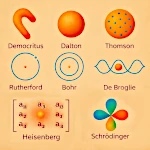 原子的各种形态:从古代直觉到量子力学