

铀(U,Z = 92):蕴含能量的元素
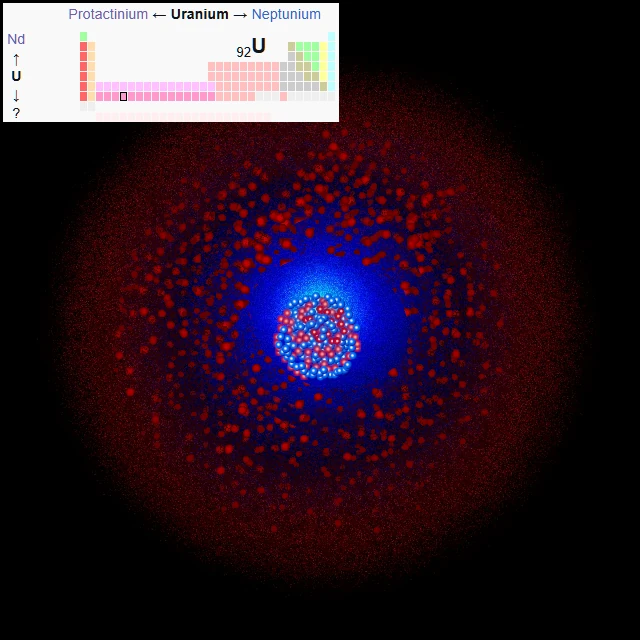
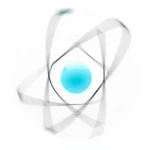
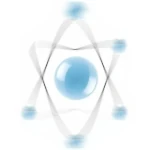
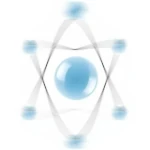
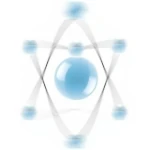
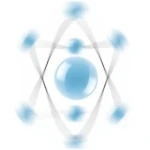
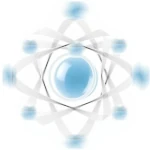
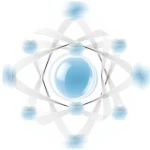
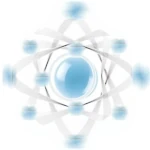
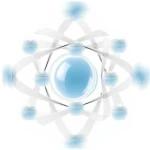
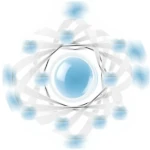
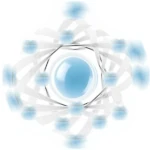
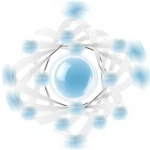
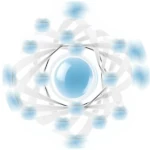
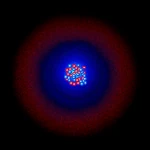
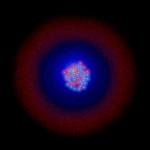
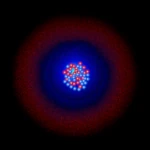
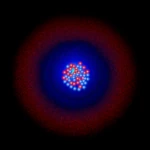
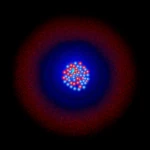
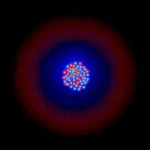
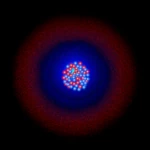
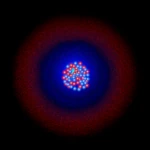
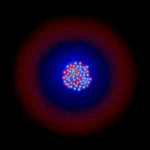
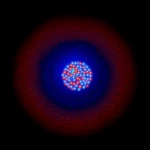
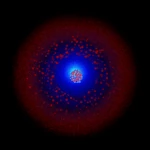
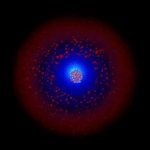
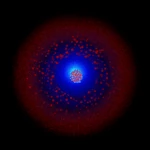
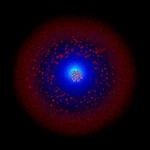
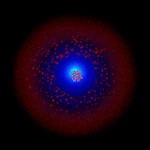
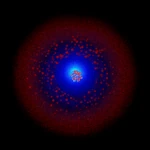
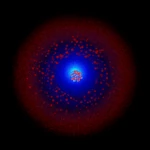
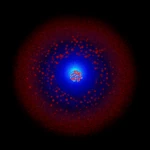
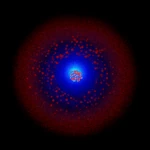
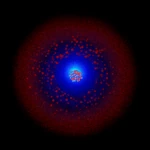
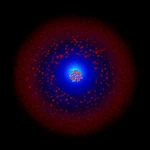
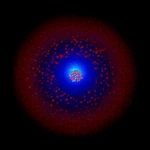
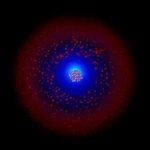
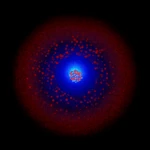
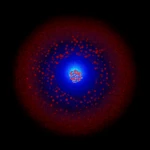
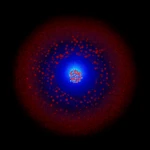
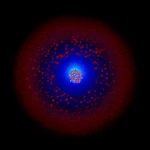
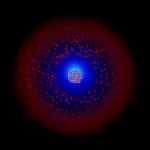
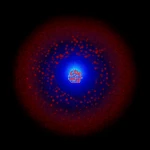
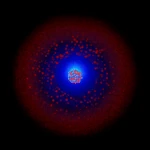
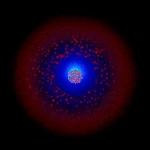
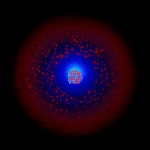
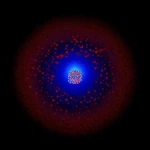
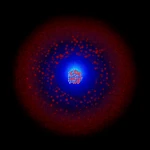
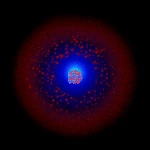
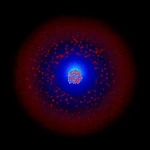
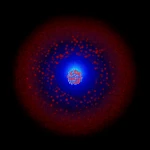
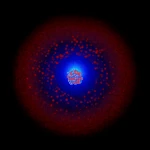
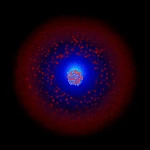
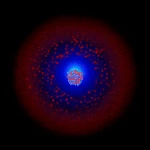
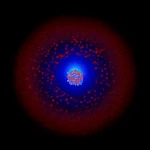
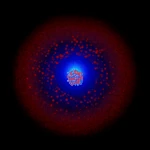
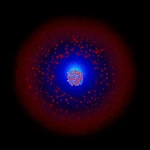
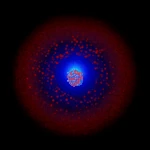
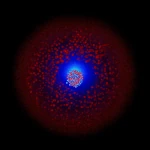
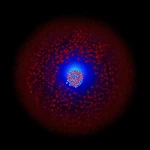
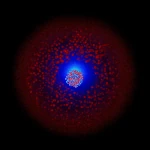
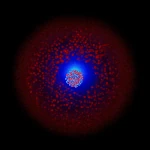
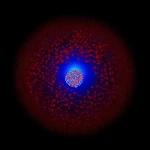
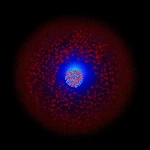
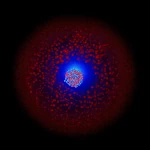
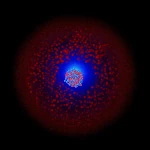
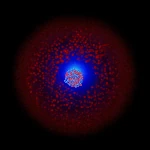
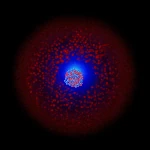
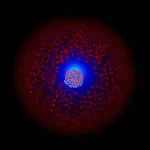
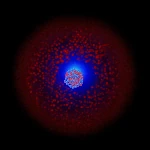
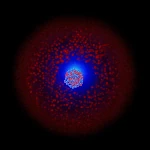
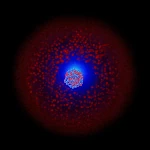
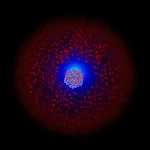
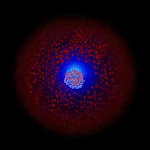
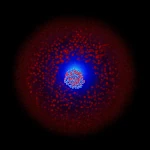
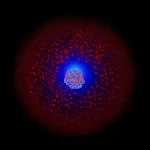
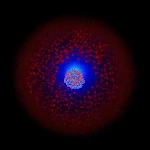
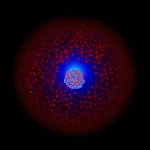
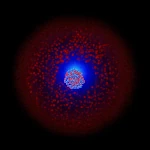
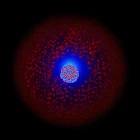
Image description: Simplified atomic model of the uranium atom. The most abundant isotope is \(^{238}\mathrm{U}\) with its 92 protons, 92 electrons, and 146 neutrons.
Image source: astronoo.com (新窗口)
铀在宇宙学与地质学中的作用
恒星与超新星中的元素合成
Uranium is an element 比铁更重 and cannot be synthesized by ordinary nuclear fusion in the cores of stars. It is mainly produced during cataclysmic events such as 中子星合并 or 核心坍缩超新星, via the rapid neutron capture process (r-process). The presence of uranium on Earth thus testifies to violent stellar events that occurred before the formation of the solar system.
地质年代学与地球的“自然时钟”
铀衰变为铅的放射性过程是地质学中最重要的定年体系之一。
- 铀铅(U-Pb)定年法: Uses the two decay chains \(^{238}\mathrm{U}\) → \(^{206}\mathrm{Pb}\) (half-life 4.47 billion years) and \(^{235}\mathrm{U}\) → \(^{207}\mathrm{Pb}\) (half-life 0.70 billion years). The \(^{207}\mathrm{Pb}/^{206}\mathrm{Pb}\) ratio provides very precise ages, allowing the dating of the formation of the oldest terrestrial (zircons) and lunar minerals, and establishing the age of the Earth at 大约45.4亿年.
- 铀-钍(U-Th)测年法: Uses the disequilibrium in the \(^{238}\mathrm{U}\) chain to date more recent events (up to 500,000 years), such as corals, limestone concretions (stalagmites), and marine sediments, providing crucial data for paleoclimatology.
地球内部热量的来源
The radioactive decay of uranium, thorium, and potassium-40 is a major source of 地球内部的热量. This internal heat drives mantle convection, responsible for 板块构造, volcanism, and the Earth's magnetic field (via the dynamo of the outer core). About half of the Earth's heat flow comes from this radioactivity.
铀的发现与使用历史
名字的词源与起源
The element is named after the planet 天王星, discovered eight years earlier by 威廉·赫歇尔 (1738-1822) in 1781. The German chemist 马丁·海因里希·克拉普罗特 (1743-1817), who isolated uranium oxide in 1789, followed a tradition of naming new elements after celestial bodies. This practice links chemistry to astronomy, as evidenced by other elements:
- 铈(Ce): Named after 谷神星, the first dwarf planet and the largest object in the asteroid belt, discovered in 1801 by Giuseppe Piazzi.
- 硒(Se): From the Greek 塞勒涅 (Σελήνη), goddess of the 月亮, due to its resemblance to tellurium (named after Tellus, the Earth).
- 碲(Te): From the Latin tellus, meaning 地球.
- 钯(Pd): Named after the asteroid 帕拉斯, discovered in 1802.
- 镎(Np) and 钚 (Pu): Following uranium, these transuranic elements were named after the planets 海王星 and 冥王星.
从发现到放射性
Klaproth believed he had isolated the pure metal, but it was actually an oxide (\( \mathrm{UO_2} \)). The metal was first isolated in 1841 by 欧仁-梅尔基奥尔·佩利戈 (1811-1890). For over a century, uranium was considered a mundane chemical element, used mainly as a yellow or green pigment (铀玻璃, "Vaseline glass" tableware) or as an additive in steels.
The revolution came in 1896 when 亨利·贝克勒尔 (1852-1908) discovered "放射性" while studying uranium salts. This revolutionary property was then studied in depth by 玛丽·居里 (1867-1934) and 皮埃尔·居里 (1859-1906), who discovered polonium and radium in pitchblende, a uranium ore.
核时代:裂变与武器
The discovery of 核裂变 by Otto Hahn, Lise Meitner, and Fritz Strassmann in 1938 changed everything. Physicists understood that the nucleus of uranium-235, when struck by a neutron, could split into lighter nuclei, releasing colossal energy and additional neutrons, allowing a 链式反应.
- 曼哈顿计划: During World War II, a colossal scientific and industrial effort (United States, United Kingdom, Canada) was launched to produce a weapon based on fission. It led to the creation of the first atomic bomb ("Little Boy") with 浓缩铀-235, dropped on Hiroshima on August 6, 1945.
- 核武库与军备竞赛: Enriched uranium and plutonium (produced from uranium-238) became the raw materials for nuclear deterrence during the Cold War.
民用核能
After the war, the focus shifted to the peaceful use of nuclear energy. The first nuclear power plant was connected to the grid in Obninsk (USSR) in 1954. Today, nuclear energy, mainly based on the fission of 铀-235 in light water reactors, provides about 10% of the world's electricity, with very low CO₂ emissions.
存款与产量
铀是地壳中相对丰富的元素(含量约为银的40倍)。主要矿石有:
- 沥青铀矿 (\( \mathrm{UO_2} \))
- 钾钒铀矿 (\( \mathrm{K_2(UO_2)_2(VO_4)_2·3H_2O} \))
- 钙铀云母 (\( \mathrm{Ca(UO_2)_2(PO_4)_2·10-12H_2O} \))
The main producing countries are Kazakhstan, Canada, Namibia, and Australia. Extraction is done through open-pit mines, underground mines, or 原位浸出 (injection of solutions directly into the deposit).
铀的结构与基本性质
分类与原子结构
Uranium (symbol U, atomic number 92) is an element of the 锕系元素 series. It is a heavy, dense, and radioactive metal. Its atom has 92 protons and, for its most abundant isotope \(^{238}\mathrm{U}\), 146 neutrons. Its electronic configuration is [Rn] 5f³ 6d¹ 7s², although the 5f and 6d electrons are energetically close, leading to variable valence chemistry.
物理和放射性特性
- 高密度: 19.1 g/cm³ (about 70% denser than lead).
- 阿尔法放射性: Natural uranium is weakly radioactive. The isotope \(^{238}\mathrm{U}\) has a half-life of 4.47 billion years, emitting an alpha particle of 4.27 MeV. Its specific activity is low (12.4 kBq/g for natural uranium).
- 金属态: Silvery-gray metal, malleable and ductile. It has three allotropes (crystalline phases) depending on temperature: orthorhombic (α) up to 668°C, tetragonal (β) up to 776°C, then body-centered cubic (γ).
- 熔点: 1135 °C.
- 沸点: 4131 °C.
- 自燃性: Fine uranium powder or shavings can spontaneously ignite in air.
化学反应活性
铀是一种化学性质活泼的金属。
- 与空气的反应: Forms a dark oxide layer (\( \mathrm{UO_2} \)) that partially protects it. In powder form, it ignites.
- 与水反应: Reacts slowly with cold water and vigorously with hot water to form uranium dioxide and hydrogen.
- 与酸的反应: Dissolves in most acids.
- 氧化态: The +4 and +6 states are the most common and stable.
- U(IV): Stable compounds, such as dioxide \( \mathrm{UO_2} \) (black, nuclear fuel).
- U(VI): Forms the linear uranyl ion \( \mathrm{UO_2^{2+}} \) (bright yellow in solution), present in compounds such as trioxide \( \mathrm{UO_3} \) or uranyl nitrate \( \mathrm{UO_2(NO_3)_2} \).
主要特点
Atomic number: 92.
Group: - (Actinide).
Electronic configuration: [Rn] 5f³ 6d¹ 7s².
Main oxidation states: +3, +4, +5, +6.
Most abundant isotope: \(^{238}\mathrm{U}\) (T½ = 4.47×10⁹ years).
Appearance: Silvery-gray, dense metal.
铀同位素表(天然)
| 同位素 / 符号 | 天然丰度 | 质子(Z) | 中子(N) | 半衰期 / 衰变模式 | 备注/应用 |
|---|---|---|---|---|---|
| 铀-234 — \(^{234}\mathrm{U}\) | 0.0055% | 92 | 142 | 2.455×10⁵ 年(α) | \(^{238}\mathrm{U}\)的子体。在天然铀中与其母体处于长期平衡状态。比同等质量的其他同位素更具放射性。 |
| 铀-235 — \(^{235}\mathrm{U}\) | 0.720% | 92 | 143 | 7.04×10⁸ 年(α,自发裂变) | 唯一天然可裂变同位素. Essential for nuclear reactors and weapons. Enrichment necessary for most applications. |
| 铀-238 — \(^{238}\mathrm{U}\) | 99.2745% | 92 | 146 | 4.468×10⁹年(α,自发裂变) | 最丰富的同位素. Fertile: captures a neutron to form plutonium-239 (fissile). Basis of U-Pb dating. |
铀的电子排布与电子壳层
注意::
Electron shells: 电子如何围绕原子核组织 (新窗口).
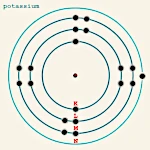
铀有92个电子,分布在七个电子壳层中。其完整电子排布为:1s² 2s² 2p⁶ 3s² 3p⁶ 3d¹⁰ 4s² 4p⁶ 4d¹⁰ 4f¹⁴ 5s² 5p⁶ 5d¹⁰ 5f³ 6s² 6p⁶ 6d¹ 7s²。通常简写为 [Rn] 5f³ 6d¹ 7s²,表明价电子位于5f、6d和7s轨道。
壳层的详细结构
K层(n=1): 2 electrons (1s²).
L层(n=2): 8 electrons (2s² 2p⁶).
M层(n=3): 18 electrons (3s² 3p⁶ 3d¹⁰).
N层(n=4): 32 electrons (4s² 4p⁶ 4d¹⁰ 4f¹⁴).
O壳层 (n=5): 21 electrons (5s² 5p⁶ 5d¹⁰ 5f³).
P壳层(n=6): 9 electrons (6s² 6p⁶ 6d¹).
Q壳层 (n=7): 2 electrons (7s²).
价电子与化学性质
The valence electrons of uranium (5f³ 6d¹ 7s²) give it a 复杂而丰富的化学. It can lose these electrons (and sometimes more internal 5f electrons) to form several oxidation states.
- +3 态 (U³⁺): Strong reducer, slowly oxidizes in water. Configuration [Rn] 5f³.
- +4 价态 (U⁴⁺): Stable, forms compounds such as \( \mathrm{UO_2} \) or \( \mathrm{UF_4} \) (green). Configuration [Rn] 5f².
- +6价态(UO₂²⁺): The 铀酰 ion is extremely stable in aqueous solution and in the solid state. Its linear O=U=O structure is characteristic. It is the most mobile form in the environment.
This ability to change oxidation states is crucial for its 核燃料循环 (extraction, conversion, reprocessing) and its 环境行为.
铀的应用
- 核能: 燃料 in nuclear power plants. Natural uranium (0.7% U-235) is 富集 (to 3-5% U-235) to power most reactors. Depleted uranium (mostly U-238) is also used in some reactors (fast neutron reactors) or as fertile material to produce plutonium-239.
- 核武器: 高浓缩铀 (HEU, >90% U-235) is a material of choice for fission nuclear weapons. Depleted uranium is used in 穿透器 (kinetic projectiles) due to its very high density and self-sharpening ability on impact.
- 舰船推进: Enriched uranium reactors power nuclear submarines and aircraft carriers, giving them considerable autonomy without the need to refuel for decades.
- 科学应用:
- 地质年代测定(U-Pb, U-Th).
- 粒子加速器的靶标 to produce transuranic elements.
- 某些工业或研究应用中的辐射源。
- 历史应用: Pigments for glass and ceramics (uranium yellow, uranium green) before the 1940s. Counterweights in aircraft control surfaces (depleted uranium).
核燃料循环
从矿山到反应堆
- 勘探与开采.
- 浓缩与纯化: Production of 黄饼 (\( \mathrm{U_3O_8} \)) pure at ~80%.
- 转换: Transformation into gaseous uranium hexafluoride (\( \mathrm{UF_6} \)) for enrichment.
- 富集: Increase in U-235 content by gaseous diffusion or gas centrifugation.
- 燃料制造: Conversion of enriched UF₆ into uranium dioxide powder (\( \mathrm{UO_2} \)), then pressed and sintered into pellets, which are loaded into zirconium alloy tubes (fuel rods).
- 用于反应堆: Irradiation for 3 to 5 years, with energy production and fission products.
乏燃料管理
- 泳池储物: Initial cooling for several years.
- 干储存: In specific containers.
- 再处理(可选): Recovery of reusable uranium and plutonium, separation of ultimate waste (fission products, minor actinides). France is a country that reprocesses its fuel.
- 深层地质储存: Long-term solution for high-level and long-lived waste (Cigéo project in France).
健康、环境与辐射防护
化学与辐射风险
Uranium presents a 双重毒性:
- 化学毒性(肾脏): Like other heavy metals, uranium is toxic to the kidneys. The occupational exposure limit is mainly based on this chemical effect, which becomes critical before radiological effects for natural or depleted uranium.
- 放射性毒性(致癌性): Due to alpha emissions (and minor gamma/beta emissions from descendants). The main risk is related to 吸入或摄入 of insoluble dust that remains in the body long-term (lungs, bones).
环境管理
- 前矿区遗址: May present risks of contamination of water and soil by uranium and its descendants (radium, radon). Rehabilitation is mandatory.
- 受控释放: Nuclear facilities release very small amounts of uranium into the environment, strictly regulated and monitored.
辐射防护
处理铀,尤其是浓缩铀,需要采取预防措施:
- 隔离 (enclosures, gloves) to avoid inhalation/ingestion.
- 临界保护: For enriched uranium, specific measures prevent any geometric configuration that could initiate an accidental chain reaction (临界事故).
- 监控: Dosimetry, contamination control.
地缘政治与经济问题
战略资源
- 供应安全: Crucial for countries dependent on nuclear energy.
- 核不扩散: The 不扩散核武器条约(NPT) and the 国际原子能机构(IAEA) monitor uranium-related activities to prevent its diversion for military purposes. Enrichment is a particularly sensitive technology.
- 波动市场: The price of uranium fluctuates depending on energy demand, political decisions (nuclear phase-out), and the discovery of new deposits.
未来挑战
- 第四代反应堆的研发: Could use uranium (including U-238) more efficiently and burn their own waste.
- 长寿命废物管理.
- 社会接纳 of nuclear energy in the face of the climate challenge.
前景
Uranium, once an unremarkable element, became in the 20th century the symbol of atomic power, both destructive and civilizing. Its future is intimately linked to that of nuclear energy. Faced with the climate emergency, this low-carbon energy source is experiencing renewed interest, but it must meet the challenges of the 循环经济 (reuse of materials, waste minimization), 绝对安全, and 民主透明度. Whether it remains an energy pillar or is gradually replaced, uranium will remain in history as the element that unleashed the energy of the nucleus, forever changing the destiny of humanity.
 核聚变所需的能量以及为什么铀是一个极限
 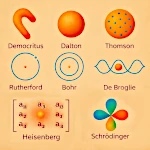 原子的各种形态:从古代直觉到量子力学