

锇(Os,Z = 76):具有极高密度和硬度的金属
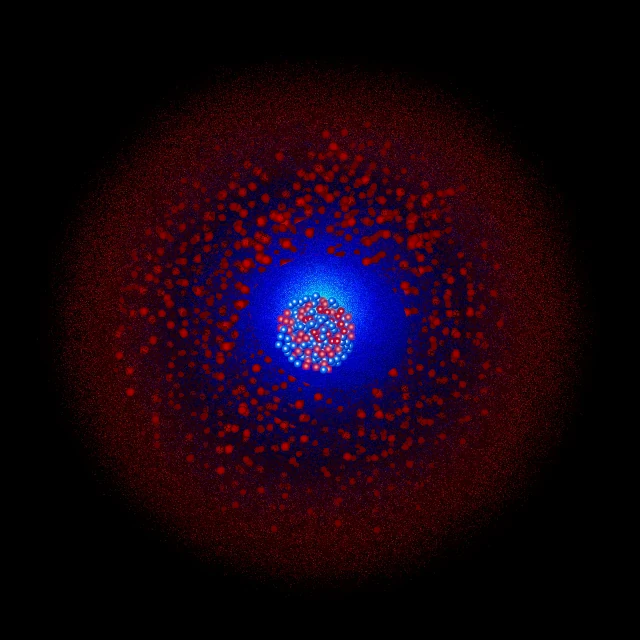
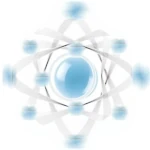
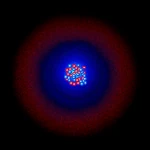
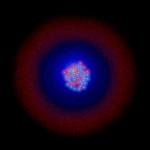
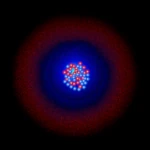
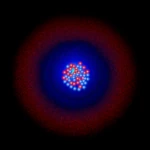
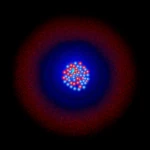
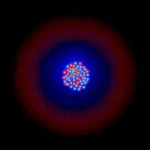
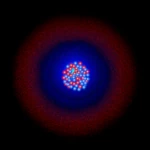
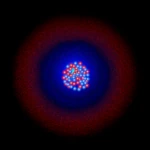
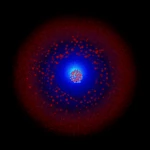
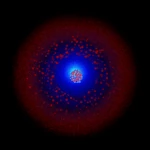
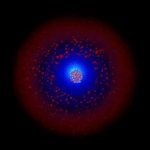
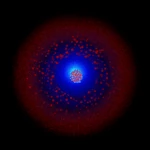
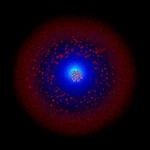
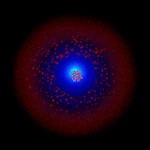
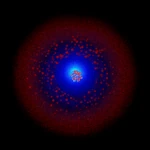
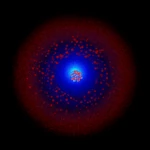
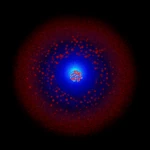
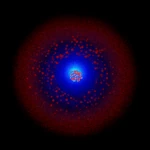
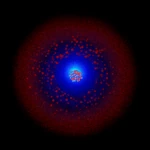
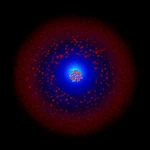
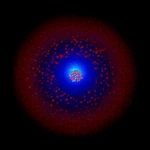
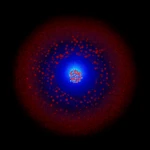
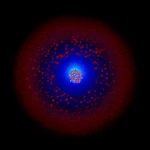
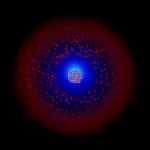
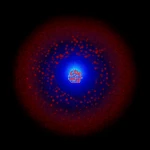
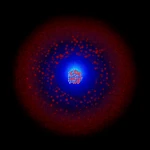
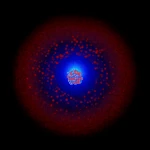
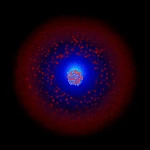
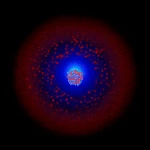
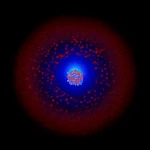
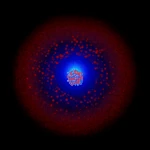
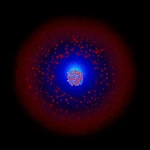
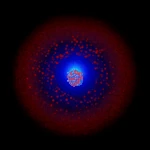
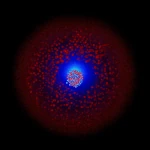
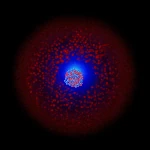
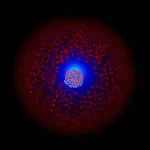
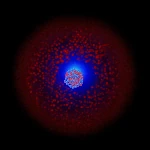
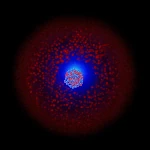
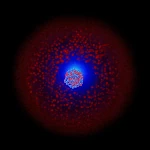
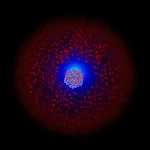
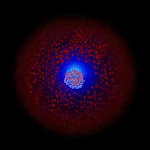
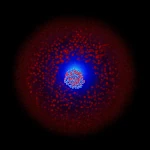
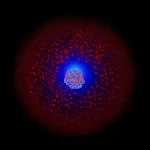
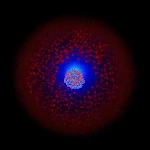
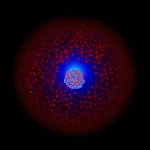
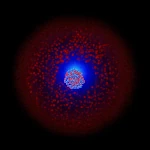
Image description:
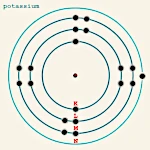
Simplified atomic model of the osmium atom. The main stable isotope is \(\,^{192}\mathrm{Os}\,
with its 76 protons, 76 electrons, and 116 neutrons.
Image source: astronoo.com (新窗口)
锇在天体物理学和宇宙学中的作用
锇的恒星合成
Osmium is synthesized in stars mainly through the r-过程 (rapid neutron capture) that occurs during cataclysmic events such as supernovae and neutron star mergers. As a heavy element with an even atomic number (Z=76), it is efficiently produced by this process. Osmium also has a significant contribution from the s-过程 (slow neutron capture) in AGB stars (asymptotic giants), but the r-process dominates, accounting for 70-80% of its solar abundance. Osmium is part of the "osmium peak" in the production spectrum of heavy elements by neutron capture.
宇宙丰度与同位素特征
锇在宇宙中的丰度(按原子数计)约为氢的6.0×10⁻¹³倍,其稀有程度与铂和金相当,比钨约稀有2-3倍。锇有七种天然同位素,其中丰度最高的是锇-192(占41.0%)。锇的同位素丰度,特别是¹⁸⁷Os/¹⁸⁸Os比值,在地球化学和宇宙化学中具有关键重要性。
地球化学与宇宙化学中的铼-锇定年体系
铼-锇同位素体系(¹⁸⁷Re → ¹⁸⁷Os)是研究地球及太阳系演化最重要的年代学工具之一。锇-187是铼-187(半衰期416亿年)通过β衰变产生的放射性成因同位素。该体系的重要性在于这两种元素显著的地球化学差异:铼具有中等亲铁性和亲硫性(偏好硫化物),而锇则具有强亲铁性(偏好金属)。这些差异在行星核形成和地质储库分异过程中产生了显著的同位素分馏。
应用于行星形成与地幔演化
Re-Os体系特别适用于:
- 测定地球核心的形成时间: By comparing isotopic compositions of the mantle and meteorites.
- 研究地球地幔的演化: Os isotopic ratios distinguish primitive mantle from depleted mantle.
- 勘探硫化物矿床: Magmatic sulfides concentrate osmium and rhenium.
- 研究石油的起源: Oils and source rocks have distinct Os signatures.
- 研究陨石撞击: Impact layers show Os anomalies.
- 定年超镁铁质岩: Which are difficult to date by other methods.
¹⁸⁷Os/¹⁸⁸Os比值被认为是地幔与地壳相互作用最灵敏的示踪剂之一。
锇的发现历史
名称的词源与起源
Osmium takes its name from the ancient Greek 气味 (osmḗ), meaning "smell". This name was chosen by its discoverer, Smithson Tennant, because of the pungent and unpleasant odor of osmium oxide (OsO₄), which resembles ozone or chlorine. Osmium shares this etymology with ozone (O₃), which also has a characteristic odor. It is one of the few elements named after a sensory property.
史密森·坦南特的发现
Osmium was discovered in 1803 by the English chemist 史密森·坦南特 (1761-1815), who also discovered iridium in the same year. Tennant was working on crude platinum from South America, which did not dissolve completely in aqua regia. He noticed that a black insoluble residue remained after treatment. By studying this residue, he identified two new elements: one producing colored salts (which he named iridium, after Iris, the Greek goddess of the rainbow), and the other producing a volatile oxide with a strong odor (which he named osmium).
早期研究与生产
早期对锇的研究因其高硬度、脆性以及挥发性氧化物的毒性而困难重重。1804年,坦南特首次制得相对纯净的金属锇。然而,直到19世纪中期,才开发出更有效的生产和提纯方法。由于锇自身特性带来的技术挑战,它成为最后一批以纯态分离的天然元素之一。
陆地存在与生产
锇是地球上最稀有的天然元素之一,其地壳丰度估计约为0.05 ppb(十亿分之一)。目前不存在原生锇矿矿床,它始终作为其他金属加工过程中的副产品回收,主要包括:
- 铂矿石: Mainly in platinum group deposits (Bushveld in South Africa, Norilsk in Russia)
- 铂金冲积层: Placers where platinum group metals have concentrated
- 镍矿和铜矿: Some sulfide deposits contain traces of osmium
世界锇产量极低,估计每年不足1吨。主要生产国包括南非、俄罗斯、加拿大和美国。因其极度稀有、特性独特且生产难度大,锇是最昂贵的金属之一,典型价格约为每公斤1万至1.5万美元(某些形态价格更高)。其需求受限于小众应用领域及供应量。
锇的结构与基本性质
分类与原子结构
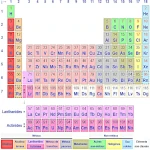
锇(符号Os,原子序数76)是第6周期的过渡金属,位于元素周期表第8族(原Ⅷ族),与铁、钌、����同族。它属于铂族金属(铂、钯、铑、钌、铱、锇)。其原子含有76个质子,通常有116个中子(对应最丰富的同位素\(\,^{192}\mathrm{Os}\)),以及76个电子,电子排布为[Xe] 4f¹⁴ 5d⁶ 6s²。该排布在5d亚层有6个电子,在6s亚层有2个电子。
卓越的物理特性
锇是一种蓝白色、有光泽、密度极大、坚硬且脆的金属。它在天然元素中保持着多项纪录:
- 最高密度: 22.59 g/cm³ at 20 °C (slightly denser than iridium, 22.56 g/cm³)
- 极高硬度: 7.0 on the Mohs scale (pure), but osmium-iridium alloys can reach 7.5
- 非常高的弹性模量: About 550 GPa (one of the stiffest materials)
- 极高的熔点: 3033 °C (one of the highest among metals)
锇在室温下具有六方密排(HCP)晶体结构,这使其具有高密度和高硬度。
非凡的转变点
Osmium melts at 3033 °C (3306 K) - one of the highest melting points among metals - and boils at 5012 °C (5285 K). It has good thermal stability and retains its mechanical properties at high temperatures, although it is generally brittle and difficult to work with.
化学反应活性
在室温下,锇相对惰性且耐腐蚀。但在中等温度下,若存在氧气,它会形成OsO₄(四氧化锇)。OsO₄在室温下为淡黄色晶体固体,但仅在40°C时便会升华(直接从固态变为气态),产生具有特殊气味的高毒性蒸气。锇在氧化剂存在下会受熔融碱侵蚀,并能溶于王水和浓硝酸。
记录物理特征(摘要)
Density: 22.59 g/cm³ - the highest of all natural elements.
Melting point: 3306 K (3033 °C) - among the highest of metals.
Boiling point: 5285 K (5012 °C).
Crystal structure: Hexagonal close-packed (HCP).
Modulus of elasticity: ~550 GPa - extremely stiff.
Hardness: 7.0 on the Mohs scale (pure) - very hard for a metal.
锇同位素表
| 同位素 / 符号 | 质子(Z) | 中子(N) | 原子质量(u) | 天然丰度 | 半衰期 / 稳定性 | 衰变 / 备注 |
|---|---|---|---|---|---|---|
| 锇-184 — \(\,^{184}\mathrm{Os}\,\) | 76 | 108 | 183.952489 u | ≈ 0.02% | 稳定 | 最轻的稳定同位素,在自然界中极为罕见。 |
| 锇-186 — \(\,^{186}\mathrm{Os}\,\) | 76 | 110 | 185.953838 u | ≈ 1.59% | 2.0×10¹⁵ 年 | α放射性,半衰期极长。在大多数应用中被视为稳定。 |
| 锇-187 — \(\,^{187}\mathrm{Os}\,\) | 76 | 111 | 186.955750 u | ≈ 1.96% | 稳定的 | 重要的放射性成因同位素(¹⁸⁷Re的衰变产物),对铼-锇地质年代学至关重要。 |
| 锇-188 — \(\,^{188}\mathrm{Os}\,\) | 76 | 112 | 187.955838 u | ≈ 13.24% | 稳定的 | 用于同位素测量的参考稳定同位素(¹⁸⁷Os/¹⁸⁸Os比值)。 |
| 锇-189 — \(\,^{189}\mathrm{Os}\,\) | 76 | 113 | 188.958147 u | ≈ 16.15% | 稳定 | 重要的稳定同位素。 |
| 锇-190 — \(\,^{190}\mathrm{Os}\,\) | 76 | 114 | 189.958447 u | ≈ 26.26% | 稳定的 | 自然界中最丰富的稳定同位素。 |
| 锇-192 — \(\,^{192}\mathrm{Os}\,\) | 76 | 116 | 191.961481 u | ≈ 40.78% | 稳定的 | 主要稳定同位素,约占天然混合物的41%。 |
锇的电子构型与电子层
注意::
Electron shells:
电子如何围绕原子核组织起来 (新窗口).
锇有76个电子,分布在六个电子壳层中。其电子排布为 [Xe] 4f¹⁴ 5d⁶ 6s²,其中4f亚层完全填满(14个电子),5d亚层有六个电子。该排布也可写作:K(2) L(8) M(18) N(18) O(32) P(8),或完整形式:1s² 2s² 2p⁶ 3s² 3p⁶ 3d¹⁰ 4s² 4p⁶ 4d¹⁰ 4f¹⁴ 5s² 5p⁶ 5d⁶ 6s²。
壳层的详细结构
K 壳层 (n=1): contains 2 electrons in the 1s subshell. This inner shell is complete and very stable.
L层(n=2): contains 8 electrons distributed as 2s² 2p⁶. This shell is complete, forming a noble gas configuration (neon).
M层(n=3): contains 18 electrons distributed as 3s² 3p⁶ 3d¹⁰. This complete shell contributes to electronic shielding.
N壳层(n=4): contains 18 electrons distributed as 4s² 4p⁶ 4d¹⁰. This shell forms a stable structure.
O壳层 (n=5): contains 32 electrons distributed as 5s² 5p⁶ 4f¹⁴ 5d⁶. The completely filled 4f subshell and the six 5d electrons give osmium its transition metal properties.
P壳层(n=6): contains 8 electrons in the 6s² and 5d⁶ subshells.
价电子与氧化态
Osmium effectively has 8 价电子: two 6s² electrons and six 5d⁶ electrons. Osmium exhibits a wide range of oxidation states, from -2 to +8, with the +4, +6, and +8 states being the most stable and characteristic.
在+8氧化态下,锇形成OsO₄(四氧化锇),这是一种挥发性且剧毒的共价化合物。+6氧化态存在于OsF₆(六氟化锇)和锇(VI)酸盐等化合物中。+4氧化态非常稳定,存在于许多化合物中,如OsO₂(二氧化锇)和锇(IV)配合物。锇还在多种配位化合物中表现出较低的氧化态(+3、+2、+1、0、-2)。
锇与钌一样,能够达到+8氧化态,这是除钌和氙外已知元素中最高的氧化态。这种丰富的氧化态化学性质,加上锇能与氧、卤素及其他配体形成多重键的能力,使其成为催化和有机合成中化学性质非常有趣的元素。
锇的化学反应活性
与空气和氧气的反应
在室温下,金属锇在空气中稳定。然而,加热时它会氧化生成OsO₄:Os + 2O₂ → OsO₄。该反应始于约200-300°C。OsO₄是一种淡黄色结晶固体,仅在40°C时升华(直接从固态变为气态)。OsO₄蒸气具有剧毒,带有独特的刺激性气味,该元素因此得名。OsO₄是一种强氧化剂,能与许多有机物质发生反应。
与水及酸的反应
金属锇对大多数冷酸具有抗性:
- 盐酸(HCl): Resistant
- 硫酸(H₂SO₄): Resistant to dilute solutions, attacked by hot concentrated acid
- 硝酸(HNO₃): Dissolves slowly, forming OsO₄
- 王水: Dissolves, forming various compounds
- 氢氟酸(HF): Resistant
锇在氧化剂存在下会被熔融碱侵蚀,形成可溶性锇酸盐。
注意::
王水, from Latin for "royal water", is a corrosive mixture of concentrated nitric acid (HNO₃) and concentrated hydrochloric acid (HCl), typically in a 1:3 ratio. Its ability to dissolve gold and platinum, metals resistant to the separate acids, is due to the 原位 formation of chlorine (Cl₂) and nitrosyl chloride (NOCl), which oxidize these metals into soluble complex ions (such as [AuCl₄]⁻). Used since alchemical times for the purification of precious metals, it remains crucial in metallurgy, microelectronics, and analytical chemistry.
与卤素及其他元素的反应
锇在中等温度下与卤素反应生成卤化物。与氟反应生成OsF₆(六氟化物,黄绿色液体)和OsF₄(四氟化物,黄色固体)。与氯反应生成OsCl₄(四氯化物,红棕色固体)和OsCl₃(三氯化物,棕色固体)。锇在高温下与硫反应生成OsS₂硫化物,与磷反应生成磷化物,与碳反应生成OsC碳化物。它还能形成硅化物、硼化物和氮化物。
四氧化锇(OsO₄)
最重要且最危险的锇化合物是四氧化锇(OsO₄)。性质:
- 极端波动性: Sublimes at 40 °C, very dangerous vapors
- 急性毒性: Severe irritant to eyes, skin, and respiratory tract
- 强氧化剂: Reacts violently with organic materials
- 显微镜中的染色剂: Colors biological tissues black
- 氧化催化剂: For organic synthesis (oxidation of alkenes to diols)
尽管OsO₄具有毒性,但它仍被用于电子显微镜中固定和染色生物样本,并在有机合成中作为选择性氧化剂使用。
锇的工业与技术应用
- 用于极端应用(笔尖、仪器枢轴、电触点)的超硬合金中;
- 作为有机化学中的催化剂(氢化、氧化,尤其是OsO₄用于烯烃氧化);
- 用于钢笔尖和其他书写工具(锇铱合金);
- 在高性能电触点(开关、继电器)中;
- 作为电子显微镜中的染色剂(OsO₄用于固定和染色生物组织);
- 用于精密仪器(天文钟、陀螺罗盘)中的枢轴和轴承
- 在医疗植入物(关节假体、心脏起搏器)中因其生物相容性而被使用;
- 作为薄膜沉积中溅射靶材的材料;
- 用于耐极端磨损的涂层;
- 在珠宝应用中(作为铂的合金元素);
- 作为计量学中的密度标准;
- 用于科学设备中的灯丝(与其他金属的合金)
- 在粒子探测器(作为靶材)中;
- 作为半导体中的掺杂剂(研究);
- 用于材料科学和催化领域的基础研究。
超硬合金:笔尖与精密仪器
锇铱合金(osmiridium)
The most famous application of osmium is its use in ultra-hard alloys, particularly the alloy with iridium. 锇铱矿 is a natural or synthetic alloy usually containing 30-70% osmium with iridium, and sometimes other platinum group metals. These alloys have exceptional properties:
- 极高硬度: Up to 7.5 on the Mohs scale (diamond = 10)
- 耐磨性: Exceptional, almost unwearable under normal conditions
- 耐腐蚀性: Excellent, almost chemically inert
- 尺寸稳定性: Does not deform over time
钢笔笔尖
在20世纪的大部分时间里,高品质钢笔笔尖由锇铱合金制成。笔尖尖端(通常为14K或18K金)焊接一小颗锇铱合金球,以提供耐用的书写表面。这种笔尖可书写数百万字而磨损甚微。尽管圆珠笔已基本取代钢笔成为日常书写工具,但高品质钢笔仍采用硬质合金笔尖(常含钌、铱或锇)。
其他精密仪器应用
- 指南针枢轴: For marine and gyroscopic compasses
- 录音针: For scientific instruments
- 电触点: In precision measuring instruments
- 球轴承: For applications requiring extreme precision and durability
- 雕刻工具: For engraving on glass and hard metal
有机化学中的催化作用
四氧化锇(OsO₄)作为选择性氧化剂
Despite its toxicity, OsO₄ is a valuable catalyst in organic synthesis for the 烯烃的不对称羟基化. In the presence of co-oxidants such as N-methylmorpholine N-oxide (NMO) or potassium ferricyanide, OsO₄ catalyzes the conversion of alkenes to vicinal diols (glycols) with high stereoselectivity and regioselectivity. This reaction, known as Upjohn or Sharpless hydroxylation (for the asymmetric version), is crucial for the synthesis of many natural and pharmaceutical compounds.
催化优势
- 选择性: Produces almost exclusively syn diols (same stereochemistry)
- 效率: High yields with low amounts of catalyst
- 温和条件: Room temperature, aqueous or organic solvents
- 互补性: Complements other oxidation methods (epoxidation, etc.)
加氢催化
锇配合物,尤其是低氧化态的锇配合物,被研究作为烯烃、酮及其他不饱和化合物氢化反应的催化剂。尽管其使用频率低于钌或铑催化剂,但某些锇配合物在特定反应中展现出有趣的活性和选择性。
医学与科学应用
电子显微镜
OsO₄在透射电子显微镜(TEM)中用作固定和染色剂。它通过交联不饱和脂质并增加电子密度(锇是一种能良好散射电子的重元素)来固定生物结构。这使得细胞膜及其他脂质结构能够以高分辨率被观察。
医疗植入物
锇及其合金因以下原因被研究用于医疗植入物:
- 生物相容性: Excellent (for metallic osmium, not OsO₄!)
- 耐腐蚀性: Does not corrode in the body
- 硬度: For joints and other wear surfaces
- X射线可见性: High density allows good visualization
然而,高昂的成本和加工难度限制了其仅用于非常专业的应用领域。
毒性与环境问题
OsO₄的极高毒性
四氧化锇(OsO₄)具有极高毒性:
- 严重刺激: Eyes, skin, respiratory tract (even at very low concentrations)
- 潜在失明: Eye contact can cause permanent damage
- 肺部问题: Pulmonary edema, chronic bronchitis
- 肾损伤: In case of chronic exposure
四氧化锇的职业接触限值(PEL)非常低:8小时内为0.0002 ppm(0.002 mg/m³)。必须在通风橱内极其谨慎地操作,并配备全套防护装备。
金属锇及其化合物的毒性
纯金属锇的毒性远低于OsO₄。锇金属粉尘可能引起机械性刺激,但不具备OsO₄的急性毒性。其他锇化合物(卤化物、低价氧化物)的毒性各不相同,但通常低于OsO₄。
废物管理
含锇废物,尤其是OsO₄,必须极其谨慎处理。OsO₄通常在处置前被还原为毒性较低的化合物(如OsO₂)。含锇固体废物通常被视为危险废物处理。
回收利用
锇的回收来源包括:
- 使用过的催化剂: Containing osmium complexes
- 电子垃圾: Contacts and components containing osmium alloys
- 使用过的仪器: Pen nibs, pivots, precision instruments
- 医疗废物: Implants, equipment
由于锇价格高昂,回收利用在经济上具有吸引力,但因产品中锇含量少且分散,技术上存在难度。回收方法包括火法冶金和湿法冶金工艺。
职业暴露
职业性接触锇主要发生在:
- 铂金精炼厂: Where osmium is produced as a by-product
- 研究实验室: Using OsO₄ or osmium complexes
- 电子工业: Manufacturing contacts and components
- 仪器制造商: Producing pen nibs and precision instruments
充足的通风、化学通风橱以及个人防护装备(手套、护目镜,必要时佩戴呼吸器)是必不可少的。
 核聚变所需的能量以及为什么铀是一个极限
 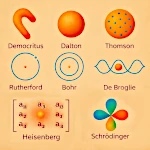 原子的各种形态:从古代直觉到量子力学