

氙(Xe,Z = 54):具有卓越特性的稀有惰性气体
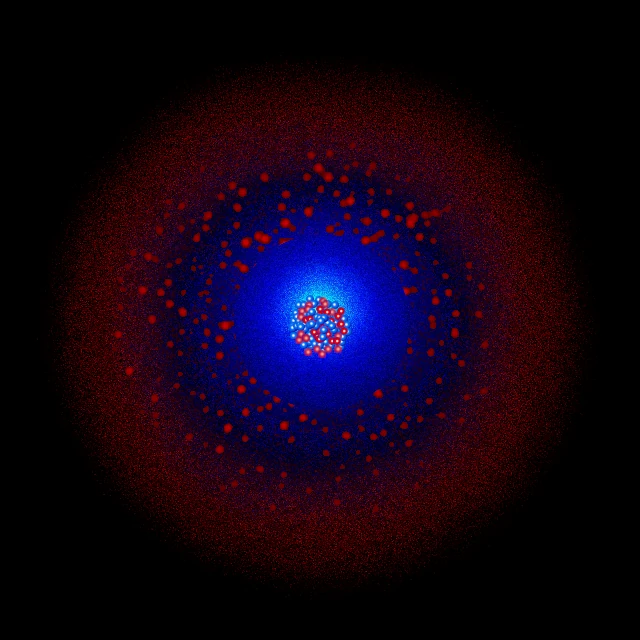
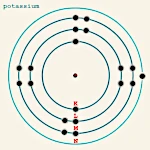
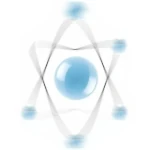
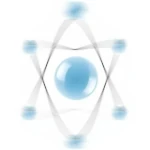
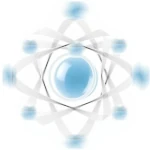
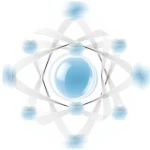
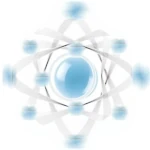
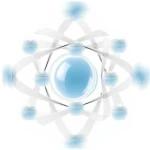
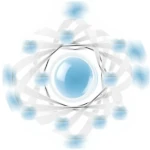
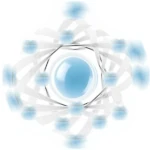
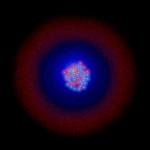
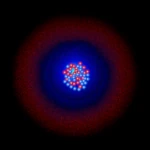
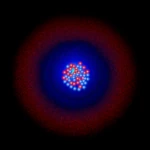
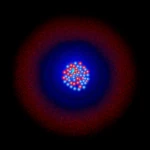
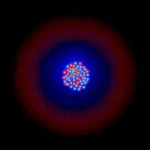
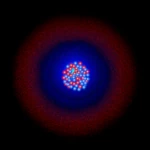
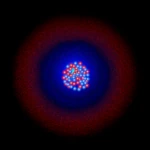
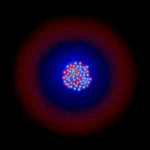
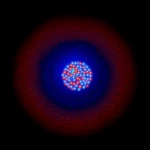
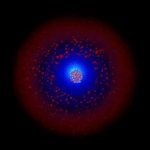
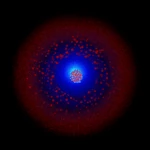
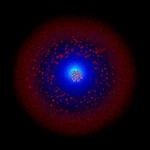
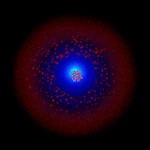
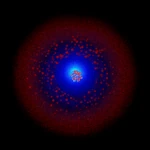
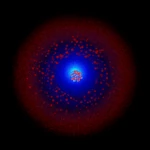
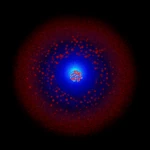
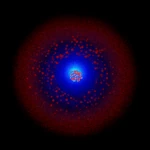
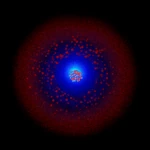
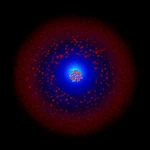
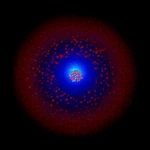
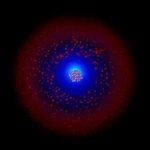
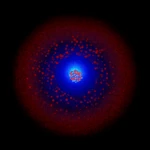
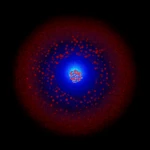
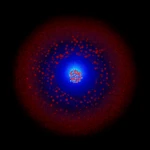
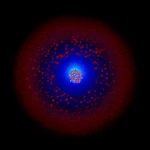
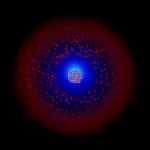
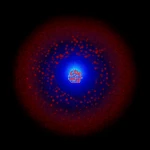
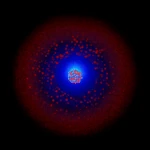
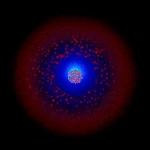
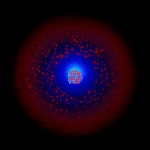
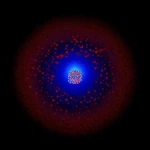
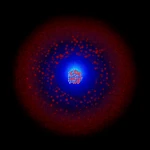
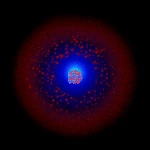
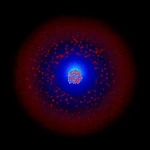
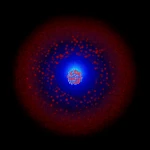
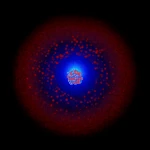
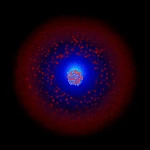
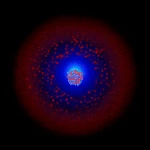
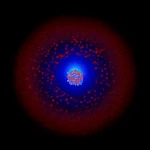
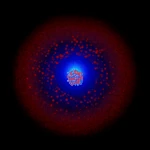
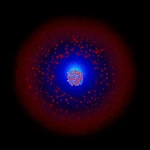
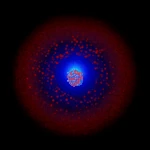
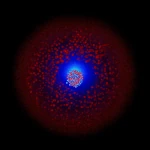
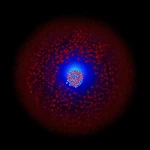
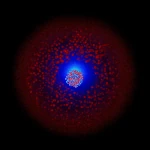
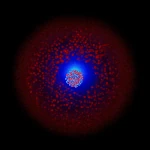
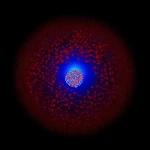
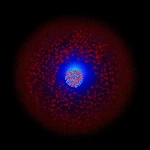
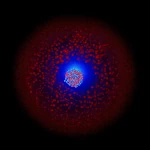
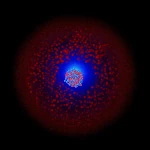
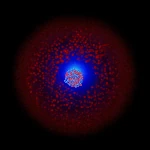
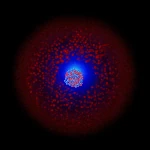
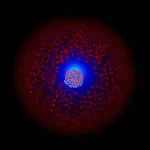
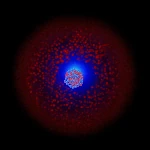
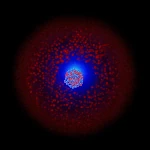
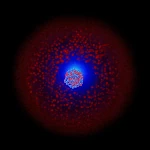
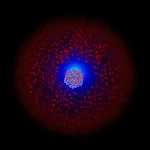
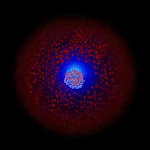
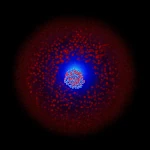
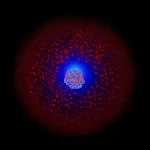
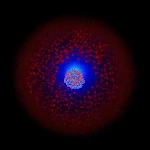
Simplified atomic model of the xenon atom with its fifty-four protons and fifty-four electrons.
The most abundant isotope is \(\,^{132}\mathrm{Xe}\,\) with 54 protons, 54 electrons, and 78 neutrons.
Image source: astronoo.com (新窗口)
从恒星到行星:星际介质中的氙
氙的宇宙丰度与起源
Xenon is a rare element in the universe, primarily produced by 恒星核合成 during the advanced stages of stellar evolution. Unlike light elements formed shortly after the Big Bang, xenon is created by neutron capture processes in massive stars and during cataclysmic events.
恒星作为氙工厂:s过程与r过程
Xenon is mainly produced by two nucleosynthesis processes: the 过程 (slow neutron capture) in asymptotic giant branch (AGB) stars and the r过程 (rapid neutron capture) during supernova explosions and neutron star mergers. These processes create the nine stable isotopes of xenon observed in nature. Stellar winds from AGB stars and supernova ejecta subsequently enrich the interstellar medium with xenon.
太阳系中的氙:缺失的氙异常
在太阳系中,氙气呈现出一种被称为“氙缺失异常”的有趣现象。与基于太阳和陨石丰度的预测相比,地球大气中的氙含量明显偏低。这一谜团表明,氙可能在地球形成早期被高压封存于深层地幔矿物中,或已逸散至太空。通过研究陨石、行星大气及岩石中捕获的惰性气体中氙的同位素比值,可为太阳系演化历史提供关键信息。
同位素:宇宙与核过程的示踪剂
氙的九种稳定同位素(\(\,^{124}\mathrm{Xe}\) 至 \(\,^{136}\mathrm{Xe}\))具有不同的丰度,反映了它们多样的核合成起源。 \(\,^{129}\mathrm{Xe}\) 尤为引人关注,因为它部分来源于已灭绝的 \(\,^{129}\mathrm{I}\)(半衰期1570万年)的放射性衰变,为太阳系形成提供了宝贵的时间约束。 \(\,^{136}\mathrm{Xe}\) 可发生双β衰变,这是一种极其罕见的核过程,是基础粒子物理学的研究对象。
在粒子物理学和暗物质探测中的作用
氙在现代基础物理研究中扮演着核心角色。安装在深层地下实验室、使用数吨超纯液态氙的探测器,被用于探测假设中的暗物质粒子(WIMP)并研究中微子特性。氙的卓越纯度、高密度以及闪烁特性,使其成为这些旨在揭示不可见宇宙奥秘的基础物理实验的理想候选材料。
氙气的发现历史
Xenon was discovered in 1898 by British chemists 威廉·拉姆齐 (1852-1916) and 莫里斯·特拉弗斯 (1872-1961) at University College London. This discovery followed those of krypton and neon as part of their systematic research on rare atmospheric gases. Ramsay and Travers isolated xenon by fractional distillation of liquid air, separating components based on their different boiling points. After evaporating krypton, they discovered an even heavier gaseous residue that emitted a bright blue light when electrically excited in a discharge tube.
The name 氙 comes from the Greek 异种 (ξένος), meaning "stranger" or "unknown," reflecting the discoverers' surprise at this unexpected gas. Ramsay received the Nobel Prize in Chemistry in 1904 for his discovery of noble gases (helium, neon, argon, krypton, xenon). For several decades, xenon was considered completely chemically inert. This certainty was shattered in 1962 when British chemist 尼尔·巴特利特 synthesized the first xenon compound, xenon hexafluoroplatinate, revolutionizing our understanding of noble gas reactivity and opening a new chapter in chemistry.
技术说明:氙气与现代照明
注意::
氙灯 have revolutionized automotive and cinematographic lighting since the 1990s.
Their bright white light, close to the solar spectrum, offers better night visibility and superior color rendering compared to traditional halogen lamps.
IMAX cinema projectors use very high-power xenon lamps to project onto giant screens with exceptional brightness.
However, the rarity of xenon (only 0.087 parts per million in air) makes it one of the most expensive gases in the world, with prices reaching several thousand euros per kilogram.
This rarity is driving the industry to develop alternative technologies such as LEDs while seeking to recycle xenon from used lamps to preserve this precious resource.
结构与基本性质
Xenon (symbol Xe, atomic number 54) is a noble gas in group 18 of the periodic table, consisting of fifty-four protons, usually seventy-eight neutrons (for the most common isotope), and fifty-four electrons.
It has nine natural stable isotopes: \(\,^{124}\mathrm{Xe}\) (0.095%), \(\,^{126}\mathrm{Xe}\) (0.089%), \(\,^{128}\mathrm{Xe}\) (1.910%), \(\,^{129}\mathrm{Xe}\) (26.401%), \(\,^{130}\mathrm{Xe}\) (4.071%), \(\,^{131}\mathrm{Xe}\) (21.232%), \(\,^{132}\mathrm{Xe}\) (26.909%), \(\,^{134}\mathrm{Xe}\) (10.436%), and \(\,^{136}\mathrm{Xe}\) (8.857%).
At room temperature, xenon is a monatomic, colorless, odorless, and generally chemically inert gas.
However, unlike lighter noble gases (helium, neon, argon, krypton), xenon can form chemical compounds under certain conditions, particularly with fluorine and oxygen.
Xenon is the densest natural noble gas, with an atmospheric concentration of about 0.087 parts per million by volume.
Xe gas has a density of about 5.894 g/L at standard temperature and pressure, making it approximately 4.5 times denser than air.
The temperature at which liquid and solid states can coexist (melting point): 161.40 K (-111.75 °C).
The temperature at which it transitions from liquid to gas (boiling point): 165.051 K (-108.099 °C).
氙同位素表
| 同位素 / 符号 | 质子(Z) | 中子(N) | 原子质量(u) | 天然丰度 | 半衰期/稳定性 | 衰变 / 备注 |
|---|---|---|---|---|---|---|
| 氙-124 — \(\,^{124}\mathrm{Xe}\,\) | 54 | 70 | 123.905893 u | 0.095% | 稳定(理论上具有放射性) | 最轻同位素;理论双电子捕获,半衰期 >10¹⁴ 年。 |
| 氙-126 — \(\,^{126}\mathrm{Xe}\,\) | 54 | 72 | 125.904274 u | 0.089% | 稳定 | 恒星核合成s过程产生的稀有同位素。 |
| 氙-128 — \(\,^{128}\mathrm{Xe}\,\) | 54 | 74 | 127.903531 u | 1.910% | 稳定的 | 主要由AGB星体中的s过程产生。 |
| 氙-129 — \(\,^{129}\mathrm{Xe}\,\) | 54 | 75 | 128.904779 u | 26.401% | 稳定的 | 非常丰富的同位素;部分由已灭绝的\(\,^{129}\mathrm{I}\)衰变产生;在地质年代学和宇宙化学中作为重要示踪剂。 |
| 氙-130 — \(\,^{130}\mathrm{Xe}\,\) | 54 | 76 | 129.903508 u | ˜ 4.071% | 稳定的 | 用于暗物质和中微子探测器。 |
| 氙-131 — \(\,^{131}\mathrm{Xe}\,\) | 54 | 77 | 130.905082 u | 21.232% | 稳定的 | 第二丰富的同位素;用于超极化氙磁共振成像进行肺部成像。 |
| 氙-132 — \(\,^{132}\mathrm{Xe}\,\) | 54 | 78 | 131.904153 u | 26.909% | 稳定的 | 最常见的同位素;核反应堆中常见的裂变产物。 |
| 氙-133 — \(\,^{133}\mathrm{Xe}\,\) | 54 | 79 | 132.905910 u | 非自然的 | 5.243天 | 放射性β⁻衰变生成\(^{133}\mathrm{Cs}\);用于医学肺部成像及探测秘密核试验。 |
| 氙-134 — \(\,^{134}\mathrm{Xe}\,\) | 54 | 80 | 133.905394 u | ˜ 10.436% | 稳定的 | 中子捕获s过程产生的大量同位素。 |
| 氙-135 — \(\,^{135}\mathrm{Xe}\,\) | 54 | 81 | 134.907227 u | 非自然的 | 9.14小时 | 放射性β⁻;重要裂变产物;强中子吸收剂(反应堆中的“中子毒物”)。 |
| 氙-136 — \(\,^{136}\mathrm{Xe}\,\) | 54 | 82 | 135.907219 u | 8.857% | 稳定(理论上具有放射性) | 可发生双β衰变(测量半衰期 >10²¹ 年);用于中微子物理研究。 |
| 其他同位素——\(^{110}\mathrm{Xe}-^{123}\mathrm{Xe}\)、\(^{125}\mathrm{Xe}\)、\(^{127}\mathrm{Xe}\)、\(^{137}\mathrm{Xe}-^{147}\mathrm{Xe}\) | 54 | 56-69, 71, 73, 83-93 | — | 非自然的 | 毫秒——数天 | 人工生产的放射性同位素;用于核研究、医学以及核试验探测。 |
电子构型与电子层
注意::
Electron shells: 电子如何在原子核周围排列 (新窗口).
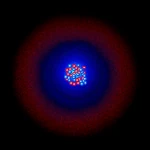
氙有54个电子,分布在五个电子层中。其完整电子排布为:1s² 2s² 2p⁶ 3s² 3p⁶ 3d¹⁰ 4s² 4p⁶ 4d¹⁰ 5s² 5p⁶, 或简写为:[Kr] 4d¹⁰ 5s² 5p⁶。该排布也可写作:K(2) L(8) M(18) N(18) O(8)。
壳的详细结构
K壳层(n=1): contains 2 electrons in the 1s subshell. This inner shell is complete and very stable.
L壳层(n=2): contains 8 electrons distributed as 2s² 2p⁶, forming a complete and stable shell.
M层(n=3): contains 18 electrons distributed as 3s² 3p⁶ 3d¹⁰, forming a complete shell.
N壳层(n=4): contains 18 electrons distributed as 4s² 4p⁶ 4d¹⁰, forming a complete shell.
O壳层(n=5): contains 8 electrons distributed as 5s² 5p⁶. This outer shell is complete with 8 valence electrons (octet configuration), giving xenon the characteristic stability of noble gases.
氙气的性质与重要性
氙,作为第18族(稀有气体)元素,拥有8个价电子(5s² 5p⁶),形成稳定的八电子构型。这种构型传统上解释了稀有气体的化学惰性。然而,氙作为最重的天然稀有气体,其外层电子因距离原子核较远(原子半径大)而结合力较弱,因此能够形成化合物——这与氦、氖、氩等较轻的稀有气体不同。氙的高极化性使其易于与氟、氧等强电负性元素发生相互作用。
氙在地球大气中极为稀有(0.087 ppm),却拥有卓越且多样化的应用。其用于汽车高强度照明和电影放映机的氙灯,凭借能产生接近太阳光谱的强光而发挥作用。在医学领域,它作为具有神经保护特性的全身麻醉剂使用。太空探索中,氙是卫星和探测器离子引擎的首选推进剂。基础物理方面,超纯液态氙探测器被用于搜寻暗物质和研究中微子。自1962年以来,氙能形成化合物(氟化物、氧化物)的独特能力彻底革新了稀有气体化学。
化学反应活性
从惰性到反应性:稀有气体化学的革命
Xenon has eight valence electrons (5s² 5p⁶) forming a complete outer shell (octet). This stable configuration explains its chemical inertness under normal conditions. For more than sixty years after its discovery, xenon was considered totally inert, incapable of forming chemical bonds. This belief was spectacularly refuted in 1962 when Neil Bartlett synthesized the first xenon compound, xenon hexafluoroplatinate (Xe[PtF₆]), demonstrating that noble gases could react. Unlike lighter noble gases, xenon has relatively accessible valence electrons due to their distance from the nucleus, the shielding effect of many inner electron shells, and its high polarizability.
氙化合物:氟化物、氧化物及奇异化合物
氙主要与氟(电负性最强的元素)和氧形成化合物。氙的氟化物包括XeF₂(二氟化氙)、XeF₄(四氟化氙)和XeF₆(六氟化氙),其中氙的氧化态分别为+2、+4和+6。这些化合物是强氧化剂和氟化剂,用于化学合成。氙还能形成氧化物如XeO₃(三氧化氙)和XeO₄(四氧化氙),以及氟氧化物(XeOF₂、XeOF₄、XeO₂F₂)和高氙酸(H₄XeO₆),尽管这些化合物热力学不稳定且具有潜在爆炸性。在特殊条件(低温、惰性基质)下,科学家已合成出氙的有机金属化合物、配位络合物,甚至氙-氮、氙-碳和氙-金键,不断拓展着氙化学这一迷人领域。
惰性气体的物理性质及应用
尽管氙具有令人惊讶的成键能力,但在常温常压条件下它仍保持化学惰性,这种稳定性使其在众多技术应用中具有重要价值。其高密度(约为空气的5.9倍)、低导热性和惰性使其成为高性能隔热窗和白炽灯泡的理想填充气体。在电场中电离的氙能产生接近太阳光谱的强光,被用于汽车照明(氙气大灯)、IMAX影院放映机、专业摄影闪光系统及建筑投影仪等高强度放电灯中。
氙气的工业与技术应用
- 在用于高强度汽车照明(氙气大灯)的氙气灯中,提供接近日光的明亮光线。
- 作为医学中的全身麻醉剂,具有独特的神经保护特性和快速恢复能力;
- 在IMAX影院放映机及巨幕高功率投影系统中;
- 用于卫星和空间探测器的离子推进(使用氙作为推进剂的霍尔效应推进器);
- 在粒子物理学的暗物质和中微子探测器中(超纯液氙探测器);
- 作为高性能隔热窗和中空玻璃的填充气体;
- 在专业摄影的高强度摄影闪光灯管和频闪灯中;
- 用于肺部MRI的超极化氙-129在诊断医学成像中的应用;
- 在准分子激光器(XeCl、XeF)中用于屈光性眼科手术(LASIK)和半导体光刻。
- 作为地质学和地球物理学中的示踪剂,用于研究陆地和火山脱气过程;
- 在医用杀菌灯和紫外线灭菌系统中;
- 通过大气中放射性氙同位素的分析来探测秘密核试验;
- 作为X射线管和粒子物理中火花室的填充气体;
- 在某些专业科学应用的低温冷却系统中;
- 用于有机和无机精细化学中强效氟化化合物的合成;
- 在医学超声造影剂(含氙微泡)中;
- 作为实验原子钟和时间计量中的原子频率标准;
- 用于生物医学研究中的同位素标记、环境研究以及水文示踪;
- 在等离子显示器及用于显示的发光放电阴极射线管中;
- 作为一种在实验神经学中对抗缺血性脑损伤的神经保护剂。
 核聚变所需的能量以及为什么铀是一个极限
 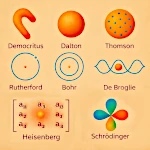 原子的各种形态:从古代直觉到量子力学