

氮(N,Z=7):地球生命无形的支柱

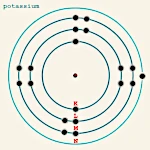
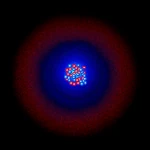
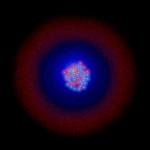
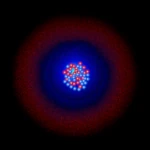
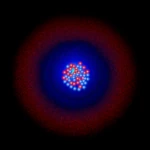
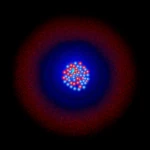
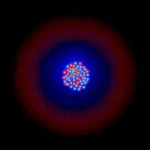
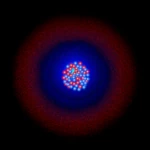
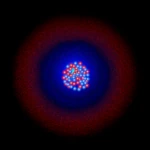
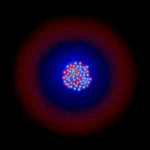
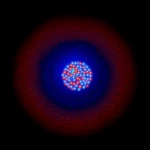
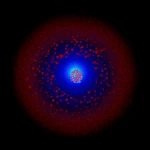
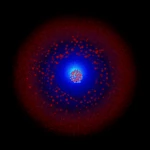
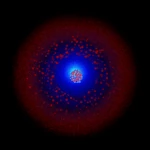
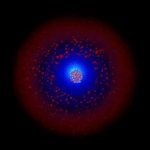
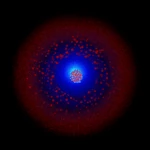
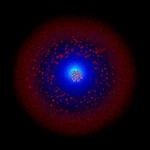
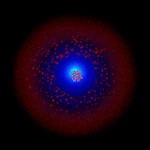
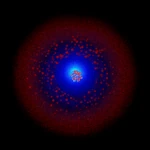
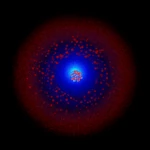
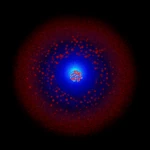
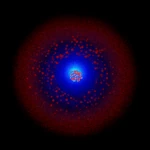
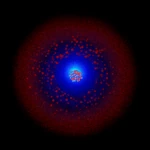
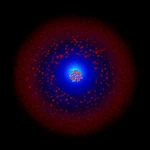
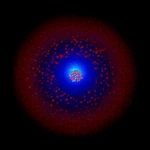
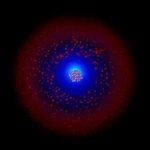
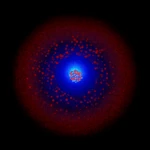
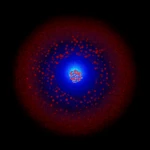
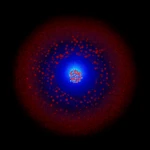
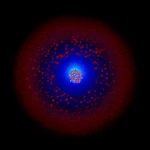
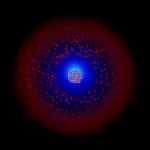
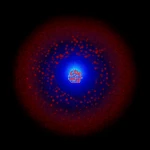
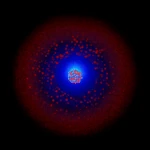
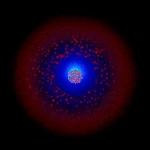
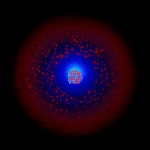
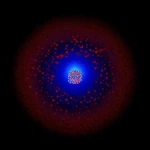
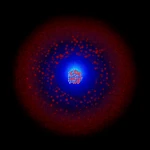
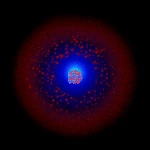
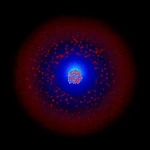
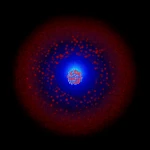
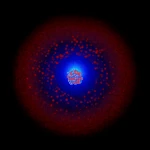
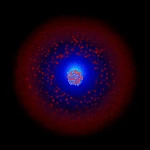
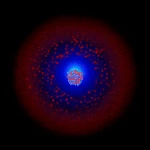
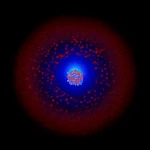
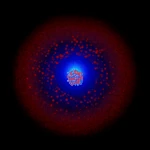
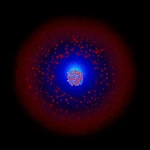
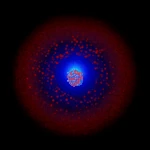
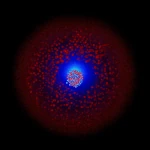
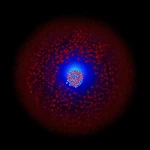
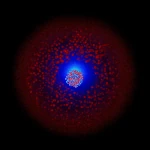
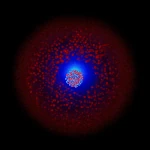
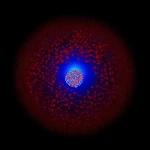
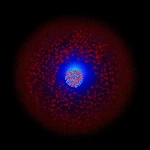
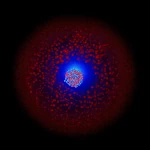
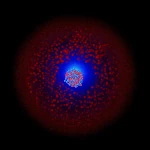
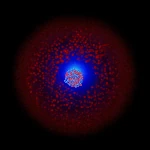
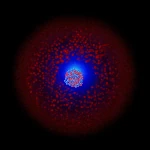
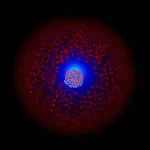
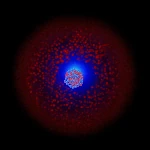
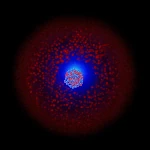
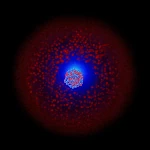
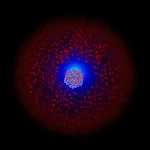
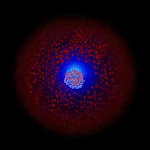
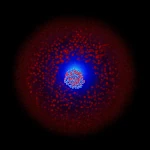
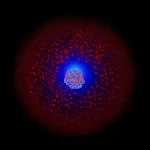
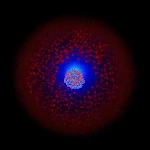
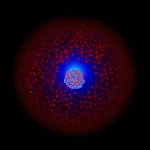
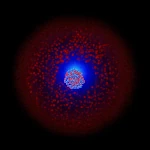
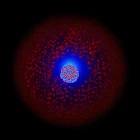
Simplified atomic model of the nitrogen atom with its seven protons and seven electrons.
The most abundant isotope is \(\,^{14}\mathrm{N}\,\) with 7 protons, 7 electrons, and 7 neutrons.
Image source: astronoo.com (新窗口)
从恒星到行星:星际介质中的氮循环
宇宙中氮的丰度与起源
Nitrogen is the fifth most abundant element in the observable universe (after hydrogen, helium, oxygen, and carbon) and plays a crucial role in the chemical evolution of galaxies. Unlike primordial elements, nitrogen is entirely produced by 恒星核合成.
恒星作为氮工厂:CNO循环
The main pathway for nitrogen production in stars is the CNO循环 (carbon-nitrogen-oxygen), where nitrogen appears as a catalytic intermediate in the fusion of hydrogen into helium. In massive stars, this cycle dominates energy production. Nitrogen-14 is mainly produced in intermediate-mass stars (2-8 solar masses) during the AGB phase (asymptotic giant branch), where it is synthesized from carbon via the CN cycle. These stars then enrich the interstellar medium with nitrogen through their powerful stellar winds.
星际介质中的氮化学
在星际介质中,氮以多种形式存在:原子态(N、N⁺)、分子态(N₂、CN、HCN、NH₃及许多其他复杂含氮分子)。含氮分子是恒星形成的稠密分子云中物理和化学条件的重要示踪物。由于缺乏永久偶极矩,双氮分子(N₂)在太空中难以直接探测,但其丰度可通过其他含氮物种间接推断。
同位素:银河历史的档案
同位素比值¹⁴N/¹⁵N在宇宙中变化显著,为研究恒星中的核合成与混合过程提供了宝贵信息。该比值在陨石、彗星、行星大气及星际介质中的测量结果,揭示了银河系物质循环的复杂历史。太阳系的¹⁴N/¹⁵N比值约为272,但根据观测源和天体的不同,该比值可能发生显著变化。
行星与天体生物学作用
在行星大气中,氮起着重要作用。在地球上,氮占大气成分的78%,对生命至关重要。在土卫六(土星的卫星)上,大气中98%是氮。研究太阳系不同天体以及潜在宜居系外行星上的大气氮及其化学循环,对于理解行星演化和寻找地外生命至关重要。
氮气的发现历史
Nitrogen was independently discovered by several chemists in the late 18th century. In 1772, Scottish physician and chemist 丹尼尔·卢瑟福 (1749-1819) isolated this gas by removing oxygen and carbon dioxide from the air, leaving a gaseous residue he called "vitiated air" or "phlogisticated air." Around the same time, 卡尔·威廉·舍勒 (1742-1786) in Sweden, 亨利·卡文迪许 (1731-1810) in England, and 约瑟夫·普里斯特利 (1733-1804) conducted similar experiments. In 1790, French chemist 让-安托万·沙普塔尔 (1756-1832) proposed the name 氮 (from Greek a = without and zoe = life), emphasizing that this gas could not support life or combustion. The English name "nitrogen" (niter generator) was introduced in 1790 by Chaptal, referring to saltpeter (potassium nitrate).
历史与环境注记:哈伯-博世工艺的遗产
注::
The 哈伯-博世法 (early 20th century) enables the industrial fixation of atmospheric nitrogen into ammonia. It has allowed the mass production of fertilizers, supporting global food security—more than half of the nitrogen in our proteins comes from it.
However, this artificial fixation (∼150 Mt/year) now exceeds natural fixation, causing water pollution (nitrates), N₂O emissions (greenhouse gas), and a major disruption of the natural nitrogen cycle.
The current challenge is to reconcile food production with the restoration of a sustainable nitrogen cycle.
结构与基本性质
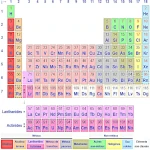
Nitrogen (symbol N, atomic number 7) is a non-metal of group 15 (pnictogens) of the periodic table, consisting of seven protons, usually seven neutrons (for the most common isotope), and seven electrons.
The two stable isotopes are nitrogen-14 \(\,^{14}\mathrm{N}\) (≈ 99.636%) and nitrogen-15 \(\,^{15}\mathrm{N}\) (≈ 0.364%).
At room temperature, nitrogen exists as a diatomic gas (N₂), colorless, odorless, and relatively chemically inert.
The N₂ molecule has a very strong triple bond (N≡N), making it particularly stable and unreactive under normal conditions.
This stability explains why nitrogen gas makes up about 78% of Earth's atmosphere by volume.
N₂ gas has a density of about 1.251 g/L at standard temperature and pressure.
The temperature at which liquid and solid states can coexist (melting point): 63.15 K (−210.00 °C).
The temperature at which it transitions from liquid to gas (boiling point): 77.355 K (−195.795 °C).
氮同位素表
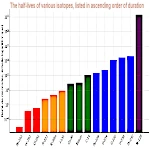
| 同位素 / 符号 | 质子(Z) | 中子(N) | 原子质量(u) | 天然丰度 | 半衰期 / 稳定性 | 衰变 / 备注 |
|---|---|---|---|---|---|---|
| 氮-13 — \(\,^{13}\mathrm{N}\,\) | 7 | 6 | 13.005739 u | 非自然的 | 9.965分钟 | 放射性β⁺衰变至¹³C;用于正电子发射断层扫描(PET)。 |
| 氮-14 — \(\,^{14}\mathrm{N}\,\) | 7 | 7 | 14.003074 u | ≈ 99.636% | 稳定的 | 主要同位素;地球上所有蛋白质和核酸的基础。 |
| 氮-15 — \(\,^{15}\mathrm{N}\,\) | 7 | 8 | 15.000109 u | ≈ 0.364% | 稳定 | 用于核磁共振波谱分析、生物学中的示踪剂,以及研究氮循环。 |
| 氮-16 — \(\,^{16}\mathrm{N}\,\) | 7 | 9 | 16.006102 u | 非自然的 | 7.13秒 | 放射性β⁻衰变至\(\,^{16}\mathrm{O}\);在核反应堆中产生。 |
| 氮-17 — \(\,^{17}\mathrm{N}\,\) | 7 | 10 | 17.008450 u | 非自然的 | 4.173秒 | 放射性β⁻;用于核研究。 |
| 其他同位素——\(\,^{10}\mathrm{N}-\,^{12}\mathrm{N},\,^{18}\mathrm{N}-\,^{25}\mathrm{N}\) | 7 | 3-5, 11-18 | — (共鸣) | 非自然的 | \(10^{-22}\) — 0.63秒 | 核物理中观察到极不稳定的状态;通过粒子发射或β放射性衰变。 |
电子排布与电子壳层
注意::
Electron shells: 电子如何围绕原子核排列 (新窗口).
氮元素拥有7个电子,分布在两个电子壳层中。其完整电子排布式为:1s² 2s² 2p³,简写为:[He] 2s² 2p³。该排布也可写作:K(2) L(5)。
壳体的详细结构
K层(n=1): contains 2 electrons in the 1s subshell. This inner shell is complete and very stable.
L壳层(n=2): contains 5 electrons distributed as 2s² 2p³. The 2s orbitals are complete, while the 2p orbitals contain only 3 electrons out of 6 possible, with one electron in each of the three 2p orbitals according to Hund's rule. Thus, 3 electrons are missing to reach the stable neon configuration with 8 electrons (octet).
氮的性质与重要性
氮元素属于第15族(氮族元素),具有5个价电子(2s² 2p³)。这一电子排布解释了其多样性:它能形成三个共价键(如NH₃中呈-3价),但也能达到最高+5的正氧化态(如HNO₃)。N₂分子凭借其异常稳定的三键,对应0价态。
二氮(N₂)占地球大气的78%。其在室温下的惰性使其适用于惰性气氛。然而,一旦被活化,氮就成为生命(蛋白质、DNA)、农业(通过哈伯-博世法生产肥料)和工业(炸药、硝酸)的关键元素。其液化还可用于低温应用。
化学反应活性
价电子与特征键
氮具有五个价电子,通常形成三个共价键(在氨NH₃中氧化态为−3),或可失去电子达到从−3到+5的多种氧化态。双原子N₂分子中的三键N≡N是已知最强的化学键之一(解离能≈945 kJ/mol),这使得氮分子在室温下极不活泼。这种惰性在工业上被用于制造保护性惰性气氛。
氮化合物的活化与多样性
然而,一旦三键断裂(需要高温、高压或催化剂),氮就会变得非常活泼。它能与几乎所有元素形成化合物,尤其是氢(氨NH₃、联氨N₂H₄)、氧(氮氧化物:NO、NO₂、N₂O、N₂O₃、N₂O₅)、卤素(三卤化氮)以及多种金属(氮化物)。氮化合物展现出极为多样的性质,从必需的肥料(硝酸盐、氨)到强力炸药(TNT、硝化甘油),乃至构成生命的蛋白质和核酸。
陆地氮生物地球化学循环
The 氮循环 is one of the most important biogeochemical cycles on Earth. Although N₂ is abundant in the atmosphere, most organisms cannot use it directly. Biological nitrogen fixation by certain bacteria (symbiotic or free-living) converts N₂ into ammonia, which can then be assimilated by plants. Other bacteria carry out nitrification (conversion to nitrites then nitrates) and denitrification (return of nitrogen to the atmosphere). Humanity has profoundly disrupted this natural cycle with the massive industrial production of nitrogen fertilizers (Haber-Bosch process).
氮气的工业和技术应用
- 创造惰性气氛以保护食品免受氧化并延长其保质期;
- 作为低温制冷剂(液氮),用于保存生物样本、细胞和胚胎;
- 在电子工业中,用于保护敏感元件在制造过程中免受氧化。
- 通过哈伯-博世法生产氨(NH₃),这是氮肥生产的基础;
- 在硝酸(HNO₃)的生产中,用于制造肥料和炸药;
- 作为防火和灭火系统中的惰性气体;
- 对于渗氮钢,提高其硬度和耐磨性;
- 在石油工业中用于加压井口并提高采收率;
- 作为饮料分配系统(生啤酒)中的推进剂;
- 用于给飞机和赛车轮胎充气(比空气稳定性更好);
- 在集成电路和电子芯片的制造过程中(受控气氛);
- 作为研究用脉冲氮激光器中的氮源;
- 用于食品速冻和医疗冷冻手术;
- 在炸药(TNT、硝化甘油)和发射药的生产中;
- 作为蛋白质、核酸及其他重要生物分子的关键组成部分;
- 通过向油藏注入氮气提高原油采收率;
- 在汽车安全气囊中(展开时快速产生氮气);
- 作为金属焊接和钎焊过程中的保护气氛;
- 在分析化学中,作为色谱法和质谱法的载气。
 核聚变所需的能量以及为什么铀是一个极限
 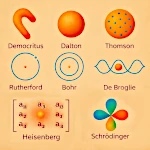 原子的各种形态:从古代直觉到量子力学