

铱(Ir,Z = 77):天体灾变的见证者
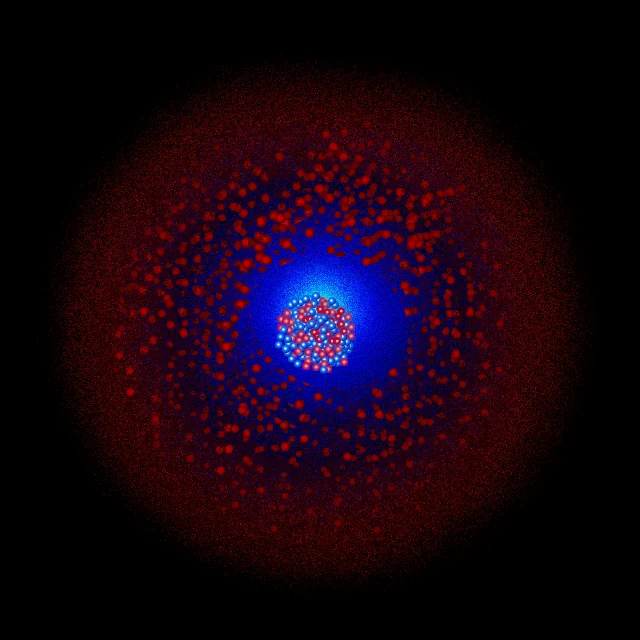
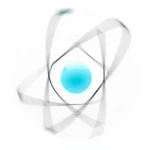
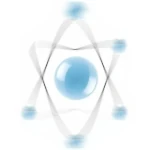
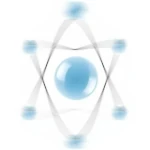
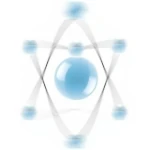
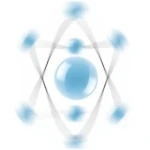
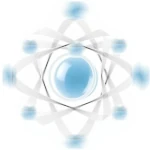
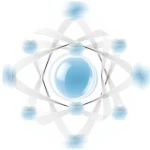
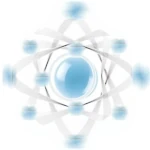
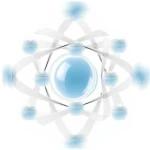
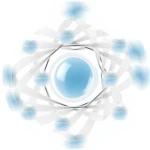
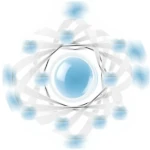
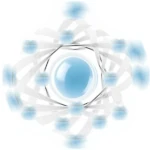
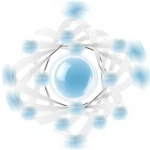
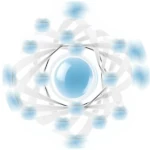
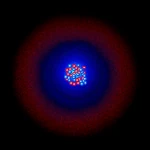
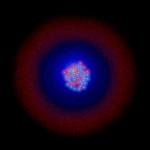
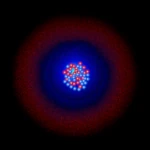
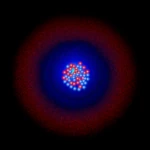
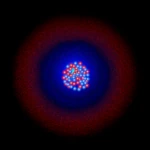
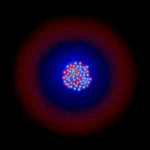
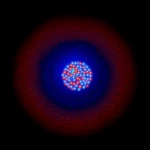
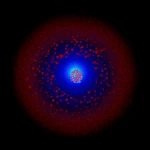
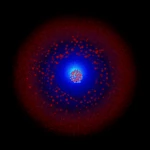
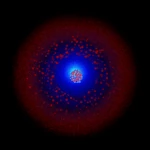
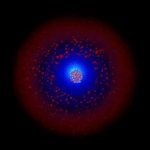
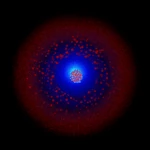
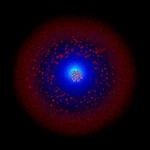
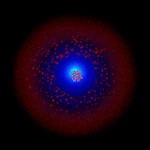
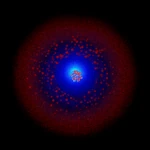
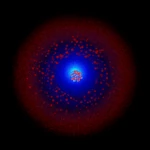
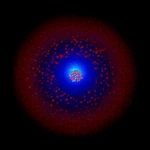
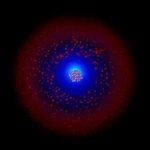
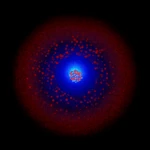
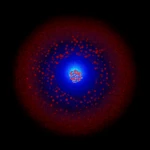
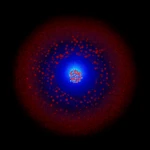
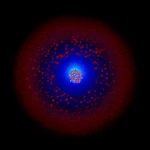
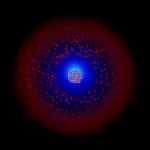
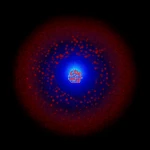
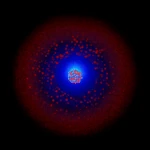
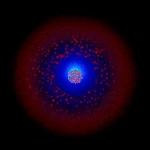
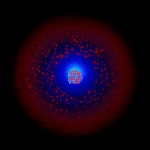
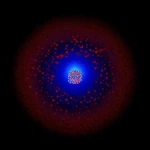
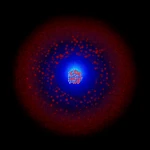
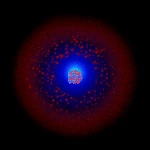
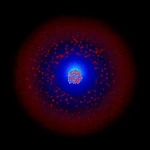
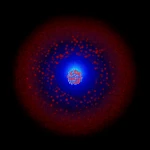
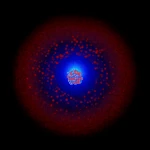
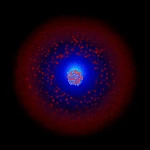
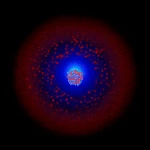
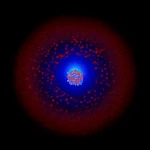
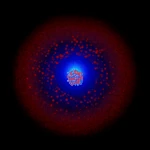
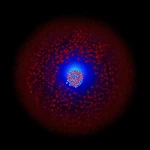
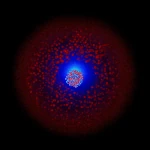
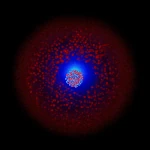
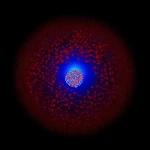
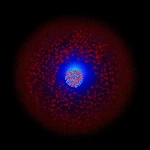
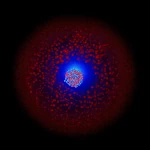
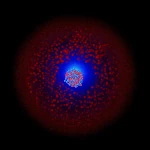
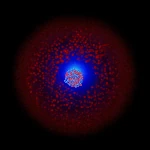
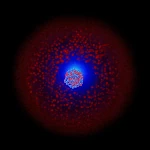
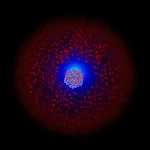
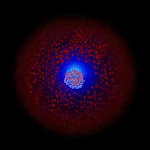
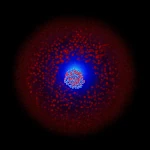
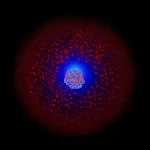
Image description:
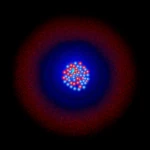
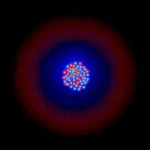
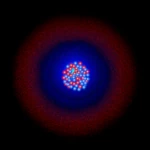
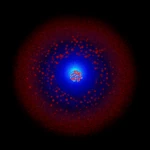
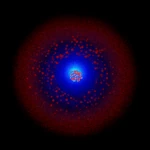
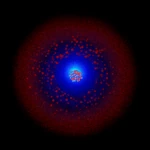
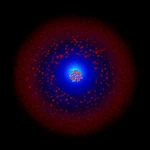
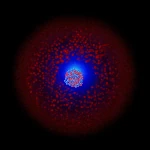
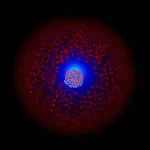
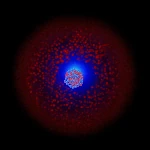
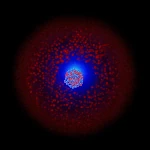
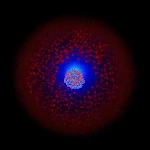
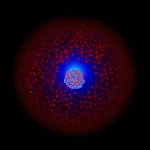
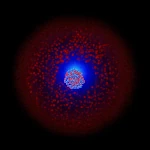
Simplified atomic model of the iridium atom. The main stable isotope is \(^{193}\mathrm{Ir}\)
with its 77 protons, 77 electrons, and 116 neutrons. Background evoking the iridium-rich clay layer at the Cretaceous-Paleogene boundary.
Image source: astronoo.com (新窗口)
铱在天体物理学和地质学中的作用
恒星合成与宇宙化学
Iridium is a heavy element synthesized almost exclusively by the r过程 (rapid neutron capture) during cataclysmic events such as type II supernovae or neutron star mergers. As a siderophile element (affinity for iron), it was largely drained into the iron core during Earth's planetary differentiation, explaining its extreme rarity in the Earth's crust. Its abundance in certain primitive chondritic meteorites is much higher, making it an ideal tracer of extraterrestrial matter.
铱层与撞击假说
The 1980 discovery by Luis and Walter Alvarez of an 异常富铱的粘土层 at the Cretaceous-Paleogene (K-Pg) boundary (66 million years ago) worldwide revolutionized geology. This anomaly, up to 100 times the normal crustal content, could not be explained by terrestrial processes. It provided the first solid evidence for the hypothesis that the extinction of the dinosaurs (and 75% of species) was caused by the impact of a 直径10公里的小行星. The corresponding crater was later identified at 希克苏鲁伯, Mexico.
一个普遍的地质标志
Since this discovery, iridium anomalies have been systematically sought in geological strata as 主要陨石撞击的标志. They have helped identify other extinction or biotic disruption events, such as at the Triassic-Jurassic boundary. Iridium has thus become a key element in linking Earth's history to astronomical phenomena.
同位素特性与示踪
铱有两种天然稳定同位素,\(^{191}\mathrm{Ir}\) 和 \(^{193}\mathrm{Ir}\)。铱的同位素比值,结合其他亲铁元素(如锇、铂或钌)的同位素比值,可用于区分地外物质的来源(例如,区分球粒陨石与分异陨石),并更深入地理解行星吸积过程。
铱的发现历史
名称的词源与起源
Iridium takes its name from the Greek goddess of the rainbow, 鸢尾花 (Ἶρις). This name was chosen by its discoverer Smithson Tennant in 1803 because of the 丰富多彩的鲜艳色彩 exhibited by its salts in solution. Unlike osmium, discovered simultaneously and named for its odor, iridium was thus celebrated for its chromatic beauty.
史密森·坦南特的发现
Like osmium, iridium was discovered in 1803 by the English chemist 史密森·坦南特. While studying the black insoluble residue obtained after dissolving native platinum in aqua regia, he managed to separate two new elements. One produced a volatile oxide with a strong odor (osmium), the other yielded salts with remarkable colors. He named the latter iridium. Its difficulty to melt and work earned it the nickname "recalcitrant metal".
首次应用与纯化
The first production of relatively pure iridium metal is attributed to Tennant as early as 1804, but it was not until 1842 that the French chemist 亨利·圣克莱尔·德维尔 succeeded in obtaining significant quantities and studying its properties. Its very high melting point and extreme hardness made industrial processing very difficult until the advent of electric arc furnaces and powder metallurgy techniques in the 20th century.
陆地存在与生产
Iridium is one of the rarest elements in the Earth's crust, with an estimated abundance of only 0.001 ppb (parts per billion), about 40 times rarer than gold. This rarity is explained by its siderophile nature. Like other platinum group metals, there are no primary iridium deposits. It is always recovered as a by-product of nickel and copper refining (sulfide deposits such as Norilsk) or, mainly, from platinum ore processing (Bushveld deposit in South Africa, which supplies the vast majority of the world's iridium).
Global annual production is very low, on the order of 几吨. The main producers are 南非, 俄罗斯, 加拿大, and 津巴布韦. Its price is extremely high and volatile, often higher than that of gold, reflecting its rarity, the complexity of its extraction, and niche demand in high technology.
铱的结构与基本性质
分类与原子结构
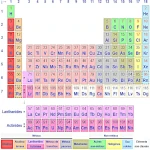
铱(符号Ir,原子序数77)是第六周期的过渡金属,位于元素周期表第9族(原第VIII族),与钴、铑和鿏同族。它属于铂族金属(铂、钯、铑、钌、锇、铱)。其原子含有77个质子,通常有115或116个中子(对应同位素\(^{193}\mathrm{Ir}\)和\(^{191}\mathrm{Ir}\)),以及77个电子,电子排布为[Xe] 4f¹⁴ 5d⁷ 6s²。该排布在5d亚层中有七个电子。
记录物理属性
铱是一种银白色、有光泽、密度极高、极硬且脆的金属。它与锇共享最密集元素的称号。
- 极端密度: 22.56 g/cm³ at 20 °C (almost identical to osmium, the difference is at the limit of measurement precision).
- 高硬度: 6.5 on the Mohs scale (pure), retains its hardness at high temperature.
- 非常高的弹性模量: About 528 GPa, the second highest after osmium.
- 熔点非常高: 2466 °C (one of the highest).
- 耐腐蚀性: Exceptional, the most corrosion-resistant metal.
铱在室温下具有面心立方(FCC)晶体结构。
非凡的转变点
Iridium melts at 2466 °C (2739 K) and boils at 4428 °C (4701 K). It maintains excellent mechanical and chemical stability at extreme temperatures, making it a material of choice for the most severe applications.
化学反应活性(或惰性)
Iridium is the 最耐腐蚀的金属. It is unattacked by all acids, including aqua regia, at room temperature. It can be slowly attacked by aqua regia at high temperature and pressure. It also resists molten alkalis. Its main chemical weakness is some surface oxidation above 600°C to form IrO₂, which is however stable and protective. This legendary inertness makes it the ideal candidate for standards and applications where purity must be preserved indefinitely.
物理特性记录摘要
Density: 22.56 g/cm³ - among the highest (with osmium).
Melting point: 2739 K (2466 °C) - extremely high.
Boiling point: 4701 K (4428 °C).
Crystal structure: Face-centered cubic (FCC).
Modulus of elasticity: ~528 GPa - extremely rigid.
Hardness: 6.5 on the Mohs scale.
Corrosion resistance: The highest of all metals.
铱同位素表
| 同位素 / 符号 | 质子(Z) | 中子(N) | 原子质量(u) | 天然丰度 | 半衰期/稳定性 | 衰变/备注 |
|---|---|---|---|---|---|---|
| 铱-191 — \(^{191}\mathrm{Ir}\) | 77 | 114 | 190.960594 u | ≈ 37.3% | 稳定的 | 稳定同位素。用于通过中子活化生产医用同位素\(^{192}\mathrm{Ir}\)。 |
| 铱-193 — \(^{193}\mathrm{Ir}\) | 77 | 116 | 192.962926 u | ≈ 62.7% | 稳定的 | 主要稳定同位素。测量参考同位素。 |
| 铱-192 — \(^{192}\mathrm{Ir}\)(人工) | 77 | 115 | 191.962605 u | 痕迹(放射成因) | 73.827天 | Radioactive β⁻ and CE. Important isotope for 放射治疗 (brachytherapy) and 工业伽马射线照相术 (non-destructive testing). Produced by neutron irradiation of \(^{191}\mathrm{Ir}\). |
铱的电子排布与电子层
注::
Electron shells:
电子如何围绕原子核组织 (新窗口).
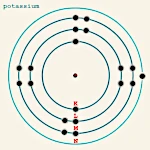
铱有77个电子,分布在六个电子壳层中。其电子构型为[Xe] 4f¹⁴ 5d⁷ 6s²,其中4f亚层完全填满(14个电子),5d亚层有7个电子。这也可写作:K(2) L(8) M(18) N(32) O(15) P(2),或完整表示为:1s² 2s² 2p⁶ 3s² 3p⁶ 3d¹⁰ 4s² 4p⁶ 4d¹⁰ 4f¹⁴ 5s² 5p⁶ 5d⁷ 6s²。
壳的详细结构
K壳层(n=1): 2 electrons (1s²).
L壳层(n=2): 8 electrons (2s² 2p⁶).
M层(n=3): 18 electrons (3s² 3p⁶ 3d¹⁰).
N层(n=4): 32 electrons (4s² 4p⁶ 4d¹⁰ 4f¹⁴).
O壳层(n=5): 15 electrons (5s² 5p⁶ 5d⁷).
P壳层 (n=6): 2 electrons (6s²).
价电子与氧化态
Iridium has 9 价电子: two 6s² electrons and seven 5d⁷ electrons. Iridium exhibits a wide range of oxidation states, from -3 to +9, with the +3 and +4 states being the most common and stable.
The +3 state is very stable and is found in many complexes (e.g., \(\mathrm{IrCl_6^{3-}}\)). The +4 state is also common (e.g., \(\mathrm{IrO_2}\), \(\mathrm{IrF_6^{2-}}\)). Remarkably, iridium can reach very high oxidation states, up to +9 in the \(\mathrm{IrO_4^+}\) cation in the gas phase, which is the absolute record for any element. This richness in oxidation states, coupled with the great inertness of the base metal, makes it a fascinating element for coordination chemistry and catalysis (notably hydrosilylation catalysts and certain organometallic catalysts).
铱的化学反应活性
与空气和氧气的反应
At room temperature, iridium is perfectly stable in air. It only begins to oxidize significantly above 600 °C, forming a layer of iridium dioxide (IrO₂) that is stable and adherent, offering some protection. Above 1100 °C, this oxide layer volatilizes. Unlike osmium, it does not form a volatile toxic oxide such as OsO₄.
与水及酸的反应
Iridium is famous for its 对酸免疫:
- 所有简单的酸 (HCl, H₂SO₄, HNO₃, HF): No attack, even concentrated and hot.
- 王水: Resistant at room temperature. Attacked very slowly at high temperature and pressure.
- 漂白剂,过氧化氢: Resistant.
- 熔融碱: Resistant in the absence of oxidants. Can be attacked in the presence of oxidants such as nitrate or peroxide.
这种耐腐蚀性使其成为处理超强腐蚀性物质的实验室坩埚的理想材料。
注意::
与卤素及其他元素的反应
铱在高温下直接与卤素反应。与氟反应生成IrF₆(六氟化物,黄色固体)和IrF₄。与氯反应生成IrCl₃(三氯化物,棕红色固体)和IrCl₄。它还能同时与氧和氯反应生成氯氧化物。在高温下,铱与硫、硒、碲、磷、砷、硅和硼形成化合物。
二氧化铱(IrO₂)
最重要的氧化合物是二氧化铱IrO₂。
- 属性: Black solid, electrically conductive, very chemically stable.
- 应用: Unattackable anodic electrodes for industrial electrochemistry (chlorine production, electrolysis). Thin layers for microelectrodes in neurology. Catalyst for water oxidation.
铱的工业与技术应用
- Material for the 国际米制标准 (platinum-iridium alloy) and the 国际千克标准 (formerly);
- In crucibles for the 单晶的生长 of oxides at very high temperatures (sapphire, garnets);
- As an unattackable anodic electrode (尺寸稳定阳极) for the industrial production of chlorine and other electrochemical processes;
- 作为化学工业中的催化剂,特别是在硝酸生产(铑铱催化剂)中;
- In 高性能火花塞 for aviation and racing engines;
- 作为用于极端环境(强烈电弧、腐蚀)的电接触材料;
- In high-temperature and corrosion-resistant alloys for 火箭发动机喷管 and space equipment;
- As a radioactive source (铱-192) for 放射治疗 (brachytherapy) and 工业伽马射线照相术;
- In alloys for 唱盘机 and pivots of precision instruments;
- 作为承受极端磨损部件的保护涂层;
- In 热电偶 of the Ir/Ir-Rh type for measuring temperatures up to 2000 °C;
- 作为奢华钢笔(含锇或钌合金笔尖)的材料;
- 在燃料电池作为电氧化催化剂的研究中;
- 作为氧化物中的掺杂剂,用于制造电阻率可控的材料;
- 在珠宝中,作为铂合金(铂950/50)的硬化元素。
关键应用:计量学与极端材料
国际米和千克标准
The 铂铱合金(90/10) alloy was chosen in the late 19th century to manufacture the international prototypes of the meter and kilogram due to unique properties:
- 极端尺寸稳定性: Low thermal expansion, no corrosion, sufficient hardness to prevent wear.
- 坚不可摧: Does not oxidize, does not react with air or humidity, ensuring constant mass and length over centuries.
- 可加工性: Relatively easier to work with than pure iridium.
尽管米和千克现在由基本常数定义,但旧的铂铱标准仍然是计量科学的历史和象征性物品。
晶体生长用坩埚
Pure iridium is the material of choice for crucibles used in the 直拉法 for growing single crystals of oxides with very high melting points, such as:
- 蓝宝石 (Al₂O₃): For LED substrates, watch glasses, optical components.
- 石榴石(YAG、GGG): For lasers (YAG:Nd), magnetic memories (GGG).
其高纯度、极高的熔点以及化学惰性,可防止对生长中的晶体造成污染。
尺寸稳定阳极(DSA)
Anodes coated with a mixture of conductive oxides (such as IrO₂ + Ta₂O₅) on a titanium substrate are called "dimensionally stable". They are 电化学不可侵蚀的 and have revolutionized the chlor-alkali industry, replacing polluting graphite anodes. They are also used for water electrolysis, water treatment, and electroplating.
医疗应用与工业控制
铱-192在放射治疗(近距离治疗)中的应用
The artificial radioactive isotope \(^{192}\mathrm{Ir}\) is a medium-energy gamma source (average energy ~380 keV) with a practical half-life of 74 days. It is widely used in 近距离放射治疗, a form of radiotherapy where the radioactive source is placed inside or in the immediate vicinity of the tumor.
- 优势: High local dose to the tumor, sparing surrounding healthy tissue.
- 应用程序: Treatment of prostate, breast, cervical, head, and neck cancers.
- 表格: Small "seeds" or wires encapsulated in stainless steel or platinum.
工业伽马射线照相术
The same \(^{192}\mathrm{Ir}\) source is used for 无损检测 by industrial radiography. It allows checking the integrity of welds on pipelines, pressure vessels, aeronautical structures, and cast parts. Its penetration is suitable for a wide range of steel thicknesses.
高性能合金
航空航天与推进用合金
镍基合金(高温合金)或铱增强铂用于热应力和化学应力最大的部件中。
- 火箭发动机喷管: Resistance to erosion by corrosive gases at high temperature.
- 放射性同位素热电发生器(RTG) for space probes: Plutonium-238 containment shells.
- 保护涂层 for turbine parts.
电接触合金
在铂、钯或钨中添加铱,可显著提高用于大功率开关、航空继电器及安全装置的电触点的硬度、耐电弧性和耐磨性。
毒理学、环境与回收利用
毒性
Metallic iridium is considered 生物惰性 and low in toxicity due to its extreme insolubility and lack of reactivity. There is virtually no risk from the bulk metal.
然而:
- 粉尘与烟雾: As with any metal, inhalation of fine dust can cause mechanical irritation of the lungs.
- 可溶性化合物: Some iridium salts (chlorides) can be irritating, but they are rare and little used.
- 放射学风险: The isotope \(^{192}\mathrm{Ir}\) poses a 强外照射风险 and requires strict radiation protection procedures during medical or industrial use.
环境影响
天然铱在环境中以极微量痕迹存在,不构成污染物。作为铂族金属之一,其开采可能对当地环境产生影响(如土壤扰动、矿山废物管理)。由于铱的价值及其作为关键元素的地位,使用铱的工业活动产生的分散性废物极少。
回收利用
The recycling of iridium is 经济上势在必行 due to its exorbitant price and rarity. It is carefully recovered from:
- 使用的化学催化剂 (especially those for nitric acid production).
- 报废坩埚及实验室设备.
- 电子废弃物 and high-end electrical contacts.
- 贫化的医疗用\(^{192}\mathrm{Ir}\)源 (where iridium is recovered after radioactive decay).
- 航空航天工业产生的废物 and platinum jewelry.
回收过程通常包括选择性收集、在剧烈条件下溶解(热王水加压),以及通过选择性沉淀或离子交换进行纯化。
前景与关键问题
Iridium is a 关键材料 for the European Union and the United States. Its applications in green technologies (electrolyzers for green hydrogen), high technology, and health make it a strategic element. Future challenges include:
- 供应安全: Dependence on a very small number of mines (South Africa).
- 闭环回收: Improving collection and recovery rates.
- 替代: Research into cheaper and more abundant alternative materials for certain applications (e.g., water oxidation catalysis).
- 太空探索: Platinum group metal-rich asteroids could, in the very long term, become a source.
铱,因其与最宏大的宇宙灾变相关联,并在最尖端技术中扮演关键角色,始终是一种既见证过去、又开启我们技术未来的元素。
 核聚变所需的能量以及为什么铀是一个极限
 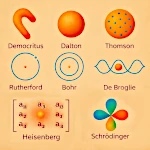 原子的各种形态:从古代直觉到量子力学