

钾(K,Z = 19):从水上之火到心脏的搏动
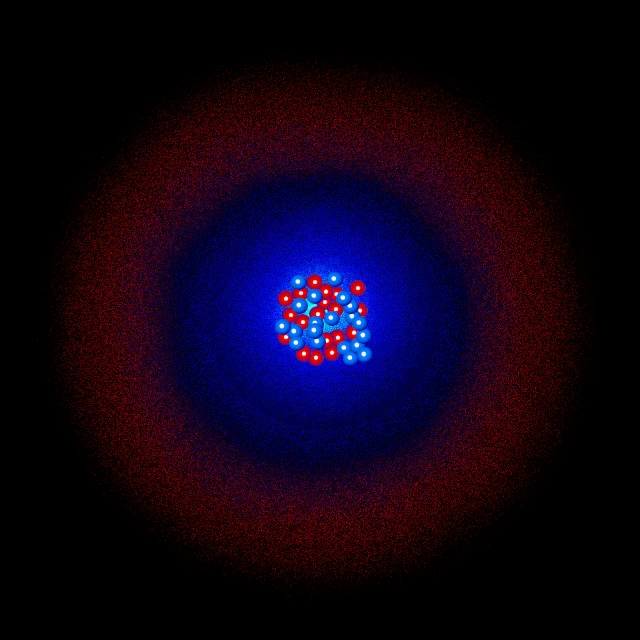
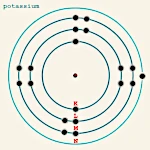
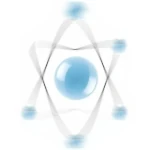
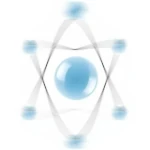
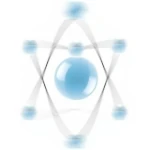
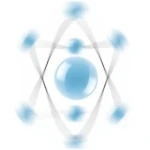
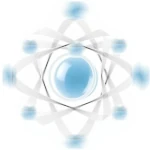
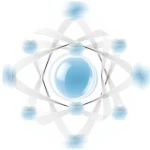
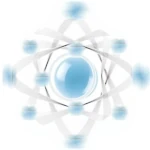
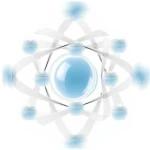
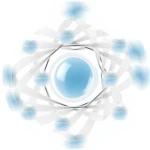
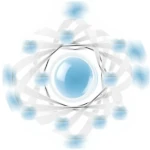
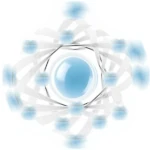
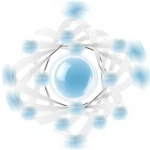
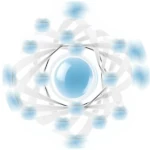
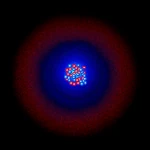
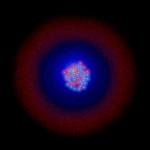
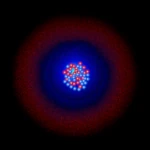
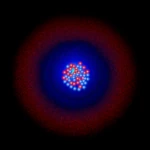
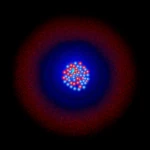
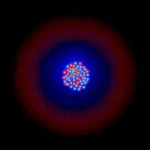
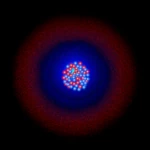
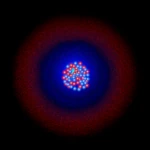
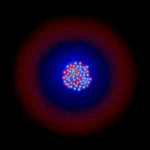
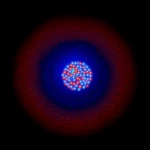
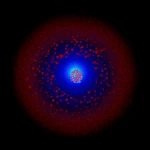
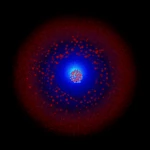
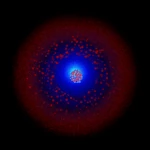
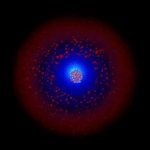
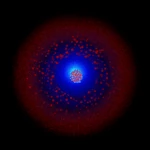
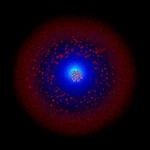
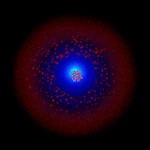
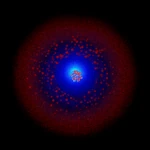
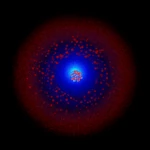
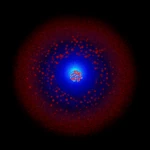
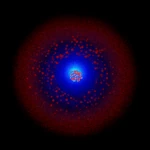
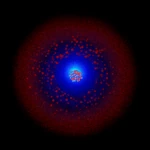
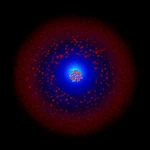
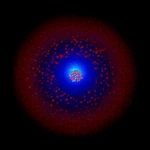
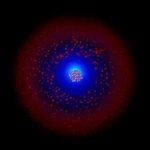
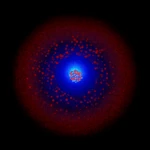
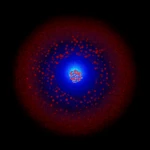
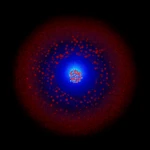
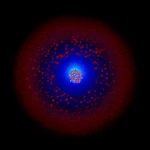
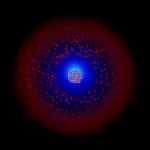
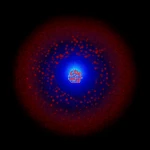
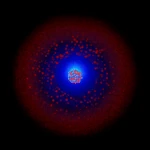
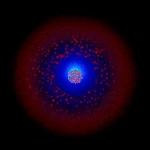
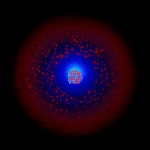
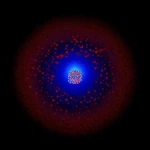
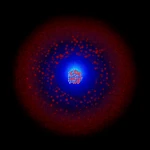
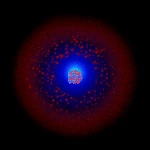
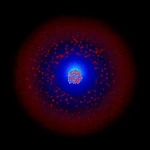
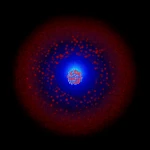
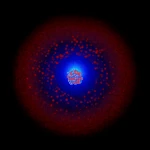
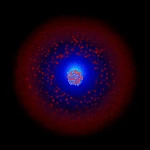
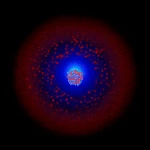
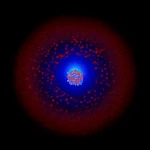
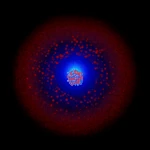
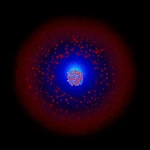
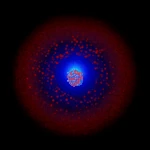
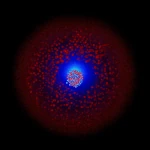
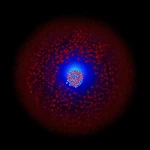
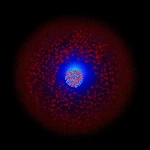
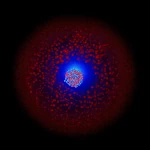
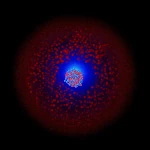
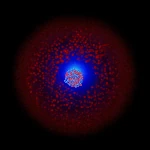
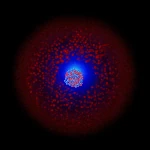
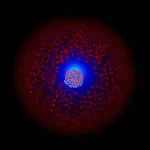
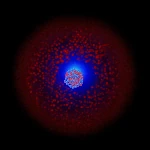
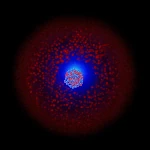
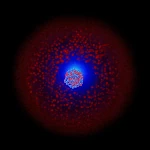
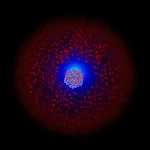
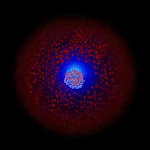
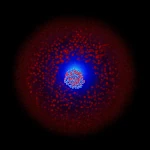
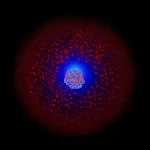
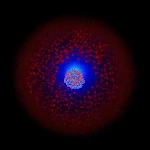
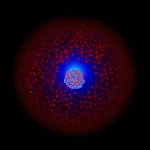
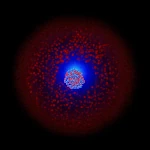
Simplified atomic model of the potassium atom.
The most abundant isotope is \(\,^{39}\mathrm{K}\,\) with its 19 protons and 20 neutrons.
Image source: astronoo.com (新窗口)
钾的发现历史
Potassium was the first metal isolated by electrolysis, marking the beginning of a revolution in chemistry. Before its discovery, potassium compounds such as potash (potassium carbonate, K₂CO₃) were known and used since antiquity to make soap and glass. In 1807, British chemist 汉弗里·戴维 (1778–1829) succeeded in isolating metallic potassium by passing an electric current through molten potash, using a powerful voltaic battery. When the first drops of metallic potassium appeared, they immediately ignited with a spectacular violet flame. Davy was so enthusiastic about this discovery that he reportedly danced for joy in his laboratory. A few days later, he isolated sodium using the same method. The name 钾 comes from the English 钾肥, itself derived from 草木灰 (ashes from a pot), as potash was obtained by leaching wood ashes in pots. The chemical symbol K comes from the Latin 钾, derived from the Arabic al-qalya (plant ash).
结构与基本性质
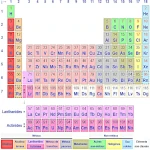
Potassium (symbol K, atomic number 19) is an alkaline metal in group 1 of the periodic table.
Its atom has 19 protons, 19 electrons, and usually 20 neutrons in its most abundant isotope (\(\,^{39}\mathrm{K}\)).
Three isotopes occur naturally: potassium-39 (\(\,^{39}\mathrm{K}\)), potassium-40 (\(\,^{40}\mathrm{K}\), radioactive), and potassium-41 (\(\,^{41}\mathrm{K}\)).
At room temperature, potassium is a soft, silvery-white solid metal that tarnishes rapidly in air due to the formation of an oxide layer.
It is soft enough to be cut with a knife. Density ≈ 0.862 g/cm³ (less dense than water, it floats!).
Melting point of potassium: 336.7 K (63.5 °C).
Boiling point: 1,032 K (759 °C).
Potassium is extremely chemically reactive, oxidizing instantly in air and reacting violently with water, producing hydrogen gas that spontaneously ignites with a characteristic violet flame (due to potassium's atomic emission).
It must be stored under mineral oil or in an inert atmosphere to prevent any reaction.
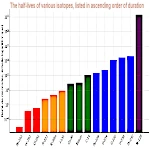
钾同位素表
| 同位素 / 符号 | 质子(Z) | 中子(N) | 原子质量(u) | 天然丰度 | 半衰期/稳定性 | 衰变/备注 |
|---|---|---|---|---|---|---|
| 钾-39 — \(\,^{39}\mathrm{K}\,\) | 19 | 20 | 38.963707 u | ≈ 93.26% | 稳定的 | 天然钾的超优势同位素。 |
| 钾-41 — \(\,^{41}\mathrm{K}\) | 19 | 22 | 40.961826 u | ≈ 6.73% | 稳定的 | 第二种稳定同位素;用于医学示踪。 |
| 钾-40 — \(\,^{40}\mathrm{K}\) | 19 | 21 | 39.963998 u | ≈ 0.012% | 12.48亿年 | 放射性:89.3% β⁻衰变 → \(^{40}\mathrm{Ca}\);10.7% 电子俘获 → \(^{40}\mathrm{Ar}\)。人体内天然放射性的主要来源,也是地质测年的关键工具。 |
| 钾-42 — \(\,^{42}\mathrm{K}\) | 19 | 23 | 41.962403 u | 非自然的 | 12.355小时 | 放射性β⁻衰变生成钙-42。在医学和生物学研究中用作示踪剂。 |
| 其他同位素——\(\,^{32}\mathrm{K}\) 至 \(\,^{57}\mathrm{K}\) | 19 | 13 — 38 | — (变量) | 非自然的 | 毫秒到分钟 | 人工产生的极不稳定同位素;实验核物理学。 |
钾的电子排布与电子层
注意::
Electron shells: 电子如何围绕原子核组织 (新窗口).
钾有19个电子,分布在四个电子层中。其完整电子排布为:1s² 2s² 2p⁶ 3s² 3p⁶ 4s¹, 或简写为:[Ar] 4s¹。该排布也可写作:K(2) L(8) M(8) N(1)。
壳层的详细结构
K 壳层 (n=1): contains 2 electrons in the 1s subshell. This inner shell is complete and highly stable.
L壳层(n=2): contains 8 electrons distributed as 2s² 2p⁶. This shell is also complete, forming a noble gas configuration (neon).
M壳层(n=3): contains 8 electrons distributed as 3s² 3p⁶. The 3s and 3p orbitals are complete, forming a stable configuration. Note that the 3d orbitals remain empty.
N壳层(n=4): contains only 1 electron in the 4s subshell. This single valence electron is very weakly bound and easily lost during chemical reactions.
价电子与氧化态
The single electron in the outer shell (4s¹) is the 价电子 of potassium. This configuration explains its chemical properties:
By losing its 4s electron, potassium forms the K⁺ ion (oxidation state +1), its unique and systematic oxidation state.
The K⁺ ion then adopts an electronic configuration identical to that of argon [Ar], a noble gas, which gives this ion maximum stability.
钾的电子构型中,其价壳层仅含一个4s电子,这使其被归类为碱金属。该结构赋予其特性:极高的化学反应活性(遇水剧烈反应,在潮湿空气中自燃)、低电离能(价电子极易失去),以及仅形成氧化态为+1的化合物。由于K⁺离子不含部分填充轨道的电子,钾的化合物不显色。其失去价电子的极强倾向使钾成为最活泼的金属之一和优良的还原剂。因反应性极强,钾必须储存在矿物油中以避免接触空气和水分。
化学反应活性
钾是元素周期表中反应性最强的金属之一。它与水发生剧烈而瞬间的反应,生成氢氧化钾(KOH)和氢气,氢气会自燃:2 K + 2 H₂O → 2 KOH + H₂(伴随特征性紫色火焰)。钾在空气中迅速氧化,依次形成氧化钾(K₂O)、过氧化钾(K₂O₂)和超氧化钾(KO₂)。它与卤素、酸及大多数非金属发生剧烈反应。钾几乎只形成+I氧化态的离子化合物。主要化合物包括氢氧化钾(KOH,强碱)、氯化钾(KCl)、碳酸钾(K₂CO₃)、硝酸钾(KNO₃,硝石)和高锰酸钾(KMnO₄)。在有机化学中,钾的衍生物如叔丁醇钾是极强的碱,常用作试剂。
钾的工业和技术应用
- 在农业肥料(氯化钾、硫酸钾)中,对植物生长至关重要;
- 用于生产氢氧化钾(苛性钾),用于制造液体肥皂;
- 作为黑火药(硝石,KNO₃)及其他炸药的成分;
- 在烟花中产生特有的紫色;
- 制造特殊耐热玻璃
- 作为食品添加剂(酸度调节剂、膨松剂、防腐剂);
- 在低钠饮食人群的食盐替代品中;
- 用于空气再生系统(潜艇、空间站)中生产超氧化物。
- 作为有机化学合成中的强还原剂;
- 在某些类型的洗涤剂和肥皂中;
- 用于皮革鞣制和纺织品染色;
- 作为某些化学反应中的催化剂;
- 在某些染料和颜料的生产中;
- 在电化学研究中制造电极;
- 作为某些核反应堆中的传热流体(液态钠钾合金NaK);
- 在光电管和光电倍增管中;
- 用于合成特定药物产品。
绝对必要的生物学作用
Potassium is indispensable for all forms of life and is the main intracellular cation (K⁺) in all living organisms. It plays a fundamental role in many vital biological functions. The 钠钾泵 (Na⁺/K⁺-ATPase), present in all cell membranes, actively pumps potassium into cells and sodium out, consuming about 20 to 40% of the body's total metabolic energy. This electrochemical gradient is essential for nerve impulse transmission, muscle contraction (including the heart muscle), cell volume regulation, and membrane potential maintenance. Potassium is involved in regulating blood pressure, acid-base balance, protein synthesis, and carbohydrate metabolism. In plants, potassium regulates the opening and closing of stomata, photosynthesis, sugar transport, and disease resistance. A potassium deficiency (hypokalemia) can cause fatigue, muscle cramps, and potentially fatal cardiac arrhythmias, while an excess (hyperkalemia) can also be dangerous for the heart.
天然放射性及其影响
钾-40是地球上存在的主要天然放射性核素之一。其半衰期为12.48亿年,缓慢衰变为钙-40(占89.3%)和氩-40(占10.7%)。尽管仅占天然钾元素的0.012%,但因其广泛存在,钾-40成为人体内部放射性的主要来源。一个体重70公斤、体内含约140克钾的人,每秒会经历约4400次钾-40的放射性衰变,每年因此受到的辐射剂量约为0.17毫西弗。富含钾元素的香蕉天然含有钾-40,由此衍生出辐射防护中幽默的"香蕉等效剂量"概念。此外,钾-40与铀、钍共同通过放射性衰变为地球内部提供热量。
丰富与来源
钾是地壳中含量第七丰富的元素(约占质量的2.1%)。由于其高反应活性,自然界中从未发现其金属单质形态,但存在于许多硅酸盐矿物(长石、云母)和蒸发岩盐中。主要的钾矿物包括钾盐(KCl)、光卤石(KMgCl₃·6H₂O)和杂卤石。海水中溶解态钾的浓度约为0.38克/升。加拿大、俄罗斯、白俄罗斯和德国拥有大型钾盐矿床。土壤中钾含量丰富,是农业中必需的常量营养素。提取主要通过开采盐矿,随后精炼生产氯化钾或其他化合物。
在天体物理学和地质年代学中的作用
Potassium is produced in stars during the explosive nucleosynthesis of supernovae by silicon fusion and neutron capture. Radioactive potassium-40 is a fundamental tool in geological dating. The 钾-氩 (K-Ar) dating method and its 氩-氩 (⁴⁰Ar/³⁹Ar) variant are among the most important in geochronology, allowing the dating of rocks from a few thousand years to several billion years. These methods have made it possible to date the age of the Earth, major events in geological history, meteorite impact craters, and the evolution of hominids. The argon-40 trapped in minerals comes exclusively from the decay of potassium-40, forming the basis of this dating technique. The isotopic ratio of potassium in meteorites and lunar samples provides information on the formation of the solar system.
注意::
The spectacular reaction of potassium with water has long fascinated chemists and students, but it is also dangerous.
When a piece of potassium is placed on water, it reacts so violently that the hydrogen produced ignites instantly with a characteristic violet flame, and the potassium melts into a bright sphere that dances frantically on the water's surface.
The heat released can be sufficient to cause the potassium to explode, projecting flaming fragments of molten metal.
For this reason, this classic demonstration must be performed with very small pieces and strict safety precautions.
The violet flame results from the excitation of potassium electrons, which, when returning to their ground energy level, emit characteristic photons at 766 nm and 770 nm (potassium doublet).
 核聚变所需的能量以及为什么铀是一个极限
 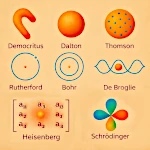 原子的各种形态:从古代直觉到量子力学