

碳(C,Z=6):宇宙的分子建筑师

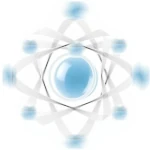
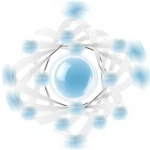
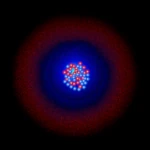
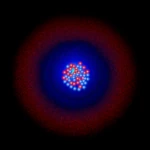
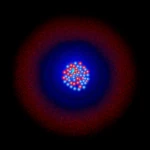
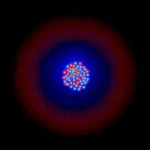
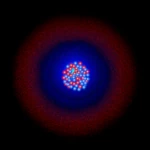
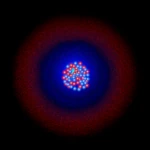
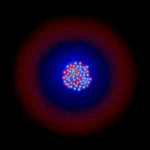
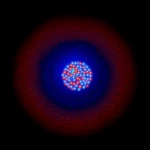
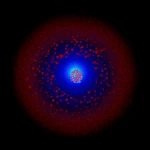
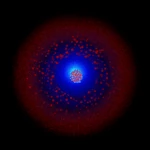
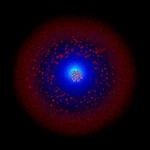
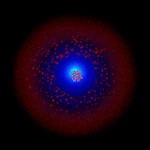
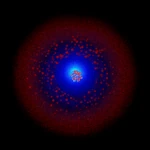
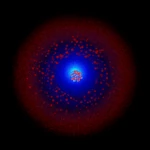
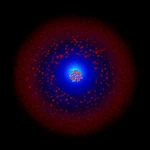
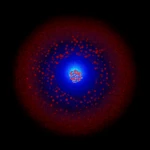
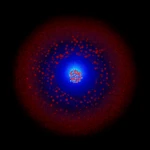
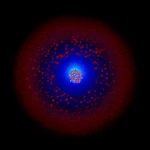
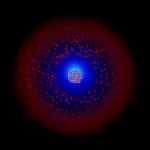
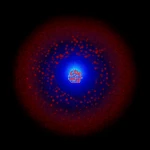
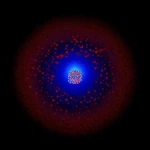
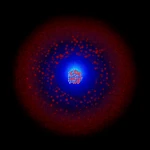
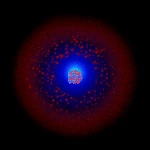
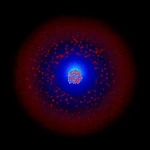
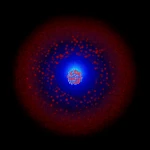
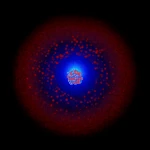
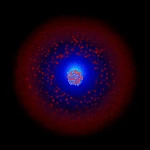
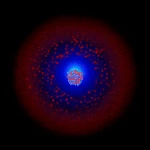
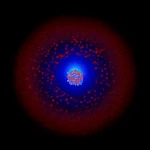
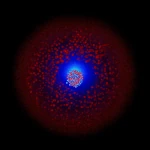
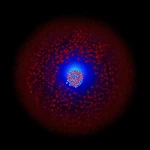
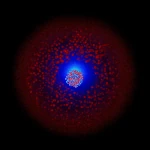
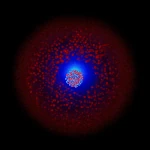
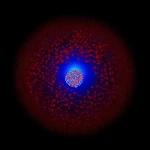
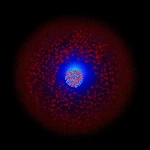
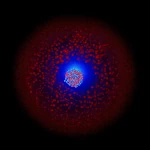
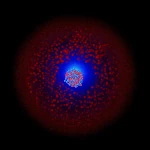
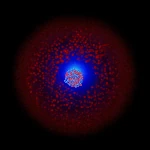
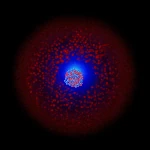
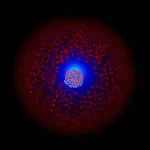
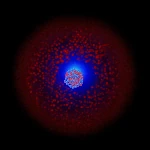
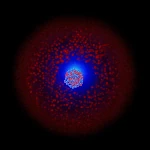
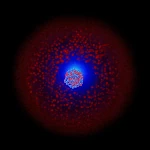
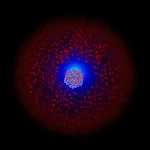
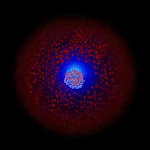
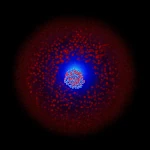
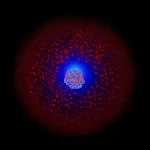
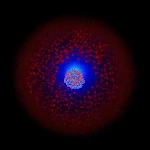
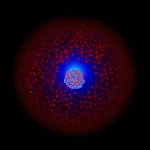
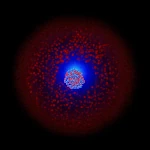
Simplified atomic model of the carbon atom with its six protons and six electrons.
Image source: astronoo.com (新窗口)
碳的发现历史
Carbon in its elemental forms (charcoal, soot, diamond, graphite) has been known since prehistoric times. Humans used charcoal as fuel and to create pigments in cave paintings over 30,000 years ago. Diamonds were prized as precious gems since antiquity. However, it was not until 1772 that 安托万·拉瓦锡 (1743-1794) demonstrated that diamond is a form of pure carbon by burning it and observing that only carbon dioxide was produced. In 1779, the Swedish chemist 卡尔·威廉·舍勒 (1742-1786) showed that graphite was also pure carbon. The name 碳 derives from the Latin 碳 meaning "coal". In 1985, a new allotropic form of carbon was discovered: fullerenes (C₆₀), followed by carbon nanotubes in 1991 and graphene in 2004, revolutionizing materials science.
结构与基本性质
Carbon (symbol C, atomic number 6) is a non-metal of group 14 in the periodic table, consisting of six protons, usually six neutrons (for the most common isotope), and six electrons.
The stable isotopes are carbon-12 \(\,^{12}\mathrm{C}\) (≈ 98.93%) and carbon-13 \(\,^{13}\mathrm{C}\) (≈ 1.07%).
Carbon-14 \(\,^{14}\mathrm{C}\) is radioactive with a half-life of 5,730 years, used for archaeological dating.
Carbon exhibits several allotropic forms with radically different properties.
钻石 is transparent, extremely hard (10 on the Mohs scale), an electrical insulator, with a tetrahedral structure where each atom is bonded to four others (sp³ hybridization).
石墨 is opaque, black, soft, electrically conductive, with a layered planar structure where each atom is bonded to three others (sp² hybridization).
Other forms include 富勒烯 (spherical or ellipsoidal structures), 碳纳米管 (rolled graphene sheets), and 石墨烯 (a single atomic layer of graphite).
Amorphous carbon exists in forms such as charcoal, carbon black, and soot.
Density: graphite ≈ 2.26 g/cm³, diamond ≈ 3.51 g/cm³.
Melting point (graphite, under pressure): ≈ 3823 K (3550 °C).
Sublimation point (graphite, atmospheric pressure): ≈ 3915 K (3642 °C).
碳同位素表
| 同位素 / 符号 | 质子(Z) | 中子(N) | 原子质量(u) | 天然丰度 | 半衰期/稳定性 | 衰变 / 备注 |
|---|---|---|---|---|---|---|
| 碳-11 — \(\,^{11}\mathrm{C}\,\) | 6 | 5 | 11.011433 u | 非自然的 | 20.334分钟 | 放射性β⁺衰变为¹¹B;用于正电子发射断层扫描(PET)。 |
| 碳-12 — \(\,^{12}\mathrm{C}\,\) | 6 | 6 | 12.000000 u(按定义) | ≈ 98.93% | 稳定 | 原子质量标度的参考同位素;所有有机化学的基础。 |
| 碳-13 — \(\,^{13}\mathrm{C}\,\) | 6 | 7 | 13.003355 u | ≈ 1.07% | 稳定的 | 用于碳-13核磁共振波谱分析,并作为生物化学和地球化学中的示踪剂。 |
| 碳-14 — \(\,^{14}\mathrm{C}\,\) | 6 | 8 | 14.003241 u | (宇宙成因)痕迹 | 5,730年 | 放射性β⁻衰变至¹⁴N;由宇宙射线产生;用于碳-14年代测定。 |
| 碳-15 — \(\,^{15}\mathrm{C}\,\) | 6 | 9 | 15.010599 u | 非自然的 | 2.449秒 | 放射性β⁻;在粒子加速器中人工产生。 |
| 其他同位素——\(\,^{8}\mathrm{C}-\,^{10}\mathrm{C},\,^{16}\mathrm{C}-\,^{22}\mathrm{C}\) | 6 | 2-4, 10-16 | —(共鸣) | 非自然的 | \(10^{-21}\) — 0.747秒 | 核物理中观察到的不稳定态;其中一些具有中子晕结构。 |
电子构型与电子层
注意::
Electron shells: 电子如何围绕原子核组织 (新窗口).
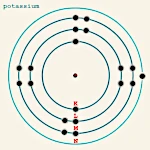
碳有6个电子,分布在两个电子壳层中。其完整电子排布为:1s² 2s² 2p²,简写为:[He] 2s² 2p²。该排布也可写作:K(2) L(4)。
壳层的详细结构
K壳层(n=1): Contains 2 electrons in the 1s sub-shell. This inner shell is complete and highly stable.
L壳层(n=2): Contains 4 electrons distributed as 2s² 2p². The 2s orbitals are complete, while the 2p orbitals contain only 2 electrons out of 6 possible. Thus, 4 electrons are missing to reach the stable neon configuration with 8 electrons (octet).
价电子与氧化态
The 4 electrons in the outer shell (2s² 2p²) are the 价电子 of carbon. This configuration explains its chemical properties:
By gaining 4 electrons, carbon theoretically forms the C⁴⁻ ion (oxidation state -4), a very rare state observed only in certain metallic carbides like Al₄C₃, adopting the stable neon configuration [Ne].
By losing 4 electrons, carbon would form the C⁴⁺ ion (oxidation state +4), another rare ionic state but observed in carbon dioxide CO₂ in covalent form.
Carbon can exhibit intermediate oxidation states: -3, -2, -1, 0, +1, +2, +3, and +4, with a preference for covalent bonds rather than ionic ones.
The oxidation state 0 corresponds to elemental carbon, which exists in several allotropic forms: diamond, graphite, graphene, fullerenes, and carbon nanotubes.
碳的电子构型在其价层中有4个电子,这使其位于元素周期表的第14族,并在化学中占据独特地位。这种结构赋予其特殊的性质:通过共享价电子形成四个稳定共价键的能力;与自身及其他元素形成单键、双键或三键的能力;以及形成几乎无限长度的直链、支链或环状链(链化作用)的可能性。碳很少形成离子,因为获得或失去4个电子所需的能量过高,因此它更倾向于通过共享电子的共价键结合。这种形成复杂多样分子结构的独特能力,使碳成为有机化学和生命的基础元素。
碳的重要性是根本性的:它是有机化学和地球生命的基础元素。所有生物体都构建于碳基分子(碳水化合物、脂质、蛋白质、核酸)之上。碳形成的化合物数量超过其他所有元素的总和,已知的有机分子种类达数百万种。其同素异形体具有卓越特性:钻石是自然界最坚硬的物质,石墨是优良的导体和润滑剂,而石墨烯则拥有非凡的电子性能。碳循环通过大气中的二氧化碳调节地球气候。在工业领域,碳以煤炭、焦炭、炭黑、碳纤维等形式被广泛应用,从燃料到高科技材料,用途不可胜数。
化学反应活性
Carbon has four valence electrons, allowing it to form four stable covalent bonds. This 四价 and carbon's ability to form single, double, and triple bonds with itself and other elements (notably hydrogen, oxygen, nitrogen, sulfur, phosphorus) are the basis for the extraordinary diversity of organic chemistry. Carbon can form linear, branched, cyclic chains, and complex three-dimensional structures, creating millions of different organic compounds.
元素碳在室温下相对惰性,但在高温下与氧气反应生成二氧化碳(CO₂)或一氧化碳(CO),具体取决于反应条件。它与金属反应形成碳化物,与氢反应生成碳氢化合物,与卤素反应生成四卤化碳。碳可存在多种杂化状态(sp、sp²、sp³),这决定了其化合物的几何构型与性质。
碳是生物化学的核心元素。所有已知的生物体都基于含碳有机分子:碳水化合物、脂类、蛋白质、核酸。 碳具有形成稳定且复杂大分子的独特能力,这使其成为我们所知生命的基础元素。
碳的工业与技术应用
- 作为能源生产和冶金用的燃料(煤、焦炭、无定形碳);
- 在炼钢过程中用于生产钢材(碳含量决定了钢材的机械性能);
- 作为钻石用于切割工具、钻探和工业磨料;
- 在珠宝中(天然及合成钻石)作为宝石使用;
- 作为铅笔芯、固体润滑剂和电极的石墨;
- 用于制造航空、汽车和体育器材的超高强度碳纤维;
- 作为核反应堆中的慢化剂材料(石墨);
- 在电池和超级电容器中(石墨、石墨烯、碳纳米管);
- 生产耐极端温度的碳/碳复合材料(热屏蔽、飞机刹车片);
- 在电子学中作为未来晶体管的半导体材料(碳纳米管、石墨烯);
- 在用于水和空气净化的活性炭过滤器中;
- 作为轮胎制造(橡胶增强)和印刷油墨中的炭黑;
- 在化学工业中作为原料用于合成数百万种有机化合物;
- 生产具有革命性应用的纳米材料(富勒烯、纳米管、石墨烯);
- 在碳捕集与封存领域应对气候变化;
- 作为考古和地质测年的元素(碳-14);
- 在太阳能电池板和光电器件中(石墨烯、纳米管);
- 制造建筑材料(含碳添加剂的混凝土)
- 在医学中用于医学成像(碳-11正电子发射断层扫描)以及作为生物材料(功能化纳米管)。
在天体物理学和宇宙学中的角色
Carbon is the fourth most abundant element in the observable universe (after hydrogen, helium, and oxygen) and plays an absolutely central role in stellar and galactic evolution. Unlike hydrogen and helium, which come from the Big Bang, carbon is entirely produced by 恒星核合成 in the cores of massive stars.
The formation of carbon in stars occurs through the 三阿尔法过程: three helium-4 nuclei fuse to form carbon-12 at temperatures above 100 million kelvin. This reaction is made possible by the existence of a particular excited state of carbon-12 (Hoyle state, predicted in 1953 by Fred Hoyle), which allows overcoming the "beryllium-8 gap". Without this remarkable quantum coincidence, carbon could not form efficiently, and carbon-based life would probably not exist. This observation was one of the first arguments for the anthropic principle in cosmology.
In evolved massive stars, carbon serves as fuel for subsequent fusion reactions (carbon burning) at temperatures of about 600 million kelvin, producing neon, sodium, and magnesium. Carbon is also an essential catalyst in the CNO循环 (carbon-nitrogen-oxygen), a hydrogen-to-helium fusion process that dominates in stars more massive than the Sun.
恒星在生命末期通过星风和超新星爆发向星际介质中富集碳元素。渐近巨星分支星(AGB星)在碳的产生与扩散方面尤为高效,能形成碳星——这类恒星大气中的碳含量超过氧含量。这种恒星碳在星际介质中形成碳尘埃,对新生恒星和行星的形成起着关键作用。
在星际介质中,碳以多种形式存在:原子态(C、C⁺)、分子态(CO、C₂、碳链)、石墨颗粒以及多环芳烃(PAHs)。一氧化碳(CO)是仅次于H₂的第二丰富分子化合物,也是绘制恒星形成区冷分子云图的主要示踪剂。
恒星和行星天体中¹²C/¹³C的同位素比值,为核合成过程、恒星混合及银河系化学演化提供了宝贵信息。在原始陨石和星际尘埃中观测到的该比值变化,揭示了构成太阳系形成的恒星来源的多样性。
注意::
The 宇宙碳循环 illustrates the deep interconnection between stars, the interstellar medium, and planetary formation.
Carbon formed in stars is dispersed into space, incorporates into molecular clouds, participates in the formation of new generations of stars and planetary systems, and ultimately allows the emergence of life on planets like Earth.
On our planet, carbon cycles between the atmosphere (CO₂), oceans (dissolved carbonates), the biosphere (living organic matter), and the lithosphere (carbonate rocks, fossil fuels) in a complex geochemical cycle.
Humanity is currently disrupting this cycle by massively releasing fossil carbon into the atmosphere, causing global climate warming.
Understanding the carbon cycle at all scales, from cosmic to planetary, is therefore essential not only for fundamental science but also for the future of our civilization.
 核聚变所需的能量以及为什么铀是一个极限
 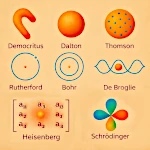 原子的各种形态:从古代直觉到量子力学