

钍(Th,Z = 90):一种丰富的核能源
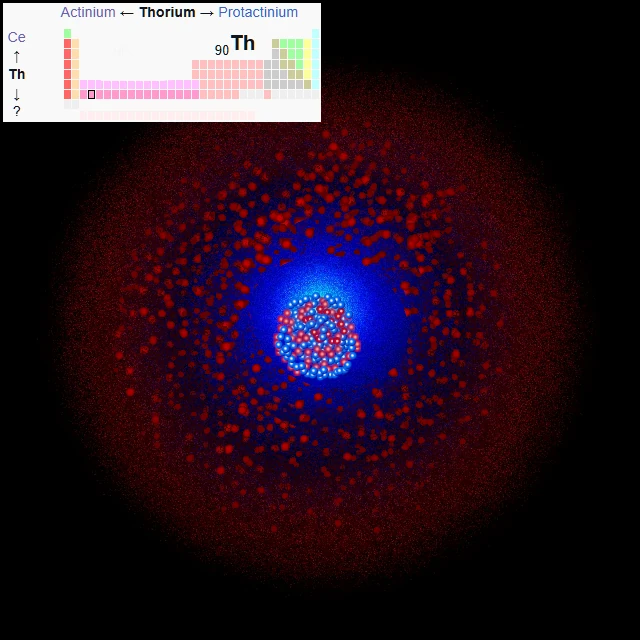
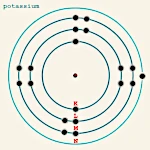
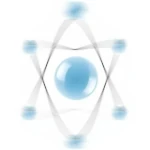
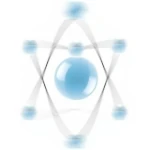
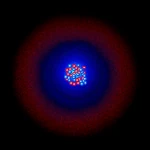
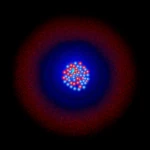
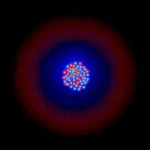
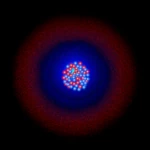
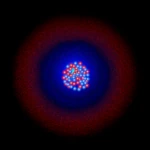
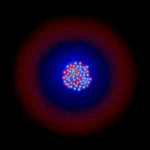
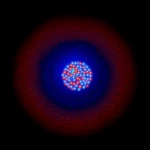
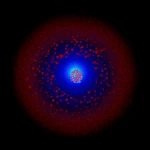
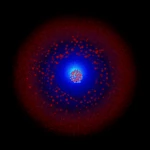
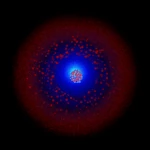
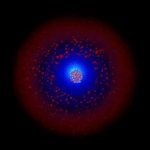
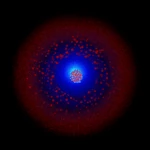
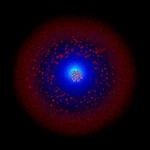
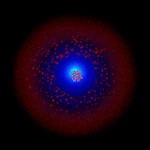
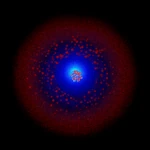
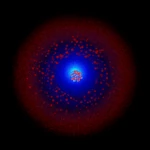
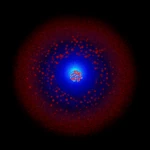
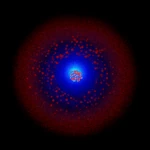
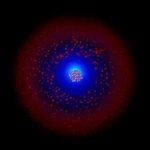
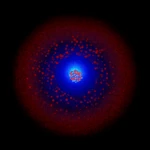
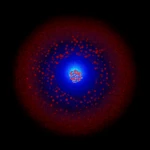
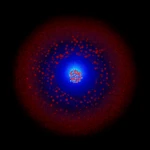
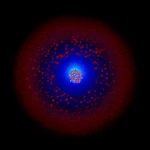
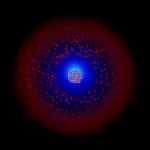
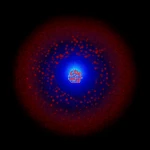
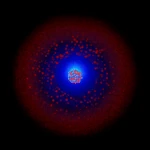
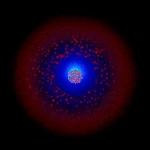
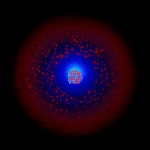
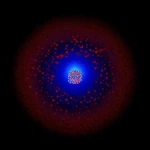
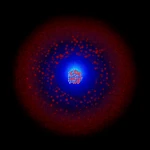
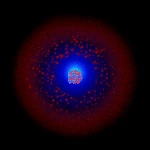
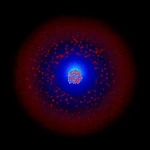
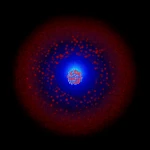
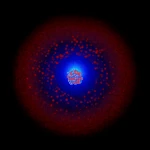
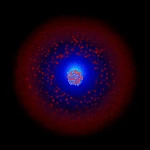
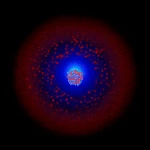
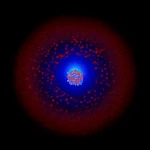
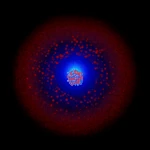
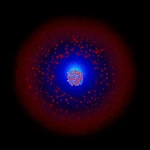
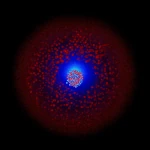
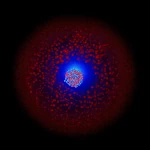
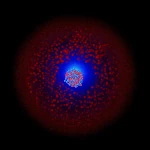
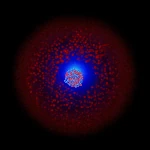
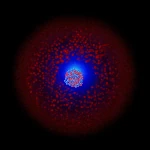
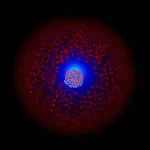
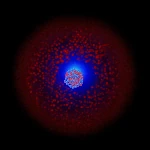
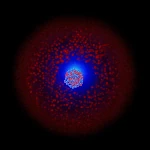
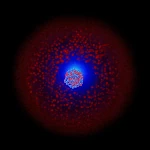
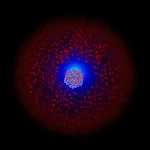
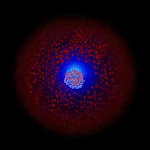
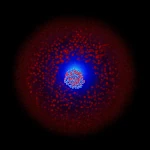
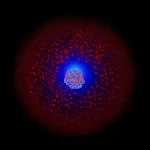
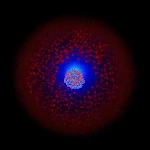
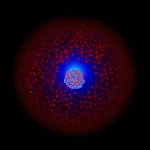
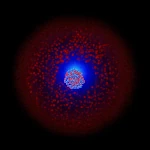
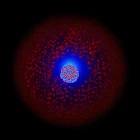
Simplified atomic model of the thorium atom.
The most abundant isotope is \(\,^{232}\mathrm{Th}\,\) with its 90 protons, 90 electrons, and 142 neutrons.
Image source: astronoo.com (新窗口)
在天体物理学和宇宙化学中的作用
Thorium, like other heavy actinides, is mainly formed during extreme astrophysical events, particularly the r过程 (rapid neutron capture process) that occurs during neutron star mergers or certain supernovae. In the solar system, it is present today due to its very long half-life. The isotope \(\,^{232}\mathrm{Th}\) (half-life of 14.05 billion years) serves as a 宇宙计时器 in geochemistry and astrophysics. The thorium/uranium (Th/U) ratio and the thorium/other heavy elements ratio allow dating the age of the Earth's crust, meteorites, and estimating the age of our galaxy. Unlike short-lived radioactive elements, thorium-232 produces a constant and long-lasting heat flow in rocky planets, contributing to the maintenance of internal geological activity over geological time scales.
钍的发现历史
Thorium was discovered in 1828 by the Swedish chemist 永斯·雅各布·贝采利乌斯 (1779-1848). He isolated it from a sample of a blackish rock known as thorite (a thorium silicate) that had been sent to him by a Norwegian pastor and amateur mineralogist, Reverend Hans Morten Thrane Esmark. Berzelius named the new element "thorium" in honor of Thor, the god of thunder in Norse mythology. For nearly a century, thorium remained mainly a laboratory curiosity and found limited applications in the incandescent mantles of gas lamps (Thorite). The true importance of thorium as a 肥沃的 element in the nuclear fuel cycle was only realized with the discovery of radioactivity and nuclear fission. In 1941, 格伦·T·西博格 and his colleagues identified the first fissile isotope derived from thorium, uranium-233 (\(\,^{233}\mathrm{U}\)), paving the way for the concept of the 钍循环.
注意::
Thorium has long been the "forgotten star" of nuclear energy. While 20th-century nuclear programs focused massively on uranium and plutonium for military (bombs) and civilian reasons, thorium, deemed less suitable for producing fissile materials for weapons, was largely neglected. It was only with the rise of concerns about proliferation, long-lived nuclear waste, and the depletion of uranium reserves that thorium experienced a global resurgence of interest in the 21st century as a potential fuel for safer and more sustainable nuclear reactors.
钍的结构与基本性质
Thorium (symbol Th, atomic number 90) is an actinide, the second element in the series after actinium. It is generally considered a 肥沃金属 rather than fissile. Its main and almost unique natural isotope is \(\,^{232}\mathrm{Th}\), an alpha emitter with a very long half-life (14.05 billion years). Pure thorium metal is silvery-gray, soft, malleable, and ductile. At room temperature, it has a face-centered cubic crystal structure. It is relatively stable in air, developing a thin protective oxide layer (ThO₂, thoria), much more stable than that of uranium. Its density is 11.7 g/cm³. It is a good electrical conductor.
Melting point: 2023 K (1750 °C).
Boiling point: 5061 K (4788 °C).
Thorium is about three to four times more abundant in the Earth's crust than uranium.
钍的主要同位素
| 同位素 / 符号 | 质子(Z) | 中子(N) | 原子质量(u) | 天然丰度 | 半衰期 / 稳定性 | 主要衰变模式 / 备注 |
|---|---|---|---|---|---|---|
| 钍-232 — \(\,^{232}\mathrm{Th}\,\) | 90 | 142 | 232.038055 u | ~100% | 140.5亿年 | α(100%)。原始可育同位素。捕获中子后启动链式反应生成可裂变铀-233。地质热源。 |
| 钍-228 — \(\,^{228}\mathrm{Th}\) | 90 | 138 | 228.028741 u | 痕迹(衰变产物) | 1.913年 | α(100%)。镭-228在钍-232衰变链中的子体。用作海洋学和地球化学中的示踪剂。 |
| 钍-230 — \(\,^{230}\mathrm{Th}\) | 90 | 140 | 230.033134 u | 非天然(衰变产物) | 75,380年 | α(100%)。又称镎。铀-238的子体。用于碳酸盐、珊瑚和海洋沉积物定年(铀系法)的关键工具。 |
| 钍-229 — \(\,^{229}\mathrm{Th}\) | 90 | 139 | 229.031762 u | 非天然的(合成的) | 7,917年 | α (100%). Known for its nuclear isomeric level of the lowest energy ever measured (~8 eV), paving the way for a 核钟 of very high precision. |
钍的电子构型与化学性质
注::
Electron shells: 电子如何围绕原子核组织 (新窗口).
Thorium has 90 electrons. Its ground state electronic configuration is [Rn] 6d2 7s2. Unlike uranium and subsequent actinides, it has no 5f electrons in its ground state. This configuration makes it chemically similar to hafnium (group 4) and, to a lesser extent, cerium. It mainly exhibits the +4 氧化态 (Th4+), which is extremely stable. The Th4+ ion is relatively large and highly charged, making it a strong Lewis acid and allowing it to form stable complexes with a wide variety of ligands (carbonates, phosphates, organics). Thorium practically does not exhibit a +3 oxidation state in aqueous solution, unlike most other light actinides.
化学反应活性及主要化合物
Thorium metal is quite reactive. It oxidizes slowly in air and burns to form thoria (ThO₂), an extremely refractory white ceramic (melting point ~3390 °C). It reacts with halogens, hydrogen, nitrogen, carbon, and sulfur at high temperatures. In solution, Th4+ is the only stable ion. It hydrolyzes easily and precipitates as Th(OH)₄ hydroxide at neutral or basic pH. Thorium oxide ThO₂ and nitrate Th(NO₃)₄ are its most important industrial compounds. The nitrate is highly soluble in water and organic solvents, which is crucial for thorium fuel extraction and reprocessing processes.
钍的应用
- 核能(钍循环): Thorium-232 is 肥沃的. In a reactor, it captures a neutron to form thorium-233, which decays into protactinium-233 and then into 可裂变铀-233. This cycle offers potential advantages: resource abundance, fewer long-lived wastes, inherent resistance to proliferation. Reactor concepts such as the LFTR (Liquid Fluoride Thorium Reactor) or molten salt reactors are specifically designed to exploit this cycle.
- 耐火材料: Thorium oxide (Thoria, ThO₂) is used in laboratory crucibles, furnace linings, and high-performance incandescent lamp filaments due to its exceptionally high melting point and chemical stability.
- 合金: Small amounts of thorium (about 2%) added to magnesium or tungsten significantly improve their mechanical properties and resistance to creep at high temperatures (Mg-Th alloys for aerospace, thoriated tungsten filaments).
- 催化作用: Thoria is used as a catalyst in petroleum cracking and the synthesis of organic chemicals.
- 地质测年: Imbalances in the uranium-thorium decay chains (series \(\,^{238}\mathrm{U}\) → \(\,^{230}\mathrm{Th}\)) are an essential dating method for carbonates (corals, stalagmites) and marine sediments up to about 500,000 years.
- 基础研究: The very low energy nuclear isomer of thorium-229 (\(\,^{229m}\mathrm{Th}\)) is being studied for the development of a 核钟, potentially more stable and precise than current optical atomic clocks.
生产、资源与经济
Thorium is a relatively 丰富的 element in the Earth's crust, with an average concentration estimated at about 9.6 ppm, three to four times that of uranium. It does not occur in native metallic form. Its main ore is 独居石, a rare earth phosphate that typically contains 3% to 12% thorium oxide (ThO₂). Other minerals include thorite and thorianite. The main reserves are located in India (which has the world's largest reserves), Brazil, Australia, the United States, and Norway. Thorium extraction is generally a by-product of rare earth or titanium mining. Currently, there is no significant global market for thorium as a nuclear fuel, so its production is limited and linked to demand for its other applications (refractories, alloys). Its price is mainly determined by the costs of separation and purification from rare earth ores.
安全与辐射防护方面
Natural thorium (almost exclusively Th-232) is a 低比活度放射性元素 due to its very long half-life. Its external radiation (mainly alpha particles and weak gamma radiation from its descendants) is easily stopped by a sheet of paper or the dead layer of skin. The 主要风险是内部风险: if inhaled or ingested as dust or aerosols, thorium can deposit in the lungs, bones, and organs, where it remains for decades, irradiating neighboring tissues. It is a recognized chemical and radiological carcinogen. Handling thorium powders or freshly separated thorium (containing few of its short-lived descendants) requires standard powder chemistry precautions (fume hood). Long-term storage of large quantities requires controlled ventilation to prevent the accumulation of radon-220 (thoron), a very short-lived radioactive gas (55.6 s) in the thorium decay chain.
 核聚变所需的能量以及为什么铀是一个极限
 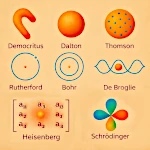 原子的各种形态:从古代直觉到量子力学