


Understanding How Inclination Changes Received Solar Energy
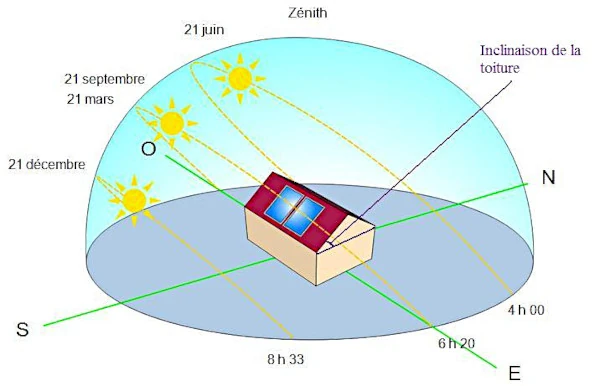
The intensity of solar energy at the zenith, when perpendicular to the surface, is \( I_0 \approx 1000 \text{ W/m}^2 \). The solar energy received by a surface depends on the angle of incidence of the sun's rays relative to the vertical.
Scientific Summary
This article examines how the angle of incidence of sunlight changes the energy received by a surface, based on Lambert's Law. This law states that the intensity (I) is proportional to the cosine of the angle (θ) relative to the normal: I = I₀ cos(θ). Thus, a surface perpendicular to the rays receives 100% of the maximum solar energy (I₀ ≈ 1000 W/m²), while a 60° angle reduces the intensity by half (500 W/m²). The article details this relationship with concrete examples and quantifies energy losses based on inclination.
How does the angle of sunlight affect the amount of solar energy received by a surface?
The solar energy received on the ground is not constant: it critically depends on the angle at which the sun's rays strike the surface. This phenomenon, described by Lambert's Law, is fundamental for understanding seasons, how solar panels work, and the climate of a region. The law states that the energy intensity (I) on a surface is equal to the product of the maximum intensity (I₀), measured when the rays are perpendicular (approximately 1000 W/m² on a clear day), by the cosine of the angle of incidence (θ).
This angle is the difference between the direction of the solar ray and the line perpendicular (the normal) to the surface. When the sun is at the zenith, θ = 0°, the cosine is 1, and the surface receives all the power. However, if the sun is low on the horizon (θ close to 90°), the cosine approaches 0, and the received energy becomes almost zero.
Also worth exploring
Continue your exploration of the Universe with these topics:
Influence of the Sunlight Angle on Received Solar Energy
Lambert's Law
Lambert's Law, formulated by the mathematician and philosopher Johann Heinrich Lambert (1728–1777), states that the intensity of incident solar energy I on a surface is proportional to the cosine of the angle of incidence θ between the solar ray and the normal to the surface: I = I0 cos(θ)
Definition of I0
I0 is the intensity of solar energy when it is perpendicular to the surface, i.e., the light intensity in watts per square meter (W/m²).
Definition of Cosine
The cosine of an angle θ in a right triangle is the ratio of the length of the side adjacent to the angle to the length of the hypotenuse.
          |\
          | \
  opposite|  \ hypotenuse
          |   \
          |θ___\
        adjacent
Angle of Incidence θ
θ is the angle of incidence relative to the Earth's surface. This angle is determined by the relative position of the sun with respect to the surface in question.
Generally, it varies depending on latitude, day of the year, and time of day. For a horizontal surface, it is also influenced by the solar elevation angle (solar altitude) and solar azimuth.
Calculating Received Solar Energy
Energy Received by an Inclined Surface
For a flat inclined surface, the received solar energy can be calculated by integrating the solar energy intensity over the surface.
If E is the energy in joules (J) received per unit area:
E = E0 cos(θ), where E0 is the energy received per unit area when the rays are perpendicular.
Relationship Between Energy and Intensity
The relationship between energy E and intensity I shows that the total energy received by a surface is proportional to the light intensity, surface area, and exposure time:
I = E / (A · t)
- I: Light intensity in watts per square meter (W/m²).
- E: Energy in joules (J).
- A: Surface area in square meters (m²).
- t: Time in seconds (s).
Examples
What is the solar energy received by a surface when the angle of incidence (relative to the vertical) is 30 degrees?
Intensity of solar energy perpendicular to the surface: I0 = ≈ 1000 W/m², called solar constant (typical value for a clear sky at solar noon).
I = I0 cos(θ)
cos(30°) = √3/2 ≈ 0.866
I = 1000 W/m² x 0.866 ≈ 866 W/m² or 86% of the solar constant.
What is the solar energy received by a surface when the angle of incidence θ = 45 degrees?
I = I0 cos(θ)
cos(45°) = √2/2 ≈ 0.707
I = 1000 W/m² x 0.707 ≈ 707 W/m² or 70% of the solar constant.
What is the solar energy received by a surface when the angle of incidence θ = 90 degrees?
I = I0 cos(θ)
cos(90°) = 0
I = 1000 W/m² x 0 ≈ 0 W/m².
Lambert's Law Table for Solar Energy
| Angle \( \theta \) (relative to vertical) | \( \cos(\theta) \) | Energy received (% of maximum) | Power received (W/m²) | Loss (%) |
|---|---|---|---|---|
| 0° | 1.000 | 100 % | 1000 | 0 % |
| 30° | 0.866 | 86.6 % | 866 | 13.4 % |
| 45° | 0.707 | 70.7 % | 707 | 29.3 % |
| 60° | 0.500 | 50.0 % | 500 | 50.0 % |
| 90° | 0.000 | 0 % | 0 | 100 % |
N.B. :
\( E = E_{\text{max}} \times \cos(\theta) \) — Energy decreases with the angle of incidence
FAQ: Everything You Need to Know About Lambert's Law and Solar Energy
What is Lambert's Law and why is it important for solar energy?
Lambert's Law (or the cosine law) is a physical rule stating that the energy received by a flat surface from a point source is proportional to the cosine of the angle of incidence. For solar energy, this means that the power (in W/m²) captured by a horizontal surface decreases as the sun moves away from the perpendicular. It is crucial for sizing and orienting solar panels to maximize their exposure, and also for understanding climates, as it explains the uneven distribution of solar energy on Earth.
Why is solar energy maximal when the angle of incidence is 0°?
When the angle θ is 0°, the sun's rays strike the surface perpendicularly. The power density is then maximal because the light flux is concentrated on a minimal surface. This is the ideal situation represented by I₀, the solar constant (approximately 1000 W/m² for a clear sky). As the angle increases, the same amount of light spreads over a larger surface, which dilutes the energy and reduces the power received per unit area, according to the formula I = I₀ × cos(θ).
How does the intensity go from 1000 W/m² to 500 W/m² in the article's example?
The transition from 1000 W/m² (at 0°) to 500 W/m² (at 60°) is a direct application of Lambert's Law. The article shows that for θ = 60°, the cosine of 60° is equal to 0.5. By multiplying the maximum intensity (I₀ = 1000 W/m²) by this factor, we indeed get 1000 × 0.5 = 500 W/m². This 50% reduction perfectly illustrates how a significant inclination of the sun in the sky drastically reduces the available solar power on a horizontal surface.
What is the relationship between energy (E) and intensity (I) mentioned in the article?
The article establishes the fundamental relationship: I = E / (A · t), where I is the intensity (W/m²), E is the energy (J), A is the surface area (m²), and t is the time (s). This means that the total energy (E) received by a surface is the product of intensity, surface area, and time. This formula allows calculating the energy collected over a given period, for example, to evaluate the daily yield of a solar panel whose angle of incidence varies throughout the day.
 Full text of Einstein's 1905 article on the nature and evolution of light
  The Speed of Light: The Ultimate Limit That Nothing Can Exceed
  Reality Escapes Us: Truths We Can Never Prove
  The Physics of the Universe in 50 Equations: User Guide
  The Kaya Identity: The Equation Complicating Our Decarbonization
  The Unsurpassable Speed in the Universe: When Energy Becomes Infinite
  How far is the horizon?
  How Do Solar Panels Inject Electricity into the Grid?
  Dynamics of Momentum to explain the propulsion of rockets or jellyfish
 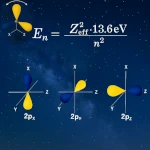 How Electron Energy Dictates Chemical Properties
  How to weigh the sun?
  The Key Role of Quantum Uncertainty: No Particle Can Be at Rest
  Energy and Power: Don't Confuse Them, Time Makes All the Difference
  Why is there a limit to cold, but not to heat?
  Galileo's Law of Falling Bodies
  The Ideal Gas Law: One Equation, Thousands of Applications
  Schrödinger's Equation Revolutionized Our View of Matter
 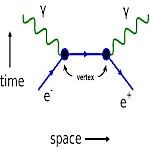 Feynman Diagram: Visualizing Particle Physics
  The Magic of Noether's Theorem: From the Principle of Least Action to Conservation Laws
  Relationship between gravitational mass and inertial mass and the equivalence principle
  Third Equation of Physics: Momentum to Understand Collisions
  The second essential equation in physics: The intuition of a conserved quantity
  The First Equation of Physics: How to Mathematize Force
  The electromagnetic force or Lorentz force
 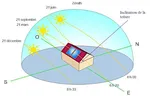 The solar energy received depends on the angle of incidence
  Why is marble colder than wood?
  Why does a photon, which has no mass, have energy?
  Bayes Formula and Artificial Intelligence
  The seven fundamental constants of physics
  What temperature does it feel like in interstellar space?
  Black body radiation curves: Planck's law
  The equivalence principle, gravitational effects are indistinguishable from acceleration
  The consequences of E=mc2 for our understanding of the Universe
  How to weigh the sun?
  Equation of the free fall of bodies (1604)
 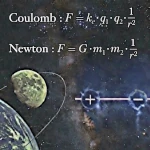 Coulomb vs Newton: The Mysterious Similarity of the Universe's Forces
 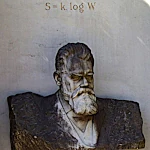 Boltzmann's equationon entropy (1877)
 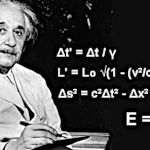 Special relativity equations (1905)
 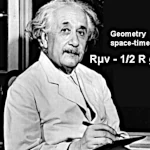 The equation of general relativity (1915)
  Planetary Rotation Equations: Between Angular Momentum and Gravitational Balance
  Equation of the orbital velocity of a planet
  Planck's equation
  Understanding Schrödinger's Equation Without Math
  Newton's Three Laws: From the Falling Apple to the Orbiting Planets
  Maxwell's equations
  Paul Dirac's equation
  Conservation of energy: A fundamental principle of physics
  Equation of electromagnetic induction
  Why do elementary particles have no mass?