


The Unsurpassable Speed in the Universe: When Energy Becomes Infinite
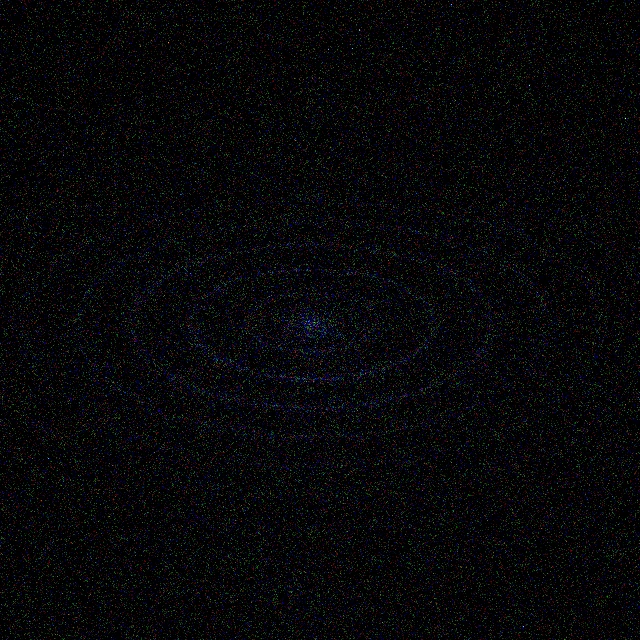
Conceptual representation of the propagation of an electromagnetic wave in a vacuum, illustrating a universal speed limit.
Image source: astronoo.com (new window)
Scientific Summary
The article explains why the speed of light in vacuum (c = 299,792,458 m/s) is an unbreakable universal speed limit for any matter or information. This limit arises directly from the structure of spacetime as described by Einstein's special relativity. The total energy of a particle of mass m is E = γmc², with γ = 1/√(1−v²/c²). As v approaches c, γ tends to infinity: infinite energy would be required to reach the speed of light. Photons, which have no rest mass (m₀=0), necessarily travel at c. The speed c is therefore an insurmountable energy barrier for any massive object, regardless of the power deployed, as illustrated by the example of a 1 g object requiring a month's worth of global energy to approach c.
Why is there an unsurpassable maximum speed in the Universe?
The speed of light in a vacuum (c = 299,792,458 m/s) is not just the speed of light: it is a universal speed limit for all matter or information. This limit arises directly from the structure of space-time, as described by Einstein's special relativity. The total energy of a particle of mass m is E = γmc², with γ = 1/√(1−v²/c²). As v approaches c, γ tends toward infinity: infinite energy would be required to reach the speed of light. Photons, which have zero rest mass (m₀=0), necessarily travel at c. Speed c is therefore an insurmountable energy barrier for any massive object, regardless of the power applied.
Also worth exploring
Continue your exploration of the Universe with these topics:
A Universal Constant Embedded in the Laws of Physics
The Universe has an unsurpassable speed limit, applicable to all matter and information. This constraint does not arise from a particular force but directly from the structure of spacetime, as described by the fundamental laws of physics.
The Electromagnetic Origin and Theoretical Calculation of Wave Speed
In 1873, James Clerk Maxwell (1831-1879) published his final treatise, begun in 1861, "A Treatise on Electricity and Magnetism". This treatise synthesizes and develops his entire theory of electromagnetism (theory of electric and magnetic fields), predicting the existence of waves propagating through a vacuum.
The speed of these electromagnetic waves is given by the relation: \( v = \frac{1}{\sqrt{\varepsilon_0 \, \mu_0}} \) where \(\varepsilon_0\) represents the permittivity of free space and \(\mu_0\) the permeability of free space. This equation shows that the speed \(v\) is an intrinsic property of the vacuum, not a speed of matter transport. It gives exactly the value of the speed of light in a vacuum, \(c\) = 299,792,458 m·s-1. The letter \(c\) to represent the speed of light was popularized by Albert Einstein (1879-1955) in his 1905 work on special relativity.
At the time of Maxwell, the exact values of \(\varepsilon_0\) and \(\mu_0\) were not defined with current precision, and the calculated speed was therefore only approximate. Maxwell himself compared this speed to the known measurements of the speed of light at the time. In 1862, Léon Foucault (1819-1868) succeeded in measuring the speed of light with great precision. Using an ingenious device combining mirrors and a toothed wheel, he obtained a value of about 298,000 km/s. Maxwell, noting this agreement, suggested that light is an electromagnetic wave.
N.B.:
The permittivity of free space (\(\varepsilon_0\)) is a physical constant that characterizes the ability of a vacuum to "host" an electric field.
It is expressed in farads per meter (F·m-1) and appears in Coulomb's law and Maxwell's equations.
The permeability of free space (\(\mu_0\)) characterizes the response of a vacuum to a magnetic field.
It is expressed in henries per meter (H·m-1) and appears in Ampère's law and Maxwell's equations.
Special Relativity and the Speed Limit
In 1905, Albert Einstein (1879-1955) postulated that this speed is the same for all inertial observers, thus founding special relativity (relativistic theory of motion at high speed).
In this theory, the total energy of a particle of mass \(m\) moving at speed \(v\) is written as: \( E = \gamma m c^2 \) with: \(c\) the speed of light and \(\gamma\) the Lorentz factor \( \gamma = \frac{1}{\sqrt{1 - \frac{v^2}{c^2}}} \).
Thus, as \(v\) approaches \(c\), the factor \(\gamma\) increases sharply and diverges to infinity (\(\gamma \to +\infty\)):
- At \(v = 0.9\,c\) ⇒ \(\gamma \approx 2.3\) — the energy is already more than double the rest energy.
- At \(v = 0.999\,c\) ⇒ \(\gamma \approx 22.4\) — the energy is multiplied by more than 20.
- At \(v = 0.9999999999\,c\) ⇒ \(\gamma \approx 70710\) — the energy increases very rapidly, the infinite value is only theoretically reached when \(v = c\).
Example of Energy Required for \(\gamma \approx 70710\)
For a 1 g object moving at a speed such that \(\gamma \approx 70710\), the total energy: \(E = \gamma \, m_0 c^2\) would be: \(\approx 6.35 \times 10^{19}\ \text{J}\). In other words, a small 1 g object would require all the energy consumed by the entire planet for about a month.
This enormous energy shows that even for a very small object with rest mass, reaching a speed extremely close to \(c\) requires an energy that is practically impossible to provide. The speed \(c\) thus appears not only as a speed limit but as an insurmountable energy barrier for any object with rest mass.
Photons have no rest mass (\(m_0 = 0\)), their energy is entirely associated with their momentum (\(E = pc\)). In the context of relativity, this relationship implies that their speed is necessarily \(c\). They can neither slow down nor exceed this speed, as any variation would violate the relativistic equation linking energy, mass, and momentum.
Table of Equations Associated with the Speed of Light
| Physical Context | Equation | Meaning | Reference |
|---|---|---|---|
| Electromagnetism | \( v = 1 / \sqrt{\varepsilon_0 \mu_0} \) | Propagation speed of electromagnetic waves | James Clerk Maxwell |
| Special Relativity | \( \gamma = 1 / \sqrt{1 - v^2/c^2} \) | Time dilation and energy increase | Albert Einstein |
| Mass-Energy | \( E = m c^2 \) | Mass-energy equivalence | Albert Einstein |
| Relativity and Photons | \( E^2 = (m_0 c^2)^2 + (pc)^2 \) | For \(m_0 = 0\), \(E = pc\); photon speed = \(c\) | Albert Einstein |
FAQ: Everything about the maximum speed in the Universe
How did Maxwell calculate the speed of light before it was accurately measured?
In 1873, James Clerk Maxwell established that the speed of electromagnetic waves in a vacuum is given by v = 1/√(ε₀μ₀), where ε₀ is the vacuum permittivity and μ₀ is the vacuum permeability. These are fundamental physical constants, measurable independently through electrical and magnetic experiments. Maxwell noted that the calculated value (about 298,000 km/s) remarkably matched the measurements of the speed of light made by Léon Foucault (1862). He concluded that light is an electromagnetic wave.
Why does the Lorentz factor γ make it impossible for a massive object to reach the speed of light?
The Lorentz factor γ = 1/√(1−v²/c²) appears in the expression for total energy E = γmc². As an object approaches the speed of light (v → c), the denominator √(1−v²/c²) tends toward zero, so γ tends toward infinity. The required energy thus becomes infinite. For example, at v = 0.999c, γ ≈ 22.4; at v = 0.9999999999c, γ ≈ 70,710. A 1 g object at this speed would require energy equivalent to global electricity consumption for a month. Reaching exactly c would require infinite energy, which is physically impossible.
Why can photons travel at the speed of light while massive objects cannot?
The fundamental difference lies in rest mass. Photons have zero rest mass (m₀ = 0). The complete relativistic equation is E² = (m₀c²)² + (pc)². For m₀ = 0, it reduces to E = pc. In this case, the photon's speed is necessarily c, as any massless particle travels at the speed of light in a vacuum. For a massive object (m₀ >0), additional kinetic energy does not result in an indefinite increase in speed, but rather in an increase of the γ factor and thus total energy. Speed c is an insurmountable barrier.
 Full text of Einstein's 1905 article on the nature and evolution of light
  The Speed of Light: The Ultimate Limit That Nothing Can Exceed
  Reality Escapes Us: Truths We Can Never Prove
  The Physics of the Universe in 50 Equations: User Guide
  The Kaya Identity: The Equation Complicating Our Decarbonization
  The Unsurpassable Speed in the Universe: When Energy Becomes Infinite
  How far is the horizon?
  How Do Solar Panels Inject Electricity into the Grid?
  Dynamics of Momentum to explain the propulsion of rockets or jellyfish
  How Electron Energy Dictates Chemical Properties
  How to weigh the sun?
  The Key Role of Quantum Uncertainty: No Particle Can Be at Rest
  Energy and Power: Don't Confuse Them, Time Makes All the Difference
  Why is there a limit to cold, but not to heat?
  Galileo's Law of Falling Bodies
  The Ideal Gas Law: One Equation, Thousands of Applications
  Schrödinger's Equation Revolutionized Our View of Matter
  Feynman Diagram: Visualizing Particle Physics
  The Magic of Noether's Theorem: From the Principle of Least Action to Conservation Laws
  Relationship between gravitational mass and inertial mass and the equivalence principle
  Third Equation of Physics: Momentum to Understand Collisions
  The second essential equation in physics: The intuition of a conserved quantity
  The First Equation of Physics: How to Mathematize Force
  The electromagnetic force or Lorentz force
  The solar energy received depends on the angle of incidence
  Why is marble colder than wood?
  Why does a photon, which has no mass, have energy?
  Bayes Formula and Artificial Intelligence
  The seven fundamental constants of physics
  What temperature does it feel like in interstellar space?
  Black body radiation curves: Planck's law
  The equivalence principle, gravitational effects are indistinguishable from acceleration
  The consequences of E=mc2 for our understanding of the Universe
  How to weigh the sun?
  Equation of the free fall of bodies (1604)
  Coulomb vs Newton: The Mysterious Similarity of the Universe's Forces
  Boltzmann's equationon entropy (1877)
 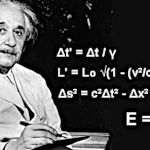 Special relativity equations (1905)
 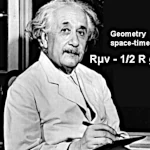 The equation of general relativity (1915)
  Planetary Rotation Equations: Between Angular Momentum and Gravitational Balance
  Equation of the orbital velocity of a planet
 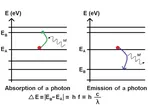 Planck's equation
  Understanding Schrödinger's Equation Without Math
 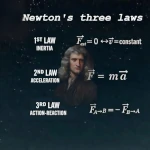 Newton's Three Laws: From the Falling Apple to the Orbiting Planets
  Maxwell's equations
  Paul Dirac's equation
 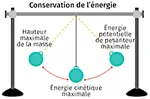 Conservation of energy: A fundamental principle of physics
  Equation of electromagnetic induction
 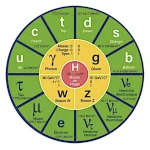 Why do elementary particles have no mass?