


Newton's Three Laws: From the Falling Apple to the Orbiting Planets
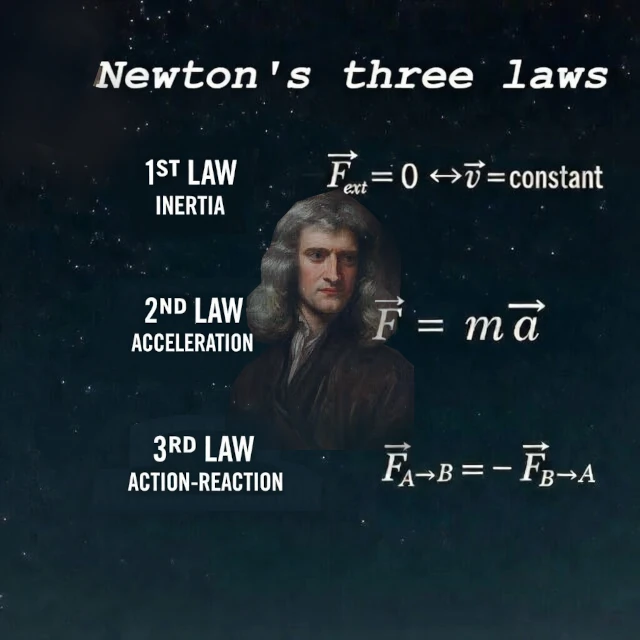
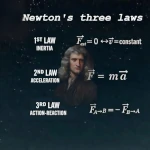
Portrait of Isaac Newton (1643-1727) and the three laws of motion: inertia, acceleration, and action-reaction.
Image source: astronoo.com (new window)
First Law: The Principle of Inertia
Every body persists in its state of rest or uniform rectilinear motion unless acted upon by an external force. This first law, also called the principle of inertia (property of a body to maintain its state of motion unless acted upon by a force), establishes that velocity does not change without cause. In the universe, a planet continues its orbit not because a force pushes it, but because no force slows it down.
If the sum of external forces is zero, so is the acceleration: \( \boldsymbol{\sum \vec{F}_{\text{ext}} = 0 \quad \Longleftrightarrow \quad \vec{v} = \text{constant}} \)
Concrete example: A cup placed on a table remains still as long as the forces acting on it are balanced. In interstellar space, a probe launched at 50,000 km/h continues indefinitely at the same speed, never slowing down, because no force opposes its motion.
Second Law: The Relationship Between Cause and Effect
The second law directly links the cause (force) to the effect (acceleration). In a Galilean reference frame (reference frame (point of view linked to a reference object) not accelerated, in uniform translation relative to distant stars), the sum of the forces applied to a material object is equal to the product of its mass and the acceleration it undergoes. The greater its mass, the harder it is to change its motion. This resistance to change is called inertia. The causal relationship is now explicit: a force always produces an acceleration in the direction in which it acts: \( \boldsymbol{\sum \vec{F} = m \cdot \vec{a}} \)
Concrete example: An empty shopping cart is easily set in motion with a gentle push, but when loaded with groceries, much more force is needed to move it. Tripling the mass requires tripling the force for the same effect.
Third Law: Action and Reaction
Action is always equal to reaction. When body A exerts a force on body B, the latter simultaneously exerts on A a force of the same intensity, same direction, but opposite sense. These two forces act on different bodies, so they do not cancel each other out: \( \boldsymbol{\vec{F}_{A \to B} = - \vec{F}_{B \to A}} \)
Concrete example: A rocket ejects burning gases downward at high speed (action). In reaction, these gases exert an upward thrust of equal intensity on the rocket, propelling it into space. Even in the vacuum of space, where there is no air to push against, this principle remains fully effective because the forces act directly between the rocket and the ejected gases. This principle does not require any external support, contrary to popular belief. When the fuel is exhausted, the rocket maintains its speed in the vacuum of space (first law), continuing its trajectory without slowing down.
Summary of the Laws of Motion
The three laws form a coherent system. The first defines the framework (inertial reference frame). The second quantifies the dynamic relationship. The third ensures the conservation of momentum in an isolated system. Together, they describe all movements, from the fall of an apple to planetary trajectories.
N.B.:
These laws, published in 1687 in the Philosophiæ Naturalis Principia Mathematica, marked the birth of classical mechanics.
Their formulation has remained unchanged since the 17th century, proof of their robustness.
| Law | Statement | Formula | Example |
|---|---|---|---|
| First law (inertia) | A body remains at rest or in uniform rectilinear motion if no force acts on it. | \(\sum \vec{F} = 0 \Rightarrow \vec{v} = \text{cte}\) | A space probe in interstellar vacuum |
| Second law (dynamics) | The sum of the forces is equal to the product of mass and acceleration. | \(\sum \vec{F} = m \cdot \vec{a}\) | Pushing a broken-down car |
| Third law (action-reaction) | Every action has an equal and opposite reaction. | \(\vec{F}_{A \to B} = - \vec{F}_{B \to A}\) | Recoil of a gun when fired |
 Full text of Einstein's 1905 article on the nature and evolution of light
  The Speed of Light: The Ultimate Limit That Nothing Can Exceed
  Reality Escapes Us: Truths We Can Never Prove
 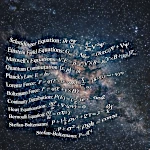 The Physics of the Universe in 50 Equations: User Guide
 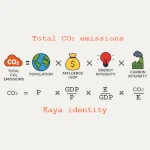 The Kaya Identity: The Equation Complicating Our Decarbonization
  The Unsurpassable Speed in the Universe: When Energy Becomes Infinite
 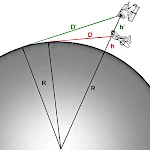 How far is the horizon?
 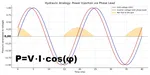 How Do Solar Panels Inject Electricity into the Grid?
 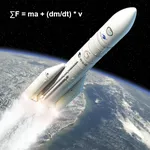 Dynamics of Momentum to explain the propulsion of rockets or jellyfish
 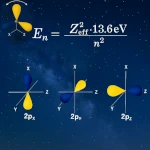 How Electron Energy Dictates Chemical Properties
  How to weigh the sun?
 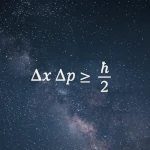 The Key Role of Quantum Uncertainty: No Particle Can Be at Rest
 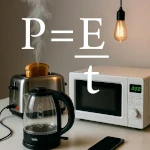 Energy and Power: Don't Confuse Them, Time Makes All the Difference
  Why is there a limit to cold, but not to heat?
 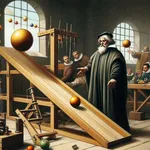 Galileo's Law of Falling Bodies
 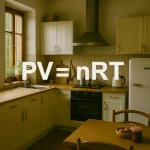 The Ideal Gas Law: One Equation, Thousands of Applications
 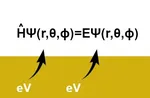 Schrödinger's Equation Revolutionized Our View of Matter
 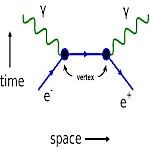 Feynman Diagram: Visualizing Particle Physics
 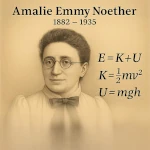 The Magic of Noether's Theorem: From the Principle of Least Action to Conservation Laws
  Relationship between gravitational mass and inertial mass and the equivalence principle
 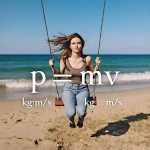 Third Equation of Physics: Momentum to Understand Collisions
 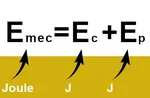 The second essential equation in physics: The intuition of a conserved quantity
 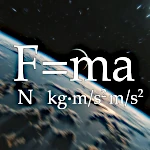 The First Equation of Physics: How to Mathematize Force
 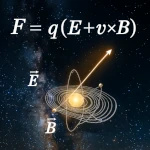 The electromagnetic force or Lorentz force
 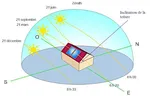 The solar energy received depends on the angle of incidence
  Why is marble colder than wood?
 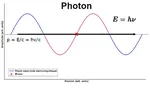 Why does a photon, which has no mass, have energy?
 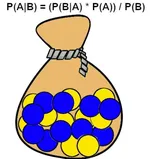 Bayes Formula and Artificial Intelligence
 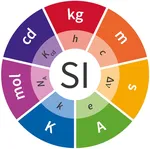 The seven fundamental constants of physics
 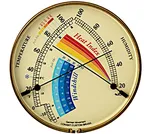 What temperature does it feel like in interstellar space?
 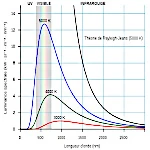 Black body radiation curves: Planck's law
  The equivalence principle, gravitational effects are indistinguishable from acceleration
  The consequences of E=mc2 for our understanding of the Universe
  How to weigh the sun?
  Equation of the free fall of bodies (1604)
 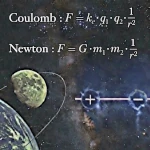 Coulomb vs Newton: The Mysterious Similarity of the Universe's Forces
 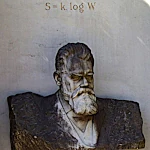 Boltzmann's equationon entropy (1877)
 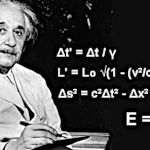 Special relativity equations (1905)
 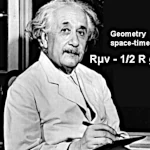 The equation of general relativity (1915)
  Planetary Rotation Equations: Between Angular Momentum and Gravitational Balance
  Equation of the orbital velocity of a planet
 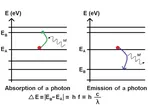 Planck's equation
  Understanding Schrödinger's Equation Without Math
  Newton's Three Laws: From the Falling Apple to the Orbiting Planets
  Maxwell's equations
  Paul Dirac's equation
  Conservation of energy: A fundamental principle of physics
  Equation of electromagnetic induction
  Why do elementary particles have no mass?