


The Kaya equation: The equation that complicates our decarbonization
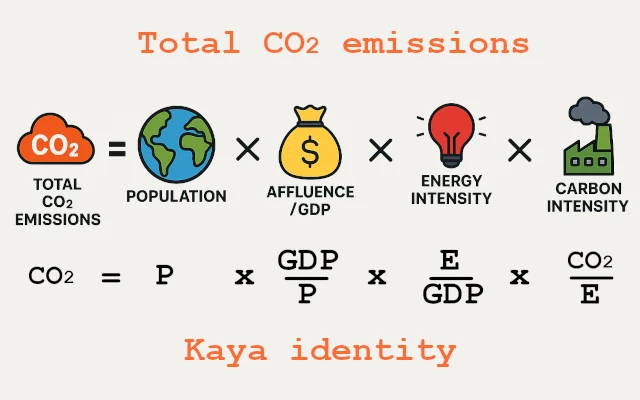
Illustration of the Kaya equation (Kaya identity) showing the four factors (Population, Wealth/GDP, Energy intensity, Carbon intensity) which, multiplied together, determine total CO2 emissions. In reality, these variables are strongly coupled.
Image source: astronoo.com (new window) — AI-generated image, public domain.
Scientific abstract
The article presents the Kaya equation, an accounting identity that decomposes global CO₂ emissions into four multiplicative factors: Population × GDP/capita × Energy/GDP × CO₂/Energy. This formula helps visualize the four climate action levers: population (P), prosperity per capita (g), energy intensity (e) and carbon intensity (f). To meet climate objectives, both most actionable levers must be acted upon simultaneously: sharply reducing energy intensity (efficiency) and decarbonizing the energy mix (f), while managing demographic trends and economic growth. The equation structures IPCC scenarios and illustrates the scale of the challenge: halving emissions by 2050 requires multiplying the current pace of decarbonization by 7 to 10.
What is the Kaya equation and how does it illuminate the climate challenge?
The Kaya equation is an accounting identity that decomposes global CO₂ emissions into four multiplicative factors: CO₂ = Population × (GDP/capita) × (Energy/GDP) × (CO₂/Energy). It helps visualize the four climate action levers: population (P), prosperity per capita (g), energy intensity (e = energy efficiency) and carbon intensity of energy (f = decarbonization). To meet climate objectives (e.g., halving emissions by 2050), both most actionable levers must be acted upon simultaneously: sharply reducing energy intensity (e) and decarbonizing the energy mix (f), while managing demographic trends and economic growth.
Also worth exploring
Continue your exploration of the Universe with these topics:
Also discover
Continue your exploration of the Universe with these topics:
- Hominins: 7 Million Years of Human Evolution
- Size of atoms: Unsuspected orders of magnitude
- Blue Giants and Red Supergiants: Life and Death
- Hadean: the first era of Earth
Understanding the roots of CO2 emissions
To act effectively against climate change, we must first understand its root causes. Greenhouse gas emissions, mainly carbon dioxide (CO2), are not the result of chance, but the direct consequence of our economic and energy activities.
The Kaya equation, named after the Japanese economist Yoichi Kaya (1934-2020), offers a clear mathematical framework for decomposing this complex phenomenon into key factors. This relation is not a predictive model, but an accounting identity that allows us to analyze the possible levers of action against climate change.
This identity, developed at the end of the 20th century, has become a fundamental tool for the IPCC (Intergovernmental Panel on Climate Change) and policymakers. It allows modeling future emission scenarios and identifying possible levers of action.
The Kaya formula
The Kaya equation establishes a multiplicative relationship between global CO2 emissions and four socio-economic and technological factors: \( \text{CO2} = \text{Population} \times \frac{\text{GDP}}{\text{Population}} \times \frac{\text{Energy}}{\text{GDP}} \times \frac{\text{CO2}}{\text{Energy}} \)
For greater clarity, it is often rewritten by defining intermediate ratios: \( \text{CO2 emissions} = \text{P} \times \text{g} \times \text{e} \times \text{f} \)
- P: Population (number of inhabitants).
- g: GDP per capita (economic wealth/prosperity).
- e: Energy intensity (amount of energy consumed per unit of GDP). This is an indicator of the energy efficiency of an economy.
- f: Carbon intensity of energy (amount of CO2 emitted per unit of energy consumed). This factor depends on the energy mix (combination of energy sources used (coal, gas, oil, nuclear, renewables…)).
N.B.:
The Kaya equation is an identity, not an equation in the strict sense.
This means it is always true by mathematical construction; it serves to organize thought and quantify the relative contributions of each factor,
and not to predict the future deterministically.
The four levers of climate action
The strength of the Kaya equation is that it highlights the four major levers on which it is possible to act to reduce CO2 emissions:
1. Population (P): A delicate and long-term lever, linked to demographic, education and health policies. Population growth mechanically amplifies the other factors.
2. Prosperity per capita (g): Reducing this factor means giving up economic growth, a politically and socially complex option. The challenge is rather to decouple growth from emissions.
3. Energy intensity (e): This is the lever of energy efficiency. Reducing 'e' means producing the same wealth with less energy, thanks to technological innovation (buildings, transport, industry) and behavioral changes.
4. Carbon intensity of energy (f): This is the most powerful and direct lever. Reducing 'f' implies decarbonizing the energy mix by replacing fossil fuels (coal, oil, gas) with low-carbon energies (renewables, nuclear).
| Factor (Symbol) | Meaning | Objective to reduce CO2 | Main means of action |
|---|---|---|---|
| Population (P) | Total number of inhabitants | Long-term stabilization | Education, health, family planning |
| GDP/capita (g) | Standard of living / Economic wealth | Decouple growth and emissions | Circular economy, sufficiency |
| Energy intensity (e) | Energy consumed per unit of GDP | Decrease (efficiency) | Building insulation, efficient engines, digital technology |
| Carbon intensity (f) | CO2 emitted per unit of energy | Sharp decrease (decarbonization) | Renewable energies, nuclear, CO2 capture |
Limits and criticisms of the model: Its simplicity is also its weakness
While the Kaya equation is a valuable pedagogical and analytical tool, it has certain limitations.
It focuses solely on energy-related CO2, leaving aside other greenhouse gases (water vapor, methane, nitrous oxide) or emissions linked to land use (deforestation). The simplicity of this identity does not account for the complex interactions and feedbacks (positive or negative) between factors. For example, energy efficiency gains (lower 'e') can sometimes lead to increased consumption (rebound effect (phenomenon where efficiency gains lead to an increase in overall resource consumption)), partially canceling out the benefit. Likewise, an increase in temperature due to CO2 emissions can increase the concentration of water vapor in the atmosphere (a powerful greenhouse gas), creating a positive feedback that amplifies the initial warming, a phenomenon the equation does not capture. It says nothing about the technical, economic or political feasibility of reducing each factor.
The factorization implicitly assumes that population, wealth, energy intensity and carbon intensity are independent. In reality, these variables are strongly coupled.
From theory to practice: the Kaya equation facing climate objectives
A compass for IPCC scenarios
Despite its limitations, the Kaya equation structures the construction of emission scenarios used by the IPCC to project climate evolution. The different scenarios (SSP1-1.9, SSP2-4.5, SSP5-8.5…) correspond to contrasting trajectories for each of the four factors. For example, the very ambitious SSP1-1.9 scenario assumes a population (P) that peaks and then declines slightly, moderate but sustainability-oriented economic growth (g), a very rapid improvement in energy efficiency (e) and an extremely rapid decarbonization of the energy system (f). Conversely, a high-emission scenario like SSP5-8.5 projects strong growth in P and g, combined with limited progress on e and f, leading to a very high P×g×e×f product.
The scale of the challenge in figures
A strong mitigation scenario (limiting warming to 1.5°C) necessarily implies a very rapid and deep decrease in carbon intensity (f) and energy intensity (e), partially offsetting the expected growth in population (P) and wealth per capita (g). For example, to halve global emissions by 2050 compared to 2020, while assuming moderate growth in P (about +20%) and g (about +80%), calculations show that energy intensity (e) would need to be reduced by about 40% and, above all, carbon intensity (f) divided by more than 4. This concretely illustrates the equation: CO2 = P×g×e×f must decrease by half, despite the increase in P and g, thanks to drastic reductions in e and f.
Although these figures may seem discouraging, they define a precise framework for action. The decline in energy intensity is already underway in many countries thanks to technological progress, and the decarbonization potential of the energy mix (lower 'f') is immense with renewable energies and nuclear power. The challenge is less technological than political and economic: it is about carrying out this transition at an unprecedented speed and scale.
| Kaya factor | Current trend (approx.) | 2050 objective (1.5°C) | Additional effort required | Examples of concrete measures |
|---|---|---|---|---|
| Population (P) | +0.8% / year | +0.5% / year (stabilization) | Accelerate demographic transition through education and access to rights | Girls' education, reproductive health, family planning |
| GDP/capita (g) | +1.5% to +2% / year | Decouple growth and emissions | Halve the carbon intensity of growth | Circular economy, services, material sufficiency |
| Energy intensity (e) | -1.5% / year | -3% to -4% / year | Double the pace of efficiency gains | Massive building renovation, electric vehicles, Industry 4.0 |
| Carbon intensity (f) | -1% / year | -7% to -10% / year | Multiply the pace of decarbonization by 7 to 10 | Triple renewables by 2030, coal phase-out, green hydrogen, nuclear |
Which levers are truly actionable?
- Most actionable lever: Carbon intensity (f)
Decarbonizing the energy mix is technologically mature (solar, wind, nuclear) and economically viable. It is the lever on which the international community agrees most, through agreements on renewable energies. - Very actionable lever: Energy intensity (e)
Energy efficiency technologies exist (insulation, high-performance engines, LEDs). The main obstacle is economic (initial cost) and regulatory (building standards). - Partially actionable lever: Prosperity (g)
Decoupling economic growth from emissions is possible, but politically sensitive. Sufficiency (consuming less but better) is an accepted concept, but its large-scale implementation faces enormous cultural and economic resistance. - Little directly actionable lever: Population (P)
Acting on demography raises major ethical questions and is a long-term matter. Positive measures (education, women's empowerment, health) are effective but slow. No coercive policy is acceptable in a democratic framework and human rights.
Thus, the realistic climate strategy focuses mainly on an accelerated transformation of factors 'e' and 'f', while accompanying a natural evolution of 'P' and orienting growth 'g' toward more sober models. The Kaya equation shows that success relies on an exponential improvement in our energy efficiency and the cleanliness of our energy.
References
- IPCC: AR6, Climate Change 2022 – Mitigation (new window)
- IPCC: trends and drivers of emissions (new window)
- IPCC: Kaya decomposition of CO₂ emissions (new window)
- IPCC: Kaya identity and IPAT identity (new window)
- International Energy Agency: Net Zero by 2050 (new window)
- International Energy Agency: Net Zero by 2050 scenario data (new window)
- International Energy Agency: Net Zero Roadmap (new window)
- UN: World Population Prospects 2024 (new window)
- UN: World Population Prospects 2024 dataset (new window)
- Institute and Faculty of Actuaries: The Kaya Identity (new window)
- Renewable and Sustainable Energy Reviews: Kaya Identity for Analysis of GHG Emissions (new window)
FAQ: Everything you need to know about the Kaya equation
Why is the Kaya equation an "identity" and not a predictive equation?
The Kaya equation is an accounting identity, always true by mathematical construction. It does not predict the future, but decomposes CO₂ emissions into four factors (population, wealth, energy intensity, carbon intensity). Its purpose is to organize thought and quantify the relative contributions of each factor, thereby identifying levers of action and building coherent emission scenarios (such as those of the IPCC).
What are the four levers of the Kaya equation and which is the most effective?
The four levers are: 1) population (P) (ethically sensitive long-term lever), 2) prosperity per capita (g) (decouple growth and emissions), 3) energy intensity (e) (improve energy efficiency), and 4) carbon intensity of energy (f) (decarbonize the energy mix). The most powerful and directly actionable lever is carbon intensity (f): replacing fossil fuels with low-carbon energies (solar, wind, nuclear) is technologically mature and economically viable. Energy intensity (e) is also very actionable (insulation, efficient engines).
What are the main limitations of the Kaya equation?
The Kaya equation has several limitations: it only considers energy-related CO₂, ignoring other greenhouse gases (methane, nitrous oxide) and emissions linked to land use. It assumes that the four factors are independent, whereas they are strongly coupled (for example, the rebound effect where energy efficiency gains can lead to increased consumption). Finally, it does not capture the complex feedbacks of the climate system (such as the increase in water vapor with temperature) and says nothing about the political, economic or technical feasibility of reducing each factor.
 Full text of Einstein's 1905 article on the nature and evolution of light
  The Speed of Light: The Ultimate Limit That Nothing Can Exceed
  Reality Escapes Us: Truths We Can Never Prove
  The Physics of the Universe in 50 Equations: User Guide
  The Kaya Identity: The Equation Complicating Our Decarbonization
  The Unsurpassable Speed in the Universe: When Energy Becomes Infinite
  How far is the horizon?
  How Do Solar Panels Inject Electricity into the Grid?
  Dynamics of Momentum to explain the propulsion of rockets or jellyfish
  How Electron Energy Dictates Chemical Properties
  How to weigh the sun?
  The Key Role of Quantum Uncertainty: No Particle Can Be at Rest
  Energy and Power: Don't Confuse Them, Time Makes All the Difference
  Why is there a limit to cold, but not to heat?
  Galileo's Law of Falling Bodies
  The Ideal Gas Law: One Equation, Thousands of Applications
  Schrödinger's Equation Revolutionized Our View of Matter
  Feynman Diagram: Visualizing Particle Physics
  The Magic of Noether's Theorem: From the Principle of Least Action to Conservation Laws
  Relationship between gravitational mass and inertial mass and the equivalence principle
  Third Equation of Physics: Momentum to Understand Collisions
  The second essential equation in physics: The intuition of a conserved quantity
  The First Equation of Physics: How to Mathematize Force
  The electromagnetic force or Lorentz force
  The solar energy received depends on the angle of incidence
  Why is marble colder than wood?
  Why does a photon, which has no mass, have energy?
  Bayes Formula and Artificial Intelligence
  The seven fundamental constants of physics
  What temperature does it feel like in interstellar space?
  Black body radiation curves: Planck's law
  The equivalence principle, gravitational effects are indistinguishable from acceleration
  The consequences of E=mc2 for our understanding of the Universe
  How to weigh the sun?
  Equation of the free fall of bodies (1604)
  Coulomb vs Newton: The Mysterious Similarity of the Universe's Forces
  Boltzmann's equationon entropy (1877)
  Special relativity equations (1905)
  The equation of general relativity (1915)
  Planetary Rotation Equations: Between Angular Momentum and Gravitational Balance
  Equation of the orbital velocity of a planet
  Planck's equation
  Understanding Schrödinger's Equation Without Math
  Newton's Three Laws: From the Falling Apple to the Orbiting Planets
  Maxwell's equations
  Paul Dirac's equation
  Conservation of energy: A fundamental principle of physics
  Equation of electromagnetic induction
  Why do elementary particles have no mass?