


The secret of the speed of light: electromagnetic runaway
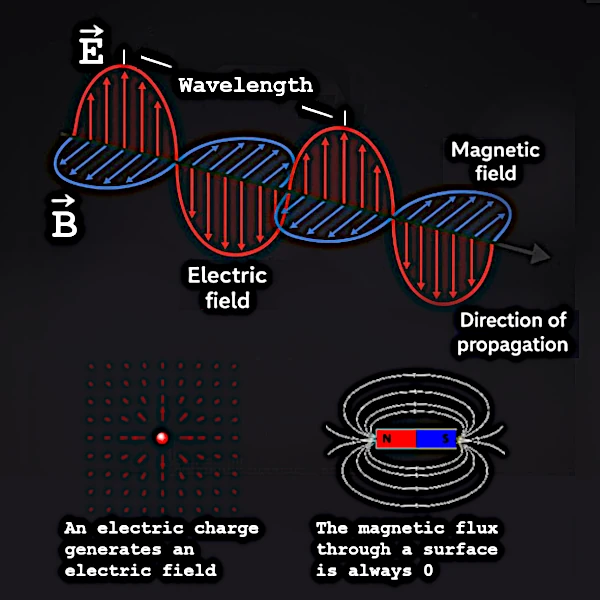
Schematic representation of a plane electromagnetic wave.
The electric field \(\mathbf{E}\) (in red) and the magnetic field \(\mathbf{B}\) (in blue) oscillate perpendicular to each other and to the direction of propagation (brown arrow).
This visualization illustrates the fundamental coupling described by Maxwell's equations.
Image source: astronoo.com (new window) — AI-generated image, public domain.
Scientific abstract
The article explains the phenomenon of "electromagnetic runaway" at the origin of the speed of light. This self-sustaining dynamic coupling between the electric and magnetic fields follows from Maxwell's equations: Faraday's law (∇×E = −∂B/∂t) and the Ampère-Maxwell law (∇×B = μ₀ε₀ ∂E/∂t). By combining these equations, Maxwell obtained a wave equation whose propagation speed is v = 1/√(μ₀ε₀). Calculating this value with the vacuum constants (μ₀ = 4π×10⁻⁷ N·A⁻², ε₀ ≈ 8.854×10⁻¹² C²·N⁻¹·m⁻²), he found v ≈ 300,000 km/s, exactly the speed of light. He thus demonstrated that light is an electromagnetic wave. The notion of a universal speed limit would only be established with Einstein's special relativity (1905).
What is "electromagnetic runaway" and how does it explain the speed of light?
"Electromagnetic runaway" refers to the phenomenon by which a time-varying electric field creates a magnetic field, and vice versa, according to Maxwell's equations. This self-sustaining dynamic coupling produces an electromagnetic wave that propagates through vacuum without the need for additional energy. By combining Faraday's law (∇×E = −∂B/∂t) and the Ampère-Maxwell law (∇×B = μ₀ε₀ ∂E/∂t), Maxwell obtained a wave equation whose propagation speed is v = 1/√(μ₀ε₀). Calculating this value with the vacuum constants (μ₀ = 4π×10⁻⁷ N·A⁻², ε₀ ≈ 8.854×10⁻¹² C²·N⁻¹·m⁻²), he found v ≈ 300,000 km/s, exactly the speed of light. He thus demonstrated that light is an electromagnetic wave.
Also worth exploring
Continue your exploration of the Universe with these topics:
The 4 Maxwell's equations
All electromagnetic phenomena reduce to a system of four fundamental relations: Maxwell's equations. On their own, these equations predict everything about the dynamics of electric and magnetic fields.
-
Gauss's law for electricity: \(\nabla \cdot \mathbf{E} = \dfrac{\rho}{\varepsilon_0}\)
(The divergence of the electric field is proportional to the charge density \(\rho\) → an electric charge creates an electric field around it)
-
Gauss's law for magnetism: \(\nabla \cdot \mathbf{B} = 0\)
(The net magnetic flux through a closed surface is zero → magnetic field lines form closed loops, there are no magnetic monopoles)
-
Faraday's law: \(\nabla \times \mathbf{E} = -\frac{\partial \mathbf{B}}{\partial t}\)
(Any variation of the magnetic field in time creates a rotating electric field)
- Ampère–Maxwell law: \(\nabla \times \mathbf{B} = \mu_0 \varepsilon_0 \frac{\partial \mathbf{E}}{\partial t}\) (A time-varying electric field in turn creates a magnetic field)
The last two equations are the key to the mystery of runaway. A time-varying magnetic field (\( \partial \mathbf{B}/\partial t \)) creates a rotating electric field. Symmetrically, a time-varying electric field (\( \partial \mathbf{E}/\partial t \)) creates a rotating magnetic field. It is this dynamic coupling that sustains itself throughout their propagation.
Maxwell and the discovery of the speed of light
When James Clerk Maxwell (1831–1879) unified the laws of electricity and magnetism in the 19th century, he discovered a surprising phenomenon: a local disturbance of an electric or magnetic field creates a wave that propagates all by itself in vacuum, without the need for additional energy.
The wave equation and the prediction of the speed of light
Maxwell showed that this wave travels at a finite speed, determined by two properties of vacuum:
The formula \( c = \frac{1}{\sqrt{\mu_0 \varepsilon_0}} \) gives this speed.
- μ₀: the vacuum's ability to carry a magnetic field
- ε₀: the vacuum's ability to let an electric field pass through
Light, an electromagnetic wave
By combining Faraday's and Ampère-Maxwell's laws, he obtained a wave equation. Inserting the values of μ₀ and ε₀, he found: \( c \approx 300\,000 \) km/s, the speed of light!
Maxwell's conclusion
In 1865, Maxwell concluded that light is an electromagnetic wave, just like radio waves or microwaves. A discovery that revolutionized physics.
N.B.:
In Maxwell's time (1865), the speed of light was not yet known with great precision.
The experimental measurements available, made notably by Armand Fizeau (1819-1896) and Albert Michelson (1852-1931), made it possible to estimate \( v \) with a significant margin of error.
Maxwell's theoretical calculation therefore gave a value very close to what would be confirmed later, which constituted an impressive validation of his theory.
Calculation of the propagation speed of the E and B fields
When Maxwell assembled the laws of electricity and magnetism, he discovered a structure that sustains itself as soon as one locally disturbs an electric or magnetic field. This "runaway" is stable, without amplification, and has no internal energy source. Vacuum carries the wave without feeding it.
The wave equation and the prediction of the speed of light
This dynamic loop between \( \mathbf{B} \) and \( \mathbf{E} \) produces a structure that propagates through vacuum at a finite speed.
The term \(\mu_0 \varepsilon_0\) of the fourth equation fixes the speed of light: \( c = \frac{1}{\sqrt{\mu_0 \varepsilon_0}}. \)
- \( \mu_0 \) = vacuum permeability constant, or the vacuum's ability to carry a magnetic field
- \( \varepsilon_0 \) = vacuum electric permittivity constant, or the vacuum's ability to let an electric field "pass"
Obtaining the electromagnetic wave equation
By mathematically combining Faraday's and Ampère-Maxwell's laws (taking the curl of one and using the other), the coupling is eliminated to obtain an equation describing each field alone.
Wave equation for the electric field
For the electric field, we find: \( \nabla^2 \mathbf{E} = \mu_0 \varepsilon_0 \frac{\partial^2 \mathbf{E}}{\partial t^2} \) This is the classical form of the wave equation. The term \( \mu_0 \varepsilon_0 \) appears in front of the second time derivative. In mathematical physics, the standard wave equation is written \( \nabla^2 \psi = \frac{1}{v^2} \frac{\partial^2 \psi}{\partial t^2} \), where \( v \) is the propagation speed.
Identification with the speed of a wave
By immediate identification: \( \frac{1}{v^2} = \mu_0 \varepsilon_0 \quad \Rightarrow \quad v = \frac{1}{\sqrt{\mu_0 \varepsilon_0}} \)
Result of the calculation: Light is an electromagnetic wave
Maxwell calculated this value with the constants known in his time:
- \( \mu_0 = 4\pi \times 10^{-7} \, \text{N} \cdot \text{A}^{-2} \)
- \( \varepsilon_0 \approx 8.854 \times 10^{-12} \, \text{C}^{2} \cdot \text{N}^{-1} \cdot \text{m}^{-2} \)
The result is astonishing: \( v \approx 2.998 \times 10^{8} \, \text{m/s} \), the speed of the waves corresponds to the speed of light measured experimentally!
N.B.:
This mathematical demonstration assumes vacuum, that is, the absence of charges and currents (\( \rho = 0, \, \mathbf{J} = 0 \)). The reasoning consists in taking the curl of Faraday's law and using the vector identity \( \nabla \times (\nabla \times \mathbf{E}) = \nabla(\nabla \cdot \mathbf{E}) - \nabla^2 \mathbf{E} \), combining it with Gauss's law (\( \nabla \cdot \mathbf{E} = 0 \) in vacuum) and the Ampère-Maxwell law. One thus obtains the same wave equation for the magnetic field \( \mathbf{B} \). This theoretical prediction by James Clerk Maxwell (1831-1879) in 1865 was confirmed experimentally by Heinrich Hertz (1857-1894) in 1887, when he produced the first radio waves (electromagnetic waves).
Limits of Maxwell's equations
Maxwell found that electromagnetic waves propagate at a certain speed in vacuum, but the demonstration that this is a limiting speed. Maxwell did not yet know relativity. He therefore had no reason to think that this was a universal speed limit. The notion of a universal limit only appeared with special relativity, well after Maxwell.
It was only with special relativity (1905) by Albert Einstein (1879-1955) that the speed of light in vacuum \( c \) was recognized as the **maximum speed at which information, energy or any physical interaction can propagate**. In other words, \( c \) is a **fundamental limit imposed by the structure of spacetime**, and not a simple consequence of Maxwell's equations.
Key takeaways
Electromagnetic phenomena obey Maxwell's equations and can be summarized as follows:
- An electric charge (electric charge) creates an electric field around it.
- A time-varying magnetic field generates an electric field.
- A time-varying electric field in turn creates a magnetic field.
- These two fields sustain each other, propagating through space as electromagnetic waves at the speed of light.
Thus, light and all electromagnetic waves are nothing other than the manifestation of this phenomenon of self-sustaining electric and magnetic fields in vacuum.
References
- NASA Science - Electromagnetics: electromagnetic radiation and the speed of light (new window)
- OpenStax - Maxwell's Equations and Electromagnetic Waves (new window)
- OpenStax - Plane Electromagnetic Waves: speed 𝑐 (new window)
- The Feynman Lectures on Physics - The Maxwell Equations (new window)
- BIPM - The metre and the exact value of the speed of light in vacuum (new window)
- NASA - Electromagnetic Waves: displacement current and electromagnetic wave (new window)
- NCERT - Electromagnetic Waves: Maxwell, Hertz and the unification of light (new window)
- CNRS Éditions - Energy and light: light as an electromagnetic wave (new window)
FAQ: Everything you need to know about electromagnetic runaway
What exactly is called "electromagnetic runaway"?
The expression designates the self-sustaining coupling between the electric field and the magnetic field. A time-varying electric field creates a time-varying magnetic field (Ampère-Maxwell law), which in turn creates a time-varying electric field (Faraday's law). Once the wave is launched, this cycle regenerates itself without the need for charges or currents: the fields "relaunch" each other and move through vacuum at speed c.
What is light according to Maxwell?
According to the equations of James Clerk Maxwell (1831-1879), light is a self-propagating transverse electromagnetic wave with electric and magnetic components where the electric and magnetic fields oscillate at right angles to each other and propagate perpendicular to the direction in which they move indefinitely unless absorbed by intervening matter. In other words, each type of field — electric and magnetic — generates the other in order to propagate the whole composite structure through empty space at the finite speed of light.
How did Maxwell calculate the speed of light from electrical and magnetic constants?
By combining Faraday's law and the Ampère-Maxwell law, Maxwell obtained a wave equation: ∇²E = μ₀ε₀ ∂²E/∂t². By identification with the classical wave equation ∇²ψ = (1/v²) ∂²ψ/∂t², the propagation speed is v = 1/√(μ₀ε₀). Using the vacuum values μ₀ = 4π×10⁻⁷ N·A⁻² (magnetic permeability) and ε₀ ≈ 8.854×10⁻¹² C²·N⁻¹·m⁻² (electric permittivity), he found v ≈ 2.998×10⁸ m/s, that is, the experimentally measured speed of light. Maxwell thus discovered that light is an electromagnetic wave.
Why is the speed of light a universal limit and not a simple electromagnetic constant?
Maxwell demonstrated that electromagnetic waves propagate at speed c = 1/√(μ₀ε₀) in vacuum, but he had no reason to think that c was a speed limit. This notion only appeared with Einstein's special relativity (1905). In this theory, c becomes the maximum speed of propagation of information, energy and any physical interaction, imposed by the very structure of spacetime. It is therefore no longer a simple consequence of Maxwell's equations, but a fundamental principle of physics.
Why does light not need a material medium to propagate?
Maxwell's equations show that the electromagnetic wave propagates in vacuum thanks to the electric and magnetic fields, without a material support. The old concept of the luminiferous aether became useless: the Michelson-Morley experiment detected no such medium. Special relativity then confirmed that c is a constant of vacuum, independent of the observer's motion.
Does the speed of light change in a material medium?
Yes. In a material medium, the effective permeability and permittivity become μ = μr μ0 and ε = εr ε0, which gives a propagation speed v = 1/√(με) = c/n, where n is the refractive index. The speed c nevertheless remains the limiting speed in vacuum, and not a simple phase speed in matter.
 Why does infrared pass through dust clouds?
  The Perception of Radiant Cold Explained by Physics
  Sprites and Cosmic Rays: The Ghostly Lightning of the Atmosphere
  Principle of absorption and emission of a photon
  The Femtosecond Laser: From Ultra-Short Time to Extreme Power
  The World of Color
  The secret of the speed of light: electromagnetic runaway
  Rainbow: formation, colors and types of arcs explained
  Photoelectric effect: Einstein, photons and electrons
  The Nature of Light
  Plasma Lamp and Field Concept
  What is Vantablack?
  Michelson-Morley Experiment
  Redshift calculation (z)
  All the Light of the Electromagnetic Spectrum
  Solar Pillars: Celestial Mirages and Light Phenomena
  The Speed of Light: A Universal Constant
  The incredible precision of the second
  Aberration of Light: The Great Gathering, Blueshift, and Dazzling
  Why do elementary particles have no mass?
  Polar Auroras: Light, Magnetism and Solar Activity
  Gravitational Lenses: When Spacetime Becomes a Mirage
  Optical Illusions: Deceptions and Mysteries of Visual Perception
  Traveling Light: How a Photon Leaves the Sun to Reach Earth?
  Bioluminescence of living organisms
  Laser light
  We do not see with our eyes but with our brain
  Zodiacal Light: Reflection of Interplanetary Dust
  The Antitwilight Arch: Earth's Shadow
  How many photons to heat a cup of coffee?
  Biosignatures: Presence of Life in the Universe
  Spectroscopy: A Key to Analyzing the Invisible World
  Field concept in physics
  Why is Cherenkov light blue? Explanations and physical phenomenon
  The lights of the Sun
  What is a Wave?
  Planck's equation and black body light