


Momentum Dynamics
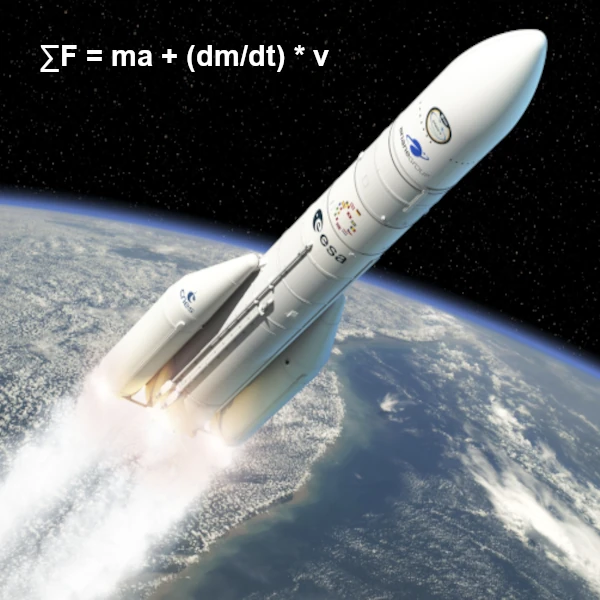
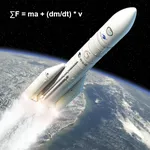
During its flight, a rocket loses mass by consuming its fuel. However, its momentum evolves under the effect of thrust, highlighting the relevance of the generalized form of the fundamental principle of dynamics.
What is Momentum?
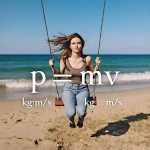
The momentum of an object is defined by: $$ \vec{p} = m \vec{v} $$
- \( \vec{p} \) is the momentum, expressed in kg·m/s,
- \( m \) is the mass of the object in kg,
- \( \vec{v} \) is the velocity of the object in m/s.
Motion in Classical Mechanics
In classical mechanics, Newton's second law represents the net force applied to an object: $$ \vec{F} = m \vec{a} $$ This law describes how force acts on an object to change its motion by producing acceleration. It is valid in inertial reference frames (non-accelerated) and for speeds much lower than the speed of light.
However, this formulation assumes that the mass \( m \) of the object is constant. For a more general description of dynamics, especially in systems where mass varies (like a rocket), it is necessary to use a more fundamental approach based on momentum \( \vec{p} \).
Momentum Theorem
"In an inertial reference frame, the time derivative of the momentum of a system is equal to the sum of the external forces applied to that system."
$$ \frac{d\vec{p}}{dt} = \sum \vec{F} $$
- \( \vec{p} \) is the momentum of the system.
- dt denotes an infinitesimal element of time, i.e., a very small variation in time.
- sum(F) represents the external forces.
General Formulation of the Principle of Dynamics
Momentum dynamics is a fundamental concept in physics that describes how forces act on a system to change its motion.
The equation (∑F = ma + (dm/dt) * v) is a form of Newton's second law applied to a variable-mass system, such as a rocket that ejects fuel.
$$ \sum \vec{F} = m \vec{a} + \frac{dm}{dt} \vec{v} $$
- ∑F: The sum of the external forces acting on the system (thrust generated by the ejection of gases + gravity + air resistance).
- ma: The product of the system's mass and its acceleration.
- (dm/dt) * v: The term that represents the variation of momentum (p=mv) due to the variation of the system's mass.
This equation accounts for a variation in mass. It is particularly useful for describing the motion of a rocket, as its mass continuously decreases by burning fuel and expelling gases. When fuel is ejected, it carries away a certain amount of momentum. For the rocket to take off, it must gain momentum in the opposite direction to the fuel ejection. This transfer of momentum allows the rocket to accelerate and take off.
In other words, thrust generates a continuous increase in speed, which in turn leads to an increase in momentum, i.e., (dm/dt) * v, despite the decrease in mass. The increase in speed thus leads to an increase in momentum, as ���� is proportional to ����. And the decrease in mass leads to a decrease in momentum (dm/dt) * v, as ���� is proportional to m.
The key to understanding why momentum increases lies in the fact that the rocket's speed increases faster than its mass decreases.
Detail of the Dynamics Calculation
By differentiating this expression with respect to time, we obtain: $$ \frac{d\vec{p}}{dt} = \frac{d}{dt} (m \vec{v}) $$ Applying the product rule: $$ \frac{d\vec{p}}{dt} = m \frac{d\vec{v}}{dt} + \frac{dm}{dt} \vec{v} $$ Since acceleration is defined by \( \vec{a} = \frac{d\vec{v}}{dt} \), this equation becomes: $$ \sum \vec{F} = m \vec{a} + \frac{dm}{dt} \vec{v} $$
- ∑F: sum of the external forces acting on the system, expressed in newtons (N),
- ma: mass of the object (in kg) times the acceleration of the center of mass (in m/s²),
- dm/dt: variation of the system's mass per unit time (in kg/s),
- v: instantaneous velocity of the center of mass (in m/s).
Real-World Examples
The dynamics equation shows that when mass varies, an additional term \( \frac{dm}{dt} \vec{v} \) must be considered. This term is crucial for explaining:
- The thrust of a rocket in flight, where the mass of the craft decreases due to the ejection of propellant gas.
- A turbojet is a dynamic variable-mass system: the mass of the incoming fluid differs from the mass exiting after combustion and acceleration. This difference is essential for generating the thrust needed for aircraft propulsion.
- The propulsion of jellyfish that expel water to move through a fluid by changing their instantaneous mass. The jellyfish loses mass because it expels the water contained in its bell.
- The mass of a hot air balloon changes due to the variation in the temperature of the air it contains. This phenomenon causes air exchanges with the outside, altering the total mass and affecting flight dynamics.
- The ejection of matter by an exploding star (supernova), where the variation in mass modifies the trajectory and speed of the outer layers.
- Icebergs breaking off from a glacier, where the loss of mass affects the stability and movement of the whole.
- …
Momentum dynamics is a more general reformulation of Newton's law, essential for understanding systems where mass varies. It plays a key role in space mechanics, aerodynamics, and fluid mechanics.
 Full text of Einstein's 1905 article on the nature and evolution of light
  The Speed of Light: The Ultimate Limit That Nothing Can Exceed
  Reality Escapes Us: Truths We Can Never Prove
  The Physics of the Universe in 50 Equations: User Guide
  The Kaya Identity: The Equation Complicating Our Decarbonization
  The Unsurpassable Speed in the Universe: When Energy Becomes Infinite
  How far is the horizon?
  How Do Solar Panels Inject Electricity into the Grid?
  Dynamics of Momentum to explain the propulsion of rockets or jellyfish
  How Electron Energy Dictates Chemical Properties
  How to weigh the sun?
  The Key Role of Quantum Uncertainty: No Particle Can Be at Rest
  Energy and Power: Don't Confuse Them, Time Makes All the Difference
  Why is there a limit to cold, but not to heat?
  Galileo's Law of Falling Bodies
  The Ideal Gas Law: One Equation, Thousands of Applications
  Schrödinger's Equation Revolutionized Our View of Matter
  Feynman Diagram: Visualizing Particle Physics
  The Magic of Noether's Theorem: From the Principle of Least Action to Conservation Laws
  Relationship between gravitational mass and inertial mass and the equivalence principle
  Third Equation of Physics: Momentum to Understand Collisions
  The second essential equation in physics: The intuition of a conserved quantity
  The First Equation of Physics: How to Mathematize Force
  The electromagnetic force or Lorentz force
  The solar energy received depends on the angle of incidence
  Why is marble colder than wood?
  Why does a photon, which has no mass, have energy?
  Bayes Formula and Artificial Intelligence
  The seven fundamental constants of physics
  What temperature does it feel like in interstellar space?
  Black body radiation curves: Planck's law
  The equivalence principle, gravitational effects are indistinguishable from acceleration
  The consequences of E=mc2 for our understanding of the Universe
  How to weigh the sun?
  Equation of the free fall of bodies (1604)
  Coulomb vs Newton: The Mysterious Similarity of the Universe's Forces
  Boltzmann's equationon entropy (1877)
  Special relativity equations (1905)
  The equation of general relativity (1915)
  Planetary Rotation Equations: Between Angular Momentum and Gravitational Balance
  Equation of the orbital velocity of a planet
  Planck's equation
  Understanding Schrödinger's Equation Without Math
  Newton's Three Laws: From the Falling Apple to the Orbiting Planets
  Maxwell's equations
  Paul Dirac's equation
  Conservation of energy: A fundamental principle of physics
  Equation of electromagnetic induction
  Why do elementary particles have no mass?