


Reality Escapes Us: Truths We Can Never Prove
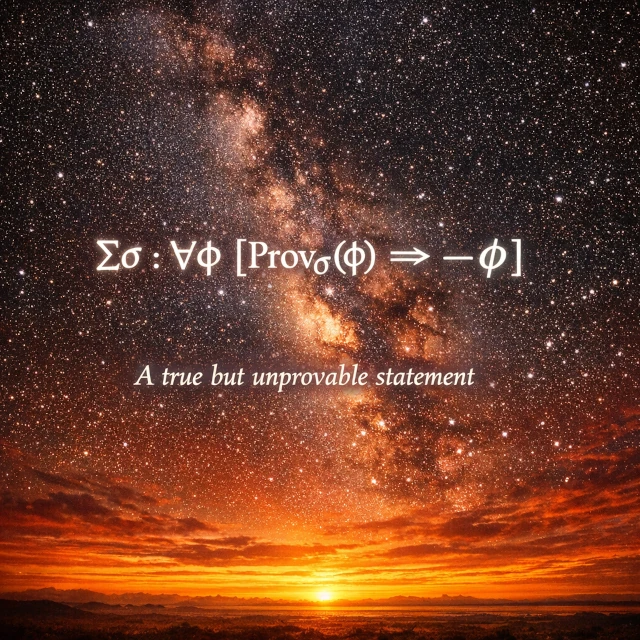
A truth without proof: at the heart of the labyrinth of knowledge, a glimmer that logic cannot grasp.
Image source: astronoo.com (new window)
Why Are Some Truths True Without Being Provable?
Because any sufficiently powerful logical system has internal limits: it inevitably contains statements that are true, yet no internal proof can establish them. This is what Gödel's incompleteness theorem reveals: as soon as a set of rules can express arithmetic, it cannot be both complete and consistent. Some truths necessarily elude it, as if logic could never fully close in on itself. This gap is not a weakness of mathematics, but a deep property of any formal language, showing that human knowledge can never capture everything from within its own systems.
The Theorem That Says "No" to Absolute Certainties
In every field where we try to understand everything, whether physics, the universe, or even human thought, some questions will always remain unanswered, some truths will always elude our theories. Even at the heart of the most abstract rigor—mathematics—there are zones of silence, statements that are true but impossible to prove. This limit is an invitation to humility, pushing us to keep our minds inventive and open. This is what Gödel's incompleteness theorem reveals.
Kurt Gödel (1906-1978), an Austrian mathematician, revolutionized our relationship with logic. His discovery, simple in appearance, is dizzying: in any formal system (i.e., without contradiction) capable of describing arithmetic, there are statements that are true but unprovable within that system. In other words: in this system, there are sentences whose truth or falsity cannot be determined, even if they are perfectly well-formed. This small flaw, far from being a disaster, is a fundamental property of logic. It makes the universe of ideas richer, more mysterious, and infinitely more interesting.
The Astronomer Trapped by His Own Galaxy
An astronomer living inside an immense galaxy has a perfect telescope, supposedly universal physical laws, and a fundamental rule: "Every observation must be confirmable by another observer located elsewhere in the universe."
He seeks to measure the exact speed of his own galaxy relative to the cosmic background. But here's the problem:
- To measure a speed, a fixed external reference point is needed.
- Any reference point he chooses (another galaxy, a quasar) is itself in motion.
- He cannot leave his galaxy to see it from the outside.
- He also cannot interpret his measurements without making an assumption about what he cannot see.
He then formulates a statement that (implicitly) says: "The speed of my galaxy cannot be measured from inside my galaxy."
This statement is true; it is a physical fact, not an opinion. But he cannot prove it with his internal instruments alone, because any proof would require stepping outside the system (the galaxy) he is studying.
What This Metaphor Teaches Us
Just as an astronomer cannot measure the speed of his own galaxy without an external point of view, a mathematical system cannot prove all its own truths. This is not a limitation of the instrument, but a property of the system itself.
Even Simpler: The Example of Copernicus
To determine if our Earth rotates, Copernicus had to change his point of view, to observe from elsewhere. But what if we want to measure the motion of the entire universe? Impossible: we have no "elsewhere." Gödel discovered the same thing in mathematics: to prove certain truths, we would have to step outside the system. And that is precisely what we cannot do.
Why Incompleteness Is Good News
If everything were provable, knowledge would be a vast, surprise-free catalog. Incompleteness reminds us that the mathematical universe—and perhaps the physical universe—contains depths that we can never exhaust. There will always be true statements, like the exact age of the universe, that our reasoning will never reach.
What to Remember
Far from being a failure, incompleteness is a window into the inexhaustible real. Every logical system, no matter how rich, leaves in the shadows truths that elude it. The limits highlighted by Gödel are therefore not an accident of arithmetic, but a deep feature of any sufficiently expressive formal system. This is how the universe, whether mathematical or physical, retains its mystery and its power to fascinate.
FAQ – Understanding Gödel's Incompleteness Theorem
What is Gödel's incompleteness theorem?
Gödel demonstrated that no logical system powerful enough to contain mathematics can be both complete and consistent. There will always be mathematical truths that cannot be proven within the system.
Why is this theorem so important?
Because it shows that mathematics cannot be based on a finite and definitive set of rules. There are structural limits to what logic can prove, even within a perfectly formalized framework.
What does "true but unprovable" mean?
Gödel constructed statements that assert their own unprovability. They are true within the system, but no internal proof can establish them. Their truth exceeds the capabilities of the system that formulates them.
Does the incompleteness theorem call mathematics into question?
No. It does not show that mathematics is false, but that it is broader than any logical framework we can define. Incompleteness is a fundamental property, not a weakness.
Are computers limited by incompleteness?
Yes. Logical machines, like computers, cannot solve certain fundamental problems, such as determining whether a program will halt in all cases. These limits directly stem from Gödel's and Turing's results.
Does the incompleteness theorem only concern mathematics?
It also touches on philosophy, artificial intelligence, and the theory of knowledge. It suggests that any formal system, even non-mathematical, has internal limits of demonstration.
Can incompleteness be bypassed?
One can extend a system by adding new axioms, but incompleteness reappears immediately in the expanded system. There is no ultimate framework that definitively eliminates these limits.
Did Gödel prove that the human mind surpasses machines?
Some philosophers interpret it this way, but it is not a necessary conclusion. The theorem only shows that formal systems have limits; it says nothing definitive about the nature of the mind.
 Full text of Einstein's 1905 article on the nature and evolution of light
  The Speed of Light: The Ultimate Limit That Nothing Can Exceed
  Reality Escapes Us: Truths We Can Never Prove
  The Physics of the Universe in 50 Equations: User Guide
 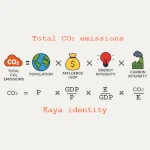 The Kaya Identity: The Equation Complicating Our Decarbonization
  The Unsurpassable Speed in the Universe: When Energy Becomes Infinite
  How far is the horizon?
  How Do Solar Panels Inject Electricity into the Grid?
  Dynamics of Momentum to explain the propulsion of rockets or jellyfish
  How Electron Energy Dictates Chemical Properties
  How to weigh the sun?
 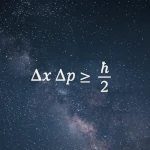 The Key Role of Quantum Uncertainty: No Particle Can Be at Rest
 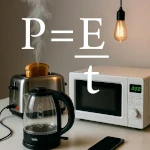 Energy and Power: Don't Confuse Them, Time Makes All the Difference
  Why is there a limit to cold, but not to heat?
  Galileo's Law of Falling Bodies
  The Ideal Gas Law: One Equation, Thousands of Applications
  Schrödinger's Equation Revolutionized Our View of Matter
 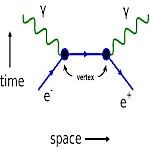 Feynman Diagram: Visualizing Particle Physics
  The Magic of Noether's Theorem: From the Principle of Least Action to Conservation Laws
  Relationship between gravitational mass and inertial mass and the equivalence principle
 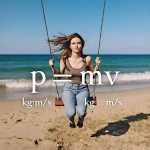 Third Equation of Physics: Momentum to Understand Collisions
 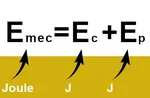 The second essential equation in physics: The intuition of a conserved quantity
 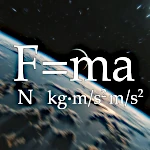 The First Equation of Physics: How to Mathematize Force
 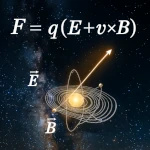 The electromagnetic force or Lorentz force
  The solar energy received depends on the angle of incidence
  Why is marble colder than wood?
  Why does a photon, which has no mass, have energy?
  Bayes Formula and Artificial Intelligence
  The seven fundamental constants of physics
  What temperature does it feel like in interstellar space?
  Black body radiation curves: Planck's law
  The equivalence principle, gravitational effects are indistinguishable from acceleration
  The consequences of E=mc2 for our understanding of the Universe
  How to weigh the sun?
 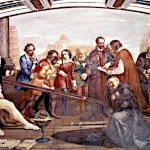 Equation of the free fall of bodies (1604)
 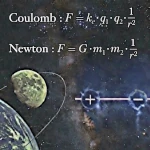 Coulomb vs Newton: The Mysterious Similarity of the Universe's Forces
 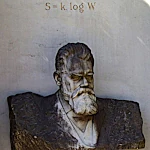 Boltzmann's equationon entropy (1877)
 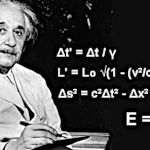 Special relativity equations (1905)
 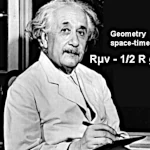 The equation of general relativity (1915)
  Planetary Rotation Equations: Between Angular Momentum and Gravitational Balance
  Equation of the orbital velocity of a planet
 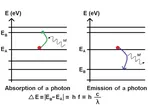 Planck's equation
 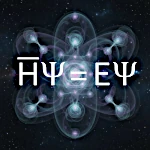 Understanding Schrödinger's Equation Without Math
 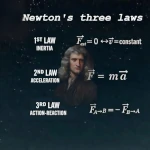 Newton's Three Laws: From the Falling Apple to the Orbiting Planets
  Maxwell's equations
 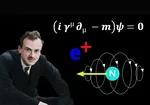 Paul Dirac's equation
 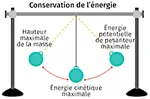 Conservation of energy: A fundamental principle of physics
  Equation of electromagnetic induction
  Why do elementary particles have no mass?