


The Speed of Light: The Ultimate Limit That Nothing Can Exceed
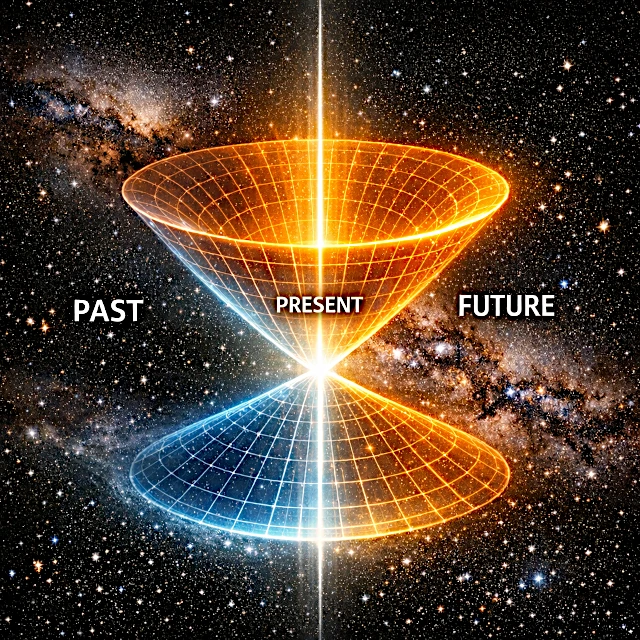
Light cone in spacetime illustrating the universal speed limit.
In the framework of special relativity, reaching the speed of light would require infinite energy, which is impossible.
Image source: astronoo.com (new window)
Why can nothing exceed the speed of light?
Nothing can exceed the speed of light because this speed is not just that of a fast object—it is a structural limit of spacetime itself. In Einstein’s theory of relativity, the faster a massive particle accelerates, the more its energy and inertia increase, to the point where an infinite amount of energy would be required to reach the speed of light: this is physically impossible. Furthermore, information and causality cannot travel faster than this limit, otherwise the order of events could reverse, and causality would be violated. Light is therefore not a "record" to be broken, but the maximum speed at which the universe allows the propagation of energy, matter, and information.
The Slow Discovery of an Immense Speed
For millennia, light was perceived as instantaneous, too fast to be measured. It was not until the 17th century that Ole Rømer (1644-1710) showed that the eclipses of Jupiter's satellites revealed a measurable delay, indicating that light takes a finite time to travel. Gradually, the idea took hold: light has a speed.
In the 19th century, measurements by Hippolyte Fizeau (1819-1896) and Léon Foucault (1819-1868) paved the way for Albert Einstein's (1879-1955) special theory of relativity, which established in 1905 that the speed of light in a vacuum is a fundamental constant of spacetime and the ultimate limit for any interaction.
The Best-Measured Speed in All of Physics
The speed of light in a vacuum is exactly \(c = 299\,792\,458\ \text{m} \cdot \text{s}^{-1}\) (m/s).
This value, denoted \(c\), represents the maximum speed at which any information, cause, or effect can propagate in the cosmos.
The limit does not apply only to light: no massive particle can reach or exceed this speed.
Why No Object Can Exceed the Speed of Light
Einstein's equations show that the kinetic energy of a body tends toward infinity as its speed approaches \(c\). The relativistic kinetic energy of a body with mass m and velocity v is written as: \[ K = (\gamma - 1)\, m c^2 \quad \text{where} \quad \gamma = \frac{1}{\sqrt{1 - \frac{v^2}{c^2}}} \]
When the velocity \(v\) approaches the speed of light \(c\),
\(
\sqrt{0} = 0
\)
therefore:
\(
\frac{1}{\sqrt{0}} = \frac{1}{0}
\)
In mathematics, division by zero is undefined. It is a forbidden operation in the set of real numbers.
The correct formulation for physics is that of the limit:
\[ \lim_{v \to c} \frac{1}{\sqrt{1 - \frac{v^2}{c^2}}} = +\infty \]
Thus, as the velocity \(v\) approaches as close as desired to the speed of light \(c\), the Lorentz factor \(\gamma\) becomes as large as desired. It can exceed any finite value. This divergence makes it impossible for a massive particle to reach \(c\).
N.B.: In physics, \(\frac{1}{\sqrt{0}} \to \infty\) is used to signify this divergence, but it is always a limit, never an equality in the algebraic sense.
Why Photons Are Condemned to Travel at the Speed of Light
Massless particles (photons, gluons) occupy a special place in the cosmos. Unlike massive particles, which can theoretically adopt any speed between 0 and \(c\), a massless particle can only exist at one speed: that of light in a vacuum.
Why this absolute constraint? The answer lies in the equations of special relativity. The energy of a particle is written as: \( E^2 = (m c^2)^2 + (p c)^2 \)
where \(m\) is the rest mass and \(p\) is the momentum. If \(m = 0\) (massless particle), the equation reduces to: \( E = p c \)
Furthermore, the velocity \(v\) of a particle is given by the relation: \( v = \frac{p c^2}{E} = \frac{p c^2}{p c} = c \)
The calculation is unambiguous: for any particle with zero mass, the speed is strictly equal to \(c\). It is impossible for it to slow down or accelerate. It is born at the speed of light and disappears at the same speed, never knowing rest.
This is why photons travel for billions of years. Throughout their journey, they have never experienced a single fraction of a second of deceleration. Their internal clock is frozen: they do not age.
 Full text of Einstein's 1905 article on the nature and evolution of light
  The Speed of Light: The Ultimate Limit That Nothing Can Exceed
  Reality Escapes Us: Truths We Can Never Prove
  The Physics of the Universe in 50 Equations: User Guide
  The Kaya Identity: The Equation Complicating Our Decarbonization
  The Unsurpassable Speed in the Universe: When Energy Becomes Infinite
  How far is the horizon?
  How Do Solar Panels Inject Electricity into the Grid?
  Dynamics of Momentum to explain the propulsion of rockets or jellyfish
  How Electron Energy Dictates Chemical Properties
  How to weigh the sun?
  The Key Role of Quantum Uncertainty: No Particle Can Be at Rest
  Energy and Power: Don't Confuse Them, Time Makes All the Difference
  Why is there a limit to cold, but not to heat?
  Galileo's Law of Falling Bodies
  The Ideal Gas Law: One Equation, Thousands of Applications
  Schrödinger's Equation Revolutionized Our View of Matter
  Feynman Diagram: Visualizing Particle Physics
  The Magic of Noether's Theorem: From the Principle of Least Action to Conservation Laws
  Relationship between gravitational mass and inertial mass and the equivalence principle
  Third Equation of Physics: Momentum to Understand Collisions
 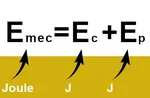 The second essential equation in physics: The intuition of a conserved quantity
 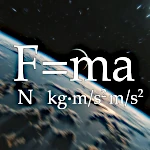 The First Equation of Physics: How to Mathematize Force
 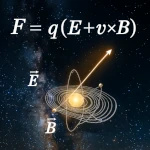 The electromagnetic force or Lorentz force
 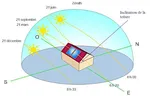 The solar energy received depends on the angle of incidence
  Why is marble colder than wood?
 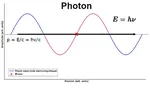 Why does a photon, which has no mass, have energy?
  Bayes Formula and Artificial Intelligence
  The seven fundamental constants of physics
  What temperature does it feel like in interstellar space?
 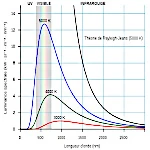 Black body radiation curves: Planck's law
  The equivalence principle, gravitational effects are indistinguishable from acceleration
  The consequences of E=mc2 for our understanding of the Universe
  How to weigh the sun?
  Equation of the free fall of bodies (1604)
  Coulomb vs Newton: The Mysterious Similarity of the Universe's Forces
  Boltzmann's equationon entropy (1877)
 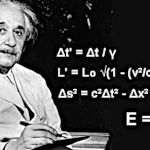 Special relativity equations (1905)
  The equation of general relativity (1915)
  Planetary Rotation Equations: Between Angular Momentum and Gravitational Balance
  Equation of the orbital velocity of a planet
 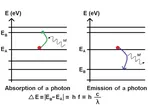 Planck's equation
  Understanding Schrödinger's Equation Without Math
 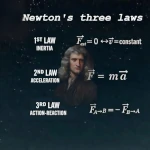 Newton's Three Laws: From the Falling Apple to the Orbiting Planets
  Maxwell's equations
  Paul Dirac's equation
  Conservation of energy: A fundamental principle of physics
  Equation of electromagnetic induction
  Why do elementary particles have no mass?