


String Theory: When Physics Breaks the Boundaries of Four-Dimensional Spacetime
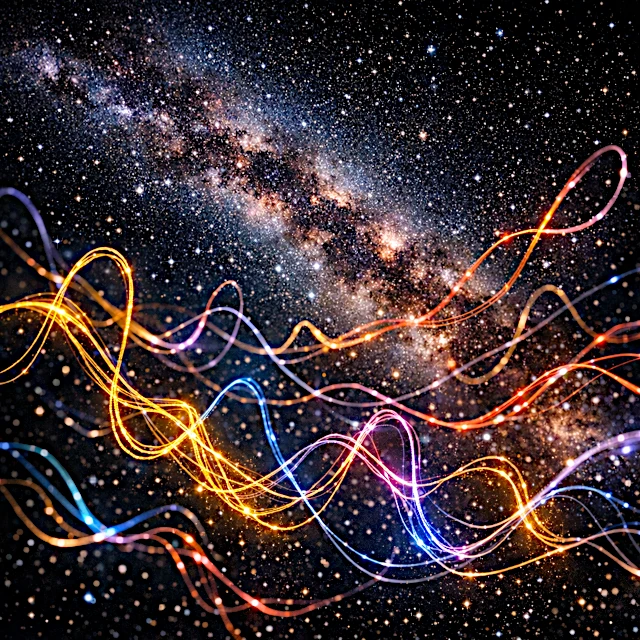
Infinitely small energy filaments, vibrating at different frequencies, would constitute the fundamental fabric of all matter and natural forces.
Image source: astronoo.com (new window)
Scientific Summary
String theory is a theoretical framework unifying general relativity and quantum mechanics. It postulates that elementary particles are one-dimensional vibrating strings, whose different modes correspond to different particles (photons, quarks, graviton). To be mathematically consistent, it requires 10 or 11 spacetime dimensions, with the extra dimensions compactified in Calabi-Yau manifolds. Despite its elegance and unifying potential, the theory lacks experimental evidence and is criticized for its unfalsifiable nature and speculative drift.
What is string theory and why does it predict extra dimensions?
String theory is a theoretical framework that attempts to unify general relativity (gravity) and quantum mechanics, two incompatible pillars of modern physics. It postulates that elementary particles are not zero-dimensional points, but tiny one-dimensional vibrating strings (at the Planck scale, ~10⁻³⁵ m). Different vibrational modes correspond to different particles (electron, quark, photon, graviton). To be mathematically consistent, string theory requires 10 dimensions (superstrings) or 11 dimensions (M-theory), with the extra dimensions compactified (rolled up) into complex geometries called Calabi-Yau manifolds, invisible at our scale.
Also worth exploring
Continue your exploration of the Universe with these topics:
The Origins of String Theory: Two Incompatible Theories
Since the early 20th century, theoretical physics has rested on two pillars. General relativity (theory formulated by Einstein describing gravity as a curvature of spacetime caused by mass and energy), developed by Albert Einstein (1879-1955), describes the behavior of massive objects on a large scale. Quantum mechanics (physical theory describing the behavior of matter and energy at subatomic scales, where quantum effects dominate), developed by Niels Bohr (1885-1962) and Werner Heisenberg (1901-1976), governs the infinitely small world of elementary particles. The problem is that these two theories are mutually incompatible: applying quantum mechanics to gravity produces infinite divergences (mathematical result of division by zero or a physical quantity that diverges to infinity, signaling a limit of the theory's validity), signaling a deep gap in our understanding of physical reality. It was to bridge this gap that string theory was born.
What is String Theory?
In the 1960s, Gabriele Veneziano (born 1942) discovered that the Euler beta function (mathematical function introduced by Euler in the 18th century, reappearing unexpectedly in the description of strong interactions) surprisingly well described certain interactions between hadrons (composite particles made of quarks, subject to the strong interaction, such as protons, neutrons, and mesons). In 1970, Yoichiro Nambu (1921-2015), Holger Bech Nielsen (born 1941), and Leonard Susskind (born 1940) realized that this formula described one-dimensional vibrating objects: strings. In 1974, John Schwarz (born 1941) and Joël Scherk (1946-1980) realized that the vibration spectrum naturally included a state corresponding to the properties of the graviton, making string theory a serious candidate for a quantum theory of gravity.
The Core of the Theory: From Particles to Vibrating Strings
The Fundamental Idea
Instead of conceiving elementary particles as zero-dimensional geometric points, string theory describes them as tiny one-dimensional vibrating objects. These strings, whose length is on the order of the Planck length (fundamental length of quantum gravity, approximately 1.616 × 10⁻³⁵ meters, far beyond any current direct detection capability) \(\ell_P \approx 1.616 \times 10^{-35}\) m, appear point-like at all accessible energy scales. An electron, a quark, a photon, or a graviton would be different manifestations of the same vibrating entity, like a violin string producing different notes depending on its mode of vibration.
The Mathematical Necessity of Extra Dimensions
A consistent string theory in only four dimensions is impossible: tachyons (hypothetical particle whose squared mass would be negative, implying faster-than-light propagation and instability of the quantum vacuum) and anomalies (quantum anomaly referring to the violation of a classical symmetry upon quantization, making the theory mathematically inconsistent) inevitably break the theory's coherence. The bosonic string theory (first consistent formulation of string theory, describing only bosonic strings without supersymmetry, requiring 26 spacetime dimensions) requires 26 dimensions; superstring theories (extension of string theory incorporating supersymmetry, describing both bosonic and fermionic strings in a 10-dimensional spacetime) integrating supersymmetry (symmetry linking bosons and fermions in a quantum field theory, postulating the existence of a supersymmetric partner for each known particle) require 10; the M-theory (theoretical framework proposed by Edward Witten in 1995, unifying the five superstring theories and 11-dimensional supergravity into a single 11-dimensional theory) by Edward Witten (born 1951) demands 11. This number is not arbitrary: it is imposed by the internal consistency of the mathematics.
Hidden Dimensions: Where Are They?
The Compactification Mechanism
If spacetime has 10 or 11 dimensions, why do we only perceive 4? The answer is compactification (process by which the extra dimensions of spacetime would be curled up on themselves at a scale so small that they remain inaccessible to any direct observation): the extra dimensions would be curled up on themselves at the Planck scale, imperceptible to our senses and instruments. Imagine a garden hose seen from afar: it looks like a one-dimensional line, but hides a circular dimension invisible to the distant observer. The extra dimensions would work analogously, in far more complex geometries.
Calabi-Yau Manifolds
To preserve supersymmetry in four dimensions, these hidden dimensions must form precise geometric structures: Calabi-Yau manifolds (compact complex manifold of real dimension 6 (or complex dimension 3), admitting a Ricci-flat metric, whose geometry determines the physical properties of particles in superstring theories), named after mathematicians Eugenio Calabi (1923-2023) and Shing-Tung Yau (born 1949). There are potentially between \(10^{500}\) and \(10^{272,000}\) distinct configurations, each generating a universe with different physical laws. This abundance, the landscape (space of all possible consistent physical theories arising from the compactification of string theory, representing a vast set of universes with different physical laws), raises a major criticism: if the theory describes an almost infinite number of universes, what is its predictive power for ours? Leonard Susskind (born 1940) responds by invoking the anthropic principle (principle according to which our universe seems fine-tuned to allow life because, without this fine-tuning, no observer would be there to notice it) and the multiverse (cosmological concept postulating the existence of a vast number of distinct universes, each with potentially different physical constants and laws).
The 1984 Revolution and the Five Theories
The First Superstring Revolution
In 1984, Michael Green (born 1946) and John Schwarz (born 1941) showed that certain quantum anomalies (quantum anomaly referring to the violation of a classical symmetry upon quantization, making the theory mathematically inconsistent) canceled out exactly in 10-dimensional superstring theories, triggering a massive influx of researchers into this field. Five consistent theories emerged: Type I (10-dimensional superstring theory whose gauge symmetry group is SO(32), containing only oriented open and closed strings), Types IIA and IIB (10-dimensional superstring theories containing only closed strings, with two non-chiral (IIA) or chiral (IIB) supersymmetries), and heterotic SO(32) and E8×E8 (hybrid theories combining bosonic strings in one sector and superstrings in the other, with SO(32) or E8×E8 symmetry groups). Their coexistence seemed incompatible with the ambition of a single, fundamental theory.
The Second Revolution and M-Theory
In 1995, Edward Witten (born 1951) settled the matter: these five theories and 11-dimensional supergravity (theory of gravity incorporating supersymmetry in 11 dimensions, appearing as a low-energy limit of M-theory) are merely facets of a deeper theory, M-theory (M for "Mother," "Mystery," "Membrane," or "Matrix"). At 11 dimensions, it extends the concept of strings to higher-dimensional objects, p-branes (extended objects with p spatial dimensions naturally appearing in superstring theories, generalizing the concept of strings (1-branes) to higher-dimensional membranes), including 2-branes (two-dimensional spatially extended object in string theory, analogous to a two-dimensional membrane moving through spacetime) and 5-branes (five-dimensional spatially extended object in M-theory, playing a fundamental role in the dualities between different superstring theories), unified by relations of duality (mathematical equivalence between two seemingly different physical theories, allowing problems in one to be solved using the tools of the other).
Main Versions of String Theory and Their Characteristics
| Theory | Dimensions | Type of Strings | Symmetry Group | Particularity |
|---|---|---|---|---|
| Bosonic Strings | 26 | Open and Closed | None (no fermions) | First historical formulation (1968-1974). Includes tachyons, physically unstable. |
| Type I Superstrings | 10 | Open and Closed | SO(32) | Only theory with open strings. Related to heterotic SO(32) theory by duality. |
| Type IIA Superstrings | 10 | Closed only | U(1) | Non-chiral. Contains D-branes of even dimensions. Low-energy limit: IIA supergravity. |
| Type IIB Superstrings | 10 | Closed only | None (self-dual) | Chiral. Central role in the AdS/CFT(duality between a gravity theory in anti-de Sitter space and a conformal quantum field theory on its boundary, proposed by Juan Maldacena in 1997) correspondence. D-branes of odd dimensions. |
| Heterotic E8×E8 | 10 | Closed only | E8×E8 | Historical candidate for describing the Standard Model. Hybrid bosonic/fermionic structure. |
| M-Theory | 11 | 2-branes and 5-branes | Not fully known | Unification of the five superstring theories. Proposed by Edward Witten in 1995. |
N.B.:
The symmetry groups in the table are Lie groups governing fundamental interactions.
The \(E_8 \times E_8\) group is remarkable because it contains all the symmetries of the Standard Model of particle physics.
D-branes (objects where open strings attach) were introduced by Joseph Polchinski (1954-2018) in 1995.
Why Is String Theory Criticized?
Despite its mathematical elegance, string theory faces three major criticisms within the scientific community. The first, and most radical, is the complete absence of verifiable predictions through experiment. Strings are so small (Planck scale) that no particle accelerator, even in the future, will ever be able to observe them directly.
The second criticism concerns what physicists call the string landscape (colossal set of mathematical solutions compatible with string theory, estimated at 10 to the power of 500 possible universes). This term refers to the astronomical number of possible universes (about \(10^{500}\) different solutions) allowed by the theory. For its detractors, this landscape makes the theory non-falsifiable: any observation can be justified a posteriori by choosing the right solution.
Finally, some scientists, such as Sabine Hossenfelder (1976–) or Peter Woit (1956–), denounce a speculative drift in fundamental physics. According to them, string theory has dominated quantum gravity research for over four decades, at the expense of other approaches (loop quantum gravity, non-commutative geometry) that might be more promising. The lack of experimental progress since the 1980s thus fuels an epistemological unease: mathematical beauty alone is not enough to make a physical theory.
Key Takeaways
String theory proposes replacing point-like particles with tiny vibrating strings and predicts the existence of the graviton (hypothetical particle, quantum messenger of the gravitational force). It naturally unifies gravity and quantum physics, but at the cost of adding 6 to 7 extra dimensions, curled up at an infinitely small scale in complex geometric structures called Calabi-Yau manifolds (compact complex manifold of real dimension 6 (or complex dimension 3), admitting a Ricci-flat metric, whose geometry determines the physical properties of particles in superstring theories). However, its greatest challenge remains the lack of experimental evidence.
FAQ: Everything You Need to Know About String Theory
Why Was String Theory Invented?
String theory was born out of the need to resolve the fundamental incompatibility between general relativity (which describes gravity and massive objects on a large scale) and quantum mechanics (which governs the world of elementary particles). Applying quantum mechanics to gravity produces infinite and absurd results. String theory, by replacing point-like particles with extended strings, allows the graviton (hypothetical particle of gravity) to be described consistently with quantum physics.
What Are "Compactification" and "Calabi-Yau Manifolds"?
Compactification is the mechanism that explains why we do not see the predicted extra dimensions (10 or 11 in total). These dimensions would be curled up on themselves at an extremely small scale (the Planck scale), making them imperceptible. Calabi-Yau manifolds are complex geometric shapes that allow this compactification while preserving supersymmetry. There could potentially be between \(10^{500}\) and \(10^{272,000}\) of these shapes, each generating a universe with different physical laws.
What Are the Main Criticisms of String Theory?
Three major criticisms are raised. 1) Lack of experimental evidence: strings are so small (Planck scale) that no accelerator, even in the future, will ever be able to observe them directly. 2) The "string landscape": the astronomical number of possible solutions (about \(10^{500}\) different universes) makes the theory difficult to falsify. 3) A speculative drift: some physicists argue that string theory has dominated quantum gravity research for too long, at the expense of other approaches (loop quantum gravity, etc.), without experimental progress.
 Does the electron have a shape? The surprising answer of quantum physics
  String Theory: When Physics Breaks the Boundaries of Four-Dimensional Spacetime
  At the Heart of Matter: The Proton's Well-Kept Secrets
  How an Electric Field Travels at 300,000 km/s with Almost Stationary Electrons
  Why Doesn't Matter Pass Through Matter?
  Magnets: From the Small Fridge Magnet to Levitation Trains
  From Electron Spin to Magnetism: Emergence of Mini-Magnets
  Free electrons: from colliding balls to dancing waves
  Water Anomalies: A Common and Abundant Molecule in the Universe
  Heat and Temperature: Two Often Confused Thermal Notions
  Electroweak Force: The Unification of Electromagnetism and the Weak Interaction
  Special Relativity: The Beginning of a New Physics
  The Higgs Boson: The Unification of Fundamental Forces
 Quantum Entanglement: When Two Particles Become One!
 The Pentaquark: A New Piece of the Cosmic Puzzle!
 Why are Rare Gases rare?
 Brownian Motion: A Link Between Two Worlds
 The 4 Articles of Albert Einstein from 1905
  Why does nuclear fusion require so much energy?
  Stars cannot create elements heavier than iron because of the nuclear instability barrier
  Alpha, Beta, and Gamma Radiation: Understanding Their Differences
  Planck wall theory
  Is Absolute Vacuum a Utopia?
  Giant Colliders: Why the LHC is Unique in the World
 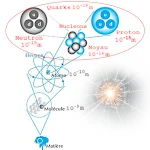 The World of Hadrons: From the LHC to Neutron Stars
  Radioactivity, natural and artificial
  The World of Nanoparticles: An Invisible Revolution
  Schrödinger's Cat: An Exploration of Quantum Mechanics
  Eternal inflation
  What is a wave?
  Quantum Field Theory: Everything is Fields
  Quantum Computers: Between Scientific Revolution and Technological Challenges
  Bose-Einstein Condensate: When Matter Becomes a Single Quantum State
  From Probability Cloud to Particle: The Electron in Quantum Mechanics
  What is Entropy? A Journey into Disorder and Information
 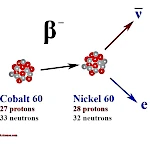 Beta Radioactivity and Neutrino: A Story of Mass and Spin
  Spacetime: Space and Time United, understand this concept
  Time Measurement: Scientific and Technological Challenge
  Spectroscopy, an inexhaustible source of information
  The Chemical Code of the Universe: Abundance and Origin of the Elements
  The size of atoms
  Magnetism and Magnetization: Why Are Some Materials Magnetic?
  Quarks and Gluons: A Story of Confinement
  Superpositions of quantum states
  Alpha decay (α)
  Electromagnetic induction equation
  Fusion and Fission: Two Nuclear Reactions, Two Energy Paths
  From the Ancient Atom to the Modern Atom: An Exploration of Atomic Models
  The Origins of Mass: Between Inertia and Gravitation
  From the Nucleus to Electricity: Anatomy of a Nuclear Power Plant
  How many photons to heat a coffee?
  How Do We See the Hidden Structure of Atoms?
  Quantum tunnelling: exploring the invisible atom by atom
  The 12 Particles of Matter: Understanding the Universe at the Subatomic Scale
  Atomic orbitals: from the probabilistic cloud to images of the infinitely small
  Antimatter: The Enigmas of Antiparticles and Their Energy
  What is an electric charge?
  Our matter is not quantum!
  Why use hydrogen in the fuel cell?
  Newton and Einstein: Two Visions for the Same Mystery
  Where does the proton's mass come from?
  Einstein's Universe: Physical Foundations of the Theory of Relativistic Gravitation
  Einstein's Annus Mirabilis : 1905, the year that revolutionized physics
  What does the equation E=mc2 really mean?
  Between
Waves and Particles: The Mystery of Duality
Between
Waves and Particles: The Mystery of Duality  The supercritical state of water: between liquid and gas, a fourth phase?
  Quantum Mechanics and Spirituality: Another Way to See the World