


From electron spin to magnetism: the emergence of mini-magnets
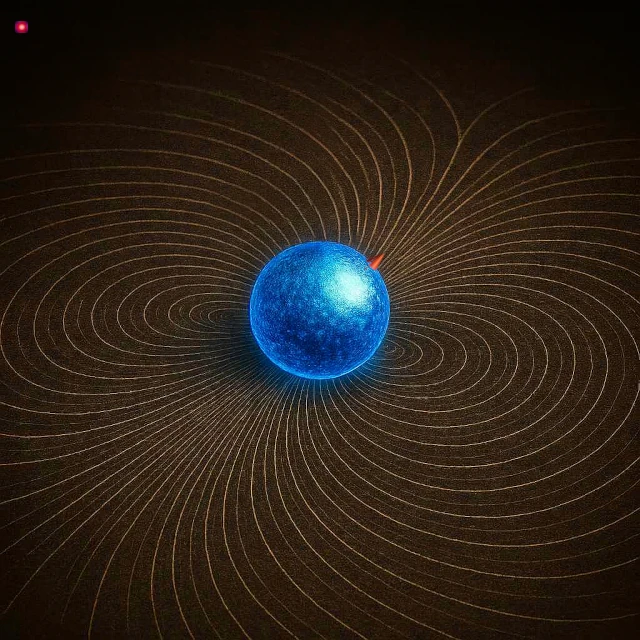
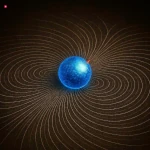
Classical conceptual visualization of an electron with its intrinsic magnetic moment, illustrating quantum spin and the magnetic field lines that arise from it.
Image source: astronoo.com (new window) - AI-generated image, public domain.
Scientific abstract
The article explains how every electron behaves like a tiny magnet thanks to spin, a quantum property as intrinsic as its charge or its mass. Contrary to what its name suggests, spin is not a physical rotation of the electron on itself. The Stern and Gerlach experiment (1922) demonstrated that the magnetic moment of the electron can take only two discrete values (spin up ↑ or spin down ↓), namely +½ and -½ in units of ℏ. The magnetic moment of the electron is about 9.284×10⁻²⁴ J/T (Bohr magneton). In 1928, Paul Dirac resolved the rotation paradox by showing that spin emerges naturally from the equations combining quantum mechanics and relativity. The collective alignment of billions of electrons in ferromagnetic materials (iron, cobalt, nickel) produces macroscopic magnetism.
How does an electron become a mini-magnet and what is the origin of its spin?
Every electron behaves like a tiny magnet thanks to a fundamental quantum property called spin. Contrary to what its name suggests, spin is not a physical rotation of the electron on itself, but an intrinsic angular momentum, as fundamental as its electric charge or its mass. The Stern and Gerlach experiment (1922) demonstrated that the magnetic moment of the electron can take only two discrete values (spin up ↑ or spin down ↓), namely +½ and -½ in units of ℏ. The magnetic moment of the electron is about 9.284×10⁻²⁴ J/T (Bohr magneton). In 1928, Paul Dirac resolved the rotation paradox by showing that spin emerges naturally from the equations combining quantum mechanics and relativity. The collective alignment of billions of electrons in ferromagnetic materials (iron, cobalt, nickel) produces macroscopic magnetism.
Also discover
Continue your exploration of the Universe with these topics:
A magnet smaller than an atom?
Magnetism at the scale of electrons
When we bring two magnets together, we feel an invisible force that attracts or repels them. This macroscopic manifestation of magnetism has its origin in the infinitely small, at the level of electrons. Every electron behaves like a tiny magnet, possessing what physicists call a magnetic moment (intrinsic magnetic moment of the electron). But how can an elementary particle, devoid of internal structure, generate a magnetic field?
The fundamental role of spin
This apparent paradox challenged classical physics for decades. The answer lies in a purely quantum property: spin (intrinsic angular momentum of the electron). Contrary to what its name might suggest, spin is not a physical rotation of the electron on itself. It is an intrinsic property, as fundamental as its electric charge or its mass, which has no equivalent in the classical world (no image can fully represent it).
Difference between electric charge and spin moment
Electron charge (e): an electromagnetic property, constant and responsible for Coulomb interactions (electric forces and magnetic fields when the electron is in motion).
Spin (S): the quantum intrinsic angular momentum of the electron, independent of any orbital motion. It is not linked to a physical rotation of the particle.
The experimental discovery of spin
The Stern and Gerlach experiment
In 1922, the physicists Otto Stern (1888-1969) and Walther Gerlach (1889-1979) carried out a revolutionary experiment. They sent a beam of silver atoms through an intense gradient magnetic field (a large spatial variation in the intensity of the magnetic field), created by a device in which one pole piece has a sharp edge and the other a flat surface. According to classical physics, the magnetic moment of these atoms could have any orientation in space, like a vector that can adopt every possible orientation. Passing through this field whose intensity varies strongly, the atoms should therefore have been deflected differently depending on the orientation of their magnetic moment, creating a continuous streak on the detector screen, from top to bottom.
A surprising quantization
Yet the observation is astonishing: instead of a continuous distribution, they see only two distinct and separated spots, one at the top and the other at the bottom of the screen, with nothing in between. This spatial quantization reveals that the magnetic moment of electrons can take only two discrete values, corresponding to two opposite orientations of spin. We speak of spin "up" (↑) and spin "down" (↓), or more rigorously of spin +½ and -½ (in units of the reduced Planck constant \(\hbar\)). This experiment constitutes the first direct proof that magnetic properties are quantized at the atomic scale.
The magnetic moment of the electron
The value of the electron's magnetic moment
The magnetic moment of the electron, denoted \(\mu_e\), is directly proportional to its spin. Its experimental value is about \(9{,}284 \times 10^{-24}\) joules per tesla, a quantity called the Bohr magneton (fundamental unit of magnetic moment). This tiny value shows how weak the magnetic effect of a single electron is. Yet when billions of billions of electrons align their spins in the same direction, as in an iron magnet, the cumulative effect becomes macroscopic.
The two contributions to the magnetic moment
The magnetic moment of an electron results from two distinct contributions:
- The orbital magnetic moment (magnetic moment due to the electron's motion around the nucleus) is associated with the motion of the electron in the central field created by the nucleus.
- The spin magnetic moment (intrinsic magnetic moment of the electron) corresponds, for its part, to an intrinsic property of the particle, comparable to its charge or its mass, and does not depend on any orbital dynamics.
The rotation paradox
Why spin cannot be a classical rotation
If we try to interpret spin as a true classical rotation of the electron on itself, we encounter a major problem. To generate the observed magnetic moment, the surface of the electron would have to rotate at a speed far greater than that of light, which would violate the theory of relativity. Moreover, in the quantum framework, the electron is described by a wave function and cannot be considered a classical rotating sphere.
Dirac's solution
This paradox was resolved in 1928 by Paul Dirac (1902-1984). When Dirac wrote the equations of the electron while respecting simultaneously quantum mechanics and relativity, spin appeared by itself in the solutions, without any need to add it artificially, like a musical note that emerges when two harmonics are combined.
Magnetic properties of elementary particles
The following table compares the magnetic properties of the main elementary particles and their role in magnetic phenomena.
| Particle | Spin | Magnetic moment (in magnetons) | Role in magnetism |
|---|---|---|---|
| Electron | ½ | 1.001 Bohr magneton | Mainly responsible for the magnetism of materials (permanent magnets, ferromagnetism). Its alignment in atoms creates macroscopic magnetic properties |
| Proton | ½ | 2.793 nuclear magneton | Exploited in nuclear magnetic resonance (NMR) to analyze molecules and in medical imaging (MRI) to visualize biological tissues |
| Neutron | ½ | -1.913 nuclear magneton | Used in neutron scattering to study magnetic structures in materials. Its negative magnetic moment reveals its composite structure (quarks) |
| Photon | 1 | 0 | Mediator particle of the electromagnetic force. Transports energy between charges and magnets, but possesses no magnetic moment of its own |
The entanglement of electron spins
Paired electrons and diamagnetism
In most materials, electrons couple into pairs of antiparallel spins (oriented in opposite directions), which leads to an almost total compensation of their overall magnetic moment. These substances are said to be diamagnetic (substances weakly repelled by a magnetic field), such as water, copper or gold, because their paired electrons are entirely paired: each electron is associated with another of opposite spin, so that the overall magnetic moment is zero in the absence of a field. When an external field is applied, there is no unpaired electron to produce a positive magnetization; the only possible response is then an induced orbital polarization, very weak and opposite to the applied field, which characterizes diamagnetism.
Unpaired electrons and paramagnetism
Conversely, when an atom possesses one or more unpaired electrons, that is, uncompensated spins, it develops a net magnetization under the action of an external magnetic field. This response characterizes paramagnetism (substances weakly attracted by a magnetic field), observable for example in aluminum or platinum.
Collective alignment and ferromagnetism
In some materials, the magnetic moments carried by these unpaired electrons can influence each other and align collectively. The material then acquires a stable magnetization even in the absence of an external field, a manifestation of ferromagnetism, as in iron, cobalt or nickel. This phenomenon results from a collective alignment of spins over macroscopic domains.
References
- Nobel Prize in Physics 1943 - Otto Stern (new window)
- Physical Review Journals Archive - Magnetic Moment of the Triton in Units of the Magnetic Moment of the Proton (new window)
- CODATA Value: electron magnetic moment - NIST (new window)
- Hyperphysics - Electron Spin - Georgia State University (new window)
- Encyclopædia Britannica - magnetic moment (new window)
FAQ: Everything to know about electron spin and magnetism
What is the Stern and Gerlach experiment and why is it fundamental?
In 1922, Otto Stern and Walther Gerlach sent a beam of silver atoms through an intense gradient magnetic field. According to classical physics, the atoms should have formed a continuous streak on the detector screen, their magnetic moments being able to orient randomly. The observation was astonishing: they obtained only two distinct and separated spots, one at the top and the other at the bottom. This spatial quantization revealed that the magnetic moment of the electron can take only two discrete values, corresponding to the two opposite orientations of spin (spin up ↑ and spin down ↓, namely +½ and -½ in units of ℏ). It was the first direct proof of the quantization of magnetic properties at the atomic scale.
Why can't electron spin be a classical rotation?
If one tried to interpret spin as a true rotation of the electron on itself, a major problem appears: to generate the observed magnetic moment (Bohr magneton ≈ 9.284×10⁻²⁴ J/T), the surface of the electron would have to rotate at a speed far greater than that of light, thus violating the theory of relativity. Moreover, in quantum mechanics, the electron is described by a wave function and cannot be considered a classical rotating sphere. This paradox was resolved in 1928 by Paul Dirac, who demonstrated that spin emerges naturally from the equations combining quantum mechanics and relativity, without any need to add it artificially.
What is the difference between diamagnetism, paramagnetism and ferromagnetism?
Diamagnetism occurs in materials where all electrons are paired (opposite spins): the overall magnetic moment is zero in the absence of a field, and a weak magnetization opposite to the field appears under an external field (water, copper, gold). Paramagnetism occurs in atoms possessing one or more unpaired electrons: the spins align partially under an external field, creating a positive magnetization (aluminum, platinum). Ferromagnetism is the most spectacular phenomenon: in certain materials (iron, cobalt, nickel), the magnetic moments of unpaired electrons influence each other and align collectively in a stable way, creating a magnetization even in the absence of an external field (permanent magnets).
What is the Bohr magneton and what is its value?
The Bohr magneton is the fundamental unit of magnetic moment in the atomic domain. It is denoted μB and is worth about 9.284×10⁻²⁴ J/T (joules per tesla). This constant represents the magnetic moment associated with the orbital angular momentum of an electron in the hydrogen atom. It is directly related to the reduced Planck constant ℏ, to the elementary charge e and to the mass of the electron me by the relation μB = eℏ / (2me). The spin magnetic moment of the electron is worth about 1.001 μB, a value slightly greater than 1 due to the radiative corrections of quantum electrodynamics (magnetic anomaly).
How is electron spin used in medical imaging (MRI)?
Magnetic resonance imaging (MRI) mainly exploits the spin of hydrogen nuclei (protons) present in abundance in biological tissues, and not directly the spin of electrons. However, the fundamental physical principle is identical: in the presence of an intense magnetic field, the nuclear spins align and can be excited by radiofrequency waves. When they return to their equilibrium state, they emit a detectable signal that allows detailed images of organs to be reconstructed. The electron spin plays an indirect crucial role through hyperfine interactions and electron-nucleus couplings that influence the measured relaxation times.
Can electron spin be used for quantum information?
Yes, electron spin is one of the main qubits (quantum bits) studied for quantum computing. In a magnetic field, the electron possesses two spin states (up and down) that can represent a quantum 0 and 1, but also a superposition of the two states. Experiments use electrons trapped in quantum dots, NV centers (nitrogen-vacancy) in diamond, or dopant atoms in silicon to manipulate and read the spin state. The quantum coherence of spin, that is, its ability to maintain a superposition without decohering, remains the main technological challenge for building large-scale quantum computers.
 Does the electron have a shape? The surprising answer of quantum physics
  String Theory: When Physics Breaks the Boundaries of Four-Dimensional Spacetime
  At the Heart of Matter: The Proton's Well-Kept Secrets
  How an Electric Field Travels at 300,000 km/s with Almost Stationary Electrons
  Why Doesn't Matter Pass Through Matter?
  Magnets: From the Small Fridge Magnet to Levitation Trains
  From Electron Spin to Magnetism: Emergence of Mini-Magnets
  Free electrons: from colliding balls to dancing waves
  Water Anomalies: A Common and Abundant Molecule in the Universe
  Heat and Temperature: Two Often Confused Thermal Notions
  Electroweak Force: The Unification of Electromagnetism and the Weak Interaction
  Special Relativity: The Beginning of a New Physics
  The Higgs Boson: The Unification of Fundamental Forces
 Quantum Entanglement: When Two Particles Become One!
 The Pentaquark: A New Piece of the Cosmic Puzzle!
 Why are Rare Gases rare?
 Brownian Motion: A Link Between Two Worlds
 The 4 Articles of Albert Einstein from 1905
  Why does nuclear fusion require so much energy?
  Stars cannot create elements heavier than iron because of the nuclear instability barrier
  Alpha, Beta, and Gamma Radiation: Understanding Their Differences
  Planck wall theory
  Is Absolute Vacuum a Utopia?
  Giant Colliders: Why the LHC is Unique in the World
  The World of Hadrons: From the LHC to Neutron Stars
  Radioactivity, natural and artificial
  The World of Nanoparticles: An Invisible Revolution
  Schrödinger's Cat: An Exploration of Quantum Mechanics
  Eternal inflation
  What is a wave?
  Quantum Field Theory: Everything is Fields
  Quantum Computers: Between Scientific Revolution and Technological Challenges
  Bose-Einstein Condensate: When Matter Becomes a Single Quantum State
  From Probability Cloud to Particle: The Electron in Quantum Mechanics
  What is Entropy? A Journey into Disorder and Information
  Beta Radioactivity and Neutrino: A Story of Mass and Spin
  Spacetime: Space and Time United, understand this concept
  Time Measurement: Scientific and Technological Challenge
  Spectroscopy, an inexhaustible source of information
  The Chemical Code of the Universe: Abundance and Origin of the Elements
  The size of atoms
  Magnetism and Magnetization: Why Are Some Materials Magnetic?
  Quarks and Gluons: A Story of Confinement
  Superpositions of quantum states
  Alpha decay (α)
  Electromagnetic induction equation
  Fusion and Fission: Two Nuclear Reactions, Two Energy Paths
  From the Ancient Atom to the Modern Atom: An Exploration of Atomic Models
  The Origins of Mass: Between Inertia and Gravitation
  From the Nucleus to Electricity: Anatomy of a Nuclear Power Plant
  How many photons to heat a coffee?
  How Do We See the Hidden Structure of Atoms?
  Quantum tunnelling: exploring the invisible atom by atom
  The 12 Particles of Matter: Understanding the Universe at the Subatomic Scale
  Atomic orbitals: from the probabilistic cloud to images of the infinitely small
  Antimatter: The Enigmas of Antiparticles and Their Energy
  What is an electric charge?
  Our matter is not quantum!
  Why use hydrogen in the fuel cell?
  Newton and Einstein: Two Visions for the Same Mystery
  Where does the proton's mass come from?
  Einstein's Universe: Physical Foundations of the Theory of Relativistic Gravitation
  Einstein's Annus Mirabilis : 1905, the year that revolutionized physics
  What does the equation E=mc2 really mean?
  Between
Waves and Particles: The Mystery of Duality
Between
Waves and Particles: The Mystery of Duality  The supercritical state of water: between liquid and gas, a fourth phase?
  Quantum Mechanics and Spirituality: Another Way to See the World